Doomsday Prep Essentials: A Home Emergency Checklist for Outages, Storms and Evacuations
Doomsday prep essentials for real households: water, food, power, light, radios, first aid, tools and a 72-hour kit, with a gear pick for each need.
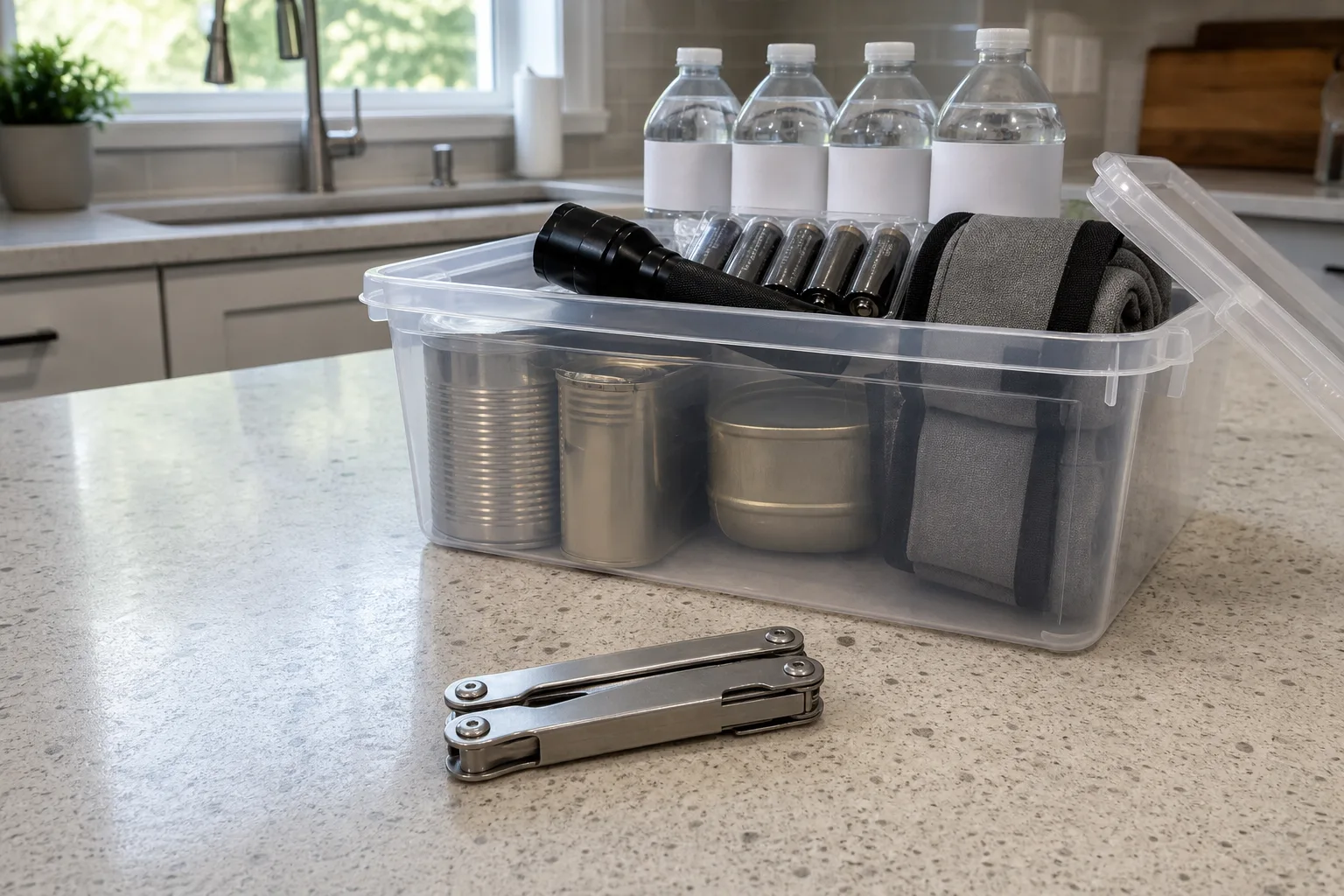
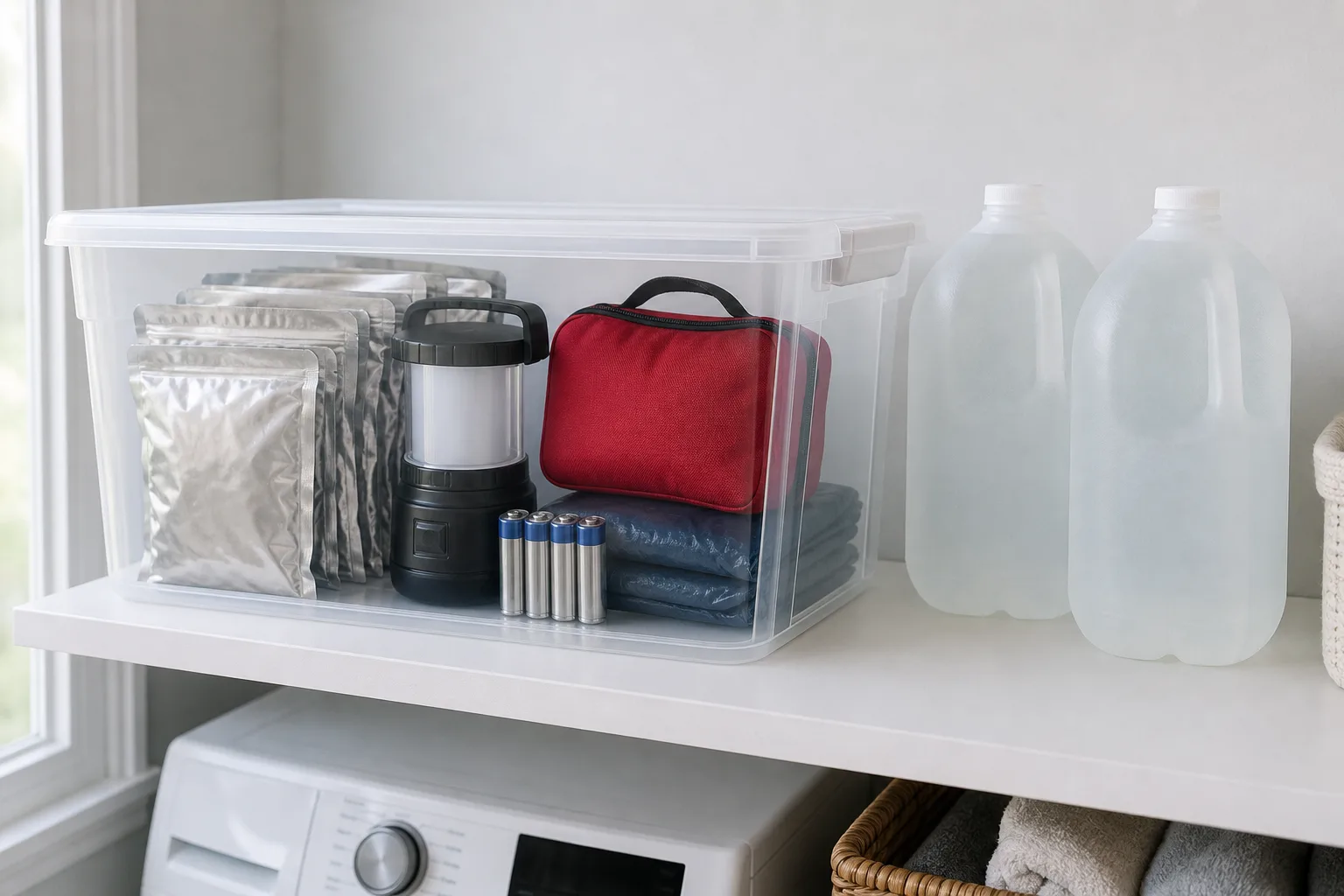
Doomsday prep essentials, for most households, come down to something much less dramatic: getting through a few days without power, tap water or a trip to the store. A winter storm that drops the lines, a flood warning that means leaving in an hour, or a boil-water notice that lasts a week are the situations a home kit is really for. Ready.gov's advice is to have enough supplies for your household to manage on its own for several days.
This is the ultimate guide to doomsday prep essentials: one checklist of the emergency supplies and survival gear a household is most likely to use. It goes need by need: water, food, cooking, power, solar, light, communication, batteries, first aid, tools, heat, alarms, documents and a ready-made 72-hour kit. Each section names the item to keep and one pick from the matching full guide, so the gear here is the same gear those guides recommend, for the same reasons.
Quick verdict
- Water: one gallon per person per day for several days, plus a portable filter as a backup. No product beats having the water already stored.
- Food: freeze-dried pouches such as Peak Refuel Beef Pasta Marinara, which packs 1,040 calories into one pouch and needs only 3/4 cup of boiling water.
- Power: a phone-and-laptop power bank like the Anker 737 Power Bank 24,000mAh 140W, and a power station or generator only if you need to run appliances.
- Light: a lantern for the room, such as the Nitecore LR70, and a headlamp for hands-free work, such as the Petzl NAO RL.
- Alerts and talk: the Midland WR120B to wake the house for county warnings, and two-way radios such as the Motorola Talkabout T605 H2O for when phones are down.
- First aid: the SurviveX Large First Aid Kit, plus a first aid class for whoever will use it.
- Tools and batteries: a Leatherman Wave+ and a set of Panasonic eneloop AA cells that hold their charge in a drawer.
- Go-bag: a ready-made kit like the Ready America 70280 2-Person 3-Day Emergency Kit is a starting point, not a finished kit. It needs water, light and more food added.
The doomsday prep checklist at a glance
| Need | Shop | What to have | Pick from the full guide | Why it matters |
|---|---|---|---|---|
| Water |  View on Amazon | 1 gallon per person per day for several days; a portable filter | Sawyer Squeeze Water Filtration System | Drinking, cooking and sanitation |
| Food |  See options | Shelf-stable meals that need no fridge | Peak Refuel Beef Pasta Marinara | 1,040 calories per pouch, 3/4 cup of water |
| Hot meals, no stove |  View on Amazon | Self-heating meal kits | APack Ready Meal Self-Heating Variety Pack | A heater in every kit |
| Cooking | 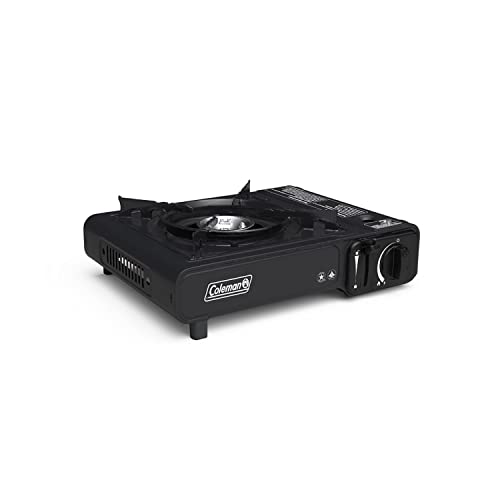 View on Amazon | A butane stove for outdoor use | Coleman Classic 1-Burner Butane Stove | Boils water when the range is dead |
| Fresh greens |  View on Amazon | A countertop hydroponic garden | Click & Grow Smart Garden 3 | Herbs and lettuce on a few watts |
| Heat | 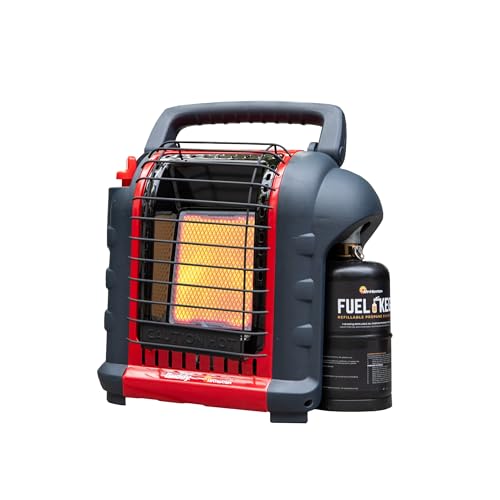 View on Amazon | One closed room and an indoor-listed heater | Mr. Heater Portable Buddy Heater (MH9BX) | Listed for up to 225 square feet |
| Power |  View on Amazon | Charged power banks; a power station or generator for appliances | Anker 737 Power Bank 24,000mAh 140W | Keeps phones and laptops running |
| Fridge backup |  View on Amazon | A power station sized for the fridge and internet | Jackery Explorer 2000 v2 | 2,042 Wh, close to a day of fridge and internet |
| Solar recharging |  View on Amazon | A panel matched to the station | Anker SOLIX C300 Solar Generator with 60W Panel | Refills a small station without fuel |
| Multi-day outages |  View on Amazon | An inverter generator, run outdoors only | Honda EU2200i Inverter Generator | Steady voltage, CO shutoff |
| Room light |  View on Amazon | A rechargeable lantern | Nitecore LR70 | Lights a table and doubles as a flashlight |
| Hands-free light |  View on Amazon | A headlamp per adult | Petzl NAO RL | Cooking, repairs and stairs in the dark |
| Alerts |  View on Amazon | A NOAA weather alert radio | Midland WR120B | Wakes you for warnings in your county |
| Talking without phones |  View on Amazon | Two or more FRS radios | Motorola Talkabout T605 H2O | Waterproof, NOAA alerts, AA backup |
| Batteries |  View on Amazon | Rechargeable AAs that hold a charge | Panasonic eneloop AA | Radios, lights and remotes |
| First aid |  View on Amazon | A stocked, organized kit and training | SurviveX Large First Aid Kit | Cuts, burns and scrapes at home or in the car |
| Tools |  View on Amazon | A multitool | Leatherman Wave+ | Cutting, prying, quick repairs |
| Alarms | Smoke and carbon monoxide alarms with battery backup | No card: see the alarm guide | Carbon monoxide is colorless and odorless | |
| Go-bag |  View on Amazon | A 72-hour kit per person or household | Ready America 70280 2-Person 3-Day Emergency Kit | A packed base to grab when leaving |
Filter for dirty water
Sawyer Squeeze Water Filtration System
Fast, durable, fits ordinary bottles and recovers its flow with a syringe backflush.
- 0.1-micron hollow fiber
- Syringe backflush
- Fits standard bottles
Good for
- Emergency kits
- Silty or stagnant water
- Gravity setups
Skip it if
- Anyone who hates a firm squeeze grip
Emergency water: store it before you need it
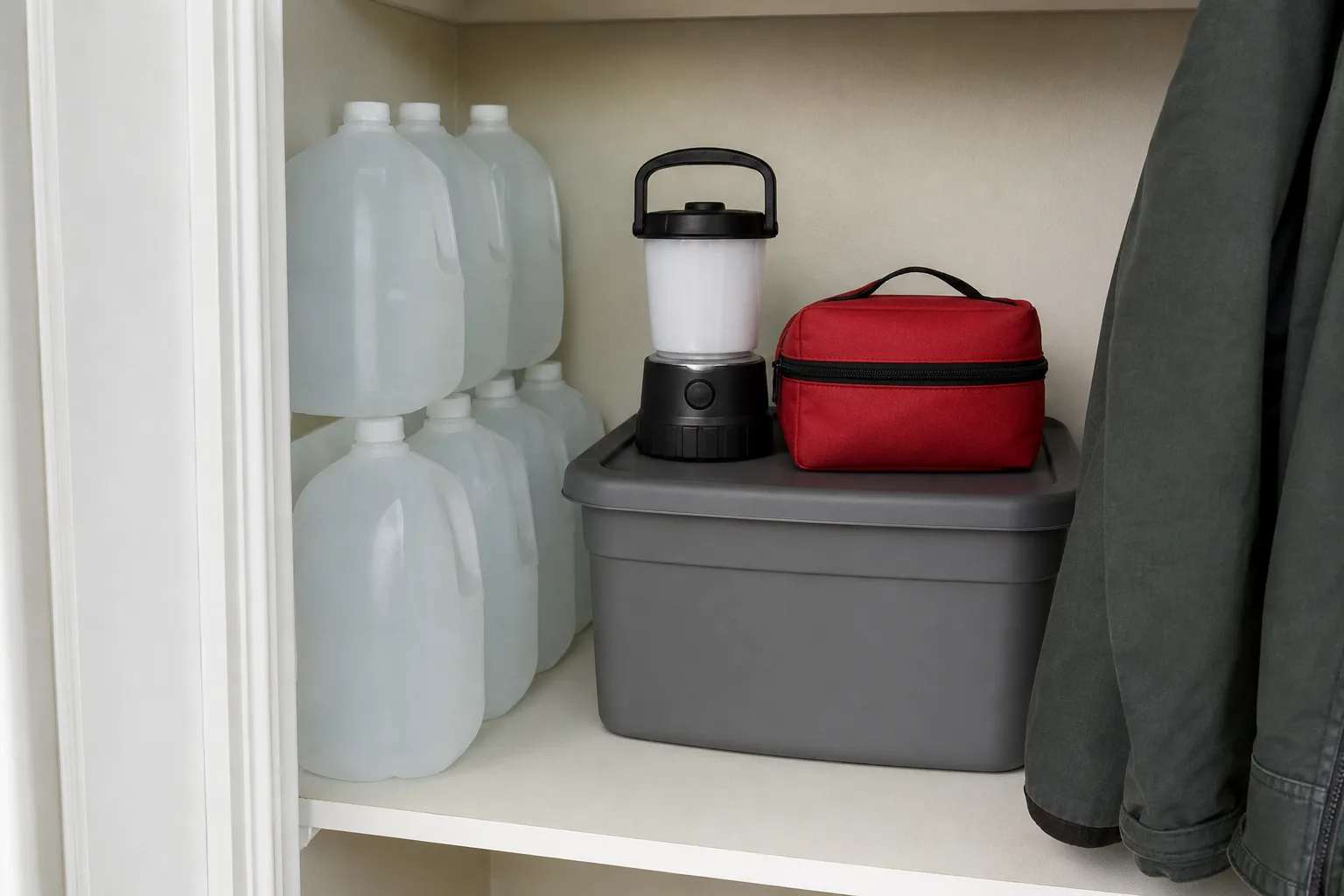
Water is the first thing to sort out and the one item no gadget replaces. Ready.gov recommends at least one gallon of water per person per day for several days, for drinking and sanitation. For four people over three days, that is 12 gallons before pets or cooking water. The simplest start is commercially bottled water, which ready.gov suggests keeping in its sealed original container in a cool, dark place.
A portable filter is the backup for when stored water runs out or the tap may not be safe after a storm. The emergency water filter guide compares squeeze filters, the Katadyn BeFree and Berkey-style gravity filters for home use. Guides to home water storage containers and rain barrels are on the way. Keep in mind that rain barrel water is meant for the garden, not for drinking.
Pick: Sawyer Squeeze
The Sawyer Squeeze Water Filtration System is the filter that holds up when the water is bad. Its 0.1-micron hollow-fiber membrane removes bacteria and protozoa, and a syringe backflush brings back most of its flow after silty water. It works squeezed into a bottle, inline or hanging as a gravity filter, and a hanging bag with a Squeeze is the setup that suits a family at home. Keep it from freezing: Sawyer says a filter that may have frozen should be replaced, and a spare that has never been wetted stays safe sealed and dry in the kit.
Filter for dirty water
Sawyer Squeeze Water Filtration System
Fast, durable, fits ordinary bottles and recovers its flow with a syringe backflush.
- 0.1-micron hollow fiber
- Syringe backflush
- Fits standard bottles
Good for
- Emergency kits
- Silty or stagnant water
- Gravity setups
Skip it if
- Anyone who hates a firm squeeze grip
For everyday tap water that is safe but tastes off, a filter pitcher is the simpler tool: the water filter pitcher guide compares Clearly Filtered, ZeroWater and Brita, and an under-sink reverse osmosis guide covers whole-kitchen systems. Neither replaces stored water or a backpacking-style filter when the tap stops.
Emergency food supply: meals that need nothing but hot water
Emergency food is where most prepping starts, and it does not have to mean a year of buckets. Canned food and pantry staples cover most short outages. For longer stretches, or a go-bag, freeze-dried meals are the simplest choice: no fridge, no recipe and usually nothing to wash. They cook in the bag. Tear the top, take out the oxygen absorber packet, add boiling water, stir, zip and wait about 10 minutes.
Look at the calories, not the serving count. Most pouches are labeled as two servings, but a hungry adult can eat one as a meal, so plan on one pouch per person per meal. Cooking water comes on top of drinking water, so a meal that needs less water stretches your supply further.
Keep the fridge closed when the power goes out. Ready.gov's power outage guidance says a refrigerator keeps food cold for about four hours and a full freezer holds its temperature for about 48 hours. For a longer outage, a good cooler and ice buy more time: the cooler guide compares how long YETI, RTIC, Blue Coolers and others hold ice.
Pick: Peak Refuel Beef Pasta Marinara
Peak Refuel Beef Pasta Marinara is beef crumbles and pasta in marinara sauce. It comes out creamy and thick rather than watery, and the beef keeps real texture. Per Peak Refuel, the pouch holds 1,040 calories and 49 grams of protein and needs just 3/4 cup of boiling water. Peak Refuel lists a shelf life of 10 years unopened. It contains milk and wheat. Store pouches somewhere dry and away from prolonged heat, so a hot garage or attic is a poor spot. The full guide compares Peak Refuel and Mountain House flavor by flavor.
Most calories per pouch
Peak Refuel Beef Pasta Marinara
Creamy pasta with beef that keeps its texture, 1,040 calories per pouch and only 3/4 cup of water to prepare.
- 1,040 calories
- 3/4 cup water
- 10-minute prep
Good for
- Go-bags and car kits
- Big appetites
Skip it if
- Anyone avoiding dairy or wheat
Hot meals with no stove: a self-heating case
Freeze-dried pouches need boiling water. A civilian MRE does not: each kit carries a flameless heater that warms the entree in its pouch. The APack Ready Meal Self-Heating Variety Pack is twelve compact kits in six menus, each with its own heater, and its spaghetti entree tastes better than canned. The rice dishes come out soft, and there is no drink mix in the bag. Store the case at 80°F or below. The MRE and ration bar guide compares it with ration bars for a go-bag.
Self-heating home case
APack Ready Meal Self-Heating Variety Pack
Twelve compact kits in six menus, each with a heater, with a spaghetti entree that beats canned and standout sunflower butter.
- 12 meals, 6 varieties
- Flameless heater in every kit
- Store at 80°F or below
Good for
- Home outage kits for two people
- Households that want a hot meal with no stove
Skip it if
- Anyone expecting a drink mix in the bag
- Eaters who dislike soft rice
Cooking without power: a butane stove, outdoors
Boiling water for pouches, coffee or pasta during an outage takes a flame or a power station. The Coleman Classic 1-Burner Butane Stove is a plain 7,650 BTU stove that lights without matches, takes a 10-inch pan and runs up to 1.25 hours on high per canister, by Coleman's figure. Coleman's manual says it is for outdoor use only: never inside a house, camper, tent or vehicle. With nowhere outdoors to cook, an electric hot plate on a power station is the flame-free choice. The outage cooking guide compares three butane stoves and what each maker allows.
Simple and dependable, outdoor use only
Coleman Classic 1-Burner Butane Stove
A plain 7,650 BTU butane stove that lights without matches, takes a 10-inch pan and is still working after several years.
- 7,650 BTU/h
- Fits a 10-inch pan
- Up to 1.25 hr on high
Good for
- A first outage stove for a home with a yard
- Camping trips between outages
Skip it if
- Cooking inside the house is the plan
- Low simmering matters
Fresh herbs and greens indoors: a countertop garden
Stored food covers calories. A countertop hydroponic garden adds something fresh through a long stretch at home, and it runs on a few watts. The Click & Grow Smart Garden 3 is a silent three-pod garden: the pods draw water up through a wick, so there is no pump to hum, and the 1.5-liter tank goes a long time between refills. Basil, cilantro and lettuce do well in it; tomatoes and peppers struggle. Its 8-watt light needs an outlet, so during an outage it needs a power station. The countertop hydroponic garden guide compares it with larger gardens for tomatoes and seedlings.
Quiet, no-pump herbs
Click & Grow Smart Garden 3
A silent three-pod wick garden that rarely needs water and suits herbs and greens far better than fruiting plants.
- 3 pods
- 1.5 L tank
- 8 W light
Good for
- Basil, cilantro and lettuce
- Bedrooms and quiet kitchens
Skip it if
- Tomatoes or peppers
Backup power: keep the phones alive first
A charged phone is how most households get outage updates and reach family, and ready.gov's outage checklist lists a portable charger or power bank among the basics. A 20,000 to 25,000 mAh bank gives about three to three and a half charges of a large phone. A household with several phones is better served by two or three banks than one large one, so everyone can charge at once. Recharge banks every few months and store the cables with them.
A power bank is for phones, tablets, headlamps and laptops. For a router, a fridge or a medical device, the tool is a portable power station or a generator. The Jackery power station guide helps size a portable station, the Anker SOLIX full guide covers larger home-backup stations, and the inverter generator guide compares the Honda EU2200i and GENMAX 2200W. Ready.gov says generators and fuel should always be used outdoors, at least 20 feet from windows, doors and attached garages.
Pick: Anker 737 Power Bank 24,000mAh 140W
The Anker 737 is the bank to beat on charging speed in both directions. On a 140 W charger it filled its 24,000 mAh in about 48 minutes. It sent about 130 W in total while charging two laptops and a phone, and its display shows battery percentage, per-port wattage, temperature and battery health, with readings that matched an external meter. It weighs 630 g and has no built-in cables. Turn its screen off before storing it: Anker says the 737 uses about 15 percent of its battery a day if the settings screen is left on. The full guide covers four more banks, including ones with cables built in.
Fastest to refill
Anker 737 Power Bank 24,000mAh 140W
Refills in about 48 minutes on a 140 W charger and powers two laptops at roughly 130 W combined, with an accurate, detailed display.
- 24,000 mAh
- 140 W PD 3.1
- 2 USB-C + 1 USB-A
Good for
- Two laptops at once
- Fast turnaround when power returns
- Watching battery health
Skip it if
- Pocket carry (630 g)
- No 140 W USB-C charger at home
Bigger backup: a power station for the fridge overnight
A quick way to size a station: a refrigerator uses about 1.5 kWh a day and the internet about 0.5 kWh, so a 24-hour outage with a few lights needs roughly 2.5 kWh after losses. The Jackery Explorer 2000 v2 (2,042 Wh, 2,200 W) gets close to a full day of that if the refrigerator door stays shut, and it can sit between the wall and network gear with a 20 ms UPS switchover. At 39.5 lb it is a station to park, not carry around. For whole circuits through a transfer switch, the whole-home battery backup guide compares the EcoFlow DELTA Pro Ultra, Jackery 5000 Plus and Anker SOLIX F3800 Plus, and the solar panel guide covers panels for recharging a station when the outage runs long.
Refrigerator through an overnight outage
Jackery Explorer 2000 v2
2,042 Wh and 2,200 W run a refrigerator plus internet and lights overnight, with a 20 ms UPS switchover.
- 2,042 Wh
- 2,200 W
- 20 ms UPS
Good for
- A refrigerator through an overnight outage
- Sitting between the wall and network gear as a UPS
Skip it if
- You'll carry it far (39.5 lb)
Longest runs: an inverter generator, used outdoors
For outages that last days, a gas inverter generator keeps going as long as there is fuel. The Honda EU2200i showed the smallest voltage dip when a big load switched on, the longest run at a heavy load, the least vibration and the least engine wear after about 98 hours, and its CO-MINDER shuts the engine off if carbon monoxide builds up. Its pull cord is the stiffest of the group. Automatic CO shutoff is a backup, not a reason to run it anywhere but outside, away from the house as ready.gov describes above.
Steadiest power for a fridge and electronics
Honda EU2200i Inverter Generator
The smallest voltage dip when a big load switches on, the longest run at a heavy load, the least vibration and the least engine wear after about 98 hours.
- 2,200 / 1,800 W
- 121 cc engine
- CO-MINDER shutoff
Good for
- Outage backup for a fridge and electronics
- RV parks with quiet hours
Skip it if
- A stiff pull cord is a problem (the heaviest pull here)
Solar generators and panels: recharging when the outage runs past a day or two
A power bank or station is a fixed tank of electricity. A solar panel refills it without fuel, slowly, which is why a solar generator, a power station sold with its own panel, shows up on most prepper gear lists. Three sizes cover most homes.
One small panel for phones, lights and a router. The Anker SOLIX C300 Solar Generator with 60W Panel pairs a 288 Wh, 300 W station with one folding panel that has a stand and a long cable. Its 60 W panel delivered 46 W in clear sun, and an hour of that sun took the station from 20 to 37 percent. That is the honest pace of a small kit: most of a clear day for a full refill. It keeps phones, laptops, lights and a router going; it will not run a heater or a coffee maker.
One small panel for phones and a router
Anker SOLIX C300 Solar Generator with 60W Panel
The panel delivered the most power of the small kits and has a stand and a long cable, paired with a 300 W station.
- 288 Wh
- 300 W AC
- 46 W measured from the 60 W panel
Good for
- Phones, laptops, lights and a router
- Camping and daytime refills
Skip it if
- Running a heater or coffee maker
- Planning to add bigger panels
One large panel for kitchen appliances. The Jackery Solar Generator 1000 v2 with 200W Panel is a 1,070 Wh, 1,500 W station with one 200 W bifacial panel. The station ran a microwave, a kettle and a coffee maker. The panel read 185 W in a single clear-sky reading and 41 W on another day with the sun behind cloud, and Jackery lists 7.5 hours for a full solar charge. Its 400 W solar input leaves room for a second panel later. The solar generator bundle guide compares the three bundles.

Largest battery, runs kitchen appliances
Jackery Solar Generator 1000 v2 with 200W Panel
A 1,070 Wh, 1,500 W station with one 200 W bifacial panel; Jackery lists 7.5 hours for a full solar charge, and the 400 W solar input leaves room for a second panel.
- 1,070 Wh
- 1,500 W AC
- One 200 W bifacial panel
Good for
- Microwave, kettle and coffee maker during an outage
- Adding a second 200 W panel later
Skip it if
- A kit that carries in one hand
- Adding battery capacity later
A fixed kit for a shed, cabin or workshop. The ECO-WORTHY 400W 12V Complete Solar Panel Kit puts four 100-watt bifacial panels, a 40-amp MPPT controller, two 100 Ah lithium batteries and a 2,000-watt inverter in one order. Once assembled it started a chop saw, an air compressor and a table saw, one at a time. It is an installation project, with heavy cable to cut and crimp, and no kit this size runs a whole house. Anything tied into house wiring is a job for a licensed electrician under local code. The solar kit guide covers what installing one takes.

Complete kit with batteries and inverter
ECO-WORTHY 400W 12V Complete Solar Panel Kit
Four bifacial panels, an MPPT controller, two lithium batteries and a 2,000-watt inverter in one order; it started a chop saw, an air compressor and a table saw.
- 4 x 100 W bifacial panels
- About 2.4 kWh of lithium storage
- 2,000 W pure sine inverter
Good for
- A shed, workshop, RV or cabin
- Outage power for small loads
Skip it if
- Cutting and crimping heavy cable sounds like too much
- The batteries would have to charge below freezing
Two smaller fixes round out the power plan: a UPS battery backup keeps a modem and router online through short blips, and a home with a basement can add a battery backup sump pump so a storm outage doesn't also flood it.
Emergency lighting: a lantern for the room, a headlamp for your hands
Ready.gov suggests a flashlight for every household member, but a flashlight leaves you working one-handed. Two more lights cover most needs: a lantern that sits on the kitchen table and lights the whole room, and a headlamp for cooking, finding the breaker panel or walking a dog. For a handheld light, the flashlight guide compares Streamlight, Olight, Fenix and Coast.
Pick: Nitecore LR70
The Nitecore LR70 is a true lantern, with three white levels from high-color-accuracy LEDs, and a 3,000-lumen flashlight in one body. It adds two red modes plus red beacon and SOS, useful at night when you don't want to blind anyone. Its 10,000 mAh battery accepts 18 W fast charging over USB-C and can charge a phone, and Nitecore rates its longest runtime at 600 hours. It weighs close to 10 ounces, and its IP67 rating is optimistic: keep it out of standing water. The full guide also covers a lantern with a hand crank.
Lantern plus real flashlight
Nitecore LR70
A true lantern and a 3,000-lumen flashlight sharing a fast-charging 10,000 mAh battery, with red modes and a reserve left after charging a phone.
- 10,000 mAh
- Red light + SOS
- USB-C fast charge
Good for
- Long outages
- Walking outside at night
- Charging a phone
Skip it if
- Anything that may end up underwater
Pick: Petzl NAO RL
The Petzl NAO RL is rated at 1,500 lumens and weighs 145 grams, with its 3,200 mAh pack at the back of the head to balance the front. A sensor dims the beam when you look down at a workbench and brightens it when you look into the distance, which stretches the charge; used as the main light through an overnight 100-mile race, it still had about half its charge at the finish. It has a rear red light. The front button is small and stiff in gloves, and the IPX4 rating covers rain, not submersion. If you would rather run a headlamp on AAA batteries from any store, the full guide covers that option too.
Long nights and hands-free work
Petzl NAO RL
A sensor that dims and brightens the beam on its own to save charge, a balanced rear battery and enough run time for a full night.
- 1,500 lumens
- 145 g
- 3,200 mAh, USB-C
Good for
- Long outages and all-night use
- Running and hiking after dark
Skip it if
- Gloved hands (small, stiff button)
- Simple one-button use
Emergency radio and communication: alerts first, then a way to talk
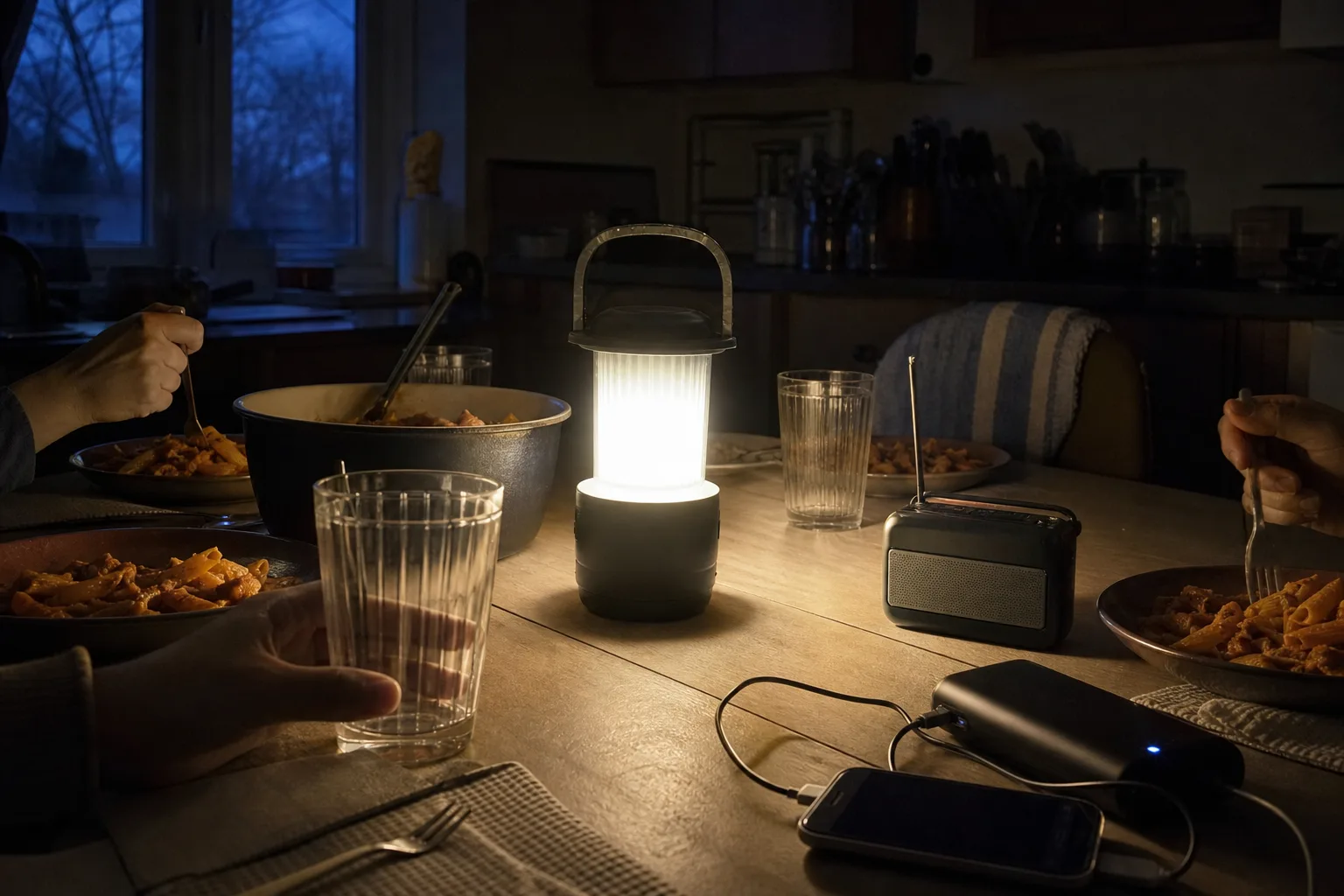
When cell towers lose power or get overloaded, two things still work: NOAA Weather Radio, the National Weather Service's own broadcast, and short-range two-way radios. Cranks and solar panels on small radios recover far less charge than the box suggests, so charge radios from USB, store them full, and treat the crank as a backup.
Pick: Midland WR120B
The Midland WR120B is a plug-in desk radio that listens to NOAA Weather Radio day and night and reacts to alerts for your area. With S.A.M.E. it stores up to 25 county codes, and each alert type can be switched on or off, so a flood advisory for a county upstream does not wake the house. Alerts can come as a 90 dB siren, a tone followed by the broadcast, or lights and text only. It runs on its AC adapter and keeps three AA batteries (not included) as backup. It has no crank, solar, AM or FM, so it pairs with a portable crank radio rather than replacing one; the full guide covers two of those.
Bedside county alerts
Midland WR120B
A plug-in alert radio that uses S.A.M.E. county codes to sound only for the places and alert types you pick, with three AA batteries as backup.
- S.A.M.E., 25 locations
- 90 dB siren
- 3 AA backup
Good for
- Overnight tornado, flood and storm warnings
- Homes that want fewer false alarms
Skip it if
- You need a portable radio
- You want AM and FM news
Pick: Motorola Talkabout T605 H2O
The Motorola Talkabout T605 H2O is the radio the full guide picks for a home kit. It is rated IP67 (one meter for 30 minutes), floats face up with its included battery, and has a white and a red LED flashlight. It carries NOAA weather channels with alerts, an emergency alert button and dual-channel watch, and it was among the strongest radios across six miles of hills and trees. It runs on its rechargeable pack or on three AA batteries when the pack runs down, and it comes as a 2-pack. Motorola notes it may not float on some AA batteries. For the longest reach in a built-up neighborhood, the full guide also covers the Rocky Talkie Mountain Radio.
Waterproof pick that floats
Motorola Talkabout T605 H2O
Fully waterproof, floats face up with a flashlight that turns on in water, and reaches far over hills, with NOAA alerts and AA backup.
- IP67
- NOAA alerts
- AA backup
Good for
- Home emergency kits
- Boating, rivers and rain
Skip it if
- A small, light radio for a pack strap
Batteries: cells that are still charged when you need them
Weather radios, remotes and many lights run on AA cells, and a pack that went flat in a drawer is no help at night. Low self-discharge rechargeables keep most of their charge for months.
Pick: Panasonic eneloop AA
The white Panasonic eneloop AA cells are made to a tight standard, so every cell in a pack performs about the same, and a charged set stays useful in a drawer for months. After about 300 daily cycles in solar garden lights, an eneloop still delivered 99% of its rated capacity. Panasonic rates it for up to 2,100 recharges and ships it pre-charged. The trade-off is capacity, about 2,000 mAh typical, so high-drain devices run longer on a bigger cell. The full guide compares higher-capacity cells and a starter kit with a charger.
Holds charge in a drawer
Panasonic eneloop AA
Very consistent cells with low self-discharge, almost no wear after about 300 cycles and the highest cycle rating in its group.
- 2,000 mAh typical
- Up to 2,100 cycles
- Pre-charged
Good for
- Outage kits and devices that sit unused
- Lights and radios that take several cells
Skip it if
- Maximum runtime in a high-drain device
First aid kit: an organized kit and someone trained to use it
A box of adhesive bandages covers a scraped knee. A household kit should handle a bad cut or a burn too, with supplies you can find quickly. Training matters as much as the kit, so put a Red Cross first aid class on the list for at least one adult in the house. Check the kit once a year and replace anything expired or used.
Pick: SurviveX Large First Aid Kit
The SurviveX Large First Aid Kit is the kit most households can buy and stop thinking about. It measures 10.4 x 7.3 x 6.7 inches and weighs 2.8 pounds, small enough for a trunk or the shelf by the garage door. Inside, three panels open flat and every compartment is labeled and color-coded. SurviveX counts 250 supplies, including Zip Stitch closures, and rates the kit for three to four people. A strap across the front keeps the bag tight as supplies get used, handles on the top and side let you grab it either way, and an empty front pocket holds a list of medications and emergency contacts. The full guide covers larger kits for bigger households.
Home closet or car
SurviveX Large First Aid Kit
A compact tri-fold kit with labeled, color-coded compartments, MOLLE mounting and Zip Stitch closures, rated for three to four people.
- 250 supplies
- Tri-fold layout
- 2.8 lb
Good for
- Couples and small families
- Car trunks and closet shelves
Skip it if
- Larger groups that need extra stock
Survival tools: one multitool in the kit
Ready.gov's basic kit includes a wrench or pliers to turn off utilities, a manual can opener, and plastic sheeting, scissors and duct tape. A multitool covers the small jobs in between: cutting cord, opening a package, tightening a screw on a loose hinge.
Pick: Leatherman Wave+
The Leatherman Wave+ packs 18 tools into a 4-inch, 8.5-ounce body, including plain and serrated blades, a saw, replaceable wire cutters, a crimper and wire stripper, files and a set of drivers. Every tool except the plier head locks open, and the warranty runs 25 years. Buy from Leatherman's own listing or an authorized seller, since knockoff Waves are common. The multitool guide compares it with the Arc, Surge and Victorinox Spirit MX.
Safe all-rounder
Leatherman Wave+
The Wave layout most people reach for: four outside tools including a serrated blade, replaceable wire cutters and a size that fits a pocket, glovebox or kit.
- 18 tools
- 8.5 oz
- 25-year warranty
Good for
- First multitool or a gift
- Emergency kits and cars
- Cutting rope with the serrated blade
Skip it if
- Opening every tool with one hand
- Blades that rarely need sharpening
Emergency heat: one warm room, by the manual
Blankets, layers and one closed room come first. For a flame heater indoors, the only kind to consider is one its maker lists for indoor use, and that listing comes with rules. The Mr. Heater Portable Buddy Heater (MH9BX) is a 4,000 or 9,000 BTU radiant heater that Mr. Heater lists for spaces up to 225 square feet. It runs about 3 to 6 hours on a 1 lb propane cylinder. Its manual requires a minimum vent area of 9 square inches, at the ceiling and at floor level, and clearances to anything that can burn of 30 inches above, 24 inches in front and 6 inches at the sides. It also says never to run the heater while sleeping. It is not rated above 7,000 feet, and the versions sold for Massachusetts and Canada are outdoor-only heaters. Read the manual for the unit in hand before the first cold night, and follow the carbon monoxide detector advice in the next section. The Mr. Heater Buddy guide goes through what the manuals require for it and the larger Big Buddy.
One closed room
Mr. Heater Portable Buddy Heater (MH9BX)
A 4,000 or 9,000 BTU radiant heater for one closed room, listed by its maker for up to 225 square feet, that has kept working through years of rough handling.
- 4,000 or 9,000 BTU/h
- About 3 to 6 hours per 1 lb cylinder
- 10.6 lb
Good for
- Heating one small closed room while awake
- Cabins, enclosed porches and fishing huts
Skip it if
- The space is a garage or an open-plan room
- The home is above 7,000 feet
Smoke and carbon monoxide alarms
Ready.gov's power outage guidance on carbon monoxide is plain: install carbon monoxide detectors with battery backup in central locations on every level of the home, use generators, camp stoves and charcoal grills only outdoors and at least 20 feet from windows, and never use a gas stove or oven to heat the home. Ready.gov calls carbon monoxide a colorless, odorless gas that can kill people and pets. The smoke and CO alarm guide compares the First Alert SC5, Kidde and X-Sense alarms.
Self-heating home case
APack Ready Meal Self-Heating Variety Pack
Twelve compact kits in six menus, each with a heater, with a spaghetti entree that beats canned and standout sunflower butter.
- 12 meals, 6 varieties
- Flameless heater in every kit
- Store at 80°F or below
Good for
- Home outage kits for two people
- Households that want a hot meal with no stove
Skip it if
- Anyone expecting a drink mix in the bag
- Eaters who dislike soft rice
Documents and money
Ready.gov suggests keeping copies of insurance policies, identification and bank records, saved electronically or in a waterproof, portable container. Add a list of medications and doctors, a printed list of phone numbers (a dead phone takes your contacts with it), and some cash in small bills, since card readers and ATMs need power. A guide to fireproof safes and document bags is on the way.
The 72-hour kit or bug-out bag: buy a base, then build on it
A packed go-bag, the bug-out bag of prepper lists, is for leaving home: an evacuation order, a gas leak or a house fire. A ready-made kit saves the work of gathering small items, but it pays to know exactly what is inside before counting on it.
Pick: Ready America 70280 2-Person 3-Day Emergency Kit
The Ready America 70280 is a backpack of basics for two people. Per Ready America, it holds two 2,400-calorie food bars and twelve 4.225-ounce water pouches (both with a five-year shelf life), two survival blankets, a 33-piece first aid kit, two 12-hour light sticks, two dust masks, four nitrile gloves, a whistle, two ponchos and a tissue pack, in a pack of about 12.5 x 9 x 5 inches that weighs 7.75 pounds.
The gaps are real. The two food bars come to about 800 calories per person per day over three days, well short of a full day's eating. The twelve pouches add up to about 0.4 gallon of water for two people, against ready.gov's six gallons for two people over three days. The first aid kit is bandages, gauze and a few pain relievers. There is no flashlight beyond the light sticks, no radio, nothing to start a fire and no real water container or filter. As a base to fill out, it is a reasonable start; as the whole plan, it falls short.
Starter kit to build on
Ready America 70280 2-Person 3-Day Emergency Kit
A packed backpack with food bars, water pouches, blankets, ponchos and basic first aid for two people, ready to fill out with light, water and food.
- 2 people, 3 days
- 5-year food and water
- 7.75 lb
Good for
- A base for a go-bag
- Gifting a starter kit to relatives
Skip it if
- Using it as a complete kit as sold
- More than two people
What to add to any ready-made kit:
- More water in a real bottle or container, and a portable filter.
- More food: freeze-dried pouches or calorie-dense bars to bring each person to full meals.
- A headlamp or small lantern and spare batteries.
- A charged power bank and the cables for the household's phones.
- A small radio for weather and news.
- A change of clothes, sturdy shoes and a warm layer per person.
- Personal items: prescriptions, glasses, hygiene supplies and copies of documents in a sealed bag.
Small survival supplies worth adding
Also worth adding:
- Duct tape and plastic sheeting, which ready.gov lists for sheltering in place, and which handle plenty of quick patches.
- Hand warmers for cold nights without heat, in the car or the go-bag. The rechargeable hand warmer guide compares reusable warmers with disposables.
- Fuel for a generator or camp stove, handled as each maker's manual directs. Ready.gov says generators and fuel are used only outdoors.
- Fire starters and matches in a waterproof container, for outdoor cooking or a fireplace that is safe to use.
- A sleeping bag or warm blanket for each person.
- Cash in small bills.
- Paper copies of documents and an emergency contact list.
- Prescriptions, with a plan for a week's supply, and copies of the prescriptions themselves.
- Pet supplies: food, extra water, a leash or carrier and vaccination records.
Simple and dependable, outdoor use only
Coleman Classic 1-Burner Butane Stove
A plain 7,650 BTU butane stove that lights without matches, takes a 10-inch pan and is still working after several years.
- 7,650 BTU/h
- Fits a 10-inch pan
- Up to 1.25 hr on high
Good for
- A first outage stove for a home with a yard
- Camping trips between outages
Skip it if
- Cooking inside the house is the plan
- Low simmering matters
How to start doomsday prepping without overdoing it
- Start with water and light. Stored water, a lantern and a headlamp handle the most common outage.
- Charge on a schedule, such as the start of each season, and re-check the whole kit once a year, as ready.gov suggests.
- Rotate food and water. Eat a few pouches on a camping trip and replace them, so the household knows what it likes before it matters.
Posted by Kristopher Larson
Frequently asked questions
What are the doomsday prep essentials for a home emergency kit?
For a real household, the essentials are the same things that get you through a long outage or an evacuation: stored water, shelf-stable food and a manual can opener, flashlights and a lantern, a NOAA weather radio, charged power banks, extra batteries, a first aid kit, a multitool, copies of important documents, cash, prescriptions and pet supplies. Start with water and light, then build out from there.
How much water should a household store for emergencies?
Ready.gov recommends at least one gallon of water per person per day for several days, for drinking and sanitation. A family of four planning for three days needs 12 gallons, plus extra for pets and for rehydrating dried food. A portable water filter is a sensible backup if stored water runs out.
Is a pre-made 72-hour emergency kit or bug-out bag worth buying?
As a starting point, yes; as a complete kit, rarely. A common two-person kit such as the Ready America 70280 includes food bars, water pouches, blankets, ponchos and basic first aid, but the food comes to about 800 calories per person per day and the water to well under a gallon in total. Add water, a real light, more food, a radio and a power bank before relying on it.
How long does food stay safe in the fridge during a power outage?
According to ready.gov, a closed refrigerator keeps food cold for about four hours, and a full freezer holds its temperature for about 48 hours. Keep the doors shut, use coolers with ice if needed, check temperatures with a thermometer, and throw out food that has been at 40 degrees or higher for two hours or more.
Can a generator or camp stove be used indoors during an outage?
No. Ready.gov says generators, camp stoves and charcoal grills should always be used outdoors and at least 20 feet away from windows, and warns never to use a gas stove or oven to heat the home. Carbon monoxide is colorless and odorless, so install carbon monoxide detectors with battery backup on every level of the home.
What kind of emergency radio belongs in a prepper kit?
Ready.gov lists both a battery-powered or hand crank radio and a NOAA Weather Radio with tone alert. In practice that often means two radios: a plug-in alert radio with battery backup that sounds for warnings in your county, and a portable crank or battery radio for news when the power is out. Charge crank radios from USB and store them full, since cranking and small solar panels recover only a little charge.
Keep reading
More from the blog
Best Wireless Microphone for Real Estate Video: Rode Wireless GO (Gen 3) vs. Wireless PRO vs. DJI Mic 3 vs. Hollyland Lark Max 2
Best Walkie Talkies: Rocky Talkie vs. Motorola Talkabout vs. Midland X-Talker for Hiking, Skiing and Outages
Best Robotic Pool Cleaners: Corded vs. Cordless, Beatbot vs. Aiper vs. Dolphin vs. ECOVACS