Best Water Filter Pitcher: Clearly Filtered vs ZeroWater vs Brita
ZeroWater vs Brita vs Clearly Filtered: what each filter removes, NSF ratings, TDS meter myths, filter life, speed and when a pitcher isn't enough.
Every water filter pitcher removes chlorine. Past that, they split fast. Some barely touch metals and salts, some strip the water down to almost nothing, and a few have put things into the water that weren't there before. The best one depends more on your tap water than on the brand.
This guide covers what each filter type removes, what the NSF/ANSI numbers mean, why a TDS meter can mislead, and how filter life, speed and pouring compare, then three pitchers worth buying.
As an Amazon Associate, Best Utah Real Estate earns from qualifying purchases.
Quick verdict
- Best all-rounder: the Clearly Filtered Water Filter Pitcher (10 Cup). Broad removal, some minerals kept, the most water per fill and the sturdiest build. It costs the most up front.
- Most complete removal, highest running cost: the ZeroWater 12-Cup Ready-Pour Pitcher. Nearly every dissolved metal and salt comes out, minerals included, but filters can wear out in weeks in hard water.
- Cheapest to run, for city water taste: the Brita Everyday Elite Water Filter Pitcher (10 Cup). Long filter life and fast filtering, weak on metals and salts.
The pitchers side by side
Removal figures come from one treated well-water supply. Your water has a different mix, so read them as each filter's strengths, not a promise.
| Pitcher | Shop | Filter type | Fluoride / uranium | Nitrate | Minerals | Flow (gal/hr) | Rated filter life |
|---|---|---|---|---|---|---|---|
| Clearly Filtered Water Filter Pitcher (10 Cup) |  Buy on Amazon | Carbon block plus proprietary media | Both removed | Down 11% | Calcium down 32%; magnesium and sodium up | 2.27 | Up to 100 gal |
| ZeroWater 12-Cup Ready-Pour Pitcher |  Buy on Amazon | 5-stage carbon plus ion exchange | Both removed | Removed | Nearly all removed | 2.62 | Depends on TDS; as low as 8 gal |
| Brita Everyday Elite Water Filter Pitcher (10 Cup) | 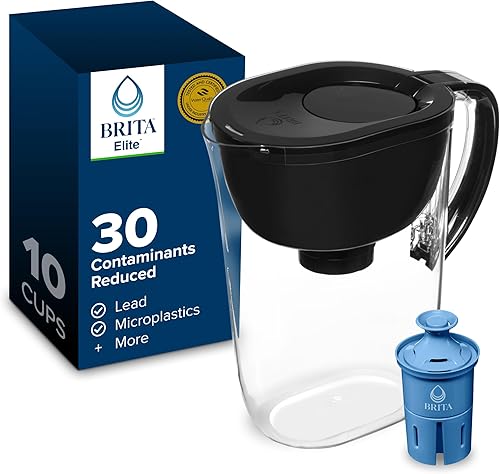 Buy on Amazon | Keeps calcium and magnesium | Fluoride stayed; uranium down 26% | Down 5% | Kept | 2.92 | Up to 120 gal or 6 months |
| LifeStraw Home Water Filter Pitcher (10 Cup) | Buy on Amazon
| Microfiltration membrane | Not measured on this water | Not measured | Not measured | Not measured | Check the listing |
| PUR Plus | Carbon plus ion exchange | Fluoride stayed; uranium down 80% | Down 42% | Calcium and magnesium down; sodium up sharply | 2.82 | 40 gal or about 2 months |
What each filter type removes
Carbon grabs chlorine and many organic chemicals, which fixes the taste of city water, but does little for dissolved salts and many metals. The Brita Elite behaves much like this: chlorine and disinfection byproducts gone, fluoride untouched, nitrate down 5%, minerals left alone.
Ion exchange resins swap charged particles for others. Paired cation and anion resins, as in ZeroWater, pull out nearly everything dissolved, healthy minerals included; ZeroWater brought total dissolved solids down to 8 ppm. A sodium-loaded resin can raise sodium instead: PUR Plus pushed it up about 388% on the same water.
Combined media is the middle path. Clearly Filtered pairs a carbon block with a stainless mesh and undisclosed media. It removed fluoride, uranium and copper completely and cut barium 86%, strontium 67% and molybdenum 53%, while nitrate and sulfate mostly passed through.
Membranes physically trap microbes. That is what the LifeStraw Home adds, and it is the only pitcher here built around bacteria and parasites.
NSF/ANSI certifications: count the claims
- NSF/ANSI 42: aesthetic effects such as chlorine, taste and odor.
- NSF/ANSI 53: contaminants with health effects, such as lead, mercury, PFOA and PFOS.
- NSF/ANSI 401: emerging and incidental contaminants.
- NSF/ANSI 372: lead-free materials, not contaminant removal.
What matters is how many of a brand's claims are certified. PUR Plus is certified to 42, 53 and 401 for everything PUR claims. The Brita Elite holds the same three for 15 of the 33 contaminants on its data sheet, mostly easier-to-remove organics. ZeroWater is certified to 42 and 53 for 6 of the 43 it lists, including lead, mercury, hexavalent chromium, PFOA and PFOS. Clearly Filtered claims over 365 contaminants, but its certifications cover chlorine under 42, PFOA and PFOS under 53, and lead-free design under 372; the rest rests on third-party data run to 200% of rated filter life. Certification and real results don't always line up, as PUR Plus shows below.
TDS meters: a filter gauge, not a safety gauge
ZeroWater includes a TDS meter and says to change the filter at 006. That works for filter life. Most dissolved solids in tap water, though, are harmless minerals like calcium and magnesium, and a meter can't see bacteria, microplastics, disinfection byproducts or particulate lead. Low TDS doesn't mean safe, and high TDS doesn't mean unsafe.
ZeroWater shows the gap itself. Its filtered water held 3.4 ppb of chloroform, a disinfection byproduct, that didn't appear in the unfiltered sample, most likely because the volatile chemical evaporated before that sample was taken rather than coming from the filter. ZeroWater's 10-cup pitcher and 32-cup dispenser also struggled with disinfection byproducts on a different supply. City water nearly always carries them.
Filter life and replacement
A Brita Elite filter is rated for up to 120 gallons or six months, the cheapest per gallon here. PUR Plus lasts about 40 gallons or two months. Clearly Filtered is rated for up to 100 gallons, but costs nearly twice as much per gallon as the budget pitchers. ZeroWater's life depends on what's dissolved in your water; hard water uses up the resin even when the solids are just minerals, and life can drop to 8 gallons. In typical conditions it costs about twice PUR's per gallon and more than four times Brita's. A big household on hard water could change it every few weeks.
Speed, leaks and pour
Gravity pitchers slow down as the filter ages. The Brita Elite was quickest at 2.92 gallons per hour, ZeroWater 2.62, and Clearly Filtered slowest at 2.27, about 13 minutes for half a gallon. Slower flow gives the media more contact time, which often means better removal.
Pouring is where pitchers annoy people. The Brita Everyday Elite's spout has a gap that can let unfiltered water mix into filtered water as you pour, a flaw other owners report too. Clearly Filtered can spill unfiltered water from under the lid if you pour with the top reservoir full. The LifeStraw Home can leak from its fill tab when tipped steeply.
The picks in detail
Clearly Filtered Water Filter Pitcher (10 Cup)
Clearly Filtered has the most effective filtration of any pitcher in this guide without stripping the water bare. Calcium fell 32% while magnesium and sodium rose and pH went from 7.4 to 8, so it tastes like water, not distilled. The Tritan body feels sturdier than ZeroWater's, the reservoirs are well balanced, and one fill yields about 8.5 cups, the fewest refills of the group. A squeeze bag makes priming quick, and the warranty runs two years.
Two caveats. Cobalt turned up in filtered water that wasn't in the tap water, and readings varied: one was above a strict health guideline, another far below it. And it is a premium pitcher with above-average filter costs.
Clearly Filtered Water Filter Pitcher (10 Cup)Check today’s price on Amazon

 Buy on Amazon →
ZeroWater 12-Cup Ready-Pour Pitcher
For removing nearly everything dissolved, nothing here matches it. Every metal and salt measured came out completely except copper, down 97%, and pH dropped to 7. It suits water high in fluoride, uranium or nitrate, or anyone who wants near-zero TDS. The filter needs no priming, and the listing notes IAPMO certification for PFOA, PFOS, lead, chromium and mercury.
Cost is the catch: the highest per gallon here, worse with hard water. The plastic feels thinner than Clearly Filtered's, seating a new filter takes force, the warranty is short, and disinfection byproducts are its weak spot.
ZeroWater 12-Cup Ready-Pour PitcherCheck today’s price on Amazon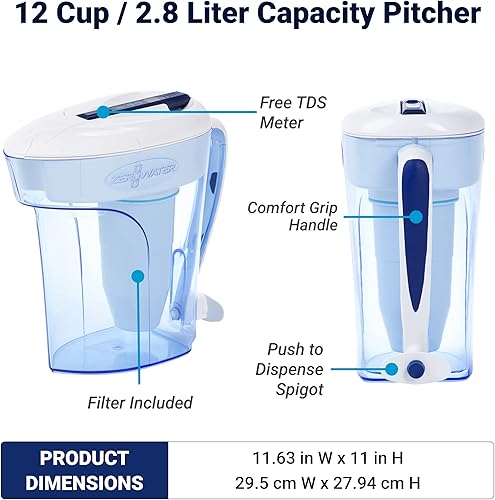

 Buy on Amazon →
Brita Everyday Elite Water Filter Pitcher (10 Cup)
The Elite filter removed disinfection byproducts, chlorine and barium completely, kept the minerals, lasts up to six months and is the cheapest to run. The Everyday Elite's indicator senses each refill, so it tracks real use instead of days. It is a taste filter first: fluoride, nitrate and most salts passed through, and uranium dropped only 26%. For treated city water with no known metal problem, it is a sensible buy; just mind the spout gap.
Brita Everyday Elite Water Filter Pitcher (10 Cup)Check today’s price on Amazon

 Buy on Amazon →
For emergencies: LifeStraw Home
The LifeStraw Home Water Filter Pitcher (10 Cup) is tested against nearly 30 species of bacteria and parasites, including E. coli and cysts, so it is a last resort when safe water isn't available and boiling isn't possible. Day to day it is awkward: four refills to fill the lower reservoir, tall enough to crowd a fridge shelf, and a small high handle that makes pouring clumsy.
Popular pitchers that missed
- PUR Plus: results varied widely. On one well supply barium fell 4%; on another, barium in filtered water rose 1,200% to over 2,000% and boron up to 4,456%, several readings above strict health guidelines. It may be a fluke, but jumps that large are rare.
- Culligan 10-cup: near-complete removal and certifications that include hexavalent chromium and fluoride, but a small top reservoir and 20-gallon filters.
- Epic Pure: the easiest to pour and use, with disappointing barium and strontium removal.
- Larq PitcherPure: very premium; its UV light targets bacteria that aren't a health concern, and metals were only partly removed.
When a pitcher isn't enough
Know your water first. City customers can find their supplier's annual Consumer Confidence Report through the EPA. Well owners have no such report; the EPA's private well guidance calls for yearly testing for coliform bacteria, nitrates, total dissolved solids and pH at a certified lab. Outside an emergency, a pitcher is no fix for bacteria in a well; that calls for disinfection at the source.
If the problem shows up at every tap, such as hard-water scale or iron stains, the whole-house water filter guide covers systems that treat everything coming in. Filtered water also means less chlorine flavor in coffee, and hard water means more descaling, per the drip coffee maker guide.
Who should buy which
- Broad removal, minerals kept, sturdy build: Clearly Filtered.
- High fluoride, uranium or nitrate, or near-zero TDS: ZeroWater, if frequent filter changes are fine.
- City water that just tastes like chlorine: Brita Everyday Elite.
- An emergency backup: LifeStraw Home.
- Well water or problems at every faucet: test first, then consider whole-house treatment.
Posted by Kristopher Larson
Frequently asked questions
What is the best water filter pitcher?
For most homes, Clearly Filtered is the strongest all-rounder: it removes a broad range of metals and chemicals, keeps some minerals and holds about 8.5 cups per fill. ZeroWater removes more dissolved solids but costs far more to run, and the Brita Everyday Elite is the low-cost choice when the goal is better-tasting city water. The right pick depends on what is in your water.
ZeroWater vs Brita: which is better?
They do different jobs. ZeroWater's ion exchange filter removed fluoride, uranium, nitrate and nearly all dissolved minerals on well water, while the Brita Elite left fluoride and most salts in place but kept the minerals. Brita filters last up to six months; ZeroWater filters can wear out after as little as 8 gallons in hard water and cost more than four times as much per gallon.
Clearly Filtered vs ZeroWater: which removes more?
ZeroWater removed slightly more of the metals and salts measured, including nitrate and sulfate, which Clearly Filtered mostly let through. Clearly Filtered still removed fluoride, uranium and copper completely, keeps more minerals, feels sturdier and lasts up to 100 gallons per filter. ZeroWater was weaker on disinfection byproducts such as chloroform, which are common in city water.
Does a low TDS reading mean water is safe?
No. Total dissolved solids in tap water are mostly harmless minerals like calcium and magnesium, and a TDS meter can't detect bacteria, microplastics, disinfection byproducts or particulate lead. A TDS meter is useful for telling when a ZeroWater filter is used up, not for judging whether water is safe to drink.
What do NSF/ANSI 42, 53, 401 and 372 mean on a water filter?
NSF/ANSI 42 covers aesthetic effects such as chlorine taste and odor. Standard 53 covers contaminants with health effects, such as lead and PFOA/PFOS. Standard 401 covers emerging contaminants, and 372 certifies lead-free materials rather than filtration. Check how many of the brand's listed contaminants are actually certified, since many pitchers claim far more than they are certified for.
How often should you replace a water filter pitcher filter?
It varies by filter and by your water. A Brita Elite filter is rated for up to 120 gallons or about six months, PUR Plus about 40 gallons or two months, and Clearly Filtered up to 100 gallons. ZeroWater filters depend on dissolved solids and should be changed when the included meter reads 006, which can happen after just a few weeks in hard water.
Keep reading
More from the blog
How to Turn a Spare Bedroom Into a Home Hair Salon in Utah
Best Glass Food Storage Containers: OXO vs Rubbermaid Brilliance vs Pyrex Snapware
Best Cutting Board for Knives: Teakhaus vs Epicurean vs Larch Wood