Whole-House Water Filter Guide: Sediment vs. Carbon vs. Softener vs. Salt-Free Conditioner
Sediment, carbon, softener or salt-free conditioner? How to test water first, size a whole-house system by flow rate, and which models fit which problem.
A whole-house water filter treats every gallon that enters a home, so the shower, the washing machine and the water heater all get the same water as the kitchen tap. That reach is the appeal, and also the reason to buy carefully. A system sized too small drops water pressure when two showers run at once, and a system built for the wrong problem can leave the real issue, such as hardness, iron or chloramine, untouched while still costing money in cartridges every year.
The right setup depends on three things: what is actually in the water, how many gallons per minute the household uses at its busiest moment, and whether the goal is cleaner water, softer water, or both.
As an Amazon Associate, Best Utah Real Estate earns from qualifying purchases.
Quick verdict: which whole-house system fits which problem
- Chlorine taste and odor on city water: the Waterdrop WHF3T-PG 3-Stage Whole House Water Filter System, a sediment-plus-carbon setup with 1-inch ports and 20-inch cartridges.
- Heavy metals, hydrogen sulfide (rotten-egg smell) or mixed city and well concerns: the iSpring WGB32B-KS, which adds a KDF stage to the usual sediment and carbon cartridges.
- Sand, grit or rust flakes, especially on a well: the iSpring WSP-50 spin-down sediment filter, a reusable 50-micron screen that goes first in line.
- Hard water that leaves scale and spots: the DuraWater Fleck 5600SXT 48,000-grain water softener, a metered, on-demand salt softener.
- Hard water where salt and a drain line are not an option: the Watts Premier OneFlow Plus, a salt-free scale-control system that pairs with a carbon block.
Test the water before buying anything
Every recommendation above assumes the buyer knows what the water contains. Guessing is how homeowners end up with a carbon filter for a hardness problem or a softener for a chlorine problem.
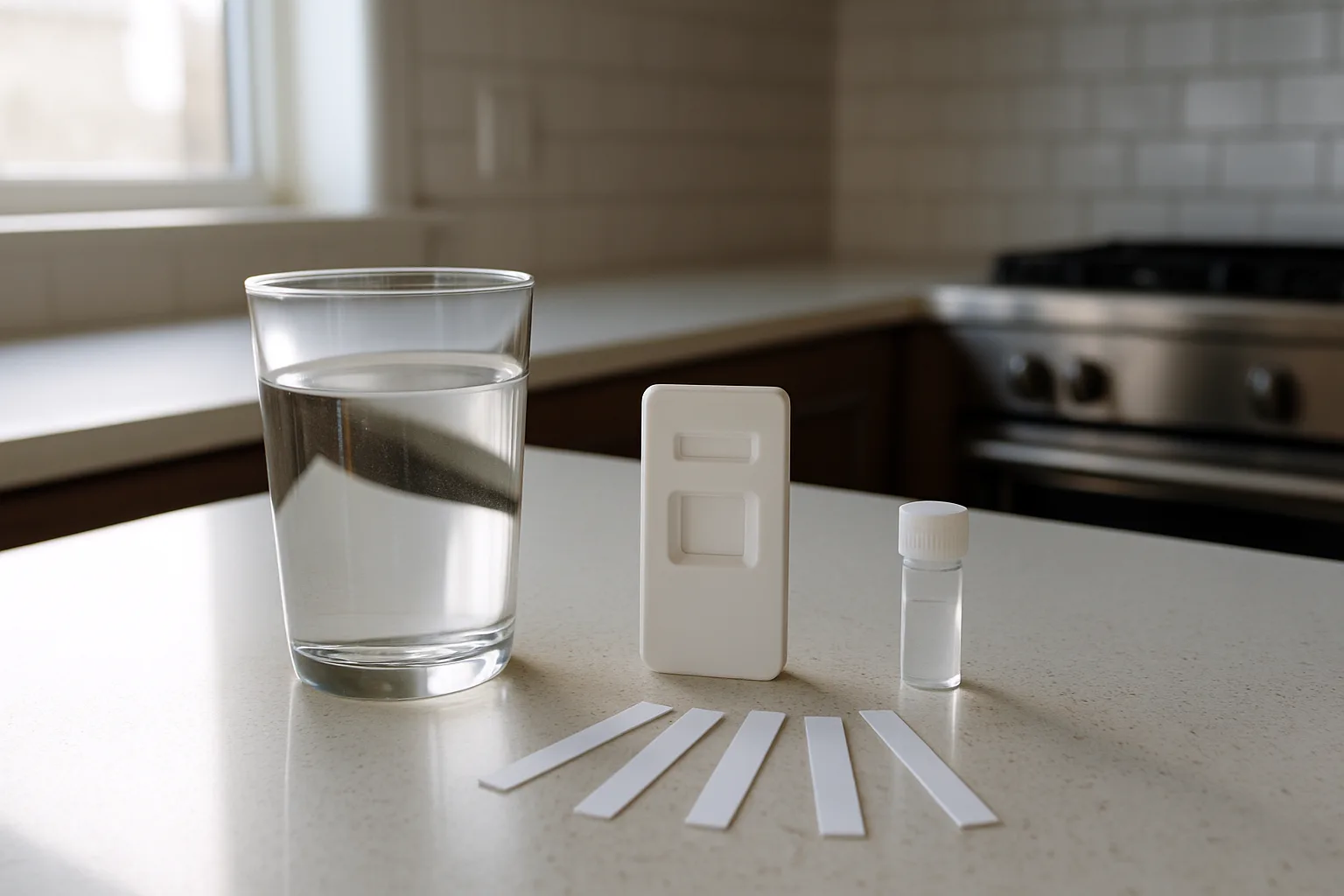
Homes on a public water system have an easy starting point. Community water suppliers must publish an annual Consumer Confidence Report, sometimes called a water quality report, listing the contaminants detected and how the levels compare with federal limits. The EPA's Consumer Confidence Report page explains what the report covers and how to find a local one. Look for disinfectant type (chlorine or chloramine), hardness, lead results, and any contaminant flagged as near or above its limit.
Private wells are different. Federal drinking water rules do not cover them, so testing is the owner's job. A certified lab test for bacteria, nitrates, iron, manganese, hardness, pH and any contaminant common in the area gives a far clearer picture than a home strip kit.
Reading hardness numbers
Hardness is reported either in milligrams per liter (mg/L, the same as parts per million) or in grains per gallon (gpg). One grain per gallon equals about 17.1 mg/L. The U.S. Geological Survey classifies water at 0 to 60 mg/L as soft, 61 to 120 as moderately hard, 121 to 180 as hard, and above 180 as very hard. Softener sizing uses grains per gallon, so convert first.
The four types of whole-house treatment
Sediment filters
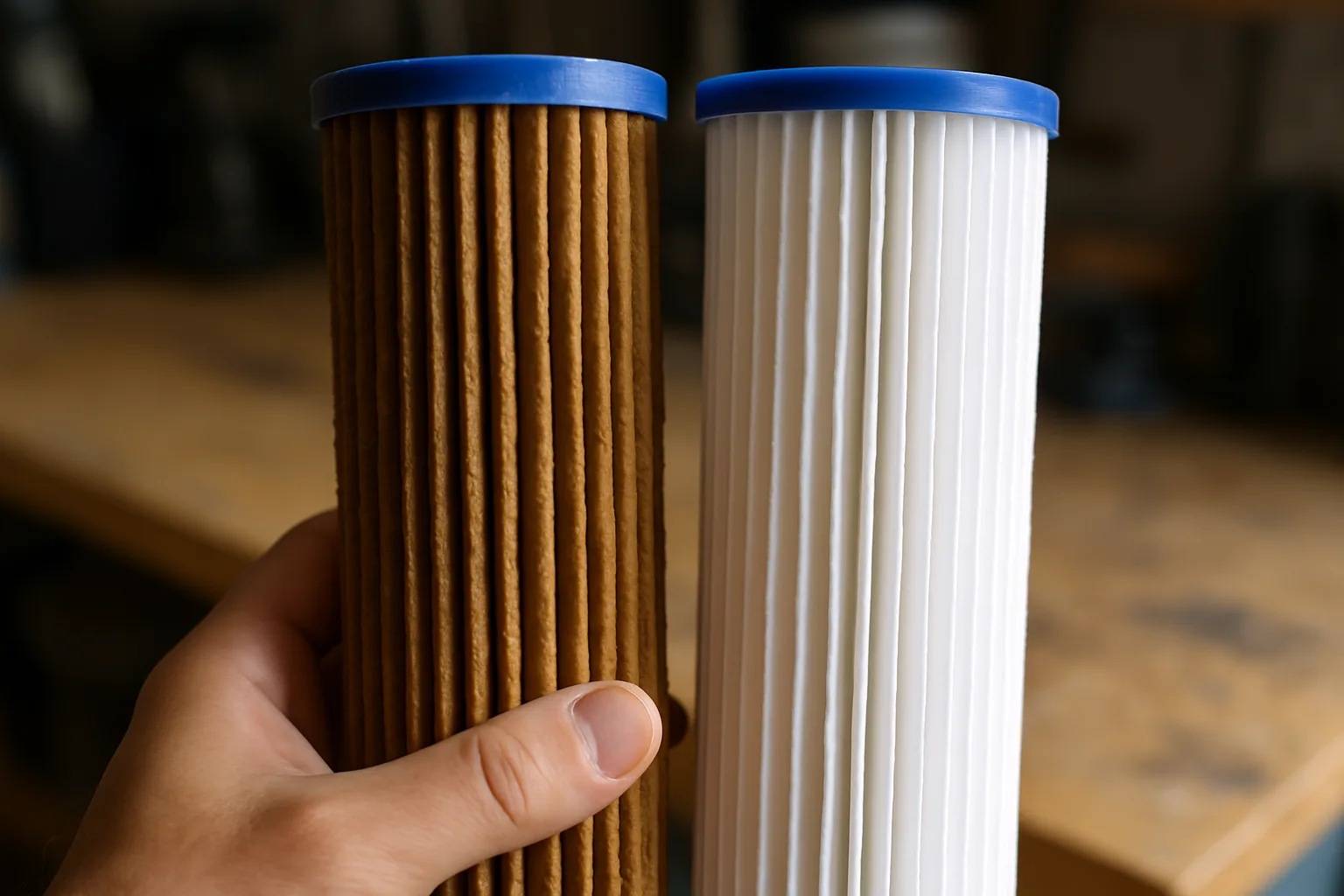
Sediment filters catch particles: sand, silt, pipe scale and rust. Spin-down units use a washable mesh screen with a flush valve at the bottom, so trapped grit can be purged in seconds without changing a cartridge. Pleated or spun cartridges catch finer particles, commonly rated around 5 microns, but they clog and need replacing. Many systems use both: a coarse spin-down screen first to protect the finer cartridges downstream.
Carbon filters
Activated carbon is the workhorse for chlorine taste and odor and many organic chemicals. Granular carbon and carbon block both work; carbon block has more contact surface and usually filters more finely. One catch matters on city water: many utilities now disinfect with chloramine instead of chlorine, and ordinary carbon removes chloramine slowly. Homes on chloramine should look for catalytic carbon specifically.
Water softeners
A salt-based softener uses ion exchange. Resin beads swap the calcium and magnesium that cause hardness for sodium (or potassium, if potassium chloride is used instead of salt). When the resin is full, the softener regenerates by rinsing it with brine from a separate tank and flushing the waste to a drain. A softener actually removes hardness, which is why it stops spotting on glass and scale in water heaters. It needs electricity, a drain, and regular salt refills, and it adds some sodium to the water.
Salt-free conditioners
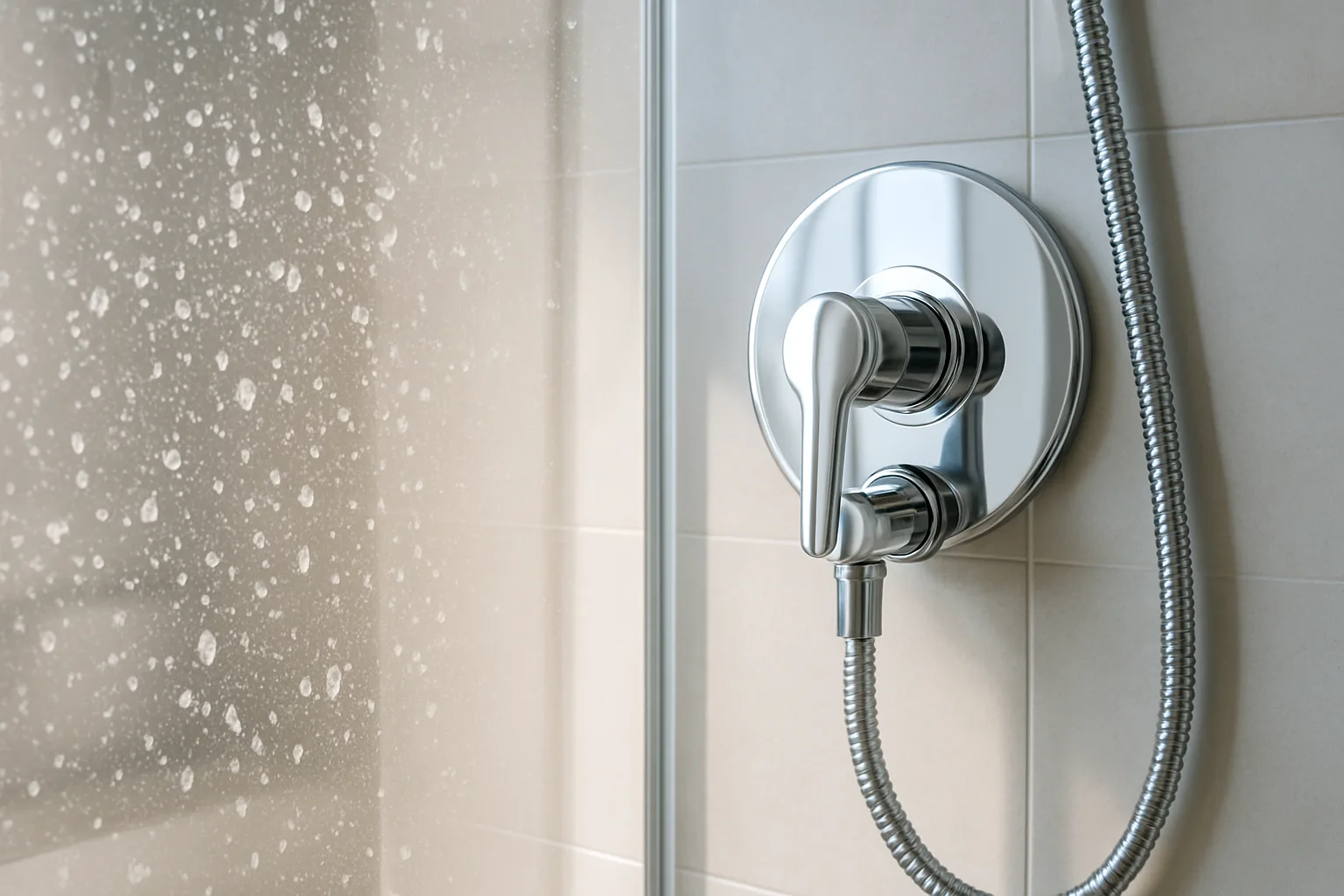
Salt-free conditioners, usually based on template-assisted crystallization (TAC), do not remove hardness minerals. They convert them into tiny crystals that are less likely to stick to pipes and heating elements. The result is less scale inside plumbing and appliances, but hard-water spots on glass and fixtures can still appear because the minerals are still in the water. There is no salt, no drain and no electricity. Most TAC systems publish a hardness ceiling; the OneFlow Plus, for example, is rated for scale control up to 30 grains per gallon.
Sizing a system by flow rate
Flow rate, in gallons per minute (GPM), is the number that decides whether water pressure holds up. A filter rated well above the home's peak demand barely affects pressure; one rated below it becomes a bottleneck.
To estimate peak demand, add up the fixtures likely to run at once. A federally compliant showerhead uses up to 2.5 GPM, and WaterSense-labeled models use 2.0 GPM or less. A kitchen faucet, a washing machine filling and a dishwasher can each add another 1.5 to 2.5 GPM. A common rule of thumb from installers:
- 1 to 2 bathrooms: a system rated around 10 GPM is usually enough.
- 3 to 4 bathrooms: look for 15 GPM, which is where most 20-inch, 1-inch-port systems sit.
- 5 or more bathrooms, or irrigation on the same line: consider 20 GPM or larger housings, or treat only the indoor branch.
Port size matters too. A 1-inch system on a 1-inch main keeps flow up; adapting a 1-inch line down to 3/4-inch fittings creates a small restriction.
Sizing a softener by grains
Softener capacity is listed in grains. Multiply the water's hardness in grains per gallon by the household's daily use. The EPA's WaterSense program puts average use at home at about 82 gallons per person per day, so a family of four uses roughly 330 gallons. At 15 gpg, that is about 4,900 grains a day. A 48,000-grain softener regenerating about once a week covers that comfortably, while leaving room for guests. Dissolved iron adds to the load, so installers typically size up when a test shows iron alongside hardness.
Whole-house systems compared
| System | Shop | Type | Treats | Ports | Listed flow | Maintenance |
|---|---|---|---|---|---|---|
| Waterdrop WHF3T-PG |  Buy on Amazon Buy on Amazon
| 3-stage cartridge | Sediment, chlorine taste and odor | 1 in. | About 15 GPM (check listing) | Replace cartridges on schedule |
| iSpring WGB32B-KS |  Buy on Amazon Buy on Amazon
| 3-stage cartridge | Sediment, chlorine, heavy metals, hydrogen sulfide | 1 in. NPT | Up to 15 GPM | Up to 12 months or 150,000 gallons |
| iSpring WSP-50 |  Buy on Amazon Buy on Amazon
| Spin-down prefilter | Sand, grit, rust flakes (50 micron) | 1 in. MNPT / 3/4 in. FNPT | Whole-house prefilter | Flush as needed; screen lasts 1 to 2 years |
| DuraWater Fleck 5600SXT | 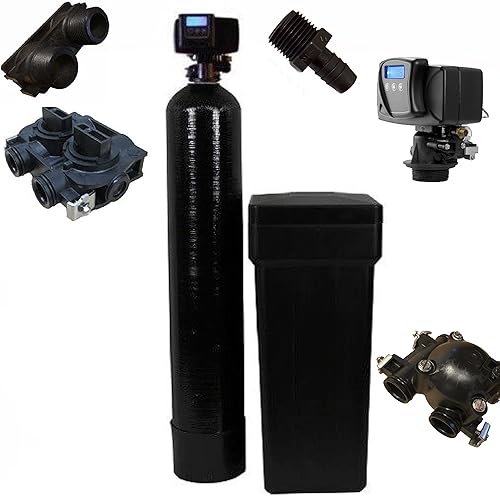 Buy on Amazon Buy on Amazon
| Ion-exchange softener | Hardness (calcium, magnesium), some iron | 1 in. bypass | About 12 to 14 GPM (varies by source) | Salt refills; regenerates on demand |
| Watts OneFlow Plus |  Buy on Amazon Buy on Amazon
| Salt-free TAC + carbon block | Scale formation, chlorine taste | 1 in. NPT | See listing | Carbon yearly; TAC cartridge about every 3 years |
Picks in more detail
Best for city water: Waterdrop WHF3T-PG
This three-housing system runs a sediment cartridge followed by carbon stages aimed at chlorine taste and odor. The 20-inch by 4.5-inch housings and 1-inch ports put it in the 15 GPM class that suits most three- and four-bathroom homes. It does not soften water or reduce total dissolved solids, which Waterdrop states directly, so it belongs in homes whose main complaint is taste and smell.
Best for metals and odor: iSpring WGB32B-KS
The iSpring keeps the familiar three-stage layout but swaps in a GAC-plus-KDF cartridge as the middle stage. KDF media targets dissolved metals such as lead and mercury and helps with hydrogen sulfide, the source of a rotten-egg smell common in some wells. iSpring lists up to 15 GPM through 1-inch NPT ports and up to 12 months or 150,000 gallons between changes. Note that iSpring sells several WGB32B variants with different media; buyers on chloramine should compare the catalytic-carbon version before ordering.
Best first stage: iSpring WSP-50
A spin-down filter is inexpensive insurance for everything downstream. The WSP-50 uses a stainless mesh screen in a clear housing, so it is obvious when it needs flushing, and a lead-free brass head. iSpring rates it for 15 to 115 psi and indoor use only. Very silty wells can clog a 50-micron screen quickly, so those homes sometimes add a coarser screen ahead of it.
Best softener: DuraWater Fleck 5600SXT, 48,000 grains
The Fleck 5600SXT control valve has been a standard in residential softeners for years, and its metered mode regenerates based on actual gallons used rather than a fixed calendar, which saves salt and water. This version ships with resin preloaded in a 1.5-cubic-foot tank, a brine tank and a bypass valve. It needs a nearby outlet and a drain for the regeneration rinse. Put it after the sediment and carbon filters, since chlorine wears down softener resin over time.
Best salt-free option: Watts Premier OneFlow Plus
For homes that cannot run a drain line, want no added sodium, or face local restrictions on softener discharge, the OneFlow Plus combines a carbon block with a TAC scale-control cartridge. Watts rates scale control up to 30 grains per gallon and says it does not control silica scale. The carbon block is replaced about every 12 months or 50,000 gallons, and the TAC cartridge every 3 years or 250,000 gallons. Expect less scale in the water heater, not spot-free glass.
Installation order and practical details
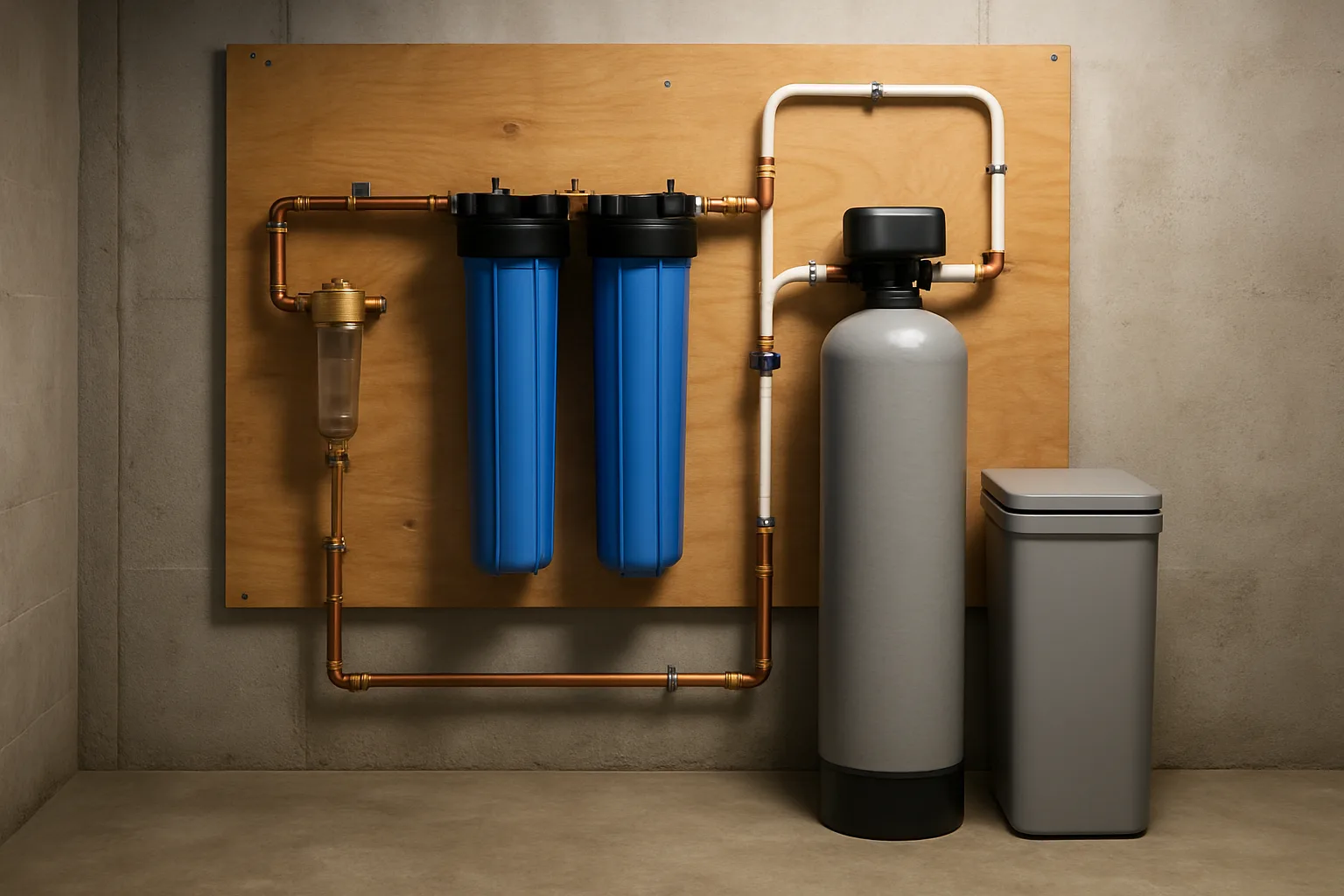
When stages are combined, the usual order from the main shutoff is: spin-down sediment filter, then cartridge sediment and carbon filters, then the softener or conditioner. Each piece should have its own bypass so it can be serviced without shutting off water to the house. A few more points save trouble later:
- Place it after the pressure regulator and before the water heater. Outdoor spigots for irrigation are often left on untreated water to save cartridges and salt.
- Leave room to change cartridges. Twenty-inch housings need clearance below them to drop the bowl.
- Check thread types. Some equipment uses NPS or NPSM threads rather than NPT, and needs matching adapters.
- Bond the plumbing if needed. In homes that use metal water pipe as part of the electrical ground, a plastic filter housing can break that path. A jumper cable across the system restores it; an electrician can confirm.
- Look for certifications that match claims. NSF/ANSI 42 covers aesthetic effects such as chlorine taste, NSF/ANSI 53 covers health-related contaminants such as lead, and NSF/ANSI 44 covers softeners. NSF/ANSI 372 only certifies that materials are low-lead; it says nothing about filtering performance.
Most of these systems are within reach of a confident DIYer with soldering or PEX tools, but a licensed plumber is the safer call where local code requires a permit or where the main line is hard to access.
What it adds to a home
A whole-house system protects fixtures and water-using appliances, and a documented, well-maintained system can be a selling point. Buyers increasingly ask about water treatment, a trend covered in this look at buyer demand for treated water systems. Scale is also one of the main enemies of tank water heaters; this guide to how heat and minerals affect pipes and water heaters covers the maintenance side. Keep a simple log of cartridge changes and salt refills, because the next owner, or the home inspector, will ask.
iSpring WGB32B-KS Whole House Water Filter SystemCheck today’s price on AmazonBuy on Amazon →
Posted by Kristopher Larson
Frequently asked questions
Do I need a water softener or a whole-house filter?
They solve different problems. A filter removes particles, chlorine taste and odor, and some contaminants, while a softener removes the calcium and magnesium that cause hardness and scale. Many homes with hard city water use both, with the filter installed first so chlorine does not wear down the softener resin.
What size whole-house water filter does a home need?
Size it by peak flow, not square footage. Homes with one or two bathrooms usually do fine with about 10 GPM, three or four bathrooms with about 15 GPM, and larger homes may need 20 GPM or more. Matching the system's port size to the main line, usually 1 inch, also helps keep pressure up.
Will a whole-house water filter lower water pressure?
A correctly sized system causes only a small pressure drop. Pressure loss becomes noticeable when the system's flow rating is below the home's peak demand, when cartridges are clogged, or when the plumbing is reduced to smaller fittings at the filter. Replacing cartridges on schedule prevents most pressure complaints.
Do salt-free water conditioners actually work?
Template-assisted crystallization systems reduce scale buildup inside pipes and water heaters, but they do not remove hardness minerals. Water spots on glass and fixtures can still appear. Most have a published hardness limit, often around 30 grains per gallon, so a water test should come first.
How do I find out what is in my tap water?
Homes on a public water system can read the utility's annual Consumer Confidence Report, which lists detected contaminants, the disinfectant used and often hardness. Private well owners are responsible for their own testing and should use a certified lab for bacteria, nitrates, metals and hardness.
How often do whole-house filter cartridges need replacing?
Most sediment and carbon cartridges are rated for 6 to 12 months or a set number of gallons, often 100,000 to 150,000, whichever comes first. Sediment-heavy water shortens that. A spin-down screen is flushed as needed and usually replaced every year or two.
Keep reading
More from the blog
Whole-House Surge Protectors: Type 1 vs. Type 2, What They Can't Stop, and Square D vs. Siemens vs. Eaton

Propane vs. Electric Patio Heaters: Mushroom vs. Infrared vs. Tabletop, and How Much Heat a Patio Needs

Chain vs. Belt vs. Wall-Mount Garage Door Openers: Chamberlain vs. Genie, Plus Smart Retrofits