Best Electric Gooseneck Kettle: OXO vs Cosori vs Bodum
Variable temperature or boil-only? How gooseneck kettles differ on accuracy, heat-up time, pour rate, balance and hold, plus OXO, Cosori and Bodum picks.
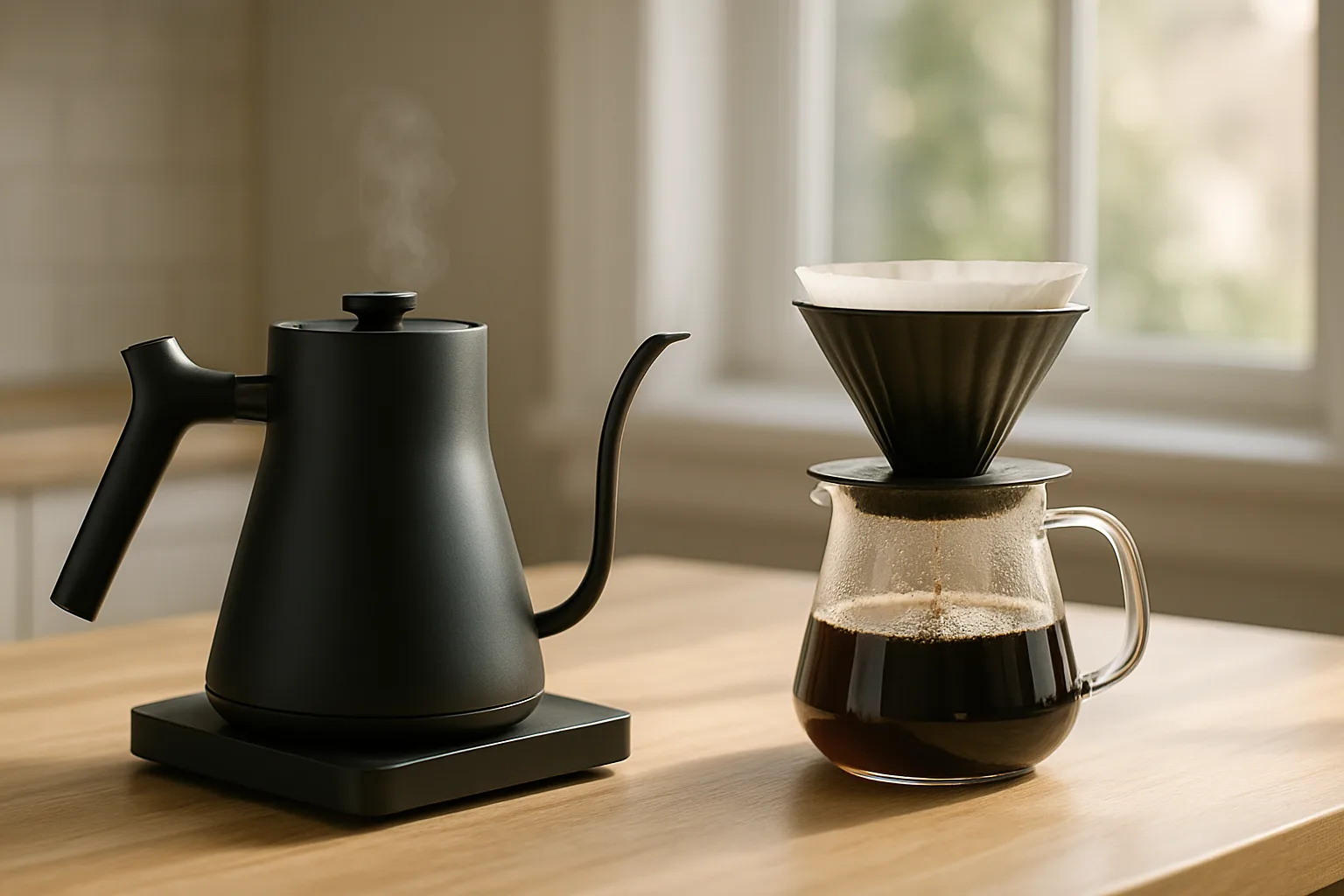
A gooseneck kettle does one job a regular kettle can't: it lets water out in a thin, steady stream, so pour-over coffee grounds get wetted evenly instead of flooded in one spot. The electric versions add a second question that matters just as much: should the kettle stop at a set temperature, or simply boil?
Coffee brews best below a full boil, in roughly the 195 to 205°F range, and many teas want cooler water still. This guide covers how variable-temperature and boil-only models differ, how much accuracy, heat-up speed, pour rate and balance really vary, and which three kettles are worth buying.
As an Amazon Associate, Best Utah Real Estate earns from qualifying purchases.
Quick verdict
- Best overall: the OXO Brew Adjustable Temperature Pour-Over Kettle. Any temperature from 104 to 212°F, a live readout of the water as it heats, an automatic 30-minute hold and a brew timer in the base. It heats faster than the Cosori and pours with good balance.
- Budget variable-temperature pick: the COSORI Gooseneck Electric Kettle (0.8 L). Five presets, a one-hour hold and a ready beep, for a lot less money. No readout, a little less capacity and a plainer build.
- Best boil-only: the Bodum Bistro Gooseneck Electric Kettle (27 oz), for anyone who wants the gooseneck pour without paying for temperature control.
The kettles side by side
| Kettle | Shop | Type | Capacity | Power | Temperature setting | Hold | Readout |
|---|---|---|---|---|---|---|---|
| OXO Brew Adjustable Temperature Pour-Over Kettle |  Buy on Amazon | Variable | 1 L | 1,500 W | 104–212°F in 1° steps, plus presets | Automatic, 30 min | Live water temperature, count-up timer |
| COSORI Gooseneck Electric Kettle (0.8 L) |  Buy on Amazon | Presets | 0.8 L | 1,200 W | 5 presets | Button, up to 1 hr | None; beeps when ready |
| Bodum Bistro Gooseneck Electric Kettle (27 oz) |  Buy on Amazon | Boil-only | 27 oz | Check the listing | None | None | None |
| Bonavita 1L Variable Temperature Gooseneck Kettle | Variable | 1 L | Check the listing | Presets, then fine-tune with +/- | Manual; resets when lifted | Set temperature; no beep | |
| Brewista Artisan Gooseneck Kettle | Variable | 1 L | Check the listing | Presets, fine-tune, rapid boil | Yes | Display plus pour timer |
Variable temperature vs boil-only
A boil-only gooseneck heats until the water boils and shuts off. That suits tea that wants boiling water and anyone happy to let coffee water cool for a moment on its own. A variable kettle stops where you tell it: anywhere in the coffee range, or around 180°F for green tea. It also saves the guessing that comes with "let it sit a bit."
Boil-only models also tend to be slower to come to a boil than the better variable kettles. The Bodum gets there, just a little later than the OXO.
Accuracy and overshoot
Accuracy varies more by unit than by price. Some kettles land within about a degree Celsius of the setting. Others finish a few degrees under it. For most brewers a couple of degrees won't change the cup; for anyone dialing in a light roast, it is worth checking a new kettle once with a good kitchen thermometer.
How a kettle approaches the target matters too. Some heat flat out and stop at the number, which can carry the water slightly past it: the Bonavita overshoots a little. Others, like the Brewista, slow down over the last few degrees and creep up to the setting so they don't overshoot. That costs a few seconds and buys a more exact finish.
A decimal on the display adds nothing; it is no more accurate than a whole-degree readout.
Heat-up time
Times swing with fill level and starting water, so treat any single number loosely. The pattern is consistent, though. Wattage drives speed: the OXO's 1,500 watts reached 205°F about a minute ahead of the 1,200-watt Cosori from a full fill. The Bonavita and Brewista are the slow ones, each needing five minutes or a little more for a near-full kettle. With a slow kettle, start the water first and grind the beans while it heats.
Pour control and flow rate
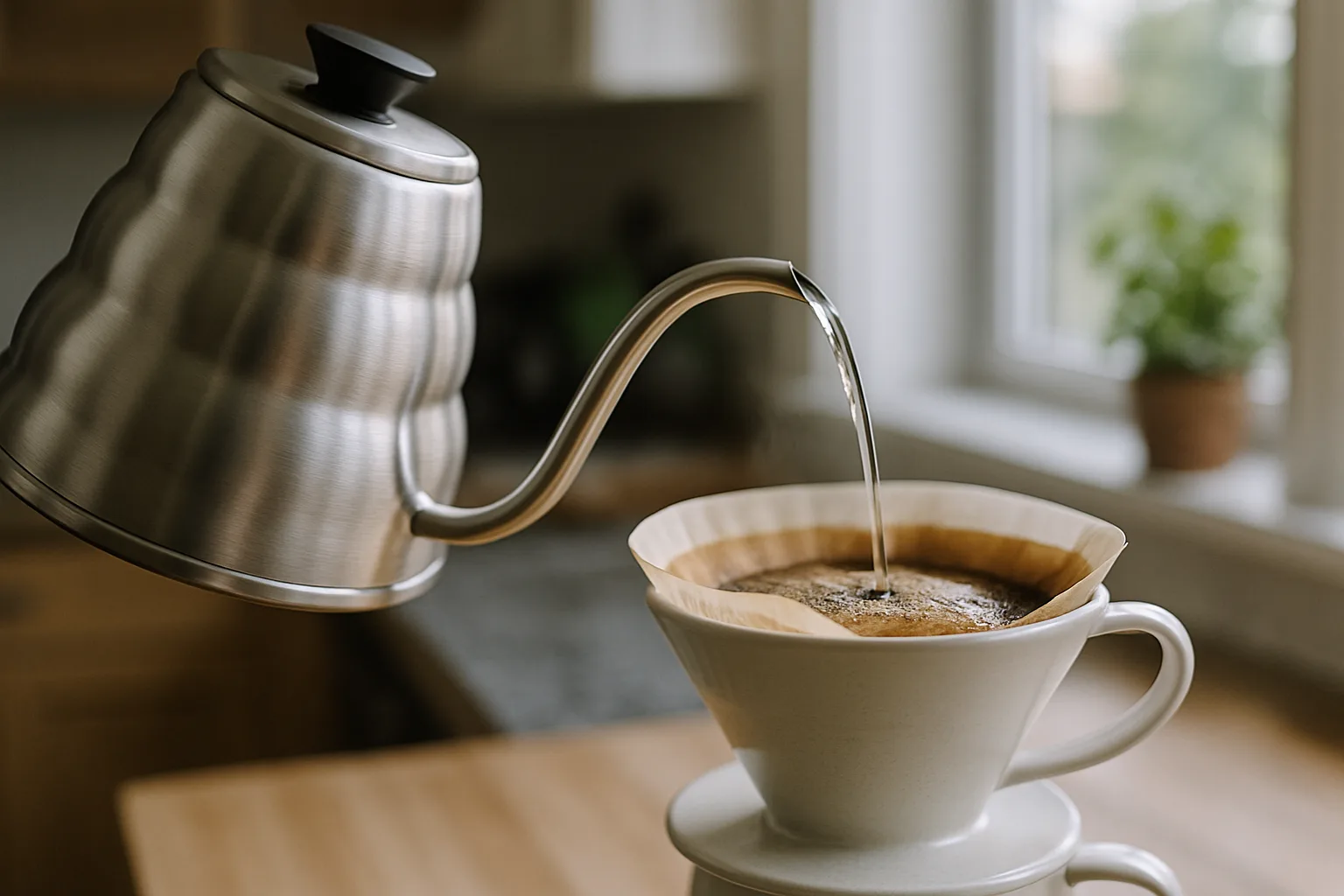
Every gooseneck pours slowly enough for pour-over, so the useful differences are at the extremes. A steady pour-over pour runs about 5 to 8 milliliters per second, and slower still during the bloom. At their slowest, these kettles all trickle out at roughly 2.5 to 3.5 grams per second, so none of them limits control at the low end.
Maximum flow is where they split. The Brewista pours fastest, close to 47 grams per second, and can empty a full liter in about 20 seconds. The Bonavita manages about 36. The Fellow Stagg EKG is the outlier: its top speed is around 17 grams per second, so it takes close to a minute to empty, which gets tedious for a mug of tea or water for cooking.
There is a trade-off. Kettles with a slower natural top speed are easier to hold at a steady trickle, which helps beginners. Fast pourers can still do slow pours with a steadier hand. Filling a little more water than the brew needs also makes the pour easier to control.
Balance, weight and handles
Weight and balance decide how tired a wrist gets over a three- or four-minute pour. Lighter kettles are easier to handle, and the best ones put enough weight toward the handle that the spout doesn't drag the kettle forward.
- OXO: well balanced, with a handle shape that sits naturally for a long, slow pour.
- Bonavita: the lightest of the group, at about 578 grams empty, and compact for a 1-liter kettle. It tips toward the spout more than most and almost wants to pour on its own when lifted.
- Brewista: about 713 grams empty, with a rounder, bulkier body and the biggest base of the group. It is easiest to control once some water is out.
- Fellow Stagg EKG and Saki Bariston: heavy, at roughly 840 and 858 grams, but both carry weight in the handle. The Saki has the best handle-to-spout balance and the slowest, steadiest trickle; its odd handle takes getting used to.
One small detail: fill markings opposite the handle are easier to read at the faucet than markings beside it.
Hold, beeps and what a readout buys
A hold setting keeps water at temperature, which helps when the beans are still being ground. The implementations differ more than the spec sheets suggest:
- The OXO holds automatically for 30 minutes after it reaches temperature.
- The Cosori holds for up to an hour, but only when its hold button is pressed. It beeps when the water is ready.
- The Bonavita has no beep and no automatic hold, and lifting the kettle off the base cancels the hold.
- Among kettles not sold here, the Fellow Stagg EKG has an auto-hold switch and reheats when it goes back on the base, the Saki holds for 60 minutes with no way to switch it off, and the Varia can hold for up to 12 hours.
Off the hold setting, gooseneck kettles lose heat at about the same rate, so the hold feature, not the body, is what keeps water ready.
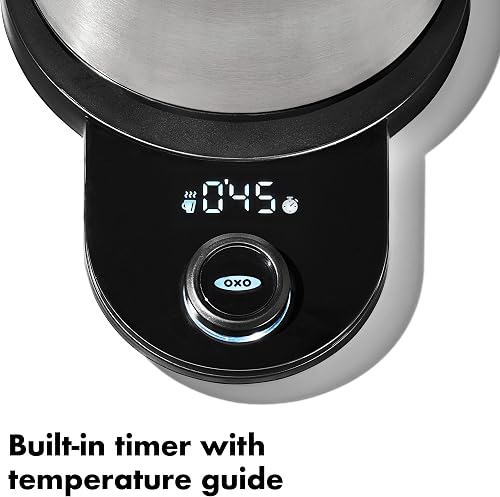
A live readout, like the OXO's, shows the current water temperature as it climbs. You can see it is nearly ready, or confirm it is still hot after sitting. A preset kettle like the Cosori just beeps when it hits its number.
The picks in detail
OXO Brew Adjustable Temperature Pour-Over Kettle
The OXO is the most complete kettle for pour-over. A dial sets any temperature from 104 to 212°F, and one-touch presets at 170, 180, 195, 205 and 212°F get you close fast. A probe inside reads the water, so the display shows the real temperature as it heats. Once it arrives, the kettle holds for 30 minutes on its own. Press and hold the button and a count-up timer starts for timing the pour.
At 1,500 watts it reaches brewing temperature about a minute ahead of the Cosori, it holds a full liter, and it pours with balance and control. The downside is a premium price over the Cosori for features some brewers won't use.
OXO Brew Adjustable Temperature Pour-Over KettleCheck today’s price on Amazon

 Buy on Amazon →
COSORI Gooseneck Electric Kettle (0.8 L)
The Cosori costs a lot less than the OXO and still covers the basics. Five presets handle tea and coffee, a hold button keeps water hot for up to an hour, and it beeps when the water is ready, which several pricier kettles don't.
The compromises: no thermometer readout, so you trust the preset. It holds 0.8 liter and is a step slower to heat at 1,200 watts. For someone who brews at the same temperature every day, none of that is a deal-breaker.
COSORI Gooseneck Electric Kettle (0.8 L)Check today’s price on Amazon

 Buy on Amazon →
Bodum Bistro Gooseneck Electric Kettle (27 oz)
The Bodum Bistro is the boil-only gooseneck to buy. It keeps the narrow, precise spout that makes pour-over work, for less than the OXO, and it simply boils and shuts off. It is a little slower to boil than the OXO, and at 27 ounces it is on the small side. With no way to set a temperature, the water for coffee comes straight off the boil or after a short wait.
Bodum Bistro Gooseneck Electric Kettle (27 oz)Check today’s price on Amazon

 Buy on Amazon →
Two more to consider
- Bonavita 1L Variable Temperature Gooseneck Kettle: well built and long lasting, with presets plus fine adjustment, a removable base cover, a cord wrap and the lightest body in the group. Expect slow heating, a slight overshoot, no beep, a hold that resets whenever the kettle is lifted, and a metal lid that scrapes.
- Brewista Artisan Gooseneck Kettle: a premium-looking kettle with presets, a rapid-boil button, a pour timer in the base and the fastest top pour of the group. It is underpowered for its size and slow to heat, the body is bulky and it lands on the base with a clunk. Brewista has sold several versions, so check which one the listing is.
The Fellow Stagg EKG is worth knowing about for its minimalist look, auto hold and slow, controlled pour, though it has no beep, no presets and the slowest top speed.
Who should buy which
- Pour-over every morning, different roasts and teas: the OXO, for any temperature, a live readout and the timer.
- The same coffee or tea temperature every day, on a budget: the Cosori.
- Just the gooseneck pour, no settings: the Bodum Bistro.
- A light kettle for a small kitchen: the Bonavita, if slow heating doesn't bother you.
- A kettle that doubles for fast, general-purpose pouring: the Brewista.
The kettle is half of a good pour-over. Grind size matters just as much, as the coffee grinder guide explains. For hands-off coffee, see the drip coffee maker comparison.
Posted by Kristopher Larson
Frequently asked questions
Is a variable temperature gooseneck kettle worth it?
For pour-over coffee and loose-leaf tea, usually yes. Coffee brews best around 195 to 205°F rather than at a full boil, and green teas want cooler water still. A variable kettle stops at the number you pick and can hold it, so there is no guessing how long to let boiling water cool. If you only make one kind of drink with boiling water, a boil-only gooseneck like the Bodum Bistro does the job for less.
OXO vs Cosori gooseneck kettle: which is better?
The OXO Brew is the more capable kettle. It sets any temperature from 104 to 212°F, shows the water's actual temperature as it heats, holds automatically for 30 minutes and has a built-in brew timer. At 1,500 watts it also heats faster than the 1,200-watt Cosori. The Cosori costs much less, beeps when ready and holds for up to an hour, but it has only five presets, no temperature readout and 0.8 liter of capacity.
What temperature should water be for pour-over coffee?
Roughly 195 to 205°F, just below boiling. The OXO kettle's base suggests 200°F for coffee. A variable-temperature kettle can stop there instead of boiling, and a boil-only kettle needs a short rest off the boil.
How fast should a gooseneck kettle pour for pour-over?
A steady pour-over pour runs about 5 to 8 milliliters per second, slower during the bloom. Every common gooseneck can trickle well below that. The bigger difference is top speed: some pour over 40 grams per second, while the Fellow Stagg EKG tops out near 17, which is slow for filling a mug. Kettles with a slower natural top speed are easier for beginners to hold steady.
Do electric gooseneck kettles keep water hot?
Most variable-temperature models have a hold setting. The OXO holds automatically for 30 minutes, the Cosori holds for up to an hour once its hold button is pressed, and the Bonavita's hold cancels whenever the kettle is lifted. With hold off, these kettles lose heat at about the same rate, so the setting matters more than the body.
Is a gooseneck kettle good for tea?
Yes, especially a variable-temperature one, since green, oolong and black teas each steep best at different temperatures. The gooseneck spout is not needed for tea, but a kettle with a fast top pour, like the Brewista, fills a teapot or mug quickly. Very slow-pouring models can feel tedious for anything other than pour-over.
Keep reading
More from the blog
Best Cutting Board for Knives: Teakhaus vs Epicurean vs Larch Wood
Best Toaster: Is a Smeg Worth It? Smeg vs KitchenAid vs Dash
Best Instant-Read Thermometer: Thermapen ONE vs. Typhur vs. Sizzle