Best Flashlight: Streamlight vs. Olight vs. Fenix vs. Coast
Measured lumens, brightness after 15 minutes, beam throw, heat and drop tests: which rechargeable flashlights deliver, and why million-lumen claims don't.
Flashlight marketing is wild. No-name lights on Amazon advertise 990,000 or even a million lumens, and established brands print 4,600 lumens on the box. Put them in a light-measuring sphere and the truth comes out: the "million lumen" lights made between about 600 and 2,600 lumens, and most bright lights drop to a fraction of their peak within a minute or two to manage heat. The number that matters is how much light a flashlight keeps putting out after the first few minutes, and how well it survives being dropped.
This guide covers what to look for and which rechargeable flashlights actually deliver, from a light that holds 1,500 lumens for its whole battery to a near-indestructible work light and a home emergency light that charges your phone.
Quick verdict
- Best overall: the Streamlight ProTac 2.0. Rated at 2,000 lumens, it measured about 2,600 and stayed near 1,500 lumens for nearly 3 hours, the brightest of any light after 15 minutes.
- Brightest: the Olight Seeker 4 Pro, which measured over 5,300 lumens and finished first overall in a 19-flashlight comparison.
- Best compact light: the Fenix E35R. About 5 ounces, over 3,500 lumens at first and still about 1,270 after 15 minutes.
- Toughest: the Coast XP11R, which survived drop after drop from 18 to 20 feet.
The flashlights side by side
| Flashlight | Shop | Rated lumens | Measured at start | Light after 15 min | Beam | Best for |
|---|---|---|---|---|---|---|
| Streamlight ProTac 2.0 |  View on Amazon | 2,000 | About 2,600 | About 1,500 | Bright center, even spill | Steady all-around light |
| Olight Seeker 4 Pro |  View on Amazon | 4,600 | About 5,500 | About 1,350 | Even hot spot, little spill | Maximum brightness |
| Acebeam Defender P17 |  View on Amazon | 4,900 | About 5,100 | About 1,290 | Very bright hot spot | Seeing far |
| Fenix E35R |  View on Amazon | 3,100 | About 3,500 | About 1,270 | Wide flood | Pocket carry |
| Nitecore P23i |  View on Amazon | 3,000 | About 2,800 to 3,300 | Drops to 700 to 800 on high | Tight, long-throw spot | Long distance |
| Coast XP11R |  View on Amazon | 2,600 (current version) | About 2,300 (earlier 2,100-lumen version) | Low, about 200 to 300 | Very wide | Durability, close work |
| Nebo Davinci 3500 |  View on Amazon | 3,500 | About 4,400 | About 930 | Wide | Home emergencies |
Best overall
Streamlight ProTac 2.0
Turns on at full power and stays there: about 1,400 to 1,500 lumens for close to 3 hours, the brightest of 19 lights after 15 minutes.
- 2,000 lm rated
- About 2,600 lm measured
- Programmable
Good for
- Steady all-around light
- Surviving drops (14 ft)
Skip it if
- Fast charging
- Huge burst brightness
What actually matters in a flashlight
Sustained brightness, not peak lumens
Almost every bright flashlight steps down. A light can hit 4,000 or 5,000 lumens for a burst, then drops to around 1,000 to protect its battery and keep from overheating. That's normal, and the bursts are useful for a quick look down a long driveway, but it means the box number tells you little about everyday use. One big-brand light rated at 4,600 lumens runs its turbo mode for only about two and a half minutes before dropping to 1,200 lumens, and then lower again if left on.
The best measure is light output after several minutes. After 15 minutes on their brightest setting, the Streamlight ProTac 2.0 led a 19-light comparison at about 1,500 lumens, followed by the Olight Seeker 4 Pro, the Acebeam Defender P17 and the Fenix E35R, all around 1,300. Many no-name lights were down to 100 to 400 lumens by then.
Ignore "million lumen" claims
The no-name lights claiming 990,000 lumens or more measured between roughly 600 and 2,500 lumens, and most faded fast. A few of them are still decent lights, but the numbers on the box are fiction. Real lumen ratings from established brands like Streamlight, Olight, Fenix, Acebeam and Nebo mostly matched or beat the measurements. Throw-distance claims are inflated too: they assume the target only needs a quarter of a lux of light, about full-moon brightness. At a more realistic 10 lux, the best no-name lights reached about 100 meters.
Flood or throw
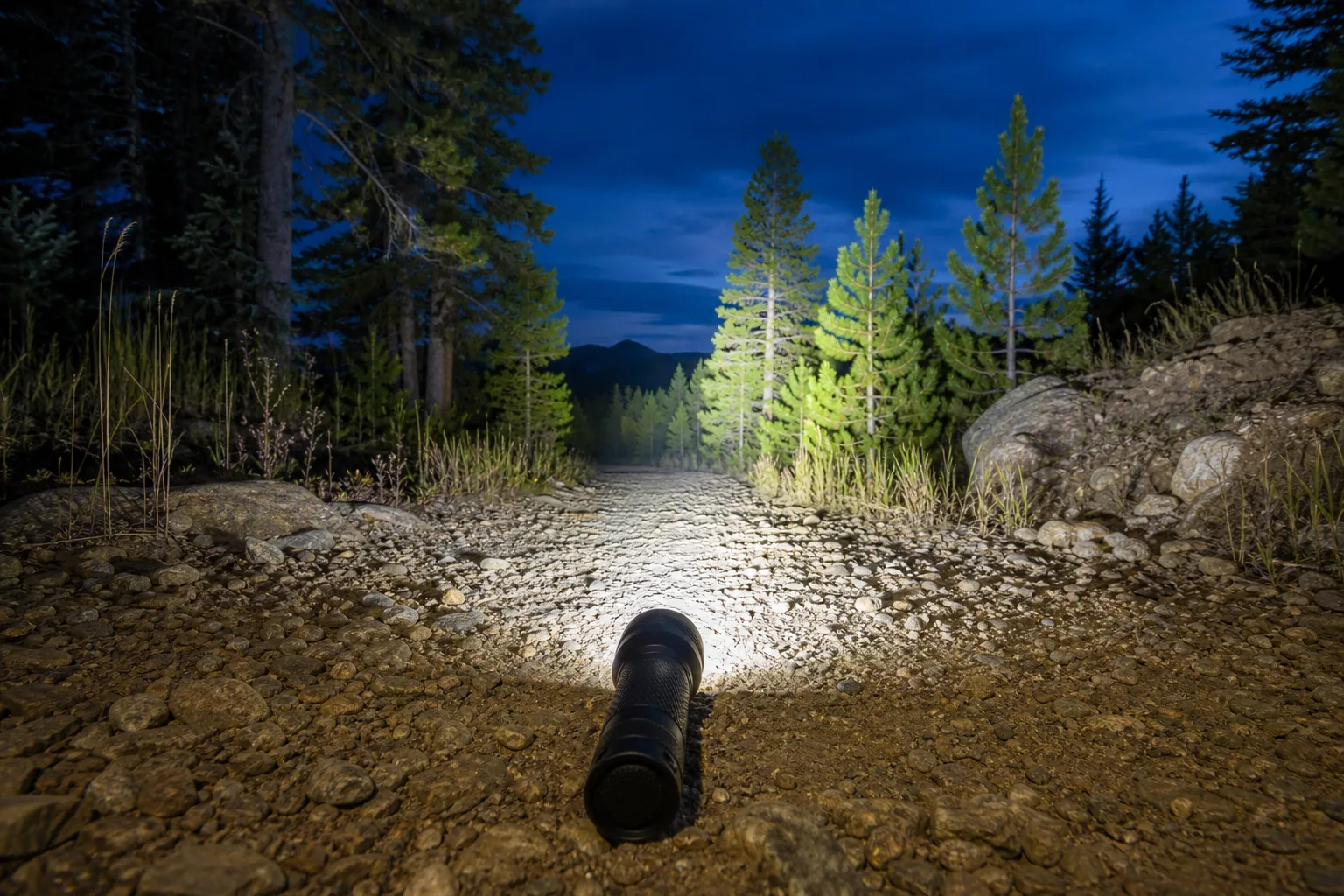
Lumens measure total light; candela measures how intense the brightest spot is, which decides how far the beam reaches. A "thrower" like the Nitecore P23i concentrates its light into a tight, intense spot that reaches far down a trail or across a field, about 46,000 candela. A "flood" light like the Coast XP11R spreads light wide, which is better for working under a hood, in a crawlspace or around a campsite, but doesn't reach as far. The Streamlight sits in between: a bright center with enough spill that you aren't blinded by the bounce-back when you use it up close.
Heat
All that light makes heat. After 15 minutes on high, surface temperatures ranged from about 107°F to 160°F. The Fenix E35R was the hottest, at about 160°F, which is the trade-off for putting that much light in such a small body. Larger lights spread the heat better.
Batteries and charging
Most of these lights use a large rechargeable 21700 or 18650 lithium cell and charge over USB-C. Measured capacities from the name brands came close to their ratings: the Olight's battery delivered about 4,820 of its rated 5,000 mAh, the Streamlight's about 4,480 of 4,900. Some no-name lights rated at 6,000 mAh delivered less than 3,800. Watch for proprietary batteries: the Nitecore P23i uses its own cell, so an ordinary 21700 spare won't fit. Charging speed varies too, and the Streamlight charges slowly, so keep it topped up.
Durability
Every light in the 19-light comparison survived 2-meter drops; a couple shut off on impact but turned right back on. Dropped from increasing heights onto concrete, though, the differences were large. The Coast XP11R survived drops from 18 and 20 feet and still worked after being spiked onto the ground, with only its front glass caving in. The Streamlight held up through a 14-foot drop. The Nitecore P23i failed at 10 feet.
The picks in detail
Streamlight ProTac 2.0: best overall
The ProTac 2.0 does something few bright flashlights do: it just turns on at full power and stays there. Rated at 2,000 lumens, it measured about 2,600 at the start and held around 1,400 to 1,500 lumens for close to 3 hours, beating its advertised run time. That made it the brightest of 19 lights after 15 minutes, ahead of lights rated more than twice as bright. Its beam has a bright center for distance with enough spill for close work, and there's no turbo mode to fall out of; a half press gives lower modes, and it can be programmed. It also survived a 14-foot drop.
The trade-offs: it charges slowly, and it doesn't have the huge burst brightness of the Olight or Acebeam.
Best overall
Streamlight ProTac 2.0
Turns on at full power and stays there: about 1,400 to 1,500 lumens for close to 3 hours, the brightest of 19 lights after 15 minutes.
- 2,000 lm rated
- About 2,600 lm measured
- Programmable
Good for
- Steady all-around light
- Surviving drops (14 ft)
Skip it if
- Fast charging
- Huge burst brightness
Olight Seeker 4 Pro: brightest
The Seeker 4 Pro finished first overall in the 19-light comparison. Rated at 4,600 lumens, it measured about 5,500 at the start and 5,377 after 30 seconds, the most of any light, and it was still near 1,350 lumens after 15 minutes. Its battery came close to its rated capacity, it delivered the most power under load of any light, and it's waterproof to IPX8 and comes with a holster. Its beam is a wide, even hot spot with little spill.
The trade-offs: its top brightness is a short burst before it steps down, and like other very bright lights its run time on the highest setting is shorter than lower-output lights.
Brightest
Olight Seeker 4 Pro
First overall in the 19-light comparison, with the most light of any at the start and still near 1,350 lumens after 15 minutes.
- 4,600 lm rated
- About 5,500 lm measured
- Holster included
Good for
- Maximum brightness
- Wet weather (IPX8)
Skip it if
- Long runs on the top setting
Acebeam Defender P17: best for seeing far
The Defender P17 finished second overall. It beat its 4,900-lumen rating at about 5,100 lumens, held over 5,000 after 30 seconds and about 1,290 after 15 minutes. Its beam has a very intense hot spot, so it lights up distant objects well, with much less light in the spill around it. It's a strong choice for a large property, hunting or patrol. Like the Olight, it gives up run time for brightness.
Best for seeing far
Acebeam Defender P17
Second overall, beating its 4,900-lumen rating, with a very intense hot spot that lights up distant objects.
- 4,900 lm rated
- About 5,100 lm measured
- Intense hot spot
Good for
- Large properties, hunting or patrol
Skip it if
- Close-up work (little spill)
- Long runs on high
Fenix E35R: best compact light
The E35R is small enough for a pocket at under 5 inches long and about 5 ounces, yet it measured about 3,500 lumens at the start against a 3,100 rating and kept about 1,270 after 15 minutes, matching lights twice its size. Its flood beam is wide and powerful, it charges over USB-C, and a magnetic tail cap holds it on a steel surface for hands-free work. It tied for third overall. The catch is heat: it reached about 160°F on high, the hottest of the group, so it isn't comfortable to hold on its brightest setting for long.
Best compact light
Fenix E35R
Pocket-size at about 5 ounces yet over 3,500 lumens at the start and about 1,270 after 15 minutes, matching lights twice its size.
- Under 5 in
- USB-C
- Magnetic tail cap
Good for
- Everyday carry
- Hands-free work (magnetic tail cap)
Skip it if
- Holding it on high for long (about 160°F)
Nitecore P23i: best long-distance thrower
If you need to see something far away, the P23i's tight beam measured about 46,000 candela, by far the most focused beam of its group. It made about 3,300 lumens at the start and about 2,800 after 30 seconds as it heated up, and on its 1,500-lumen high setting it settled at 700 to 800. A second switch gives instant access to turbo or strobe. The downsides: it gets hot, its proprietary battery can't be swapped for a standard cell, its ceramic striking bezel leaves dark notches in the beam, and it failed in the drop test at 10 feet.
Best long-distance thrower
Nitecore P23i
A tight beam of about 46,000 candela, by far the most focused of its group, with a second switch for instant turbo or strobe.
- About 46,000 cd
- Turbo/strobe switch
- Proprietary battery
Good for
- Seeing something far away
Skip it if
- Rough handling (it failed a 10 ft drop)
- Standard swappable cells
Coast XP11R: toughest
The XP11R is the light to toss in a truck or toolbox. In drop testing it kept working after drops from 18 and 20 feet onto concrete and after being thrown at the ground, with only its front glass giving way. It casts a very wide, even beam that's great for engine bays and close work, and it charges over USB-C. The earlier version, rated at 2,100 lumens, measured about 2,300; Coast now rates the current version at 2,600. On high it drops to a few hundred lumens within minutes, but that lower output lasts a long time: about 7 hours, against its 5-hour rating. Its battery threads were rough out of the box.
Toughest
Coast XP11R
Kept working after drops from 18 and 20 feet onto concrete, with a very wide, even beam for engine bays and close work.
- Wide flood beam
- USB-C
- 2,600 lm (current rating)
Good for
- Trucks and toolboxes
- Long runs at lower output (about 7 hours)
Skip it if
- Sustained high output
Nebo Davinci 3500: best for home emergencies
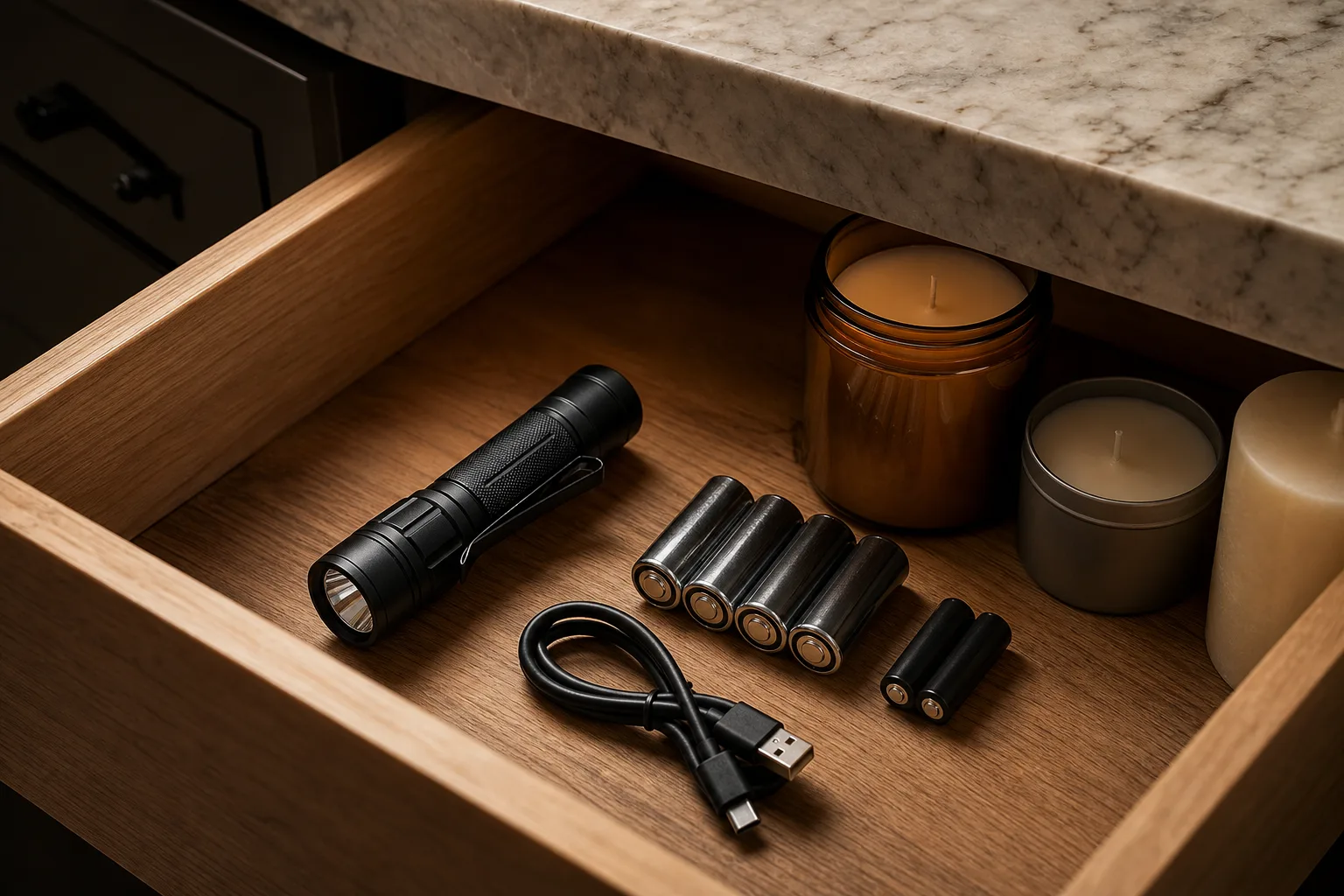
The Davinci measured about 4,400 lumens at the start, well over its 3,500 rating, still 4,000 after 30 seconds and about 930 after 15 minutes. Its wide beam lights a whole yard, and it doubles as a power bank to charge a phone during an outage. It's bigger and heavier than the pocket lights, so it's best kept in a drawer, car or emergency kit rather than carried.
Best for home emergencies
Nebo Davinci 3500
Well over its 3,500-lumen rating at the start, with a wide beam that lights a whole yard, and it charges a phone during an outage.
- About 4,400 lm measured
- Power bank
- Wide beam
Good for
- Emergency kits, drawers and cars
- Charging a phone
Skip it if
- Carrying in a pocket
Tips for a flashlight that works when you need it
- Keep one charged where you can find it. A rechargeable light with a dead battery is worse than a basic one with fresh batteries. Top it up every few months.
- Use the medium setting most of the time. It's plenty for walking the dog or checking the breaker box, and it runs far longer and cooler.
- Lock it out in a bag. Many lights have a lockout mode or a tail cap you can loosen a quarter turn so it can't switch on in a pocket or backpack and drain or heat up.
- Don't point a bright light at faces. Thousands of lumens can dazzle someone for several seconds.
- Store lithium-ion lights partly charged and away from heat, and don't leave them in a hot car all summer.
Brightest
Olight Seeker 4 Pro
First overall in the 19-light comparison, with the most light of any at the start and still near 1,350 lumens after 15 minutes.
- 4,600 lm rated
- About 5,500 lm measured
- Holster included
Good for
- Maximum brightness
- Wet weather (IPX8)
Skip it if
- Long runs on the top setting
How to choose
- One great all-around light? The Streamlight ProTac 2.0.
- The brightest light you can buy here? The Olight Seeker 4 Pro.
- Need to see across a field or down a long road? The Acebeam Defender P17 or Nitecore P23i.
- Something small for a pocket? The Fenix E35R.
- Work light that will be dropped? The Coast XP11R.
- For a power-outage kit? The Nebo Davinci 3500.
Building a home emergency kit? See the inverter generator guide for backup power and the jump starter comparison for the car. For lighting the garage itself, the LED garage light guide covers overhead options.
Posted by Kristopher Larson
Frequently asked questions
How many lumens do you need in a flashlight?
For around the house, walking the dog or checking a breaker box, 300 to 500 lumens is plenty. For a large yard, trails or working outside at night, a light that can sustain 1,000 to 1,500 lumens is a big step up. Bursts of 3,000 lumens or more are useful for a quick look far away, but most lights can only hold them for a minute or two.
Are million-lumen flashlights real?
No. No-name flashlights advertised at 990,000 to a million lumens measured between roughly 600 and 2,600 lumens, and most faded quickly. Some are still decent lights, but the ratings are fiction. Established brands like Streamlight, Olight, Fenix, Acebeam and Nebo generally met or beat their ratings.
Why does my flashlight get dimmer after a few minutes?
Bright flashlights step down on purpose to manage heat and battery drain. A light rated at 4,000 lumens or more typically holds that for a short burst and then drops to around 1,000 to 1,500 lumens. The Streamlight ProTac 2.0 stood out because it held around 1,500 lumens for nearly its whole battery.
What is the difference between lumens and candela?
Lumens measure the total light a flashlight puts out. Candela measures the intensity of the brightest spot, which decides how far the beam reaches. A focused "thrower" like the Nitecore P23i has very high candela and reaches far, while a "flood" light like the Coast XP11R spreads its lumens wide for close work.
What is the most durable flashlight?
The Coast XP11R kept working after drops from 18 and 20 feet onto concrete and after being thrown at the ground, with only its front glass caving in. Every light in a 19-flashlight comparison survived 2-meter drops, but at greater heights the Coast and the Streamlight ProTac 2.0 held up far better than most.
Is a rechargeable flashlight good for emergencies?
Yes, as long as it's charged. Top it up every few months and store it partly charged, away from heat. A light that doubles as a power bank, like the Nebo Davinci 3500, can also charge a phone during an outage. Keeping a small backup light with standard batteries in the kit is a good idea too.
Keep reading
More from the blog
Oral-B vs. Sonicare: Which Electric Toothbrush to Buy
Which Keurig Should You Buy? K-Mini vs. K-Express vs. K-Supreme
Best Rechargeable Hand Warmers: DeeKom, Ocoopa, Unihand