Best Jump Starter: NOCO vs. Wolfbox vs. Avapow vs. Gooloo
Cranking power, dead batteries, diesels and cold weather: how NOCO, Wolfbox, Avapow and Gooloo jump starters compare, and why amp ratings mislead.
A portable jump starter turns a dead battery from a wait for a tow or a stranger with cables into a two-minute fix. The box ratings are mostly fiction, though. A pack rated at 1,000 amps may never deliver even 400. A 4,250-amp NOCO out-cranks packs rated at 6,000 and 8,000 amps. Many packs won't even switch on when the car battery is fully drained.
This guide covers what actually separates a strong jump starter from a weak one: real cranking power, whether it wakes up on a truly dead battery, how it handles a diesel, and how much it loses in the cold. Then it covers which pack fits which vehicle.
Quick verdict
- Most powerful, best for diesels and big V8s: the NOCO Boost X GBX155 4250A Jump Starter. It delivered by far the most current on a load tester and started a diesel truck with two dead batteries as if they were fully charged.
- Best for truly dead batteries: the Gooloo GP4000 Jump Starter. Strong output, an easy diesel start, and it switched on with a battery at almost zero volts, which several other packs refused to do.
- Best for cold climates: the Wolfbox 4000A Jump Starter. It lost the least power of the lithium packs after a night in a freezer, charges fast over USB-C, and comes with a 65-watt charger.
- Runner-up for diesels: the Avapow 6000A Jump Starter (A68). It started a diesel truck three times in a row without overheating and finished second only to the big NOCO.
- Best mid-size NOCO: the NOCO Boost X GBX55 1750A Jump Starter. A large step up from NOCO's smaller packs, with cables wired straight into the case and fast USB-C charging.
The jump starters side by side
| Jump starter | Shop | Rating and weight | Real cranking power | Fully dead battery | In the cold | Best for |
|---|---|---|---|---|---|---|
| NOCO Boost X GBX155 4250A Jump Starter |  View on Amazon | 4,250 A, 5.6 lb | The strongest by a wide margin: about 7,200 to 10,800 W on a load tester | Boost mode needed; wouldn't switch on at zero volts in one test | Not cold-tested | Diesels, big V8s, anyone who wants the most power |
| NOCO Boost X GBX55 1750A Jump Starter |  View on Amazon | 1,750 A | Highest peak output of its mid-size group; cranked a four-cylinder load for a full minute | Not tested | Lost about half its output | Cars, SUVs and gas V8s |
| Wolfbox 4000A Jump Starter |  View on Amazon | 4,000 A, 1.9 lb | About 5,700 W, with steady cranking speed in boost mode | Use the boost button | Lost about a third of its output, the least of the lithium packs | Cold climates, gas engines |
| Avapow 6000A Jump Starter (A68) |  View on Amazon | 6,000 A | About 5,950 W; three diesel starts in a row without overheating | Wouldn't switch on at zero volts | Not cold-tested | Diesels, runner-up |
| Gooloo GP4000 Jump Starter | 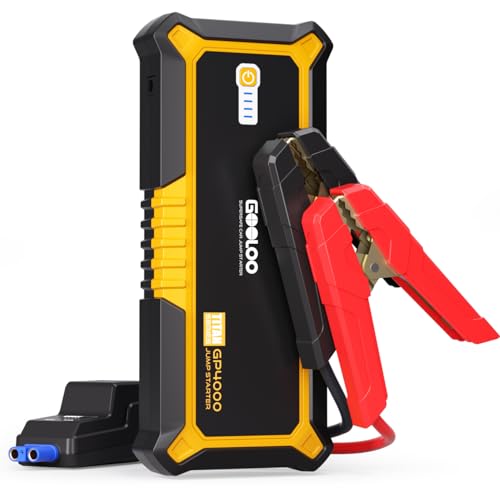 View on Amazon | 4,000 A | About 5,600 W; started a diesel easily | Switched on at almost zero volts | Not cold-tested | Strong all-around power |
| NOCO Boost Plus GB40 1000A Jump Starter |  View on Amazon | 1,000 A | Never delivered more than about 366 A | Has a manual override | Lost about two-thirds of its output | Small four-cylinder cars in mild weather |
Wattage figures come from bench tests with a carbon pile load tester, measuring amps and volts together. Treat them as a comparison between models, not as a guarantee for every unit.
Most powerful
NOCO Boost X GBX155 4250A Jump Starter
Turned every engine over faster than any other lithium pack, from a V6 on a dead battery to a diesel truck with two dead batteries, and still performed like new at two years old.
- 4,250 A rated
- About 78 Wh
- About 182 lumens
Good for
- Diesel trucks and big V8s
- The brightest light and most power-bank energy
Skip it if
- You want a tire inflator
- A light pack (about 5.6 lb)
What makes a jump starter good
Ignore the peak amp rating
Peak amp ratings on lithium jump starters have stopped meaning much. Measured on a dyno that sampled current hundreds of times a second, a pack rated at 1,000 amps never went above about 366 amps. Packs rated at 1,600, 1,750, 2,000 and 4,000 amps all landed between about 535 and 655 amps when asked for 700. An 8,000-amp pack delivered less power than several rated at half that. Even a healthy car battery isn't putting out thousands of amps, so the number on the box is marketing, not a measurement.
What matters is how much power the pack holds up under load, measured in watts (amps times volts), and how long it can keep the engine turning before it overheats or shuts itself off.
A truly dead battery is the hard case
Most jump starters look for some voltage in the car battery before they'll send power, a safety feature that prevents sparks and reversed connections. When the battery is fully drained, many packs simply do nothing. Some have a boost or override button that forces them on; others need help from a second power source first. On a battery at almost zero volts, the Gooloo GP4000 switched on, while the much stronger NOCO GBX155 and the Avapow 6000A would not activate until they saw some voltage. If the car tends to sit for weeks, a pack that wakes up on a fully dead battery is worth more than raw power.
Diesels and big engines separate the field
Almost any decent pack will start a small V8 when the battery still holds a little charge. A big-block gas engine on a nearly dead battery, or a diesel truck with two dead batteries, is a different story. Many other packs either couldn't turn the diesel over or overheated after one or two starts. The NOCO GBX155 started it easily every time. The Avapow 6000A started it three times in a row, and the Gooloo GP4000 also started it with no trouble. The Wolfbox 4000A has a strong gas-engine record, but its overcurrent protection threw a fault on every diesel attempt.
Cold weather costs lithium packs a lot
After a night in a freezer, the lithium packs lost a big share of their power. The small NOCO GB40 lost about two-thirds of its output and almost all of its usable energy. The NOCO GBX55 lost about half. The Wolfbox 4000A did best of the lithium group, losing about a third. A pack warms up somewhat with use, but in a cold climate it's better to keep it in the house or a heated garage and bring it out when needed, or to choose a capacitor-type starter (below).
Overheating and build quality
Weak packs don't just fail to start the engine; some damage themselves trying. On weaker units, a jumper lead melted on the load tester, and the solder inside another pack's cable connector melted during the first attempts. Better packs shut down cleanly when they get too hot and come back after a short cool-down. Expect a few seconds of cranking per attempt, and let the pack rest between tries.
Charging, power banks and lights
Most of these packs double as a USB power bank, but the real usable energy is far below the milliamp-hour claims. Measured capacities ran from about 66 watt-hours for the Wolfbox to about 78 for the NOCO GBX155, with weaker packs far lower. Charging speed varies even more. The Wolfbox charges at up to 65 watts over USB-C and includes the charger. The GBX55 takes about 60 watts over USB-C, but you supply the wall adapter. The small GB40 charges at about 10 watts over micro USB and takes three to four hours. Built-in lights also vary: the GBX155's light measured about 182 lumens, while several weaker packs put out under 40.
The picks in detail
NOCO Boost X GBX155 4250A Jump Starter: the most powerful
The GBX155 turned every engine over faster than any other lithium pack, from a V6 on a dead battery to a 454 big-block to a diesel truck with two dead batteries. On a load tester it put out roughly 920 to 1,040 amps while holding a higher voltage, well ahead of every other pack. A unit about two years old still performed like new. It also measured the most usable power-bank energy of the lithium group, about 78 watt-hours, and the brightest light of the lithium packs.
The trade-offs: it weighs about 5.6 pounds, and has no tire inflator. Its boost button has to be pressed before you connect the second clamp, and in one test it wouldn't switch on with a battery at zero volts until it had help from another 12-volt source.
Most powerful
NOCO Boost X GBX155 4250A Jump Starter
Turned every engine over faster than any other lithium pack, from a V6 on a dead battery to a diesel truck with two dead batteries, and still performed like new at two years old.
- 4,250 A rated
- About 78 Wh
- About 182 lumens
Good for
- Diesel trucks and big V8s
- The brightest light and most power-bank energy
Skip it if
- You want a tire inflator
- A light pack (about 5.6 lb)
Gooloo GP4000 Jump Starter: best for truly dead batteries
The GP4000 is a 4,000-amp-rated pack with no air pump, just jump starting, two USB ports and a USB-C port. On the big-block V8 it spun the engine faster than nearly every pack before it, and it started the diesel truck easily. On a load tester it made about 5,600 watts, third in its group, with about 68 watt-hours of usable power-bank energy. Most important for everyday use, it switched on with a battery at almost zero volts when the NOCO GBX155 and the Avapow would not.
On a V6 with a fully dead battery it cranked hard but shut off after about four seconds each time, so give it a moment between attempts.
Best for truly dead batteries
Gooloo GP4000 Jump Starter
Strong output, an easy diesel start, and it switched on with a battery at almost zero volts when the NOCO GBX155 and the Avapow would not.
- 4,000 A rated
- About 68 Wh
- USB-C
Good for
- Most drivers
- Truly dead batteries
Skip it if
- Long back-to-back cranks (give it a moment between tries)
Wolfbox 4000A Jump Starter: best for cold climates
The Wolfbox is light at about 1.9 pounds, charges at up to 65 watts over USB-C, and includes a 65-watt wall charger. On gas engines it cranked about as well as a fully charged car battery, lasting over 10 seconds on a big-block V8, and it measured about 5,700 watts on a load tester. It held up best of the lithium packs after a night in a freezer, losing about a third of its output, and after a long run it still showed about 85 percent charge.
Use boost mode. The manual frames it as a fallback for very dead batteries, but in boost mode the Wolfbox cranked much longer and held its voltage better, with no downside. Its one weak spot is diesels: its overcurrent protection stopped every attempt on a diesel truck. For a gas car in a cold climate, it's the pick.
Best for cold climates
Wolfbox 4000A Jump Starter
Lost the least power of the lithium packs after a night in a freezer, cranks about like a charged car battery on gas engines, and charges fast over USB-C.
- 4,000 A rated
- 65 W USB-C
- 65 W charger included
Good for
- Gas cars in cold climates
- A light pack (about 1.9 lb)
Skip it if
- Diesels (overcurrent protection stopped every try)
Avapow 6000A Jump Starter (A68): a strong diesel runner-up
The Avapow finished second overall in a lineup of a dozen packs. It spun a big-block V8 faster than the Gooloo and started a diesel truck with two dead batteries three times in a row without overheating, with the charge indicator still full afterward. On the load tester it made close to 6,000 watts, and it measured about 70 watt-hours of usable power-bank energy. It has a USB-C port, two USB ports and a 12-volt DC outlet, but no tire inflator.
Its catch: it wouldn't switch on with a fully drained battery. It needs some voltage in the car battery to wake up.
Strong diesel runner-up
Avapow 6000A Jump Starter (A68)
Second overall in a lineup of a dozen packs: it started a diesel truck with two dead batteries three times in a row without overheating.
- 6,000 A rated
- About 70 Wh
- 12 V outlet
Good for
- Diesels
- Big V8s
Skip it if
- Fully drained batteries (it needs some voltage to wake)
NOCO Boost X GBX55 1750A Jump Starter: best mid-size NOCO
The GBX55 finished just ahead of the Wolfbox in a dyno lineup that also included NOCO's smaller packs and two capacitor starters. Its cables come straight out of the case instead of through a plug-in connector. It hit the highest peak power of the group on V8 and large-engine loads and delivered the most current, about 655 amps, when asked for 700. On a four-cylinder load it kept cranking for a full minute before timing out. It charges at about 60 watts over USB-C, though the wall adapter isn't included.
It drops off faster than the Wolfbox in a long, hard crank, and it lost about half its output in the freezer. For a gas car or SUV in a mild climate, it's a big step up from NOCO's smaller packs.
Best mid-size NOCO
NOCO Boost X GBX55 1750A Jump Starter
Cables wired straight into the case, the highest peak power of its group on V8 loads and about 655 amps delivered when asked for 700.
- 1,750 A rated
- 60 W USB-C
- Wall adapter not included
Good for
- Gas cars and SUVs in mild climates
- NOCO fans
Skip it if
- Cold climates (it lost about half its output frozen)
The small NOCO and capacitor starters
- NOCO's smallest packs. The NOCO Boost Plus GB40 1000A Jump Starter is one of the best-selling jump starters on Amazon, and it does start four- and six-cylinder cars in mild weather. It never made more than about 366 amps, though, couldn't keep up with a large engine, charges slowly over micro USB, and lost about two-thirds of its output when cold. NOCO's 1,500-amp GB50 was only about 10 percent stronger. Both let their cells drain to very low voltage under a heavy load, and a GB40 and a GB50 were each damaged that way on a test rig. For more power, step up to the GBX55.
- Capacitor jump starters like the Milwaukee M18 Hot Shot charge their capacitors from a cordless tool battery in about 30 seconds to a minute, then dump the power all at once. They barely notice the cold, losing only about 7 percent after a night in a freezer, and they can do many jumps in a row from one tool battery. They can't sustain a long crank like the top lithium packs, though: the Hot Shot didn't have enough for a diesel and faded after a few seconds on a big-block V8. It makes the most sense for someone already invested in that tool battery system.
- Jump starters with a built-in tire inflator are handy, but the pumps are slow. On the packs that had one, filling a flat 15-inch tire took anywhere from about 6 to 14 minutes, and some stopped to cool down partway through. The air hoses also ran between about 225 and 310°F. The strongest jump packs here have no pump at all.
- Jumper cables that run off a cordless tool battery couldn't turn over a V6 with a dead battery, and they have no reverse-polarity protection.
The small NOCO
NOCO Boost Plus GB40 1000A Jump Starter
One of the best-selling jump starters on Amazon; it starts four- and six-cylinder cars in mild weather but never made more than about 366 amps.
- 1,000 A rated
- Micro USB
Good for
- Four- and six-cylinder cars in mild weather
Skip it if
- Large engines
- Cold weather (lost about two-thirds of its output)
How to choose
- Match the pack to the engine. For a diesel or a big V8, buy real power: the NOCO GBX155, the Avapow or the Gooloo. For a four- or six-cylinder car, a mid-size pack is plenty.
- Check how it handles a fully dead battery. If your car sits for long stretches, look for a boost or override that works at very low voltage.
- Plan for the cold. Lithium packs lose a lot of power when frozen. Keep the pack inside in winter, or pick one that held up best in the cold, like the Wolfbox.
- Look at charging. USB-C at 60 watts or more recharges a pack far faster than the 10-watt ports on older packs. Check whether a wall charger is included.
- Keep it topped up. Check the charge every few months and recharge right after any jump.
To jump-start with any of these, connect the pack's cable, clamp red to the battery's positive terminal and black to the negative terminal or a ground point the vehicle's manual names, wait for the ready light, then start the engine. Use boost or override modes only as the pack's manual describes.
Setting up the garage for winter? See the garage heater guide, the air compressor guide for topping up tires, and the snow blower buying guide.
Best for truly dead batteries
Gooloo GP4000 Jump Starter
Strong output, an easy diesel start, and it switched on with a battery at almost zero volts when the NOCO GBX155 and the Avapow would not.
- 4,000 A rated
- About 68 Wh
- USB-C
Good for
- Most drivers
- Truly dead batteries
Skip it if
- Long back-to-back cranks (give it a moment between tries)
Who should buy which
- Diesel trucks and big V8s, maximum power: the NOCO GBX155.
- Most drivers who want strong performance: the Gooloo GP4000.
- Gas cars in cold climates: the Wolfbox 4000A.
- Diesels, second choice: the Avapow 6000A.
- Cars and SUVs, NOCO fans: the NOCO GBX55.
Posted by Kristopher Larson
Frequently asked questions
Do the peak amp ratings on jump starters mean anything?
Not much. Measured under load, a pack rated at 1,000 amps never delivered more than about 366 amps, and packs rated anywhere from 1,600 to 4,000 amps all landed between roughly 535 and 655 amps. An 8,000-amp pack made less power than several rated at 4,000. Compare real output and how long a pack keeps cranking instead of the number on the box.
Can a jump starter start a completely dead battery?
Only some can. Most packs look for a little voltage in the car battery before they send power, and many won't switch on when the battery is fully drained. Some have a boost or override button for this. On a battery at almost zero volts, the Gooloo GP4000 switched on, while the NOCO GBX155 and the Avapow 6000A needed some voltage first.
Does cold weather affect a portable jump starter?
Yes, a lot. After a night in a freezer, a small NOCO GB40 lost about two-thirds of its output, the NOCO GBX55 about half and the Wolfbox 4000A about a third. Capacitor starters like the Milwaukee M18 Hot Shot lost only about 7 percent. In winter, keep a lithium pack in the house or a heated garage and bring it out when you need it.
Can a portable jump starter start a diesel truck?
A strong one can. The NOCO GBX155 started a diesel truck with two dead batteries easily, the Avapow 6000A started it three times in a row, and the Gooloo GP4000 started it without trouble. Several other packs couldn't turn the diesel over, and the Wolfbox 4000A's overcurrent protection stopped it on every diesel attempt.
How often should I charge a jump starter?
Check the charge every few months and top it up, and recharge it right after any jump. Lithium packs need a top-up a couple of times a year even when unused. Packs that charge over fast USB-C, like the Wolfbox and the NOCO GBX55, are back to full much sooner than older micro-USB packs.
Is a jump starter with a built-in tire inflator worth it?
It's convenient, but the pumps are slow. Filling a flat 15-inch tire took anywhere from about 6 to 14 minutes on combo packs, some had to stop and cool down partway through, and the air hoses ran between about 225 and 310°F. The most powerful jump packs have no pump at all, so a separate inflator is often the better pairing.
Keep reading
More from the blog

Best Waffle Maker: Presto FlipSide vs. Bella vs. Cuisinart vs. Dash Mini
Smoke and CO Alarms: Photoelectric vs. Ionization, Kidde vs. X-Sense
Best Rowing Machine for Home: Concept2 vs Hydrow vs Aviron