Best Air Compressor for a Home Garage: Quiet, CFM and Tank Size Explained
Quiet air compressors for a home garage compared: DeWalt DWFP55130, California Air Tools 10020C, Makita MAC210Q and Craftsman. CFM, noise and tank size.
A small air compressor earns its spot in a home garage fast: tires, a blow gun, a nailer for trim, and sooner or later an impact wrench. The box numbers rarely tell you how one behaves. Two 2-gallon units can differ by minutes filling a tire, and "ultra quiet" labels range from genuinely quiet to nearly as loud as an old pancake compressor.
Below: tank size vs. CFM vs. PSI, what air tools actually draw, noise, and which compressor fits which job.
As an Amazon Associate, Best Utah Real Estate earns from qualifying purchases.
Quick verdict
- Best small compressor overall: the DEWALT DWFP55130 2.5 Gal Quiet Trim Compressor. Its 200 PSI tank holds far more air than any 2-gallon here.
- Quiet garage compressor for real air tools: the California Air Tools 10020C Ultra Quiet 10 Gal Air Compressor, rated at 5.3 CFM at 90 PSI and 70 dB.
- Well-protected 2-gallon: the Makita MAC210Q Quiet Series, with a roll cage and steady performance, though louder than its label.
- Lightest: the CRAFTSMAN 2 Gal Portable, about half the weight of most 2-gallons, but loud and slow. Fine for tires and inflatables, not tools.
The compressors side by side
| Compressor | Shop | Tank | Max PSI | Rated CFM at 90 PSI | Peak noise (about 2 ft) | 0 to 100 PSI | Nailer shots in 1 min |
|---|---|---|---|---|---|---|---|
| DEWALT DWFP55130 2.5 Gal Quiet Trim Compressor |  Buy on Amazon | 2.5 gal | 200 | 3.0 | 80.7 dB | about 32 sec | 64 |
| California Air Tools 10020C Ultra Quiet 10 Gal Air Compressor |  Buy on Amazon | 10 gal | See listing | 5.3 | 70 dB (rated) | — | — |
| Makita MAC210Q Quiet Series 2 Gal Air Compressor |  Buy on Amazon | 2 gal | about 135 (shutoff) | 2.0 | 87.9 dB | about 37 sec | 42 |
| CRAFTSMAN 2 Gal Portable Air Compressor |  Buy on Amazon | 2 gal | 125 | 0.5 | 95.5 dB | 2 min 5 sec | 19 |
| Husky 2 gal (Home Depot store brand) | Buy on Amazon
| 2 gal | 135 | 2.4 | 79.5 dB | 30.8 sec | 42 |
| Fortress 2 gal (Harbor Freight store brand) | Buy on Amazon
| 2 gal | 135 | 2.1 | 82.2 dB | 32.1 sec | 42 |
Tank size vs. CFM vs. PSI
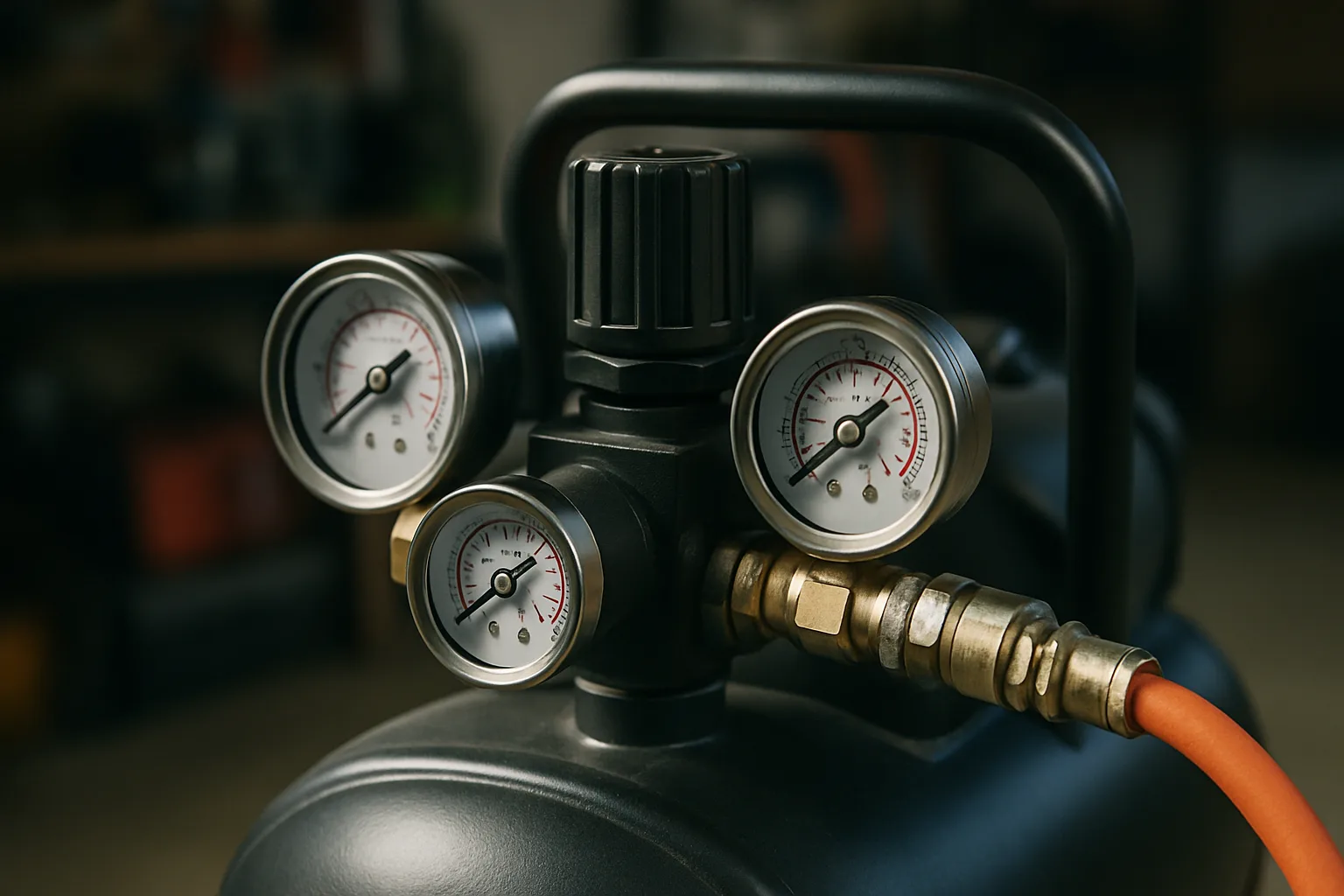
PSI is pressure, how hard the air pushes. Most small compressors shut off somewhere between 100 and 135 PSI. Higher shutoff pressure packs more air into the same tank, which is why the DeWalt's 200 PSI tank behaves like a much bigger one.
CFM (cubic feet per minute) is how much air the pump makes, usually quoted at 90 PSI because that is where most air tools run. It decides whether a compressor keeps up with a tool or only supplies short bursts.
Tank size is the reserve. A bigger tank buys more time before the motor kicks on, but can't make up for a pump too small for the tool.
Label claims are a weak guide. Based on how fast each climbs from 85 to 95 PSI, the DeWalt delivers about 3.3 CFM and the Husky about 2.75.
What CFM do air tools actually need?
Nailers, tire chucks and blow guns take air in short bursts, so a 2-gallon compressor handles them. A typical impact wrench draws about 6 CFM at 90 PSI, a cut-off wheel about 5 CFM, and a lighter air tool around 4 CFM.
Here is how long each compressor runs those tools from a full tank before pressure falls to 50 PSI:
- 4.5-gallon, 3.0 CFM portable: 25 seconds on the 6 CFM tool, 37 seconds on the 4 CFM tool.
- 20-gallon, 4.0 CFM unit: 2 minutes 35 seconds on the 6 CFM tool, 4 minutes 1 second on the 4 CFM tool.
- 26-gallon, 4.5 CFM unit: 2 minutes 39 seconds on the 6 CFM tool, 5 minutes 3 seconds on the 4 CFM tool.
The rule: buy CFM for the tool you will run longest, then buy tank for how long you need to run it. For lug nuts and cutting, a 4 to 5 CFM compressor with a bigger tank runs for minutes instead of seconds. For trim, tires and cleanup, a fast 2-gallon is plenty. Weighing cordless instead? See the drill vs. impact driver guide.
Noise: why quiet matters in an attached garage
An old-style 1-gallon pancake compressor measures about 97 dB at roughly two feet. Newer quiet 2-gallons peak around 75 to 82 dB. In an attached garage, that decides whether you can run it in the evening without waking the house.
Labels overstate quiet: several 2-gallons claim 60 dB but peak between 75 and 88 dB at about two feet. Compressors also get louder as tank pressure climbs, so judge the peak. Distance helps: one quiet 13-gallon unit read about 77 dB at a foot, 68 dB at 15 feet and 61 dB at 30 feet.
Duty cycle and recovery
Recovery is how long the compressor takes to refill after it kicks back on. Watch the cut-in pressure (where the motor restarts) and the refill time. The DeWalt restarts at about 167 PSI, so tools still get full regulated pressure while it refills. The Husky and Fortress restart near 102 to 104 PSI and refill in about 14 to 15 seconds. The Craftsman needs about 38 seconds, which is why it lags on a nailer.
Duty cycle is how much of the time the motor can run without overheating, and excess cycling wears out small compressors. The 10020C runs two larger pistons at a slower speed instead of one small fast piston, which makes less noise and heat and lets it run longer, so a 10-gallon tank keeps up with tools that usually call for a bigger one. It also has a self-resetting thermal cutoff.
Oil-free vs. oil-lubricated
Every compressor in this guide is oil-free. No oil to add or change, and they can sit on a surface that isn't perfectly level, the easy choice for a home garage. Oil-lubricated pumps need oil checks and a level spot, and are mostly found on large stationary shop units.
Power: 120 V outlets and extension cords
All of these run on a standard 120 V household outlet, but they draw very different power. Most 2-gallons peaked around 720 to 935 watts, the DeWalt near 1,300 watts, the Craftsman only about 395 watts, and the 20- and 26-gallon units around 1,430 to 1,466 watts. A big one sharing a circuit with a freezer or space heater can trip the breaker.
Plug directly into the wall when possible and add air hose for reach rather than a long extension cord. A long, thin cord starves the motor at startup; if one is unavoidable, keep it short and heavy-gauge, per the manual. The 10020C's easy-start valve lowers the startup load, which helps in cold garages and on generators.
Draining the tank
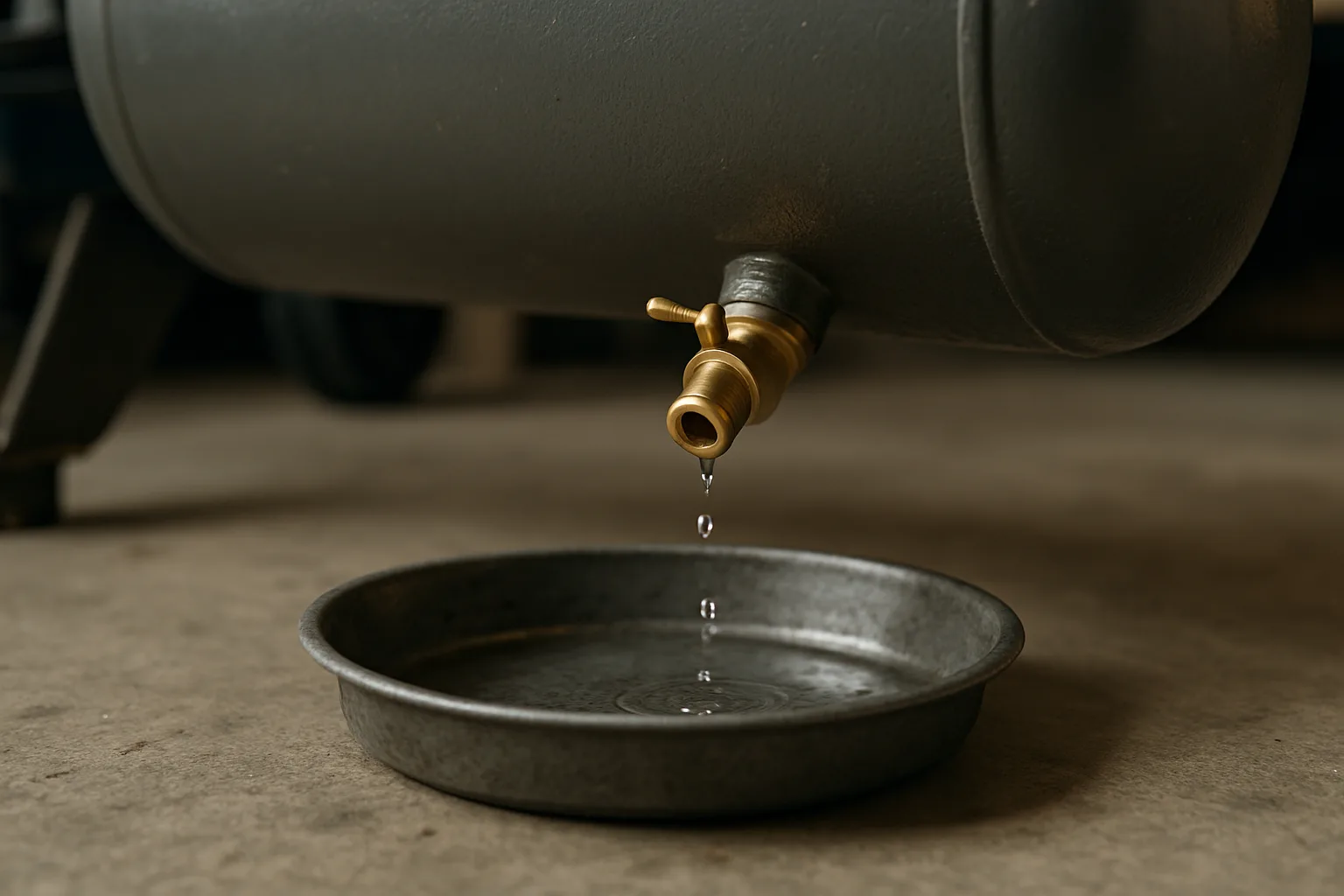
Compressing air squeezes water out of it, and that water collects at the bottom of the tank. Open the drain valve after each use, with the tank pressure bled down, and let it run until only air comes out. Water left inside rusts a steel tank from the inside. The 10020C's quarter-turn drain sits low on the tank, close to the floor, so close it before moving the compressor or setting it down hard.
Hoses and couplers
Automatic couplers let you push a hose plug in with one hand; manual couplers need the sleeve pulled back while the plug goes in, which is a two-hand job. Two outlets, like on the DeWalt and the 10020C, let two hoses stay connected. Match hose plugs to the compressor's coupler style, and keep runs as short as the job allows.
The picks in detail
DEWALT DWFP55130 2.5 Gal Quiet Trim Compressor
The DeWalt is by far the strongest small compressor here. Its 2.5-gallon tank builds to 200 PSI, reaching that in about 1 minute 23 seconds, while the regulator holds tool pressure near 138 PSI. An SUV tire went to 40 PSI in about 53 seconds without the line ever dropping below 40, and a framing nailer fired 64 times in a minute against 42 for the next best units. It fired 10 shots before the motor even started.
It peaked at 80.7 dB, mid-pack, and weighs about 36.5 lb. It runs upright or on its side and has two couplers. The trade-offs are cost and a near 1,300-watt draw.
DEWALT DWFP55130 2.5 Gal Quiet Trim CompressorCheck today’s price on AmazonBuy on Amazon →
California Air Tools 10020C Ultra Quiet 10 Gal Air Compressor
The 10020C is the step up for a garage that runs real air tools. It's rated at 6.4 CFM at 40 PSI and 5.3 CFM at 90 PSI from a 2 HP motor and a 10-gallon steel tank, with a 70 dB rating at one foot. It is mostly metal, with tank and regulated gauges, a locking regulator, two quick-disconnect outlets and serviceable dual air filters.
It's oil-free, uses a heavy-duty switch built for frequent cycling, and rolls on two wheels. At about 82.5 lb it is a roll-around unit, not a carry-around one. Its one weak spot is the low drain valve. The warranty is one year.


Makita MAC210Q Quiet Series 2 Gal Air Compressor
The Makita is a solid 2-gallon with a 1 HP motor, a 2.0 CFM at 90 PSI rating and a full roll cage that protects the compressor. It reaches 100 PSI in about 37 seconds, shuts off at 134 PSI and refills in about 15.5 seconds. It filled an SUV tire in just under 66 seconds and tied the Husky and Fortress at 42 nailer shots.
Two things to know. It is not as quiet as its 60 dB label: it peaked at 87.9 dB, among the louder 2-gallons. And at about 45.5 lb it is one of the heaviest, with a single hose coupler.
Makita MAC210Q Quiet Series 2 Gal Air CompressorCheck today’s price on Amazon

 Buy on Amazon →
CRAFTSMAN 2 Gal Portable Air Compressor
The Craftsman hot dog compressor is the one to carry around: about 19.5 lb, roughly half the weight of most 2-gallons, with an automatic coupler and a low 395-watt draw. It is rated at 0.5 CFM at 90 PSI with a 1/3 HP motor and 125 PSI max. The trade-off is speed: it took 2 minutes 5 seconds to reach 100 PSI, nearly 6 minutes to fill an SUV tire from its tank, and managed 19 nailer shots in a minute. It is also loud, peaking at 95.5 dB. Fine for tires, bikes and pool floats; step up for anything sustained.
CRAFTSMAN 2 Gal Portable Air CompressorCheck today’s price on Amazon

 Buy on Amazon →
Store-brand alternatives: Husky and Fortress
The Husky 2-gallon is the fastest to 100 PSI here at 30.8 seconds, peaks at a fairly quiet 79.5 dB and has one coupler plus a port for a second, at about 43 lb. The Fortress 2-gallon is nearly as quick, peaks at 82.2 dB and has two connectors, at about 37.7 lb. Both match the Makita on the nailer. Neither is sold on Amazon.
Safety basics
- Never exceed a tool's or hose's rated pressure. Set the regulator to what the tool needs; tank pressure on the DeWalt (200 PSI) is far above what most tools can take.
- Drain the moisture after every use to keep the tank from rusting.
- Wear eye protection when blowing off parts or running air tools.
- Protect your hearing on units peaking in the 90s dB, like the Craftsman.
- Bleed the pressure before moving the compressor, and never point a blow gun at skin.
Who should buy which
- Most performance in a small package: the DEWALT DWFP55130.
- Impact wrenches, cut-off tools and a quiet attached garage: the California Air Tools 10020C.
- A protected, dependable 2-gallon: the Makita MAC210Q.
- Light carry-around inflation: the CRAFTSMAN 2 Gal Portable.
- Shopping in store: the Husky or Fortress 2-gallon.
Setting up the rest of the garage? See the comparison of garage floor tiles vs. epoxy and the guide to LED garage lights.
Posted by Kristopher Larson
Frequently asked questions
What size air compressor do I need for a home garage?
It depends on the tools. For tires, inflatables, a blow gun and brad or framing nailers, a fast 2- to 2.5-gallon compressor is enough. For an impact wrench (about 6 CFM at 90 PSI) or a cut-off wheel (about 5 CFM), look for a compressor rated around 4 to 5 CFM at 90 PSI with a larger tank. A 4.5-gallon, 3 CFM unit runs a 6 CFM tool for only about 25 seconds before pressure falls to 50 PSI, while 20- and 26-gallon units rated 4 to 4.5 CFM run it for more than two minutes.
Is CFM or PSI more important on an air compressor?
For running tools, CFM matters more. PSI is how much pressure the tank holds, and most tools run at 90 PSI. CFM is how much air the pump delivers at that pressure, which decides whether the compressor keeps up or the tool stalls while you wait. Higher tank PSI does help a small tank store more air, which is why a 200 PSI, 2.5-gallon compressor outperforms 2-gallon units that stop near 135 PSI.
What is the quietest type of air compressor?
Oil-free compressors with slow-running motors are the quietest. The California Air Tools 10020C, for example, uses two larger pistons at a lower speed and is rated at 70 dB. Many modern 2-gallon quiet units peak in the mid-70s to low-80s dB at about two feet, compared with about 97 dB for an old-style pancake compressor. Treat 60 dB claims with caution: several units labeled 60 dB peak between 75 and 88 dB.
Can I run an air compressor on an extension cord?
It's better to plug the compressor straight into a wall outlet and use a longer air hose for reach. A long or thin extension cord can starve the motor of power when it starts. If a cord can't be avoided, keep it short and heavy-gauge and follow the cord guidance in the compressor's manual. Larger units draw well over 1,000 watts, so avoid sharing the circuit with other big loads.
How often should I drain my air compressor tank?
Drain it after every use. Compressing air pulls moisture out of it, and the water pools at the bottom of the tank, where it causes rust. Bleed the pressure down, open the drain valve and let it run until only air comes out, then close it before moving the compressor.
Is an oil-free air compressor good enough for a garage?
Yes. Oil-free compressors need no oil changes, are ready to use out of the box and can sit on a floor that isn't perfectly level, which suits most home garages. Oil-lubricated pumps need oil checks and a level spot and are mostly found on large stationary shop compressors.
Keep reading
More from the blog
Best LED Garage Lights: Deformable Screw-In vs. Shop Lights, by Measured Brightness
How to Choose a Garage Heater: Propane vs. Electric vs. Mini-Split
Garage Floor Tiles vs. Epoxy: Swisstrax vs. RaceDeck vs. VEVOR