Best LED Garage Lights: Deformable Screw-In vs. Shop Lights, by Measured Brightness
LED garage lights compared by measured brightness: SANSI 60 W vs. 100 W and 120 W models, color temperature, glare, ceiling height and install tips.
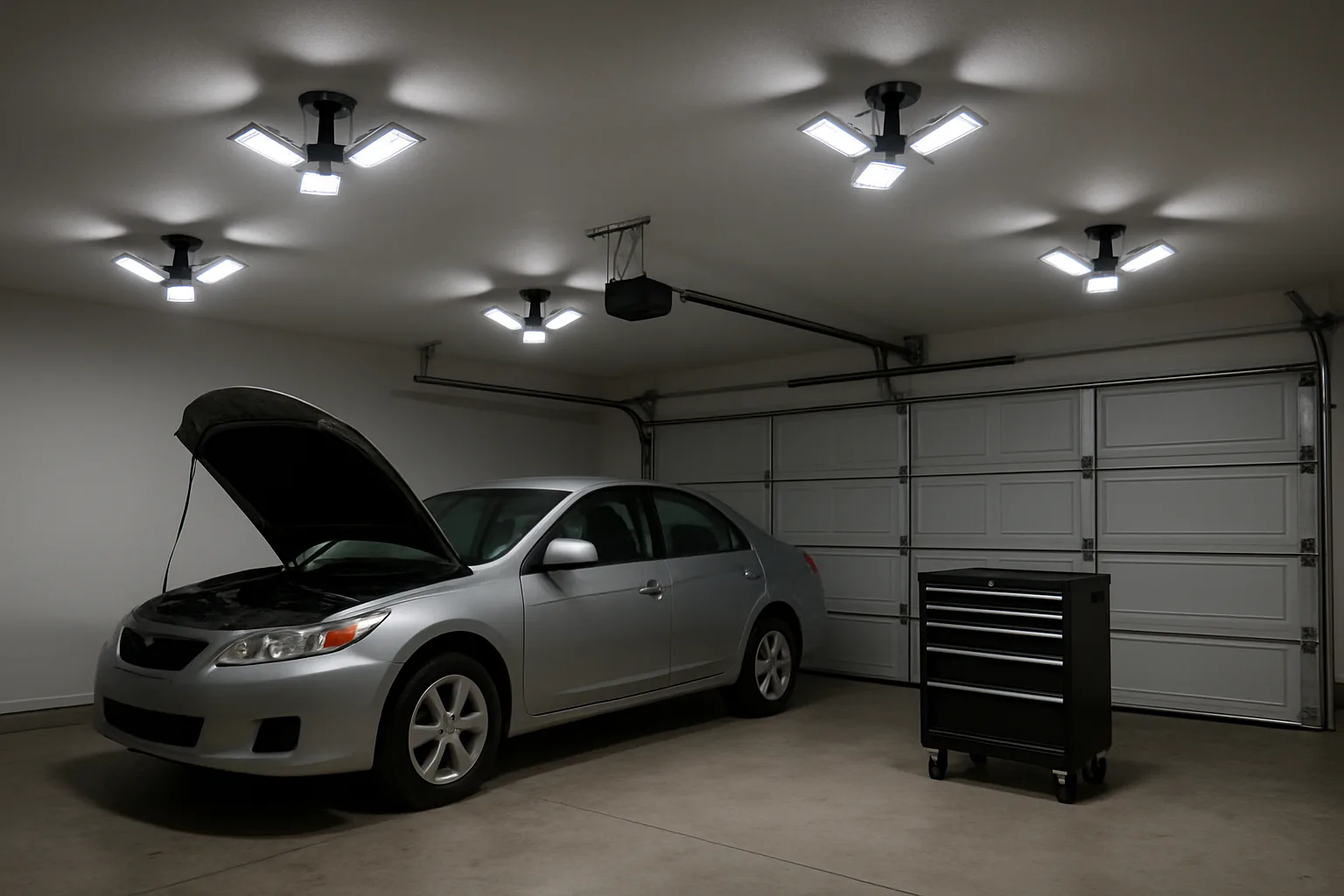
Most garages are lit by one or two bare sockets in the ceiling, and a standard bulb in each one leaves the corners dark and the workbench in shadow. LED garage lights fix that without new wiring. A deformable garage light screws into the same socket and opens into three or four adjustable panels, while a linkable LED shop light mounts to the ceiling and runs a long, even strip of light.
The box numbers only tell part of the story. Several 60 W lights here carry the same 6,000-lumen rating, yet one puts nearly twice as much light on the floor as the others. This guide compares four screw-in picks by measured brightness, color temperature, glare and start-up behavior, then covers ceiling height, placement and safe installation.
As an Amazon Associate, Best Utah Real Estate earns from qualifying purchases.
Quick verdict
- Best 60 W garage light: the SANSI 60 W Deformable LED Garage Light. It is the brightest 60 W light in the group by a wide margin, comes on instantly and has a 5000K color that suits shop work.
- Most light from one socket: an unbranded 120 W four-panel deformable light, with the highest peak brightness of any light here. It is built for high ceilings and fixtures rated for the load.
- High-ceiling metal option: an unbranded 100 W three-panel deformable light, close to the SANSI 60 W in overall brightness with metal wings.
- Half the wattage for a small space: the SANSI 3-Panel 30 W Deformable LED Garage Light, a lighter three-panel version.
- Low glare for many fixtures: the SANSI 27 W LED Bulb (4,000 lm). It is too dim to light a two-socket garage, but easy on the eyes in a basement or a room with plenty of sockets.
The lights side by side
Each light was measured alone in an empty garage. Average lux shows how evenly light spreads across the floor; peak lux shows its strongest spot.
| Light | Shop | Watts | Rated lumens | Color | Average lux | Peak lux | Power-on delay | Warranty listed |
|---|---|---|---|---|---|---|---|---|
| SANSI 60 W Deformable LED Garage Light | 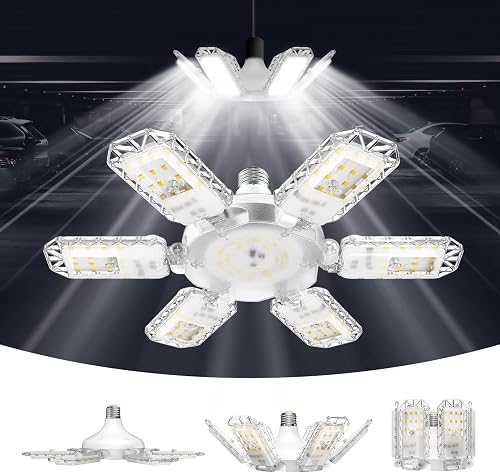 Buy on Amazon | 60 W | 6,000 | 5000K | 456 | 1,301 | None | 5 years |
| Unbranded 120 W four-panel light | 120 W | 12,000 | 6000K | 418 | 1,394 | None | None listed | |
| Unbranded 100 W three-panel light | 100 W | 10,000 | 6000K | 435 | 1,322 | None | None listed | |
| SANSI 27 W LED Bulb (4,000 lm) |  Buy on Amazon | 27 W | 4,000 | 5000K (3000K also sold) | 113 | 278 | None noted | 5 years |
The deformable lights here are non-dimmable; keep them off dimmer switches. The SANSI bulb is the exception: its listing says it dims on most standard dimmers.
Lumens vs. watts vs. measured brightness
Watts measure power drawn and lumens are the maker's light rating. Neither says how much light reaches the workbench. Five different 60 W deformable lights in the group are all rated for 6,000 lumens. Four of them measure between 231 and 266 lux on average. The SANSI 60 W measures 456, close to the 100 W light and ahead of the 120 W light on average. Its four wings each push out a strong pod of light, and that design matters more than the box rating.
Higher wattage still buys more light, especially at the peak. An 80 W, 8,000-lumen three-panel light measures 303 lux on average with a 940 peak, clearly brighter than most 60 W lights. Gains shrink as ratings climb: a 12,000-lumen four-panel light looks only somewhat brighter than a 9,000-lumen three-panel light, and an 800-lumen bulb doesn't look ten times dimmer than a light rated ten times higher.
Color temperature: 5000K, 6000K or 6500K?
- 5000K is a crisp daylight white that shows color well without looking blue. It is a strong default for a shop, and the SANSI 60 W uses it.
- 6000K varies by brand. One 60 W 6000K light has a noticeable blue cast, while other 6000K lights look close to neutral.
- 6500K carries a slight blue tint you can see next to 6000K lights.
- Warmer light (the 3000K version of the SANSI bulb, or a warm-toned shop light) makes wood and skin tones look more natural, which helps in a woodshop or a garage that doubles as a hangout space. 4000K sits between warm and daylight white.
For car detailing and paint correction, bright daylight-white deformable lights angled almost straight down show swirl marks and water spots in the clear coat clearly. Pick the color for the job the garage does most.
Deformable lights vs. shop lights vs. panel fixtures
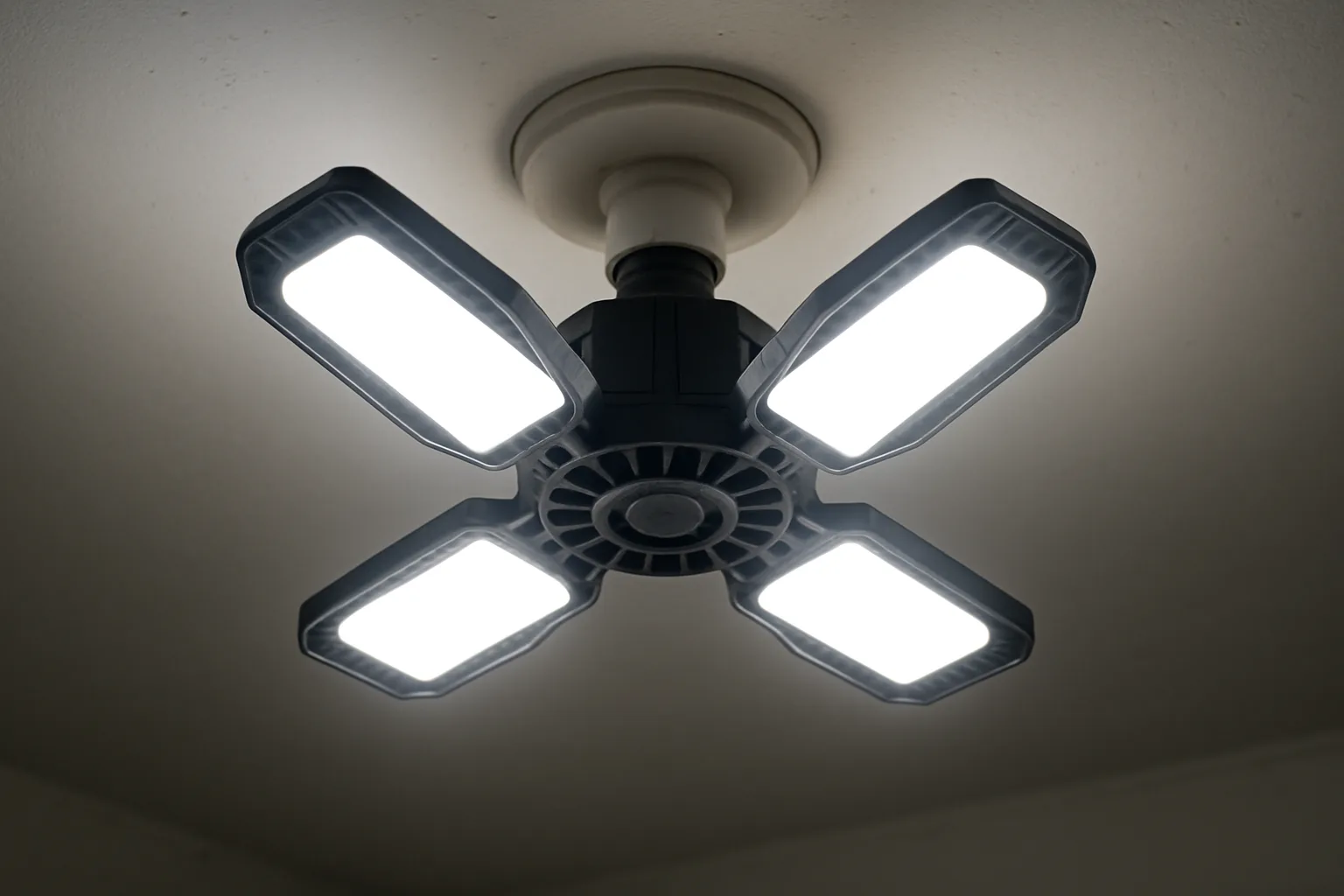
Deformable screw-in lights need no tools and no new wiring. The center screws into a standard socket, and each wing tilts on its own. Angle the wings down for a work zone, out at 45 degrees to spread light, or up to wash the walls. Some have bolts that lock the wings in place, which helps in a garage where the door shakes the ceiling. Their weak points are glare when you look up and, on some models, a short delay after the switch is flipped.
Linkable LED shop lights mount to the ceiling and spread light along their length rather than from one point. A shop light can light a room as well as a good three-panel deformable and often has a warmer, more natural tone. It costs more and has to be fixed to the ceiling and plugged in or wired.
Flat LED panel fixtures are hardwired and spread light evenly with little glare. They suit a garage being rewired anyway; they are a fixture swap, not a bulb swap.
Glare, ceiling height and placement
- Standard-height ceilings: a 60 W deformable is the sweet spot for most garages. Higher wattage at that height means glare at eye level.
- 10 to 16 ft ceilings and pole barns: the 80 W, 100 W and 120 W lights make sense here, with the light up and out of your line of sight.
- Four wings vs. three: four-wing lights spread the light across more surface, so glare is lower than on a three-wing light of similar power. Lights with small, concentrated LED patches glare the most.
- Two sockets: aim one light's wings mostly down over the work area and the other's out toward the walls. Two well-aimed deformables can light a typical garage that has two ceiling sockets.
- Glare-sensitive spaces: a diffused white plastic 60 W deformable with a socket extension (231 lux average, almost no glare) or the SANSI ceramic bulb suits a low-ceiling basement.
Power-on delay and cold mornings
Several deformable lights pause a moment after the switch is flipped. It does no harm, but it feels off. The SANSI 60 W, the 100 W and the 120 W lights here all come on immediately. An 80 W light has only a very slight delay. Two of the 60 W 6000K models have a delay you will notice.
Unlike older fluorescent shop tubes, LEDs don't need to warm up in a cold garage. If the garage freezes, check that the listing rates the light for those temperatures.
The picks in detail
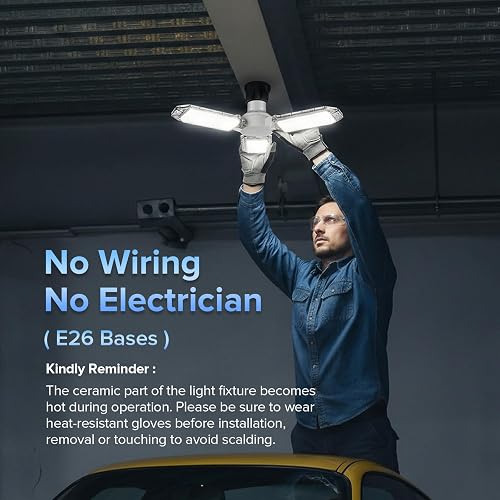
SANSI 60 W Deformable LED Garage Light
This is the standout. At 456 lux average and 1,301 peak, it out-measures every other 60 W light in the group and matches lights with almost twice its wattage. It is rated 6,000 lumens at 5000K, is non-dimmable and has a 5-year warranty. It responds like an ordinary light, with no power-on delay.
The body and four wings are plastic, and the LEDs cool through the plastic. The center section is heavy, so the socket it goes in should be solid. It sometimes sells out, so a restock may be worth the wait.
SANSI's current 60 W listing differs a little from the four-wing version described above: it has six adjustable panels plus a center panel and lists 6,500 lumens at 5000K, with an E26 screw-in base.
SANSI 60 W Deformable LED Garage LightCheck today’s price on Amazon
 Buy on Amazon →
SANSI 3-Panel 30 W Deformable LED Garage Light
For a smaller garage, a closet-size workshop or a socket that can't take a heavy fixture, SANSI also makes a three-panel deformable light at half the wattage. Its listing describes a 30 W, E26 screw-in light with adjustable panels in 5000K daylight, sold as a 300 W incandescent equivalent. It is not part of the brightness measurements above, so expect noticeably less light than the 60 W.
 SANSI 3-Panel 30 W Deformable LED Garage LightCheck today’s price on Amazon


 Buy on Amazon →
Unbranded 120 W four-panel deformable light
For the most light from a single socket, this four-panel light is rated 12,000 lumens at 6000K and posts the highest peak reading of the group, 1,394 lux, with a 418 average. Four panels spread the output, so glare is lower than expected, though still noticeable. It has no power-on delay and feels well built. No warranty is listed, which is the main drawback. It belongs in a high-ceiling garage or shop with fixtures rated for 120 W.
Unbranded 100 W three-panel deformable light
This three-panel light is rated 10,000 lumens at 6000K and measures 435 lux average with a 1,322 peak, nearly the same as the SANSI 60 W. Its 6000K color isn't harsh. The wings are metal, which may last longer than plastic. It comes on with no delay, but no warranty is listed. It suits ceilings from about 10 to 16 ft, where the glare stays out of your eyes.
SANSI 27 W LED Bulb (4,000 lm)
This omnidirectional bulb mimics a standard bulb, with LEDs around the outside and internal cooling fins. It is rated 4,000 lumens, comes in 5000K or 3000K, is dimmable according to its listing and has a 5-year warranty. At 113 lux average and 278 peak, it is the dimmest light here, and it can't light a large garage with only two sockets. It fits a basement or utility area with many fixtures, where low glare matters more than output.
SANSI 27 W LED Bulb (4,000 lm)Check today’s price on Amazon

 Buy on Amazon →
Installing a screw-in garage light safely
- Turn off the breaker for the circuit before working on the socket, not just the wall switch.
- Check the fixture's wattage rating. A 100 W or 120 W LED actually draws 100 or 120 W. A fixture labeled for 60 W maximum is not a match for those, so stick to a 60 W light or replace the fixture.
- Check the weight. Deformable lights are much heavier than a bulb. A bare porcelain socket screwed firmly to a ceiling box handles the weight better than a loose or cracked socket, a pull-chain fixture or a plastic socket adapter.
- Mind the heat. The fins are heat sinks, and they get warm to the touch after hours of use, which is normal. Leave room around the light so the heat can escape. ENERGY STAR notes that heat management is the biggest factor in how long an LED keeps its brightness.
- Hardwiring: mounting a shop light or panel fixture permanently means following the maker's instructions and local code. Hire an electrician if new circuits or boxes are needed.
Who should buy which
- A typical garage with standard ceilings and one or two sockets: the SANSI 60 W Deformable LED Garage Light.
- A tall garage, pole barn or shop that needs the most light per socket: a 120 W-class four-panel deformable light, on a fixture rated for it.
- High ceilings and a preference for metal wings: a 100 W-class three-panel deformable light with metal wings.
- Basements and rooms with many sockets, or anyone bothered by glare: the SANSI 27 W LED Bulb (4,000 lm).
Pair better light with overhead storage racks, a garage floor tile or epoxy floor, and a garage heater for winter projects. For lights you control from an app inside the house, see the Philips Hue vs. Govee vs. WiZ vs. Lutron comparison.
Posted by Kristopher Larson
Frequently asked questions
What is the best LED garage light for a standard garage?
A 60 W deformable LED garage light is the best fit for most garages with standard-height ceilings. The SANSI 60 W four-wing light is the strongest of that group, measuring about 456 lux on average and 1,301 lux at its peak, with no delay when it is switched on.
What is a deformable garage light?
A deformable garage light is a high-output LED light that screws into a standard light socket and has three or four panels, or wings, that tilt independently. The panels can point straight down over a work area, out at an angle to spread light across the room, or up toward the walls and ceiling.
Are more lumens always brighter in a garage?
Not reliably. Several 60 W lights rated for 6,000 lumens measure between about 231 and 266 lux on average, while one with the same rating measures 456. Panel layout and how the LEDs are spread matter as much as the lumen rating. Higher-wattage lights do raise peak brightness, but each step up looks smaller than the numbers suggest.
What color temperature is best for a garage?
5000K is a strong all-around choice for a garage workshop: bright and clear without a blue cast. 6000K to 6500K lights can look slightly blue, depending on the brand. Warmer light makes wood and skin tones look more natural, while bright daylight white aimed down over a car makes swirl marks and water spots easier to see during detailing.
Can a 100 W or 120 W LED garage light go in any socket?
No. A 100 W or 120 W LED light draws that much power, so the fixture has to be rated for it; a fixture labeled 60 W maximum is not a match. These lights are also heavy, so the socket should be solid and firmly mounted. Turn off the breaker before installing one.
Why do some LED garage lights take a second to turn on?
Some deformable LED lights have a short power-on delay built into their drivers, so they light a moment after the switch is flipped. It is not a defect, but it can be annoying. Lights such as the SANSI 60 W and the 100 W and 120 W deformable models in this guide come on instantly.
Keep reading
More from the blog
Best Air Compressor for a Home Garage: Quiet, CFM and Tank Size Explained
How to Choose a Garage Heater: Propane vs. Electric vs. Mini-Split
Garage Floor Tiles vs. Epoxy: Swisstrax vs. RaceDeck vs. VEVOR