Best Walkie Talkies: Rocky Talkie vs. Motorola Talkabout vs. Midland X-Talker for Hiking, Skiing and Outages
Rocky Talkie, Motorola T605 and T802 and Midland T10 compared on real range, batteries and waterproofing, plus FRS vs. GMRS licensing and a family plan.
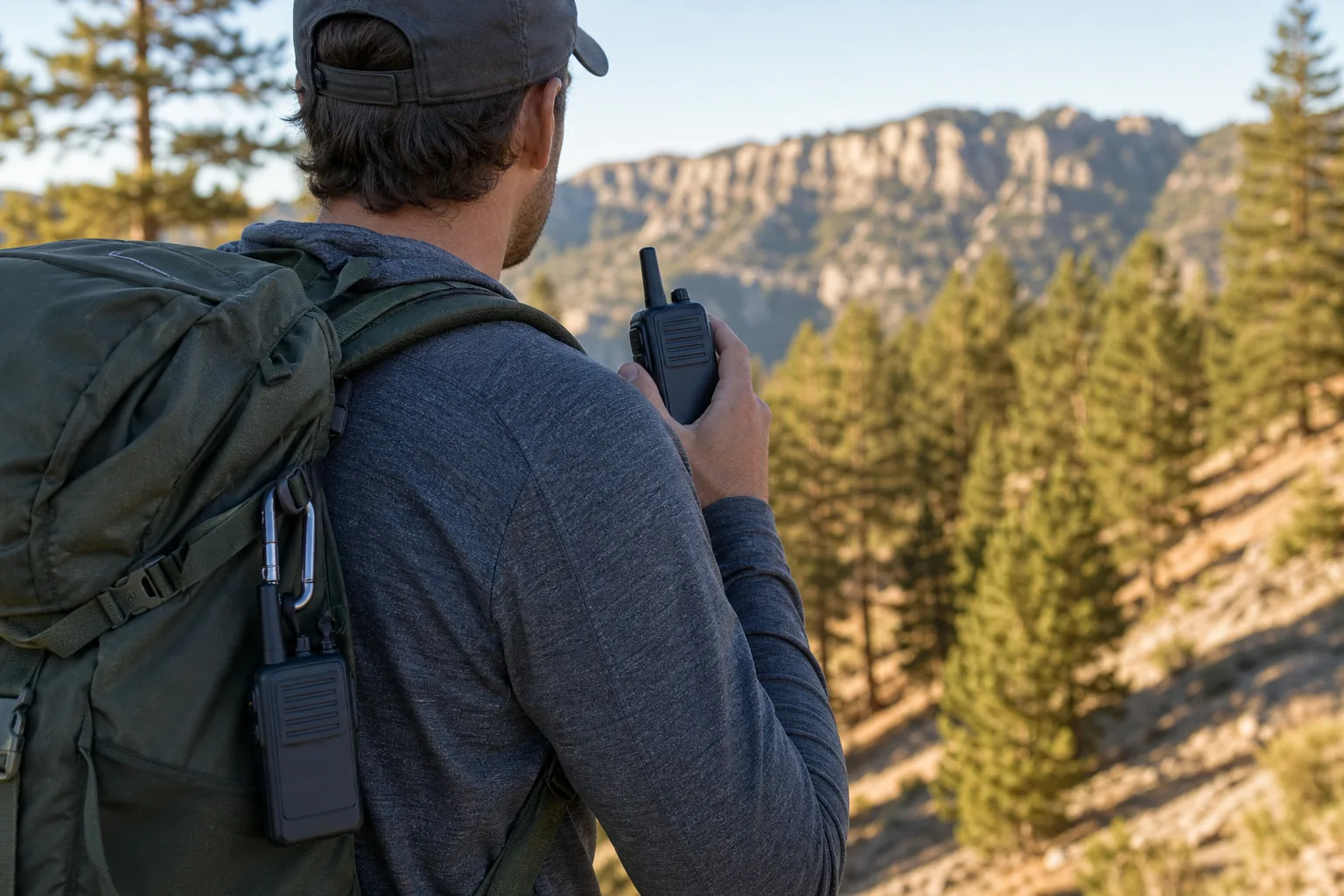
A good pair of walkie talkies earns its place twice. On a ski day, a trail or at a campsite, they keep a group talking where phones drop to one bar. At home, they are a simple backup for the times cell service goes down: a storm, a long power outage or a crowded network. Family Radio Service (FRS) radios need no license, run on their own batteries and talk to any other FRS radio set to the same channel and privacy code, whatever the brand.
The catch is that the range printed on the box is a best case over open ground. In neighborhoods and trees, the most basic radios can fade out at a quarter mile. This guide covers four FRS radios that suit different jobs, how far they really reach, what the FRS and GMRS rules actually say, and how to set up a simple family radio plan.
Quick verdict
- Best all-around for hiking, skiing and climbing: the Rocky Talkie Mountain Radio. The clearest signal at the longest distance in a dense suburb, a carabiner and leash that keep it attached to a pack, and a battery that runs for days. It has no weather channels and is splashproof, not submersible. The main listing is a single radio, so a group needs two or more.
- For water, rain and a home emergency kit: the Motorola Talkabout T605 H2O. Fully waterproof, it floats face up, carries NOAA weather alerts and takes AA batteries when the rechargeables run down. It held a clear signal across six miles of hills and trees.
- For off-grid texts and location sharing: the Motorola Talkabout T802. Voice range and sound matched the T605, and a phone app connected over Bluetooth sends messages and locations over the radio itself, with no cell signal.
- For kids, short range and AAA batteries: the Midland T10 X-Talker. Simple, clear at short range, with weather alerts, and it runs on AAA batteries you can keep in a drawer. It dropped out at about a mile with houses and trees in the way.
The radios side by side
| Radio | Shop | Service | Water rating | Power source | Weather alerts | Sold as | Best for |
|---|---|---|---|---|---|---|---|
| Rocky Talkie Mountain Radio |  View on Amazon | FRS, 2 W, no license | IP56, splashproof, not submersible | 1550 mAh lithium-ion, rated 3 to 5 days; USB-C | No | Single radio | Hiking, skiing, climbing |
| Motorola Talkabout T605 H2O |  View on Amazon | FRS, no license | IP67, floats face up | NiMH pack (up to 9 hours) or 3 AA (up to 23 hours) | Yes, NOAA | 2-pack | Water, rain, emergency kits |
| Motorola Talkabout T802 |  View on Amazon | FRS, no license | IP54 | NiMH pack; USB-C | Yes, NOAA | 2-pack | Off-grid messages and locations |
| Midland T10 X-Talker |  View on Amazon | FRS, no license | Water resistant | 3 AAA per radio (not included) | Yes | 2-pack | Kids, short range, AAA backup |
Best all-around
Rocky Talkie Mountain Radio
The clearest signal at the longest distance, a carabiner and leash that keep it on a pack, and a battery that lasts days between charges.
- FRS 2 W
- IP56
- 3 to 5 day battery
Good for
- Hiking, skiing and climbing
- Groups that need multi-day battery life
Skip it if
- Weather alerts are a must
- Radios that get dunked
FRS vs. GMRS: which radios need a license
The FCC's Family Radio Service page says FRS is "licensed by rule": no individual license is needed, at any age, as long as the radio is an unmodified, FCC-certified FRS unit. There are 22 FRS channels. Channels 1 to 7 and 15 to 22 allow up to 2 watts; channels 8 to 14 are limited to half a watt, and the FCC puts their usual range at under half a mile. For the longest reach, pick a channel in the 1 to 7 or 15 to 22 groups.
The General Mobile Radio Service shares all 22 of those frequencies, adds more channels and repeater use, and requires an FCC license. The FCC puts GMRS range at one to 25 miles, depending on the station and terrain. The applicant must be 18 or older, the license runs ten years, and any family member of any age can use radios under it. Radios sold as GMRS, such as Midland's GXT series and Rocky Talkie's 5-watt Expedition Radio, transmit at higher power and reach farther, and they still talk with FRS radios on the shared channels. Everything carded below is FRS, so it works out of the box.
How the radios differed in real use
Range: plan on a half mile to two miles
Box claims of 20 to 35 miles assume a clear line of sight, such as mountain to valley. Through houses, trees and hills, a half mile to two miles is a realistic expectation for a good FRS radio. The gaps between radios showed up quickly. In a dense suburb, with dozens of blocks of homes and a large hill in between, the Rocky Talkie Mountain Radio was still clear at 2.7 miles. The earlier Motorola T800 lost contact at that point after holding on to about 1.9 miles.
Across about six miles of interstate, hills and trees, the Motorola T605 and T802 came through clearly, while several basic radios dropped out entirely and a DeWalt jobsite pair was weaker. The Midland T10 was clear at a quarter mile in open ground, but it was out of range at about a mile with houses and trees in the way. The plainest no-name packs struggled even at a quarter mile.
Sound and push-to-talk lag
In a lineup of about a dozen FRS radios, the two Motorolas had the clearest, least staticky sound, and both are loud. Nearly every radio clips the start of a message after the talk button is pressed: on a fast count from one to ten, the T802 lost one or two numbers and the T605 about two, while a couple of radios lost none. Either way, press the button, wait a beat, then speak.
Carrying them
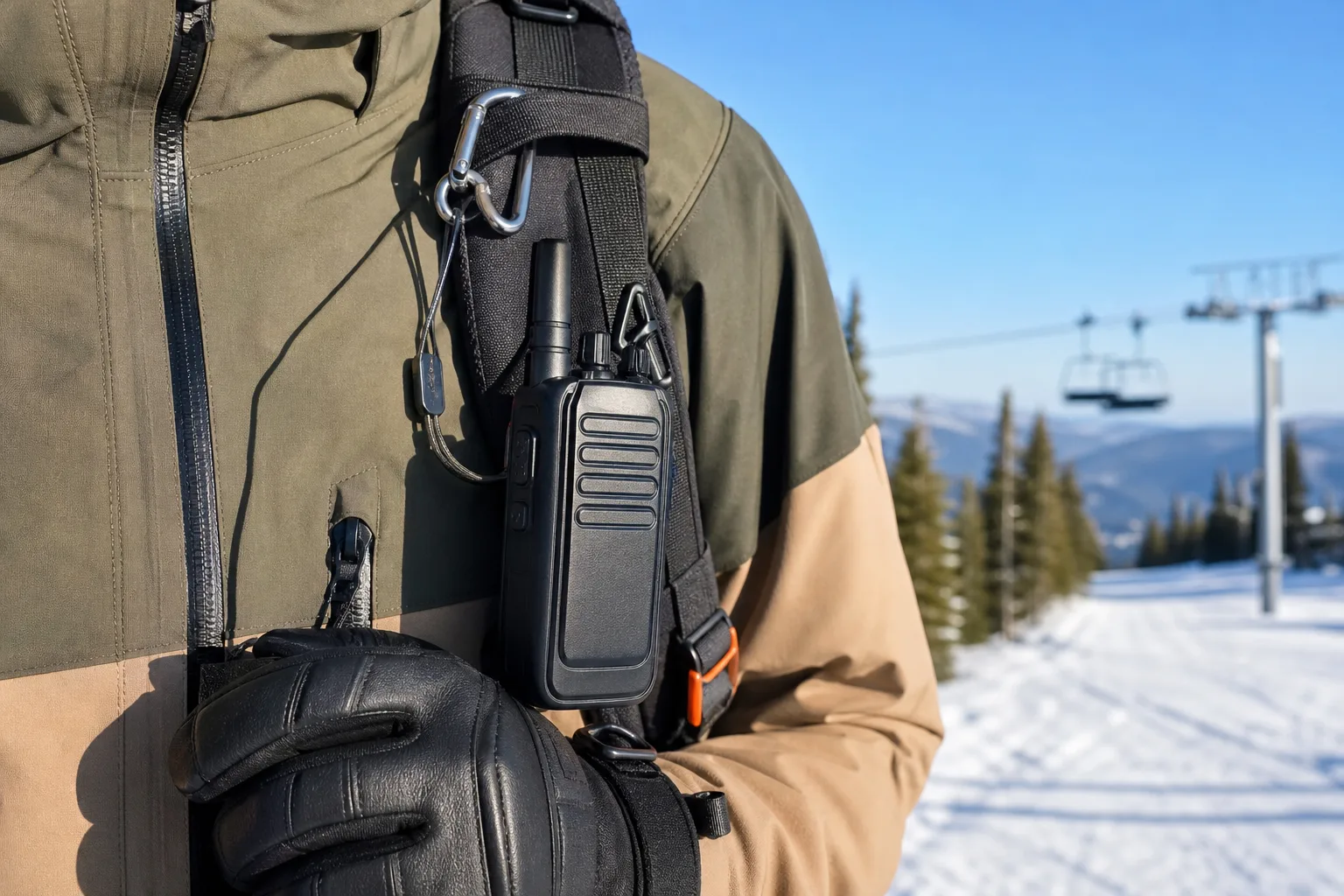
A radio that falls off a pack strap doesn't help anyone. The Rocky Talkie's climbing-rated carabiner and backup leash were the easiest to live with: clip it to a shoulder strap and it stays put. Plastic belt clips on basic radios popped off in drops and in daily use, and a DeWalt pair with a holster was the worst to keep on a pack.
Water and drops
All four radios here survived repeated drops. On the T802 the battery and its cover popped out, then went back in with no damage. Water is where they split. The T605 is rated IP67 and floats face up, and its flashlight turns on by itself when it hits water, so a dropped radio is easy to spot. The Rocky Talkie is rated IP56: fine in rain and snow, but water that gets into the mic can muffle the voice until it drains.
Waterproof pick that floats
Motorola Talkabout T605 H2O
Fully waterproof, floats face up with a flashlight that turns on in water, and reaches far over hills, with NOAA alerts and AA backup.
- IP67
- NOAA alerts
- AA backup
Good for
- Boating, rivers and rain
- Home emergency kits
Skip it if
- A small, light radio for a pack strap
Batteries during a power outage
For home preparedness, the power source matters as much as the range. Rechargeable radios are convenient until the power is out for a few days. The Rocky Talkie's lithium-ion battery is rated for 3 to 5 days per charge and lasted four or five days of light use, and it charges over USB-C from a power bank or a portable power station. The T605 runs up to 9 hours on its NiMH pack or up to 23 hours on three AA batteries, per Motorola, so a pack of AAs in the kit keeps it talking. The T10 runs only on AAA batteries, which are easy to stock.
Setting up a family radio plan
Ready.gov's Make a Plan page asks every household to decide how it will reach each other and where to meet if separated. Radios fill part of that gap. A few habits make them work when needed:
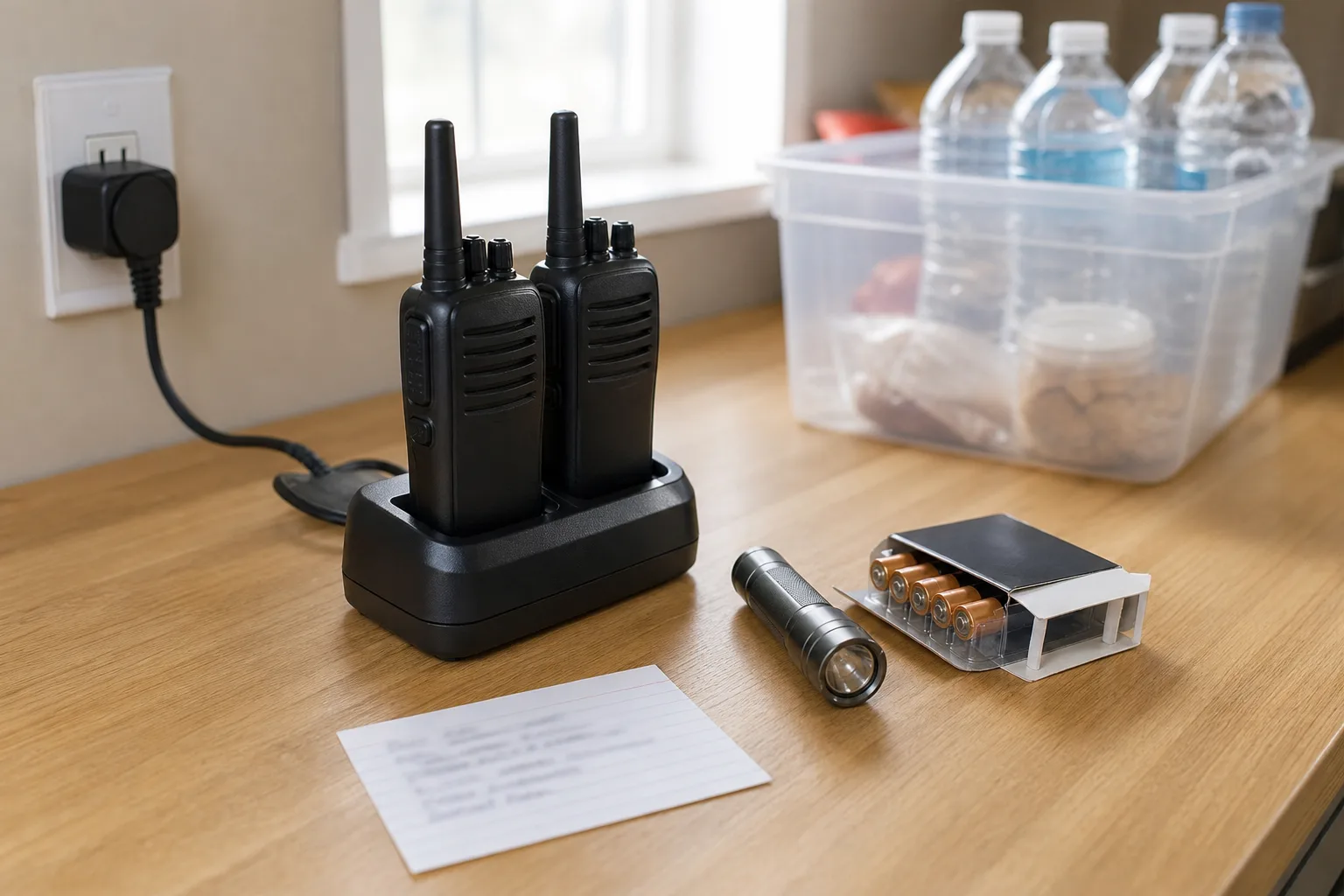
- Pick a main channel and privacy code, plus a backup. Use a channel from 1 to 7 or 15 to 22. Write both on a card kept with the radios. A privacy code doesn't make a conversation private; it only filters out other people's traffic.
- Agree on check-in times, such as the top of every hour, so radios can stay off between calls and save battery.
- Test from the places that matter. Try the radios from the house to a relative's street, the school or the meeting spot. Hills and buildings change range a lot.
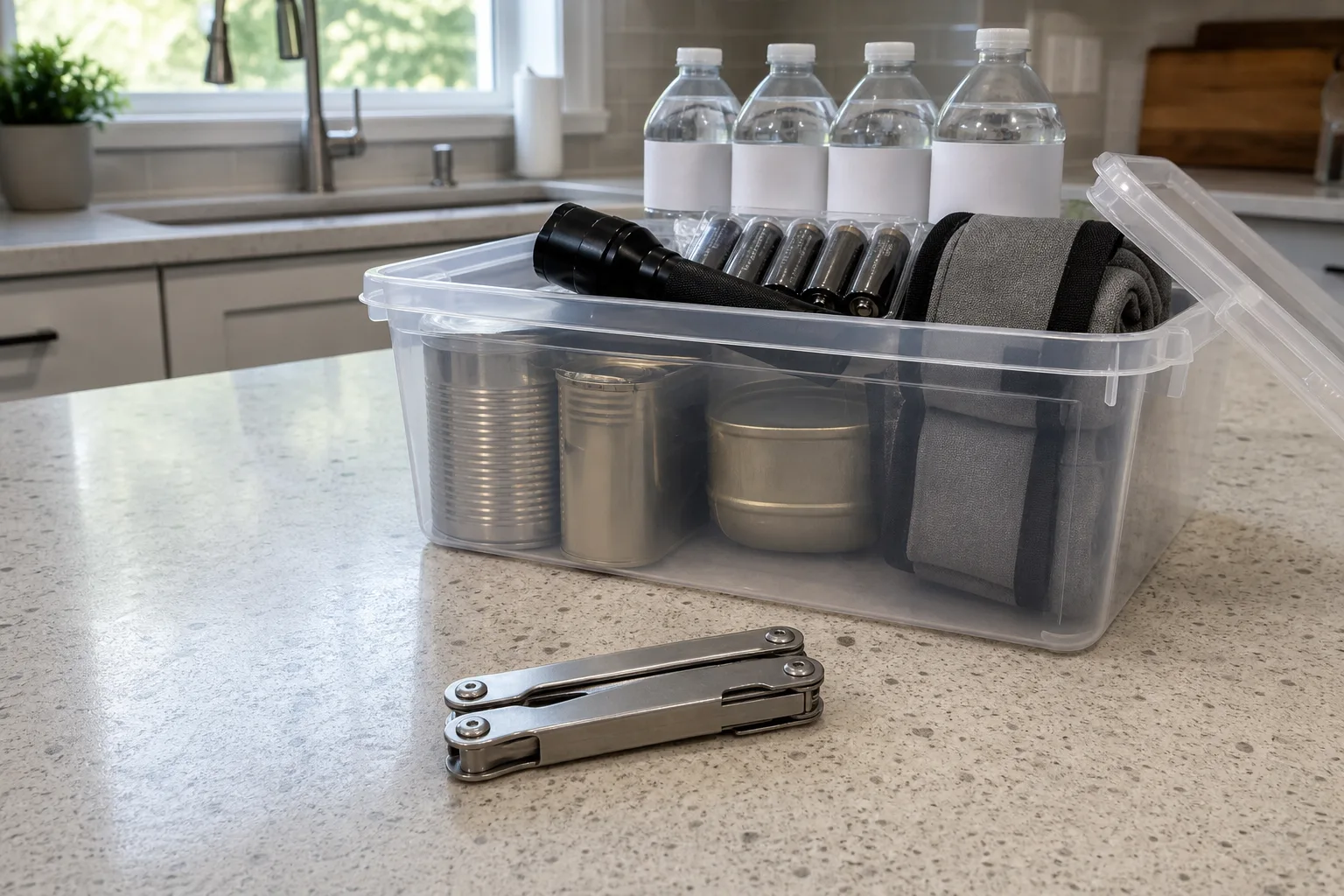
- Keep them charged and rotate spare batteries every few months, along with the rest of the kit: a good flashlight and an emergency water filter.
- Turn on weather alerts on radios that have them, so a NOAA warning comes through even with the phone network down.
Off-grid texts and locations
Motorola Talkabout T802
Long range and clear sound, plus a phone app that sends messages and locations over the radio with no cell service.
- IP54
- USB-C
- NOAA alerts
Good for
- Groups spread out over a big area
- Off-grid messaging
Skip it if
- A radio that gets wet often
- Keeping it simple
The picks in detail
Rocky Talkie Mountain Radio: best all-around for hiking and skiing
The Rocky Talkie Mountain Radio transmits at 2 watts, the most FRS allows, and its signal stayed the clearest at 2.7 miles through a dense suburb. It is compact, with five simple buttons, high and low power modes to save battery and a keypad lock. The carabiner and metal-reinforced leash are the best attachment system here. The trade-offs: no NOAA weather channels, an IP56 rating rather than full waterproofing, and the main listing is a single radio, so a group needs two or more.
Best all-around
Rocky Talkie Mountain Radio
The clearest signal at the longest distance, a carabiner and leash that keep it on a pack, and a battery that lasts days between charges.
- FRS 2 W
- IP56
- 3 to 5 day battery
Good for
- Hiking, skiing and climbing
- Groups that need multi-day battery life
Skip it if
- Weather alerts are a must
- Radios that get dunked
Motorola Talkabout T605 H2O: waterproof and floats
The Motorola Talkabout T605 H2O is the radio for boats, rivers, rain and a home kit. It is rated IP67 (one meter for 30 minutes), floats face up with its included battery, and has a white and a red LED flashlight. It carries NOAA weather channels with alerts, an emergency alert button and dual-channel watch. It was among the strongest radios across six miles of hills, and it shrugged off drops. The T605 is the same radio as the T600 with a carry case, extra batteries and earpieces added. Motorola notes it may not float on some AA batteries.
Waterproof pick that floats
Motorola Talkabout T605 H2O
Fully waterproof, floats face up with a flashlight that turns on in water, and reaches far over hills, with NOAA alerts and AA backup.
- IP67
- NOAA alerts
- AA backup
Good for
- Boating, rivers and rain
- Home emergency kits
Skip it if
- A small, light radio for a pack strap
Motorola Talkabout T802: off-grid messages and locations
The T802 matched the T605 for range and sound, with very little clipping of the first word. Its difference is the TALKABOUT phone app. Over Bluetooth, the app uses the radio to send messages, locations and push-to-talk over FRS to other T800-series users, with no cell signal, per Motorola. It is rated IP54, charges over USB-C and has NOAA alerts and an emergency button that sounds an alarm. It replaces the T800, which charged over micro-USB and had a lighter IPX4 rating. The app takes some setup, so it pays off mainly for groups that will use it.
Off-grid texts and locations
Motorola Talkabout T802
Long range and clear sound, plus a phone app that sends messages and locations over the radio with no cell service.
- IP54
- USB-C
- NOAA alerts
Good for
- Groups spread out over a big area
- Off-grid messaging
Skip it if
- A radio that gets wet often
- Keeping it simple
Midland T10 X-Talker: for kids and short range
The Midland T10 X-Talker had some of the clearest sound among basic two-packs, plus a weather alert radio and channel scan, which many basic packs skip, and hands-free eVOX. It runs on three AAA batteries per radio, which makes it easy to keep ready in a drawer, and it is simple enough for kids. It isn't built for distance: it faded out at about a mile with houses and trees in the way, and its battery cover popped off in a drop. Best for a campground, a yard or a few houses apart.
For kids and short range
Midland T10 X-Talker
A simple, clear FRS radio with weather alerts that runs on AAA batteries, for campgrounds, yards and kids.
- 22 channels
- 38 privacy codes
- 3 AAA
Good for
- Kids and families
- AAA battery backup
Skip it if
- Distances of a mile or more
Who should buy which
- Hikers, skiers and climbers: the Rocky Talkie Mountain Radio, for its range, battery and carabiner.
- Boaters, river trips and a radio for the emergency kit: the Motorola Talkabout T605 H2O, for waterproofing, weather alerts and AA backup.
- Groups that want texts and locations without cell service: the Motorola Talkabout T802.
- Kids and short-range use: the Midland T10 X-Talker.
- More range than FRS allows: a GMRS radio with an FCC license. Rechargeable radios also pair well with a backup power plan, such as an inverter generator.
This guide is part of our home emergency checklist, which covers water, food, power, light, communication and first aid in one place.
Posted by Kristopher Larson
Frequently asked questions
Do walkie talkies need a license?
FRS radios don't. The FCC treats the Family Radio Service as licensed by rule, so anyone of any age can use an unmodified, FCC-certified FRS radio. GMRS radios do need an FCC license; the applicant must be 18 or older, it runs ten years, and family members of any age can use radios under it. All four radios in this guide are FRS.
Do walkie talkies work when cell service is down?
Yes. FRS radios talk directly to each other on their own frequencies, with no cell towers, Wi-Fi or internet involved. As long as the batteries are charged and the radios are within range, they work during outages and network congestion. Radios with NOAA weather channels also pick up weather alerts on their own.
How far do walkie talkies really reach?
Plan on a half mile to two miles through houses, trees and hills with a good FRS radio. The 20 to 35 mile figures on the box assume open water or a mountaintop. Use channels 1 to 7 or 15 to 22, which allow 2 watts; channels 8 to 14 are limited to half a watt and usually reach less than half a mile, per the FCC.
Can different brands of walkie talkies talk to each other?
Yes, if they are both FRS (or FRS and GMRS on the shared channels) and set to the same channel and the same privacy code. Privacy code lists differ between brands (the Midland T10 has 38 codes, the Motorolas 121), so check that the radios really hear each other before relying on them.
Does a privacy code make a radio conversation private?
No. A privacy code only filters out other groups' transmissions so your radio stays quiet. Anyone on the same channel without a code, or with a scanner, can still hear you. Don't share anything sensitive over FRS or GMRS.
Which walkie talkie is best for an emergency kit?
One that can run on store-bought batteries and receives weather alerts. The Motorola Talkabout T605 H2O takes three AA batteries as a backup to its rechargeable pack and has NOAA alerts, and the Midland T10 X-Talker runs on AAA batteries. Keep spare batteries with the radios, write the family's main and backup channel on a card, and test the radios every few months.
Keep reading
More from the blog
Best Wireless Microphone for Real Estate Video: Rode Wireless GO (Gen 3) vs. Wireless PRO vs. DJI Mic 3 vs. Hollyland Lark Max 2
Best Robotic Pool Cleaners: Corded vs. Cordless, Beatbot vs. Aiper vs. Dolphin vs. ECOVACS
Doomsday Prep Essentials: A Home Emergency Checklist for Outages, Storms and Evacuations