Home Theater Room Setup: Best Projectors, Surround Sound, Screens and Lighting
How to set up a home theater room: projectors for dark and bright rooms, screens, AV receivers, 5.1 to 7.1.4 speakers, subwoofers and lighting.
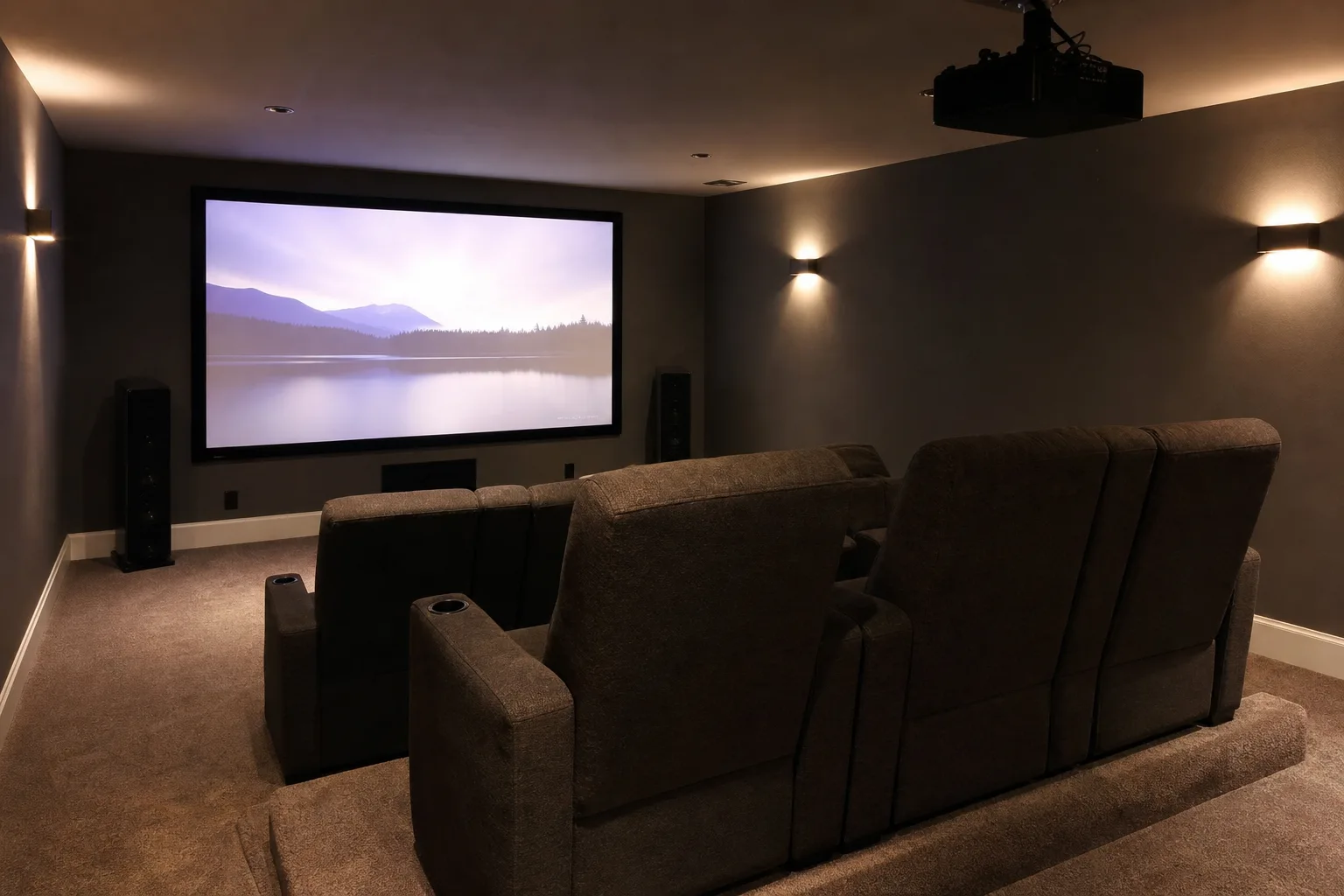
A real home theater room is more than a big TV and a soundbar. It is a projector filling a 100- to 150-inch screen, an AV receiver running separate speakers around and above the seats, and a subwoofer you feel as much as hear. Done well, it sounds and looks closer to a commercial cinema than any living room setup, and it does not have to take over the whole basement.
This guide covers the gear that matters most and how to put it together: which projector suits a dark room versus a room with some light, which screen material to pair with it, how a receiver-based surround system compares with wireless systems, how to pick and place a subwoofer, and how to light the room so the picture stays clean.
The short version
- Projector for a blacked-out room: the Valerion VisionMaster Max has the deepest blacks and a dynamic contrast mode that actually helps.
- Projector for a room that isn't fully dark: the XGIMI Horizon 20 Max is far brighter and still has excellent contrast.
- First projector for movie night: the NexiGo PJ40 Pro measured brighter than its rating, with very high native contrast and gaming-grade input lag.
- Receiver for most rooms: the Denon AVR-X2900H covers 5.1, 7.2 and 5.2.2 systems; step up to the Denon AVR-X3900H for four ceiling speakers or several subwoofers.
- Speakers: the Polk Signature Elite set (Polk Signature Elite ES50 towers, ES35 center, ES15 surrounds) sounds warm and clear and is easy for any receiver to drive.
- Subwoofer: the SVS SB17-Ultra for a dedicated room with space to spare, the SVS 3000 Micro when the room is small.
- Can't run speaker wire? The Hisense HT Saturn was the best wireless surround system in a head-to-head with Sony and Valerion.
Plan the room before buying anything
The room decides more than the gear does. Three questions settle most of the choices that follow.
- How dark can it get? A basement or interior room with no windows lets a projector show deep blacks. A room with daytime light or a lamp that stays on needs a brighter projector, an ambient-light-rejecting screen, or both.
- Where will the projector sit? The single-LCD projectors here throw a 100-inch image from about 9 to 10 feet away. Many single-LCD models have no lens offset, which means the middle of the lens has to line up with the middle of the screen, so they work best on a shelf or table at about bar height just behind the seats. Ceiling mounts and ultra-short-throw projectors change the screen choice, covered below.
- Can wire go in the walls or ceiling? A wired surround system with ceiling speakers clearly outperforms wireless systems, but running the wire through an attic or open joists can take a full day. If the drywall is still open, run speaker wire and an HDMI cable (or empty conduit) to the projector spot now.
For the bigger picture on picking a room, seating and layout, see this guide to converting any room into a home theater. A theater built inside a basement hangout follows many of the same rules as these man cave layouts.

Best for a dark theater
Valerion VisionMaster Max
15% offBlack Friday Dealoff recent price · as of 9:20 am MT · details
The deepest blacks of the group and a dynamic contrast mode that adds depth instead of flicker, for a dedicated blacked-out room.
- 4K laser
- Wide color gamut
- Dynamic contrast
Good for
- Fully dark rooms
- Large screens
- HDR movies
Skip it if
- The room has windows or lights you can't control
Projectors: match brightness to the room
Projectors trade brightness against black level. A dim projector keeps its black floor low, which looks great in a fully dark room and washed out once a light is on. A bright projector handles a lamp or a crack of daylight but needs more help from the screen and the room to look cinematic. Listed brightness is also unreliable: among 15 popular single-LCD projectors, most measured under half of their advertised ANSI lumens.
| Projector | Shop | Best room | Light source | Resolution | Strength | Watch out for |
|---|---|---|---|---|---|---|
| Valerion VisionMaster Max | View on Amazon
| Fully dark theater | Laser | 4K | Deepest blacks, effective dynamic contrast | Loses its edge in a lit room |
| XGIMI Horizon 20 Max |  View on Amazon | Living room or partly lit theater | RGB triple laser | 4K | Much brighter, still excellent contrast | Laser speckle on some screens |
| Hisense M2 Pro | 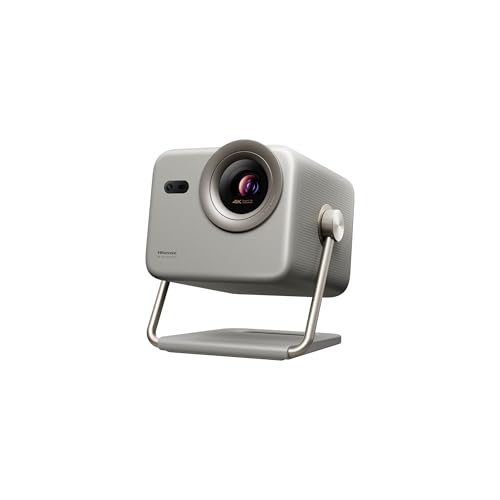 View on Amazon | Small dark room | RGB triple laser | 4K (pixel shift) | Wide color, accurate out of the box | Noticeably dimmer |
| NexiGo PJ40 Pro | 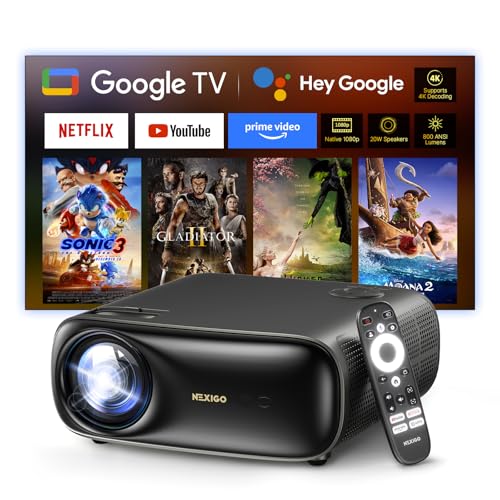 View on Amazon | Dim or dark room, first projector | LED, single LCD | 1080p native | High contrast, low input lag, Google TV | Loud fan at full brightness, dim corners |
Valerion VisionMaster Max: the dark-room pick
In a blacked-out room, the Valerion VisionMaster Max has the most cinematic picture of the group. Blacks stay deep in dark scenes and in mixed scenes where bright objects sit next to shadow. Most projectors' dynamic contrast modes either do nothing or cause distracting brightness jumps; Valerion's is one of the rare ones worth turning on, adding depth without making the picture pump. It is also bright enough for a large screen, covers a very wide color range for HDR, looks solid in its accurate modes out of the box and calibrates well.
Best for a dark theater
Valerion VisionMaster Max
15% offBlack Friday Dealoff recent price · as of 9:20 am MT · details
The deepest blacks of the group and a dynamic contrast mode that adds depth instead of flicker, for a dedicated blacked-out room.
- 4K laser
- Wide color gamut
- Dynamic contrast
Good for
- Fully dark rooms
- Large screens
- HDR movies
Skip it if
- The room has windows or lights you can't control
XGIMI Horizon 20 Max: the bright-room pick
The XGIMI Horizon 20 Max gets much brighter than the Valerion, and that changes how easy it is to live with. It can run a bigger image without looking dull, works with more screen materials and isn't punished much when the room isn't fully dark. It is not just bright, either: contrast is excellent, so movies keep their depth. In a truly dark room with adapted eyes, the Valerion still pulls ahead on blacks. The Horizon 20 and 20 Pro share the same features with less brightness and look nearly as good in a dark room.
Best for rooms with some light
XGIMI Horizon 20 Max
23% offBlack Friday Dealoff list price · as of 9:20 am MT · details
Far brighter than a typical dark-room projector while keeping excellent contrast, so it suits a living room or a theater with a lamp on.
- 4K
- RGB triple laser
- Very high brightness
Good for
- Living rooms
- Bigger screens
- Rooms that aren't fully dark
Skip it if
- You want the deepest blacks in a blacked-out room
XGIMI also makes the Horizon 30 Pro and Horizon 30 Ultra Max, which add 4K 120 Hz; they aren't compared here yet.
Hisense M2 Pro: portable triple laser
The Hisense M2 Pro uses a triple laser light source with pixel-shifted 4K, very wide color and strong accuracy straight out of the box. It is noticeably dimmer than the projectors above it, so set expectations: in a fully dark space it delivers a punchy picture with good depth, and it is a clear step up in color and detail over typical lamp projectors.
Best portable laser
Hisense M2 Pro
31% offBlack Friday Dealoff list price · as of 9:20 am MT · details
Triple laser color and detail in a portable projector, at its best in a dark room on a modest screen.
- Triple laser
- 4K pixel shift
- 65 to 200 in image
Good for
- Small dark rooms
- Accurate color without calibration
Skip it if
- You watch with lights on
NexiGo PJ40 Pro: best first projector
Among 15 popular projectors measured side by side, the NexiGo PJ40 Pro won clearly. It measured 818 ANSI lumens, slightly above its 800 rating, when most rivals came in under half of their claims, and its native contrast was close to 4,400:1. Picture quality held up against far more advanced projectors, and input lag was just 10.1 ms at the middle of the screen, the lowest measured on a single-LCD projector, so it doubles as a gaming screen. It also runs genuine Google TV.
The catch is the fan. At full brightness it reaches about 55 dB. Brightness level 4 is the sweet spot: about 475 lumens at 44 dB. Like all single-LCD projectors, corners are dimmer than the center (54 to 69% uniformity, versus 95% or more for many DLP projectors). The ELEPHAS W1K placed third, with strong brightness and contrast.
Best first projector
NexiGo PJ40 Pro
17% offBlack Friday Dealoff recent price · as of 9:20 am MT · details
Measured brighter than its rating with very high native contrast and low input lag, a strong picture for movies and games in a dim room.
- Native 1080p
- 800 ANSI lumens
- 10.1 ms input lag
Good for
- First projector
- Gaming on a big screen
- Google TV built in
Skip it if
- The projector sits right beside your seat (fan noise)
Pick the screen for your projector and light
The screen matters almost as much as the projector. Start with the form factor, then the material.
- Fixed frame: best tension and the widest choice of materials, plus a felt border that hides light spill around the image. The default for a dedicated room.
- Pull-down or motorized: frees the wall when the screen is up. Non-tensioned versions curl slightly at the edges, which is harmless for standard projectors but turns an ultra-short-throw image wavy. Ultra-short-throw projectors need a tab-tensioned screen.
- Painted wall: nothing to hang, but walls are less flat than they look and paint can't reject ambient light the way a good screen material can.
Gain describes how bright the screen is compared with plain white. A higher-gain screen raises brightness and the black floor together, so it can't improve contrast. Ambient-light-rejecting (ALR) screens can, by blocking light from the ceiling while reflecting the projector toward the seats. The trade-off is that ALR materials need the projector and the seating in the right place: off-center projection, keystone correction and wide seating all made ALR screens look uneven, while a white screen stayed uniform even at a 45-degree viewing angle.
Triple-laser projectors such as the XGIMI and Hisense add one more issue: laser speckle, a sparkle in bright, even areas. Textured, non-reflective materials reduce it most. The Silver Ticket STR Woven Acoustic Screen removed it completely and lets the front speakers sit behind the screen, and the Elite Screens Sable Frame CineWhite UHD kept it low with the even brightness of a white screen. For a room with ceiling lights on and a single-laser or hybrid projector, the Valerion Fresnel ALR Screen had the best uniformity of the ALR screens built for standard projectors.
| Screen | Shop | Type | Best with | Strength | Watch out for |
|---|---|---|---|---|---|
| Elite Screens Sable Frame CineWhite UHD | 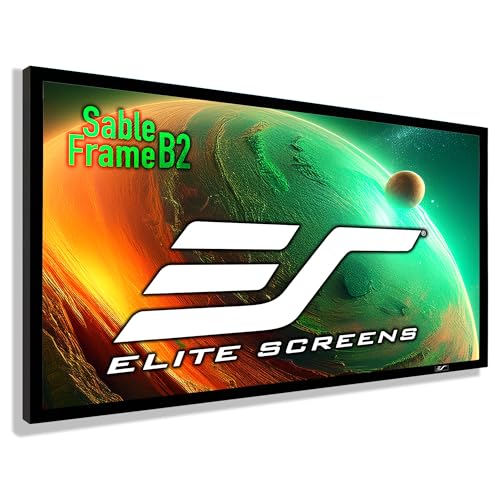 View on Amazon | White, fixed frame | Dark rooms, wide seating | Even brightness, low laser speckle | No ambient light rejection |
| Silver Ticket STR Woven Acoustic Screen |  View on Amazon | Woven acoustically transparent | Speakers hidden behind the screen, triple-laser projectors | Zero laser speckle, wide viewing angle | Texture shows with ultra-short-throw projectors |
| Valerion Fresnel ALR Screen |  View on Amazon | Fresnel ALR for long-throw projectors | Rooms with overhead lights on | Strong overhead light rejection, good uniformity | Dimmer when flipped for a ceiling mount |
Best white screen
Elite Screens Sable Frame CineWhite UHD
A tensioned white fixed-frame screen with even brightness edge to edge and little laser sparkle, for a dark room.
- Fixed frame
- CineWhite UHD
- 120 in
Good for
- Dark theaters
- Wide rows of seats
Skip it if
- You need to fight overhead light
Best to hide speakers
Silver Ticket STR Woven Acoustic Screen
15% offBlack Friday Dealoff recent price · as of 9:20 am MT · details
Sound passes through the woven material, so the front speakers can sit behind the screen, and it eliminated laser speckle entirely.
- Acoustically transparent
- Fixed frame
- Sizes past 140 in
Good for
- Speakers behind the screen
- Triple-laser projectors
Skip it if
- You use an ultra-short-throw projector
Best for overhead light
Valerion Fresnel ALR Screen
A Fresnel ALR screen made for standard throw projectors that rejected about 81% of overhead light and kept the best uniformity of the ALR screens.
- Fresnel ALR
- Fixed frame
- 100 in
Good for
- Rooms with ceiling lights
- Single-laser or hybrid long-throw projectors
Skip it if
- Your projector is ultra-short-throw
- Your projector is triple laser (more speckle)
Surround sound: a receiver and real speakers
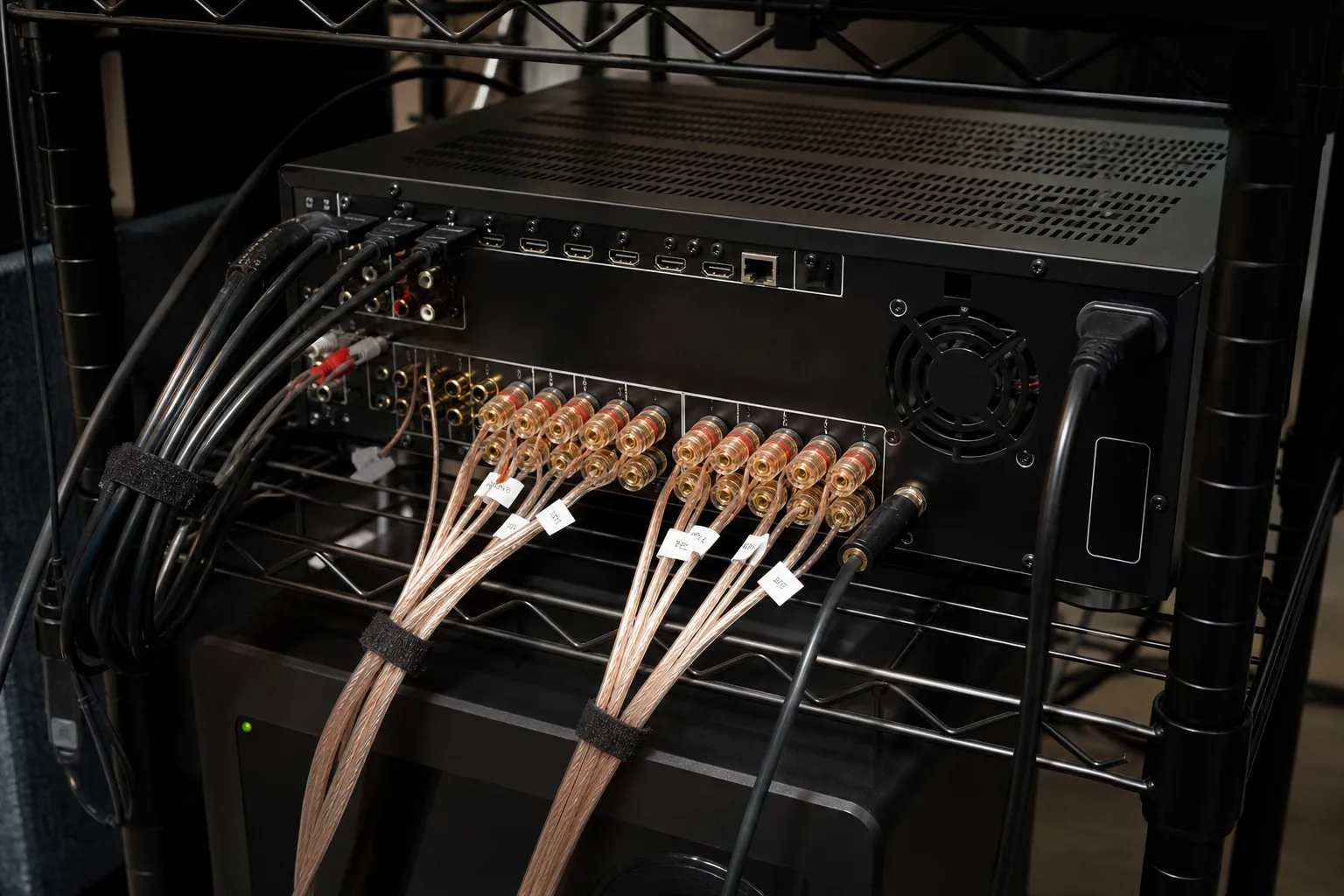
A soundbar is built to fake width and height from one box under the TV. A theater room gets separate speakers instead: front left, center and right, surrounds beside or behind the seats, one or more subwoofers, and for Dolby Atmos, height speakers in the ceiling. The numbers name the layout: 5.1 is five speakers and a sub, 5.1.2 adds two height speakers, and 7.1.4 is seven ear-level speakers, a sub and four overhead. Dolby's speaker setup guides show where each one goes.
How much difference does wired make? In a head-to-head with three wireless surround systems, a wired 5.1.4 setup with four in-ceiling height speakers and a 12-inch subwoofer clearly won on front width, overhead effects and deep bass. The wireless systems' 6.5- to 7-inch subwoofers and up-firing height drivers that bounce sound off the ceiling couldn't match real ceiling speakers. For a living room that only needs a clean upgrade, the best soundbars for TV and movies are still the simpler route.
| Gear | Shop | Role | Channels or size | Key strength | Watch out for |
|---|---|---|---|---|---|
| Denon AVR-X2900H | 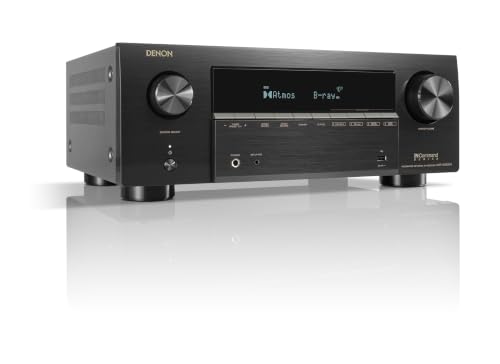 View on Amazon | Receiver | 7.2 channels, 95 W per channel | Clean HDMI switching, 4K 120 Hz and VRR for consoles, two HDMI outputs | Step up for four ceiling speakers or several subs |
| Denon AVR-X3900H |  View on Amazon | Receiver | 9.4 channels, 105 W per channel | Four sub outputs, full preamp outputs, Dirac ART upgrade | Dirac is a paid add-on with a learning curve |
| Polk Signature Elite ES50 |  View on Amazon | Front towers | Two 5.25 in woofers | Deep bass for the size, warm and clear | Bass tightens up with a high-pass filter |
| Polk Signature Elite ES35 |  View on Amazon | Center channel | Six 3 in woofers | Clear, natural dialogue in a slim cabinet | Add pads if wall-mounted to stop rattles |
| Polk Signature Elite ES15 |  View on Amazon | Surrounds or bookshelf | 5.25 in woofer | Good enough for front duty | Sticks out about 10 in from the wall |
| SVS SB17-Ultra |  View on Amazon | Subwoofer | 17 in driver | Reference output down to 15 Hz | 124 lb and very large |
| SVS 3000 Micro |  View on Amazon | Subwoofer | Dual 8 in drivers | Small, same app control as the big SVS | Can't match a large sub's deepest bass |
| Klipsch RP-1000SW |  View on Amazon | Subwoofer | 10 in driver | Plenty of punch for a mid-size room | Boomier and less detailed than the SVS |
Receivers: Denon AVR-X2900H or AVR-X3900H
The receiver decodes Dolby Atmos and DTS:X, powers every speaker, switches the projector's sources and runs room correction. For most theater rooms, the Denon AVR-X2900H is the right size. It sounds clearly more dynamic than Denon's AVR-X1700H, keeps dialogue clear under heavy bass and runs an Xbox Series X at 4K 120 Hz HDR with no handshake problems or black screens when switching inputs. It has six HDMI inputs (three with full 8K 60 Hz and 4K 120 Hz bandwidth), two HDMI outputs for running a TV and a projector, VRR, ALLM and FreeSync for gaming, Audyssey MultEQ XT room correction, a backlit remote and front preamp outputs for adding an amplifier later.
Best receiver for most rooms
Denon AVR-X2900H
Enough power and channels for a 5.1, 7.2 or 5.2.2 theater, with reliable HDMI switching and full gaming features.
- 7.2 channels
- 95 W per channel
- Two HDMI outputs
Good for
- 5.1 to 7.2 systems
- Consoles at 4K 120 Hz
- TV plus projector
Skip it if
- You want four ceiling speakers or several subs
The Denon AVR-X3900H is the step up for a bigger Atmos layout: 9.4 channels at 105 W per channel, four independent subwoofer outputs, full preamp outputs and a preamp mode for outside amplifiers. Its standout is support for the full Dirac suite, including Dirac ART, a paid upgrade that uses all the speakers and subs together to cancel lingering bass. With ART on, bass decay between 30 and 120 Hz dropped by 30 to 60%, dialogue got clearer and speakers that don't match blended into one sound field. Plan on some trial and error with Dirac, and on an outside amplifier if the front speakers are very demanding: one high-end tower distorted above 80 dB on the Denon's built-in power. The Onkyo TX-RZ30 is the main alternative, with Dirac Live included and a slightly livelier sound, but it supports two subs and can't run ART.
Best for a big Atmos layout
Denon AVR-X3900H
A 9.4-channel receiver with four sub outputs and Dirac ART support, for 5.1.4 rooms that want the cleanest bass.
- 9.4 channels
- 105 W per channel
- Four sub outputs
Good for
- Four ceiling speakers
- Two or more subwoofers
- Dirac room correction
Skip it if
- You will never use more than 5.1
Speakers: the Polk Signature Elite set
The Polk Signature Elite speakers have a warm, non-fatiguing sound with natural dialogue that rarely turns harsh, and every model is an 8-ohm design that any receiver can drive. The Polk Signature Elite ES50 towers (sold individually) dig surprisingly deep and fit close to the wall. Setting a high-pass filter around 70 Hz in the receiver tightens their bass, especially for music.
Best front towers
Polk Signature Elite ES50
Medium-size towers with deep bass for their size and a warm, clear sound that works for movies and music.
- Two 5.25 in woofers
- 1 in tweeter
- 8 ohm
Good for
- Front left and right
- Rooms without much space behind the speakers
Skip it if
- You want a bright, forward sound
The standouts are the smaller pieces. The Polk Signature Elite ES35 center channel packs six 3-inch woofers into a slim cabinet and can hang on the wall (add a few foam pads to stop rattles). The Polk Signature Elite ES15 bookshelf pair is good enough to play front channels, so as surrounds it is almost overqualified. They stick out nearly 10 inches from the wall, so stands or swing-arm mounts can keep them out of the way.
Best center channel
Polk Signature Elite ES35
A slim center with six small woofers that keeps voices clear and natural under loud scenes.
- Six 3 in woofers
- Slim cabinet
- Wall mountable
Good for
- Dialogue clarity
- Under a screen or on the wall
Skip it if
- You need a deep shelf-filling center
Best surrounds
Polk Signature Elite ES15
A bookshelf pair good enough for front duty, used as surrounds to match the towers and center.
- 5.25 in woofer
- 1 in tweeter
- Sold as a pair
Good for
- Side or rear surrounds
- Small front speakers
Skip it if
- You need speakers that sit flush with the wall
Polk's own HTS 10 subwoofer is the weak link of that set: it bottomed out on big movie scenes and doesn't reach below 30 Hz. Pair the speakers with one of the subwoofers below instead.
Subwoofers: size it to the room
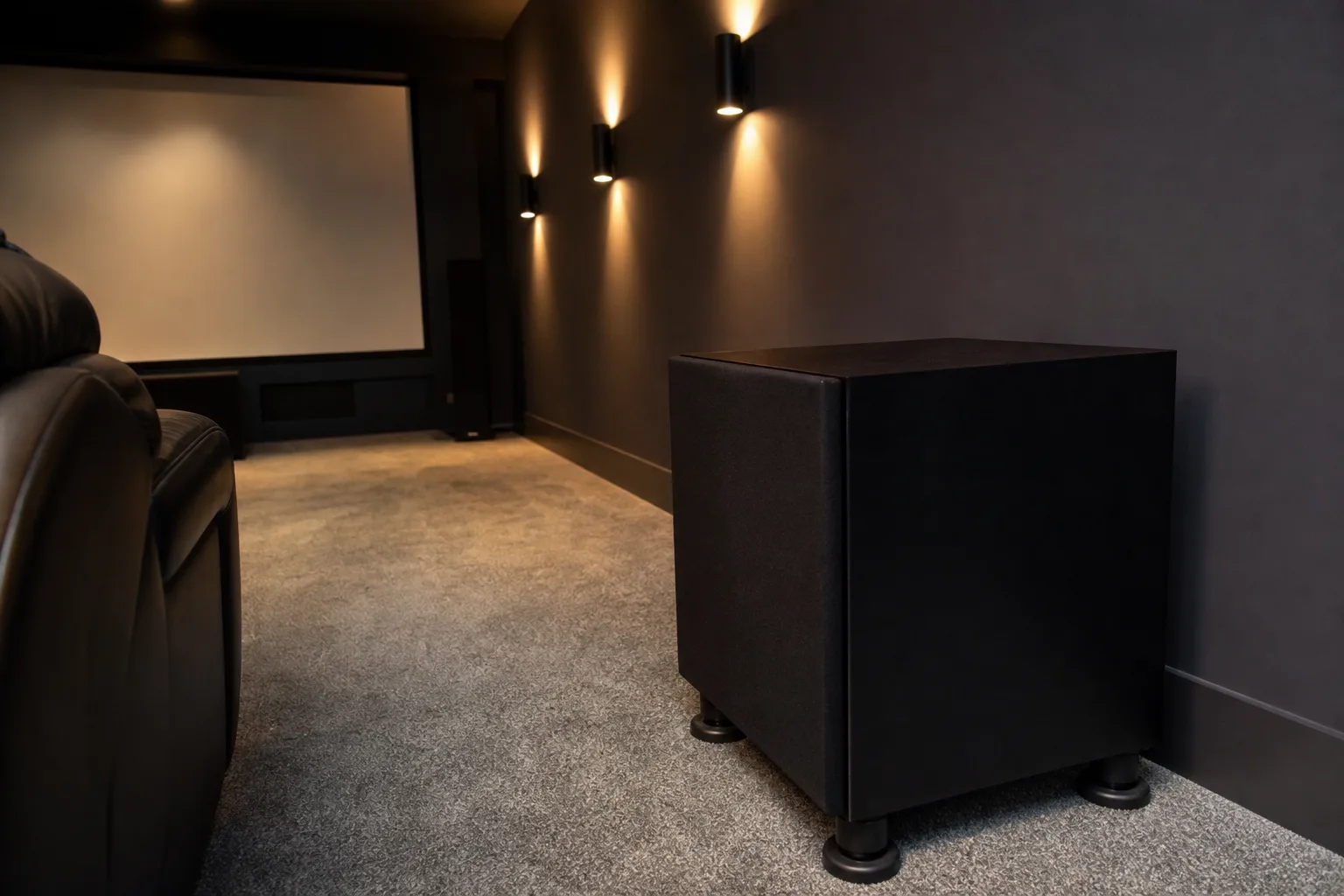
A good subwoofer is the single biggest upgrade in most systems, and placement matters as much as the sub itself. Front corners, where subwoofers usually end up in photos, can create a bass dip at the seats. Try a few spots (moving the sub along a side wall toward a corner often adds a lot) before settling, and let the receiver's room correction finish the job.
The SVS SB17-Ultra (full name SB17-Ultra R|Evolution) is a reference-grade sealed subwoofer with a 17-inch driver and a 2,800-watt amplifier. Measured outdoors, it hit 20 Hz at about 92 dB and 15 Hz at 86 dB, and stayed flat from 20 to 200 Hz. It never bottomed out or distorted and still sounded subtle and agile with music. It is also huge at 124 pounds, rattled nearby furniture and pushed open a cabinet door, so plan on isolation feet or washing-machine pucks, and on SVS's wireless adapter if a cable run is awkward.
Best for a dedicated theater
SVS SB17-Ultra
Reference-level bass down to 15 Hz that stays clean at any volume, for a room with space for a very large sub.
- 17 in driver
- 2,800 W RMS
- App EQ and presets
Good for
- Dedicated theater rooms
- Large spaces
- Movies and music
Skip it if
- The room is small or shared
For a smaller room, the SVS 3000 Micro uses two 8-inch drivers in a compact sealed cabinet and the same SVS app with the same level of adjustment. It can't match the big sub's output, but for most rooms it is more than enough. SVS also sells a 3000 Micro R|Evolution version, which isn't compared here yet. The Klipsch RP-1000SW is a strong choice for a mid-size room and can reach 20 Hz with help from the room, but it sounds boomier and less detailed than the SVS and bottomed out once or twice at very high volume. Two smaller subs can also be easier to place than one giant one.
Best compact subwoofer
SVS 3000 Micro
Two 8-inch drivers in a small sealed box with full app control, for rooms where a big sub won't fit.
- Dual 8 in drivers
- 800 W RMS
- Sealed
Good for
- Small theaters
- Bedrooms and bonus rooms
- Hiding a sub
Skip it if
- You want the deepest bass at reference volume
Best mid-size subwoofer
Klipsch RP-1000SW
27% offBlack Friday Dealoff recent price · as of 9:20 am MT · details
A 10-inch sub with plenty of punch for movies in a medium room, or as one of a pair.
- 10 in driver
- Cerametallic cone
- Mid-size cabinet
Good for
- Mid-size rooms
- Running two subs
Skip it if
- You want tight, detailed bass for music
Wireless surround for rooms you can't wire
Wireless surround systems put separate speakers around the room without running wire through the ceiling. They connect to the TV or projector through one HDMI eARC cable, which makes them a good match for a projector on a shelf or ceiling mount.
In a head-to-head of three wireless systems, the Hisense HT Saturn finished first or second in every category: clear vocals from its phantom center, wide front separation, convincing rear effects and a sound bubble that made the room feel much bigger than it was. It is a 4.1.2 system with four wireless speakers and a wireless 6.5-inch subwoofer, run from a small box with HDMI eARC, an HDMI input, optical and Bluetooth 5.3.

Best wireless surround
Hisense HT Saturn
31% offBlack Friday DealEnds tomorrowoff list price · as of 9:20 am MT · details
Four wireless speakers and a sub that beat the other wireless systems on vocals, width and surround effects, with no wire to run.
- 4.1.2 channels
- Wireless 6.5 in sub
- HDMI eARC
Good for
- Rentals and finished rooms
- Projector setups
- Simple setup
Skip it if
- You can run wire for a real receiver system
The Sony Bravia Theater Quad had the best overhead effects of the wireless group, thanks to its phone-based room calibration, and the strongest bass when paired with Sony's optional subwoofer (it doesn't include one). It came last on the all-around sound bubble, though. It suits Sony fans and oddly shaped rooms where its room correction helps. The Valerion Thunderbeat was the disappointment of the group: its sub clipped and distorted, and volume jumped between audio formats. One quirk to know with any wireless system: the speakers cut the range of a wireless mouse nearby, which matters for a home theater PC.

Best wireless height effects
Sony Bravia Theater Quad
26% off list price · as of 9:20 am MT · details
Four wireless speakers with app-based room calibration that placed overhead effects well, best for awkward rooms.
- Four wireless speakers
- Room calibration
- HDMI eARC
Good for
- Odd room shapes
- Sony TV owners
Skip it if
- You want deep bass without buying a separate sub
Lighting a theater room
Light is the projector's enemy, so plan it with the screen in mind.
- Keep light off the screen. Even one small lamp washes out a dim projector. Put dimmable lights on the side and rear walls, aimed away from the screen.
- Ceiling lights and ALR screens: ALR screens reject light from above best. A ceiling-mounted ultra-short-throw projector needs the screen flipped upside down, which removes that protection, so plan more uplights than downlights in that room.
- Use scenes. Smart bulbs or switches can dim everything to a movie scene with one tap; this comparison of Hue, Govee, WiZ and Lutron covers which to use. LED strips under riser steps or along the ceiling add a low glow for walking around; see which Govee strip to buy.
- TV instead of a projector? A TV backlight reduces eye strain in a dark room, and a large OLED like those in this LG vs. Samsung vs. Sony comparison is the alternative when the room can't be made dark.
Best for rooms with some light
XGIMI Horizon 20 Max
23% offBlack Friday Dealoff list price · as of 9:20 am MT · details
Far brighter than a typical dark-room projector while keeping excellent contrast, so it suits a living room or a theater with a lamp on.
- 4K
- RGB triple laser
- Very high brightness
Good for
- Living rooms
- Bigger screens
- Rooms that aren't fully dark
Skip it if
- You want the deepest blacks in a blacked-out room
Common theater room mistakes
- Buying on listed lumens. Many single-LCD projectors measure at less than half their advertised brightness; go by tested numbers.
- Keystoning instead of placing. Digital keystone softens the image. Put the projector where the lens lines up with the screen.
- An ALR screen in the wrong room. Off-center projectors and wide seating make ALR screens look uneven; a white screen is better there.
- A sub in the front corner by default. Test positions first; a corner can cancel the bass you paid for.
- Skipping isolation. A big sub will rattle furniture and doors without isolation feet or pucks.
- Closing the walls first. Run speaker wire and HDMI before drywall goes up. Echo control matters too: fabric acoustic panels like those in this spare-room studio guide tame a hard, echoey room.
Which setup fits which room
- Dedicated basement theater: Valerion VisionMaster Max on a white or woven screen, the Denon AVR-X3900H with a 5.1.4 Polk system and the SVS SB17-Ultra.
- Bonus room that isn't fully dark: XGIMI Horizon 20 Max on the Elite CineWhite screen, the Denon AVR-X2900H, Polk speakers and the SVS 3000 Micro.
- Spare bedroom or first theater: NexiGo PJ40 Pro, the Elite CineWhite screen, the Denon AVR-X2900H with a 5.1 set and the Klipsch RP-1000SW.
- Finished room, no wiring: any projector above with the Hisense HT Saturn.
Posted by Kristopher Larson
Deal badges come from Amazon. Product prices and availability are accurate as of the date/time indicated and are subject to change.
Frequently asked questions
Is a projector or a big TV better for a home theater room?
A projector wins on size: a 100- to 150-inch image is easy to reach with a projector and screen, and it feels more like a cinema. A large OLED or mini-LED TV wins on brightness and black level when the room can't be made dark. In a dedicated room with light control, a projector is the usual choice.
Does a home theater need an AV receiver for surround sound?
For a wired system with separate speakers, yes. The receiver decodes Dolby Atmos and DTS:X, powers each speaker, switches HDMI sources and runs room correction. Wireless surround systems and soundbars skip the receiver but can't match real ceiling speakers and a large subwoofer.
What does 5.1.2 or 7.1.4 mean?
The first number is the speakers at ear level, the second is subwoofers, and the third is height (ceiling or Atmos) speakers. A 5.1.2 system has left, center, right, two surrounds, one sub and two height speakers. A 7.1.4 adds two rear surrounds and four height speakers.
Is an ambient light rejecting screen worth it?
Only if the room has light you can't control and the projector and seats can sit where the screen expects them. ALR screens reject overhead light well but look uneven with off-center projection, keystone correction or wide seating. In a fully dark room, a white screen gives the most even picture.
Where should a subwoofer go in a home theater?
Test a few spots before settling. Front corners often create a bass dip at the seats, while a spot along a side wall can add a lot of output. Then run the receiver's room correction, and put isolation feet under a large sub so it doesn't rattle furniture.
Are wireless surround sound systems any good?
The best ones are. A wireless 4.1.2 system can sound wider and more convincing than a soundbar and connects to a projector with one HDMI eARC cable. A wired receiver system with in-ceiling speakers and a 12-inch or larger sub still sounds clearly better, especially for overhead effects and deep bass.
Keep reading
More from the blog
Mobile Office for Real Estate Agents: Canon PIXMA TR160 vs. HP OfficeJet 250 vs. ScanSnap iX1300
Solar Generator Bundles Compared: Jackery 1000 v2 vs. Anker SOLIX C300 vs. Bluetti Elite 30 V2
Best Whole-Home Battery Backup: EcoFlow DELTA Pro Ultra vs. Jackery 5000 Plus vs. Anker SOLIX F3800 Plus