Amazon Solar Kits: Renogy 200W and 400W Kits vs. ECO-WORTHY's Complete 400W Kit, and What Installing One Takes
Renogy's 200W RV kit and 400W Premium kit vs. ECO-WORTHY's complete 400W kit: what each box includes, what it runs and what installing one takes.
A solar kit is the middle ground between a portable power station and a rooftop system. One box holds the panels, the charge controller and the cables, and the fuller kits add batteries and an inverter. Amazon's listings look alike until the contents are read line by line: some are a complete power system, and others are only the solar half.
This guide compares three 12-volt kits. Two from Renogy, at 200 and 400 watts, supply panels and a charge controller. One from ECO-WORTHY adds batteries and an inverter. For the rest of a household readiness plan, the home emergency checklist covers water, food, light and heat.
Quick verdict
- Small roof-mount kit for an RV, van or shed: the Renogy 200W 12V N-Type RV Solar Panel Kit. Two 100-watt panels, a flush-mount 30-amp PWM controller and 30 feet of cable to bring the power inside. It includes no battery and no inverter.
- Complete system in one order: the ECO-WORTHY 400W 12V Complete Solar Panel Kit. Four 100-watt bifacial panels, a 40-amp MPPT controller, two 100 Ah lithium batteries and a 2,000-watt inverter. Once assembled it started a chop saw, an air compressor and a table saw, one at a time.
- More panel and an MPPT controller, battery chosen separately: the Renogy 400W Premium Solar Kit. Four 100-watt panels, the Rover 40-amp MPPT controller, a Bluetooth module, cables and fuses. No battery, no inverter.
- None of the three is a plug-in appliance. Each arrives as parts that have to be mounted, cabled and configured from the manual, and none should be tied into house wiring without an electrician.
The three kits side by side
| Kit | Shop | Panels | Charge controller | Battery | Inverter | Still to buy |
|---|---|---|---|---|---|---|
| Renogy 200W 12V N-Type RV Solar Panel Kit | 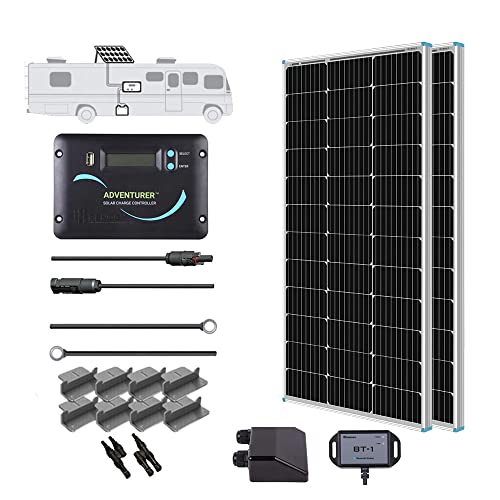 View on Amazon | 2 x 100 W N-type | Adventurer 30 A PWM, flush mount | Not included | Not included | Battery, inverter, fuses, roof sealant |
| ECO-WORTHY 400W 12V Complete Solar Panel Kit |  View on Amazon | 4 x 100 W bifacial | 40 A MPPT, 12/24 V | Two 12 V 100 Ah LiFePO4 (about 2.4 kWh) | 2,000 W pure sine wave, 12 V to 110 V | Panel rack or roof mounting, cable tools |
| Renogy 400W Premium Solar Kit |  View on Amazon | 4 x 100 W monocrystalline | Rover Li 40 A MPPT with BT-2 Bluetooth module | Not included | Not included | Battery, inverter, inverter cables and fuses, three more 10 A fuses for parallel panels |
Small roof-mount kit for an RV or van
Renogy 200W 12V N-Type RV Solar Panel Kit
15% offBlack Friday Dealoff recent price · as of 9:20 am MT · details
Two panels, a flush-mount 30-amp PWM controller and the cables to reach a battery; the battery and inverter are separate purchases.
- 2 x 100 W N-type panels
- Adventurer 30 A PWM, flush mount
- Expandable to 400 W
Good for
- Keeping an RV or van battery charged
- A first, small system that can grow to 400 watts
Skip it if
- Drilling into a roof is off the table
- An MPPT controller is wanted
What is actually in the box
The word "kit" covers two different products. A panel-and-controller kit, like the two Renogy kits, turns sunlight into regulated battery charging and stops there. Renogy says of its 400-watt kit that a buyer still needs an inverter, batteries, battery-to-inverter cables and inverter fuses. A complete kit, like the ECO-WORTHY, adds the storage and the 110-volt outlets.
ECO-WORTHY sells its 400-watt kit with and without batteries, and with one battery or two, on separate Amazon pages. The two-battery, 2,000-watt version is the one compared here, so check the battery count and inverter wattage in the title before ordering. The "1.6KWH" in the listing name is ECO-WORTHY's estimate of what the panels produce on an average day. It is not the battery size: the two batteries hold about 2.4 kWh.
What kits this size can run
The inverter's watt rating decides what can be switched on. The battery's kilowatt-hours decide how long it stays on.
Through its 2,000-watt inverter the ECO-WORTHY kit started and ran a chop saw, an air compressor and a table saw, one at a time. A 100-watt load running for 10 hours uses 1 kWh, so a full 2.4 kWh bank is roughly a day of steady 100-watt draw before the panels add anything. That suits a router, phone charging and LED lights. For a refrigerator, divide the kWh-per-year figure on its EnergyGuide label by 365 and compare. No kit this size runs a whole house, electric heat or central air conditioning.
Panels refill a battery slowly, and rated watts are a noon-in-full-sun figure. The ECO-WORTHY array, tilted at the 30 degrees its instructions call for, was making about 98 watts at five in the afternoon. The Renogy 400-watt kit's panels, laid flat on the ground, pushed about 15 amps into a 12-volt lithium bank, close to half of the array's rating.
The 200-watt Renogy kit is sized to keep one battery topped up. With two panels wired in parallel in full sun, the Adventurer controller held a 100 Ah battery at 14.2 volts while charging. Renogy describes the kit as power for small electronics and limited low-wattage equipment, which means lights, a fan and phone charging in a van, not a household refrigerator.
Complete kit with batteries and inverter
ECO-WORTHY 400W 12V Complete Solar Panel Kit
30% offBlack Friday Dealoff list price · as of 9:20 am MT · details
Four bifacial panels, an MPPT controller, two lithium batteries and a 2,000-watt inverter in one order; it started a chop saw, an air compressor and a table saw.
- 4 x 100 W bifacial panels
- About 2.4 kWh of lithium storage
- 2,000 W pure sine inverter
Good for
- A shed, workshop, RV or cabin
- Outage power for small loads
Skip it if
- Cutting and crimping heavy cable sounds like too much
- The batteries would have to charge below freezing
What installing one takes
Plan on a weekend and a few purchases the kit does not cover. A Renogy 200-watt bundle with a self-heating 100 Ah lithium battery and a 1,000-watt inverter took 8 to 10 hours to fit into a truck: cables had to be cut and re-crimped to place the fuses, one positive cable was black and needed marking, and the panel came with no mounting hardware.
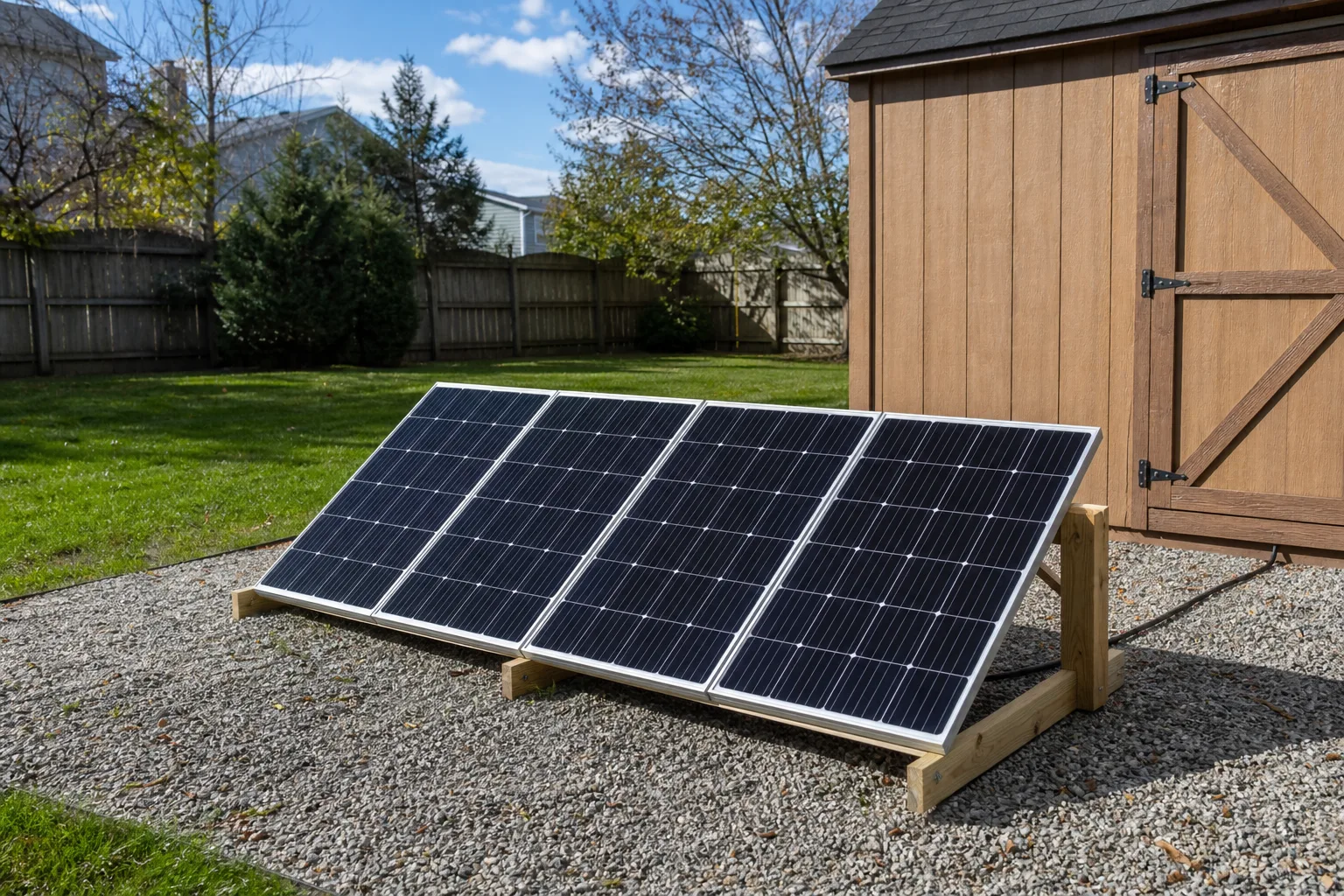
- Something to mount the panels on. All three kits include Z brackets, which fasten a panel flat to a roof or a frame. None includes tilt legs. The ECO-WORTHY panels went onto a rack built from 2x4 lumber. The Renogy 400-watt panels, with no stand, could only lie on the ground.
- Holes in a roof, and sealant. Mounting a panel from the Renogy 200W kit on a van meant ten holes in the roof and one more for the cables. The kit as installed supplied self-tapping screws with rubber washers. Through-bolts with locking nuts, and roof sealant under every bracket, are the sturdier choice on sheet metal. Renogy recommends Sikaflex 252 or a similar adhesive for the cable entry housing.
- Cable tools. The ECO-WORTHY install meant cutting heavy cable, crimping lugs onto it and sealing the ends with heat-shrink. No crimper or cable cutter is in the box.
- Parts the diagram may call for. A battery on/off switch was added to the ECO-WORTHY system, and three cable lugs ended up stacked on one battery post for want of a bus bar. Neither part is in the box, and where one goes is for the maker's diagram to say.
- Fuses for the panel layout. Renogy's contents list for the 400-watt kit has one 10-amp in-line fuse and one 40-amp ANL fuse. Renogy says three more 10-amp in-line fuses are needed when all four panels are wired in parallel.
- A settings step. The Rover controller had to be switched to its lithium setting, following the manual, before it charged a lithium bank properly. On one Adventurer controller the terminals were unlabelled, and the manual was the only guide to which was which.
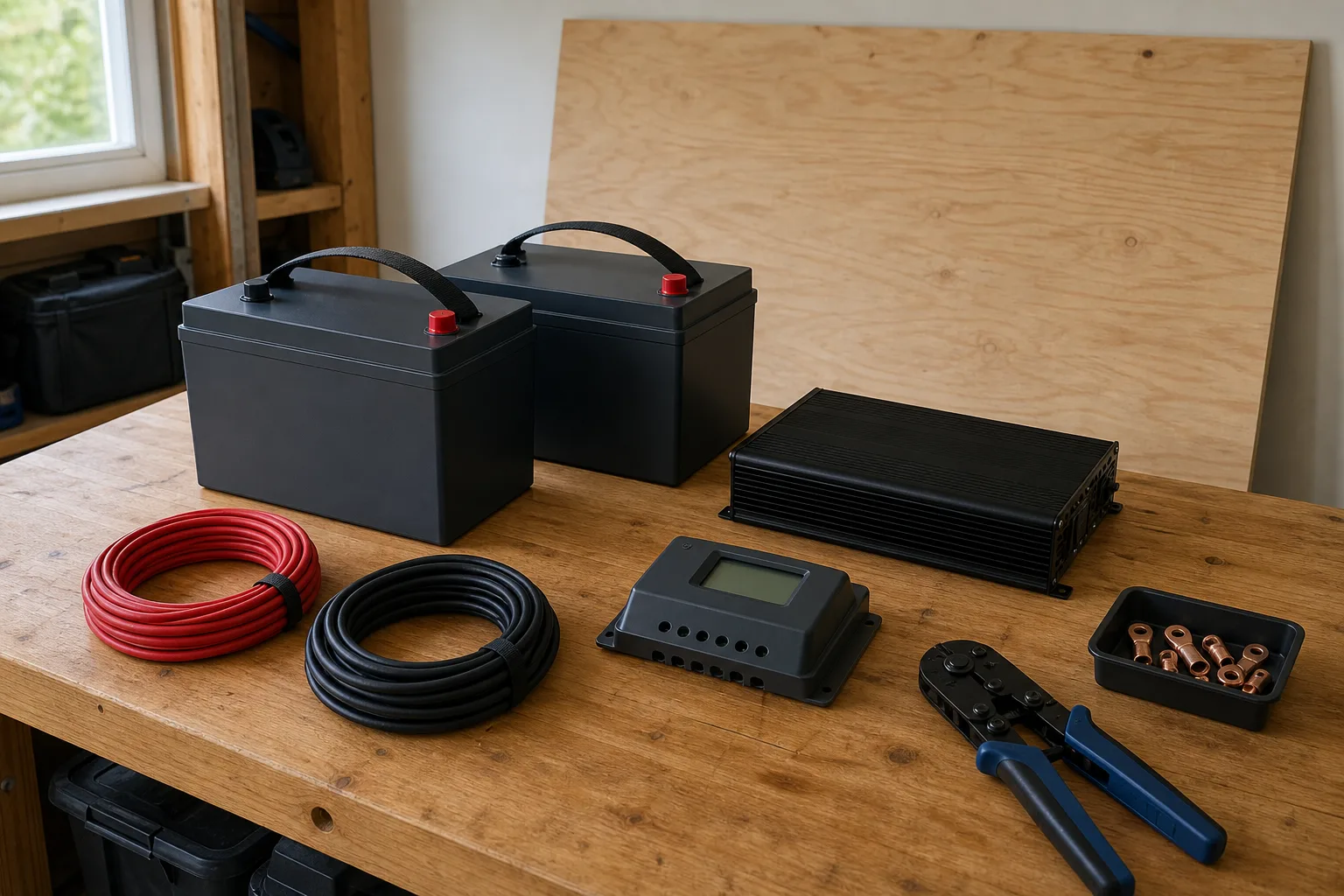
Follow the maker's wiring diagram exactly, including cable sizes, fuse sizes and the order of connections. If a diagram is missing, get it from the maker before connecting anything, and hire an electrician if any step is unclear. ECO-WORTHY posts its manuals on its kit page, and Renogy lists contents, fuse requirements and manuals on the pages for its 200-watt and 400-watt kits.
Keep it separate from house wiring
These kits are stand-alone systems. Appliances plug into the inverter's own outlets.
Connecting a kit to a home's electrical panel is a different job. It needs a transfer switch or interlock, usually a permit, and a licensed electrician. Never feed a house circuit by plugging an inverter into a wall outlet. Rules vary by city and county. The National Electrical Code is the base most of them build on, and the local building department has the final word.
Panel output falls late in the day and under cloud, so for a long outage a fuel generator covers what the panels cannot. The inverter generator comparison covers that side.
400 watts of panels with an MPPT controller
Renogy 400W Premium Solar Kit
18% offBlack Friday Dealoff list price · as of 9:20 am MT · details
Four panels, the Rover 40-amp MPPT controller, Bluetooth monitoring, cables and fuses; the battery and inverter are separate purchases.
- 4 x 100 W panels
- Rover Li 40 A MPPT
- BT-2 Bluetooth module
Good for
- Charging a battery bank already owned
- An RV or van with its own inverter
Skip it if
- One box should hold the whole system
- Panels need to prop up without a frame
The picks in detail
Renogy 200W 12V N-Type RV Solar Panel Kit: a small roof-mount charging kit
The Renogy 200W 12V N-Type RV Solar Panel Kit is built for a vehicle roof. The Amazon listing names N-type panels. Renogy's package list for the kit has two 100-watt panels, the Adventurer 30-amp PWM controller, the BT-1 Bluetooth module, a 30-foot adaptor cable, a 16-foot tray cable, Y branch connectors, Z brackets and a roof cable entry housing. Renogy's own site calls it the 200W 12V Essential Solar Panel Kit. Confirm the Bluetooth module and entry housing in the listing's contents, and take panel dimensions from the listing.
The Adventurer mounts flush in a wall or cabinet, with a screen that shows panel voltage, battery voltage and charging state. Through the BT-1 module, the same figures and the battery settings show on a phone. Connecting the panels backwards brought up an error message on the screen. Renogy lists support for lithium, sealed, gel and flooded batteries and room for up to 400 watts of panels.
Two limits come with the PWM controller. Renogy lists its maximum panel input at 25 volts, which two 12-volt panels in series would exceed. The Y branch connectors in the box are for wiring the panels in parallel. And PWM is the simpler type: the MPPT controllers in the two 400-watt kits turn spare panel voltage into extra charging current.
Small roof-mount kit for an RV or van
Renogy 200W 12V N-Type RV Solar Panel Kit
15% offBlack Friday Dealoff recent price · as of 9:20 am MT · details
Two panels, a flush-mount 30-amp PWM controller and the cables to reach a battery; the battery and inverter are separate purchases.
- 2 x 100 W N-type panels
- Adventurer 30 A PWM, flush mount
- Expandable to 400 W
Good for
- Keeping an RV or van battery charged
- A first, small system that can grow to 400 watts
Skip it if
- Drilling into a roof is off the table
- An MPPT controller is wanted
ECO-WORTHY 400W 12V Complete Solar Panel Kit: everything in one order
The ECO-WORTHY 400W 12V Complete Solar Panel Kit is the one to look at when the goal is working outlets. Its four 100-watt panels are bifacial. The 40-amp MPPT controller accepts up to 560 watts of panels at 12 volts, leaving room to add one later.
The two 12-volt 100 Ah lithium iron phosphate batteries weigh about 21 pounds each. ECO-WORTHY lists their charging range as 32 to 131 degrees Fahrenheit, so in an unheated garage or shed they will run loads below freezing but should not be charged.
The weak spot is finish work: the rack, the mounting board and the crimped cable ends are the installer's job.
Complete kit with batteries and inverter
ECO-WORTHY 400W 12V Complete Solar Panel Kit
30% offBlack Friday Dealoff list price · as of 9:20 am MT · details
Four bifacial panels, an MPPT controller, two lithium batteries and a 2,000-watt inverter in one order; it started a chop saw, an air compressor and a table saw.
- 4 x 100 W bifacial panels
- About 2.4 kWh of lithium storage
- 2,000 W pure sine inverter
Good for
- A shed, workshop, RV or cabin
- Outage power for small loads
Skip it if
- Cutting and crimping heavy cable sounds like too much
- The batteries would have to charge below freezing
Renogy 400W Premium Solar Kit: more panel, MPPT controller
The Renogy 400W Premium Solar Kit suits a buyer who already owns batteries, or who wants to choose the battery and inverter separately. It includes four 100-watt panels, the Rover Li 40-amp MPPT controller, the BT-2 Bluetooth module, a 20-foot adaptor cable, an 8-foot tray cable, Z brackets, Y branch connectors and two fuses.
The Rover accepts up to 520 watts of panels at 12 volts or 1,040 watts at 24 volts, so the kit can grow. Feeding a lithium battery bank, the kit kept charging steadily while an inverter drew from the same batteries.
400 watts of panels with an MPPT controller
Renogy 400W Premium Solar Kit
18% offBlack Friday Dealoff list price · as of 9:20 am MT · details
Four panels, the Rover 40-amp MPPT controller, Bluetooth monitoring, cables and fuses; the battery and inverter are separate purchases.
- 4 x 100 W panels
- Rover Li 40 A MPPT
- BT-2 Bluetooth module
Good for
- Charging a battery bank already owned
- An RV or van with its own inverter
Skip it if
- One box should hold the whole system
- Panels need to prop up without a frame
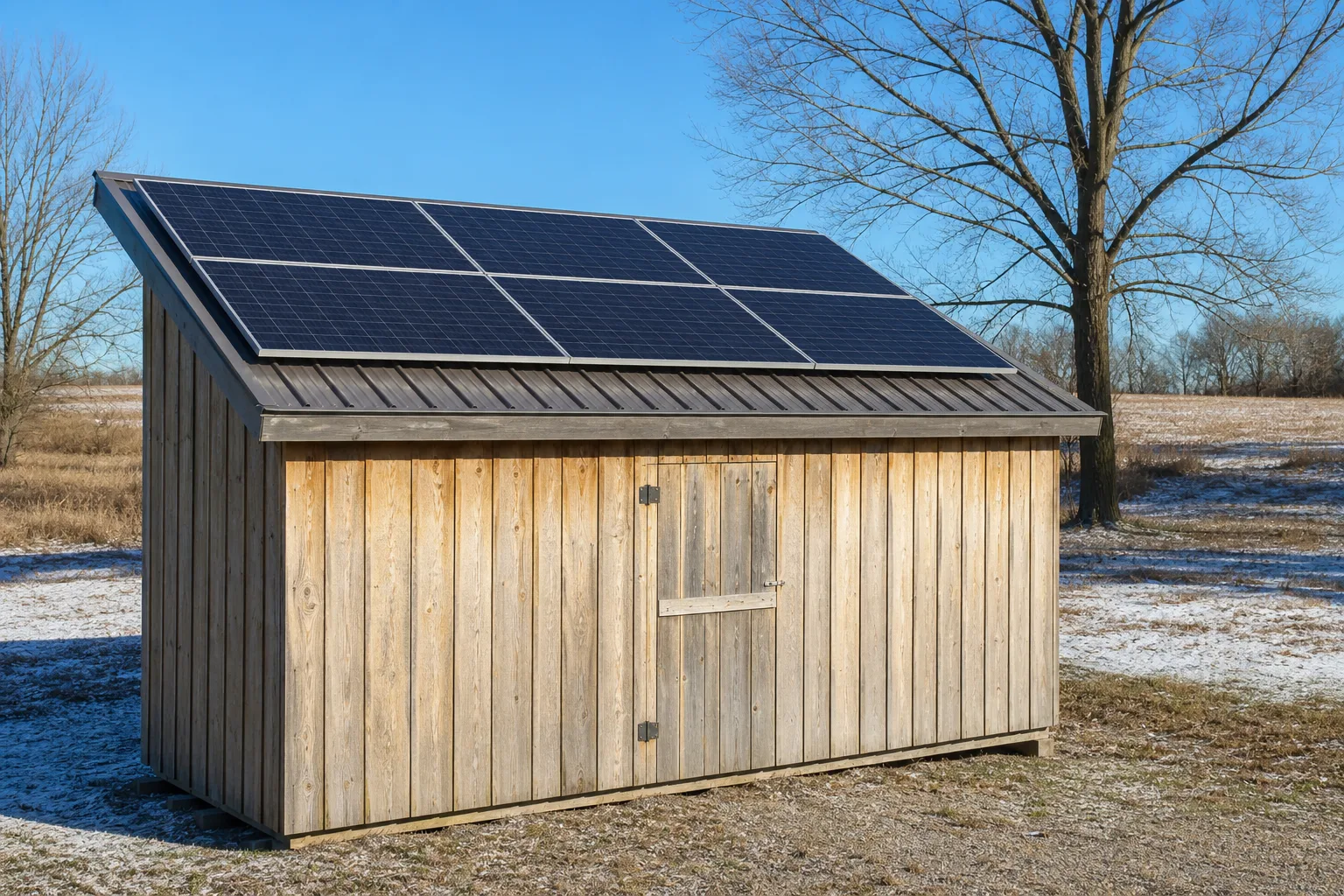
When 400 watts is not enough: 48-volt kits
ECO-WORTHY's larger kits move to 48 volts. They pair 195-watt bifacial panels with a 3,500-watt all-in-one inverter and charger and a 48-volt 100 Ah rack battery that holds 5.12 kWh, a little more than twice the storage of the 12-volt kit.
None is compared here. Panel strings at this size run at voltages high enough to be dangerous, and the string layout has to come from the inverter's manual, so plan one with an electrician.
Small roof-mount kit for an RV or van
Renogy 200W 12V N-Type RV Solar Panel Kit
15% offBlack Friday Dealoff recent price · as of 9:20 am MT · details
Two panels, a flush-mount 30-amp PWM controller and the cables to reach a battery; the battery and inverter are separate purchases.
- 2 x 100 W N-type panels
- Adventurer 30 A PWM, flush mount
- Expandable to 400 W
Good for
- Keeping an RV or van battery charged
- A first, small system that can grow to 400 watts
Skip it if
- Drilling into a roof is off the table
- An MPPT controller is wanted
Who should buy which
- An RV or van that needs its battery kept charged: the Renogy 200W kit, with its flush-mount controller.
- A first system for a shed, workshop or outage shelf: the ECO-WORTHY complete kit, because nothing has to be matched.
- A cabin or larger RV that already has batteries: the Renogy 400W kit, which adds faster charging without duplicating parts.
- Daily loads beyond a 2,000-watt inverter and 2.4 kWh of storage: a 48-volt kit, planned with an electrician.
- Anyone who wants power without mounting or cabling: a portable power station. See the Jackery power station guide.
- Anyone buying loose panels to build around: see the solar panel guide.
Posted by Kristopher Larson
Deal badges come from Amazon. Product prices and availability are accurate as of the date/time indicated and are subject to change.
Frequently asked questions
What can a 400-watt solar kit run?
It depends on the battery and inverter more than the panels. A complete 400-watt kit with about 2.4 kWh of lithium storage and a 2,000-watt inverter can start power tools one at a time and keep a router, lights and phone chargers going. A 100-watt load uses 1 kWh in 10 hours, so compare an appliance's daily kWh with the battery size. It is too small for a whole house, electric heat, a clothes dryer or central air conditioning.
Do solar kits on Amazon come with a battery and inverter?
Some do and some do not. Renogy's 200W 12V N-Type RV Solar Panel Kit and 400W Premium Solar Kit include panels, a charge controller and cables, with no battery or inverter. ECO-WORTHY sells its 400-watt kit with or without batteries and an inverter. Read the contents list on the listing, not only the title.
Can a solar kit be connected to a home's electrical panel?
Not as a do-it-yourself step. These kits are built for stand-alone use, with appliances plugged into the inverter's outlets. Tying any power source into a home's panel requires a transfer switch or interlock, compliance with the local electrical code, usually a permit, and a licensed electrician. An inverter should never be plugged into a wall outlet to power a circuit.
How much power does a 400-watt solar kit make in a day?
ECO-WORTHY estimates an average of 1.6 kWh a day for its 400-watt kit, depending on sunlight. Real output moves a lot with weather, season, shade and panel angle. Panels lying flat or working late in the afternoon can produce a quarter to a half of their rating.
Is a 12-volt or a 48-volt solar kit better?
A 12-volt kit fits small systems of a few hundred watts of panels and matches RV and marine equipment. A 48-volt kit makes sense for larger arrays and inverters of several thousand watts, because higher voltage moves the same power on thinner cable. The voltages in a 48-volt system's panel strings are higher and call for more care.
Do lithium solar batteries work in a cold garage?
They will power loads in the cold, but most lithium iron phosphate batteries should not be charged below freezing. ECO-WORTHY lists a charging range of 32 to 131 degrees Fahrenheit for its 12-volt 100 Ah battery. Check the battery's manual for its limits before installing one in an unheated space.
Keep reading
More from the blog
Mobile Office for Real Estate Agents: Canon PIXMA TR160 vs. HP OfficeJet 250 vs. ScanSnap iX1300
Solar Generator Bundles Compared: Jackery 1000 v2 vs. Anker SOLIX C300 vs. Bluetti Elite 30 V2

Home Theater Room Setup: Best Projectors, Surround Sound, Screens and Lighting