Best Whole-Home Battery Backup: EcoFlow DELTA Pro Ultra vs. Jackery 5000 Plus vs. Anker SOLIX F3800 Plus
EcoFlow DELTA Pro Ultra, Jackery 5000 Plus and Anker SOLIX F3800 Plus compared for outages: capacity, 240V output, solar and safe panel hookup.
A whole-home battery backup is a big rolling power station, usually 4 to 6 kWh per box with room for more batteries, that can feed your home's circuits during an outage with no fuel and no exhaust. Three of the most capable are the EcoFlow DELTA Pro Ultra, the Jackery Explorer 5000 Plus and the Anker SOLIX F3800 Plus. All three put out 120 and 240 volts, but they differ in what matters: how much they run at once, how they connect to a panel, and how much solar they can take.
Below: how each does in real outages, and the wiring step you can't skip. If you only need to run a fridge, a CPAP or a laptop, a smaller unit is enough: see the guide to portable Jackery power stations.
Quick verdict
- Best for long outages and big solar arrays: the EcoFlow DELTA Pro Ultra. The most output and the most solar input of the group, and it grows the furthest, but it's a two-piece stack that stays on hard floors.
- Best single box for a generator inlet: the Jackery Explorer 5000 Plus. Battery, inverter and charger in one case, with 120/240-volt output that runs an electric dryer, oven and water heater.
- Best for automatic switchover on key circuits: the Jackery Explorer 5000 Plus and Smart Transfer Switch, the same unit with a switch an electrician wires in for 12 circuits.
- Best for RV owners and pairing with a gas generator: the Anker SOLIX F3800 Plus Portable Power Station and BP3800 Expansion Battery, with an RV outlet, EV charging mode and a 240-volt generator bypass.
The home battery backups side by side
| Home battery | Shop | Capacity (one unit) | Continuous output | Output voltage | Max expansion | Max solar input | Weight |
|---|---|---|---|---|---|---|---|
| EcoFlow DELTA Pro Ultra |  See options | 6,144 Wh | 7,200 W | 120/240 V split phase | 30 kWh per inverter, 90 kWh as a 3-inverter system | 5,600 W (80-450 V and 30-150 V inputs) | Inverter 70 lb + battery 111.8 lb |
| Jackery Explorer 5000 Plus | 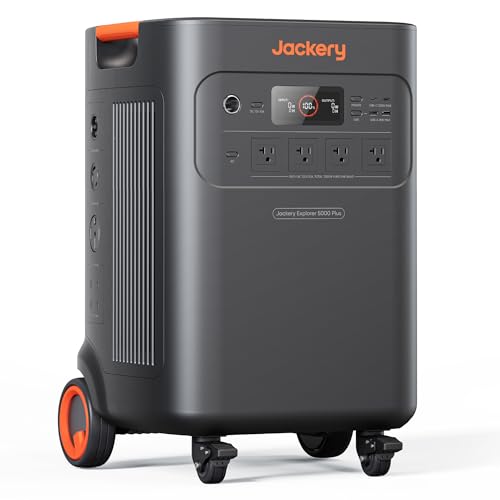 View on Amazon | 5,040 Wh | 7,200 W | 120/240 V split phase | 60 kWh | 4,000 W (135-450 V and 16-60 V inputs) | About 134.5 lb |
| Anker SOLIX F3800 Plus Portable Power Station and BP3800 Expansion Battery |  See options | 3,840 Wh unit + 3,840 Wh battery | 6,000 W | 120/240 V split phase | 6 expansion batteries per unit; 53.8 kWh with two units | 3,200 W (two 11-165 V inputs) | Unit 136.7 lb + battery 72.8 lb |
Best one-box unit
Jackery Explorer 5000 Plus
An all-in-one 240-volt unit that plugs into a standard generator inlet and runs dryers, ovens and water heaters one at a time.
- 5,040 Wh
- 7,200 W at 120/240 V
- 4,000 W solar
Good for
- Homes with a generator inlet already installed
- All-electric houses
- A simple one-case setup
Skip it if
- You need it to start a standard central air conditioner without a soft starter
How they actually differ
240 volts is what makes it whole-home
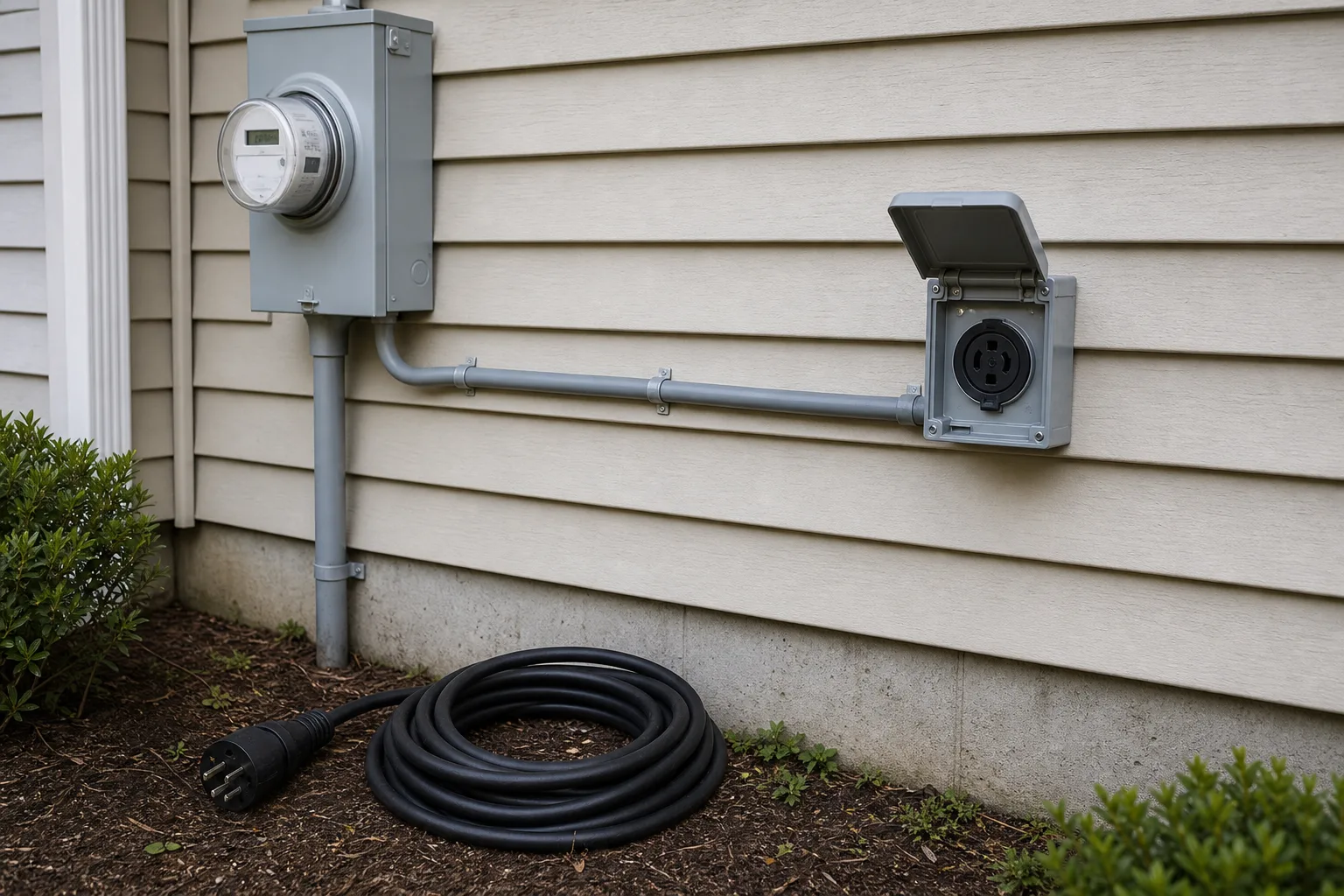
All three are split-phase 120/240-volt units, which is what a North American home panel uses. Fed through a 30-amp generator inlet with the grid disconnected, the Jackery Explorer 5000 Plus powered a whole 200-amp, all-electric house's 120-volt circuits and its 240-volt appliances one at a time: lights, fridge, TV and router drew about 460 W together; baking in the electric oven pushed the total to about 3,060 W; one burner on medium pulled about 3,000 W; the electric dryer pushed output just past 6,000 W; and a 4,500 W water heater ran without a trip. The EcoFlow, at the same 7,200 W, handles the same single big loads, and the Anker's 6,000 W covers most of them.
Units that put out 120 volts only can't feed both legs of a panel. The BLUETTI AC500, a modular 120-volt system that's hard to find in stock, shows what that setup is still good for: on transfer panels covering eight circuits, two of its batteries (about 6 kWh) ran a full-size fridge, sump pump, garage door opener, router and every light on two floors for about 24 hours without conserving and about two days on essentials, very quietly. It couldn't touch a dryer, range or well pump.
Central air is the usual exception
None of these is a guaranteed match for a standard central air conditioner. The Jackery would not start a 4-ton central unit because the compressor's starting surge is too high; a soft starter fitted to the condenser by an HVAC tech is the usual fix. Mini-splits and window units are easy work for all of them.
Runtime is about the battery, not the inverter
A big inverter drains a small battery fast. At about 6,000 W, the Jackery's single 5 kWh battery had a little over half an hour left; at 460 W of lights and fridge it showed close to five hours from half charge. That's why every one of these takes extra batteries, and why the Anker listing here comes with one. Plan on at least one expansion battery: the Jackery Battery Pack 5000 Plus, for example, doubles the 5000 Plus to about 10 kWh.
Solar input decides how long you can keep going
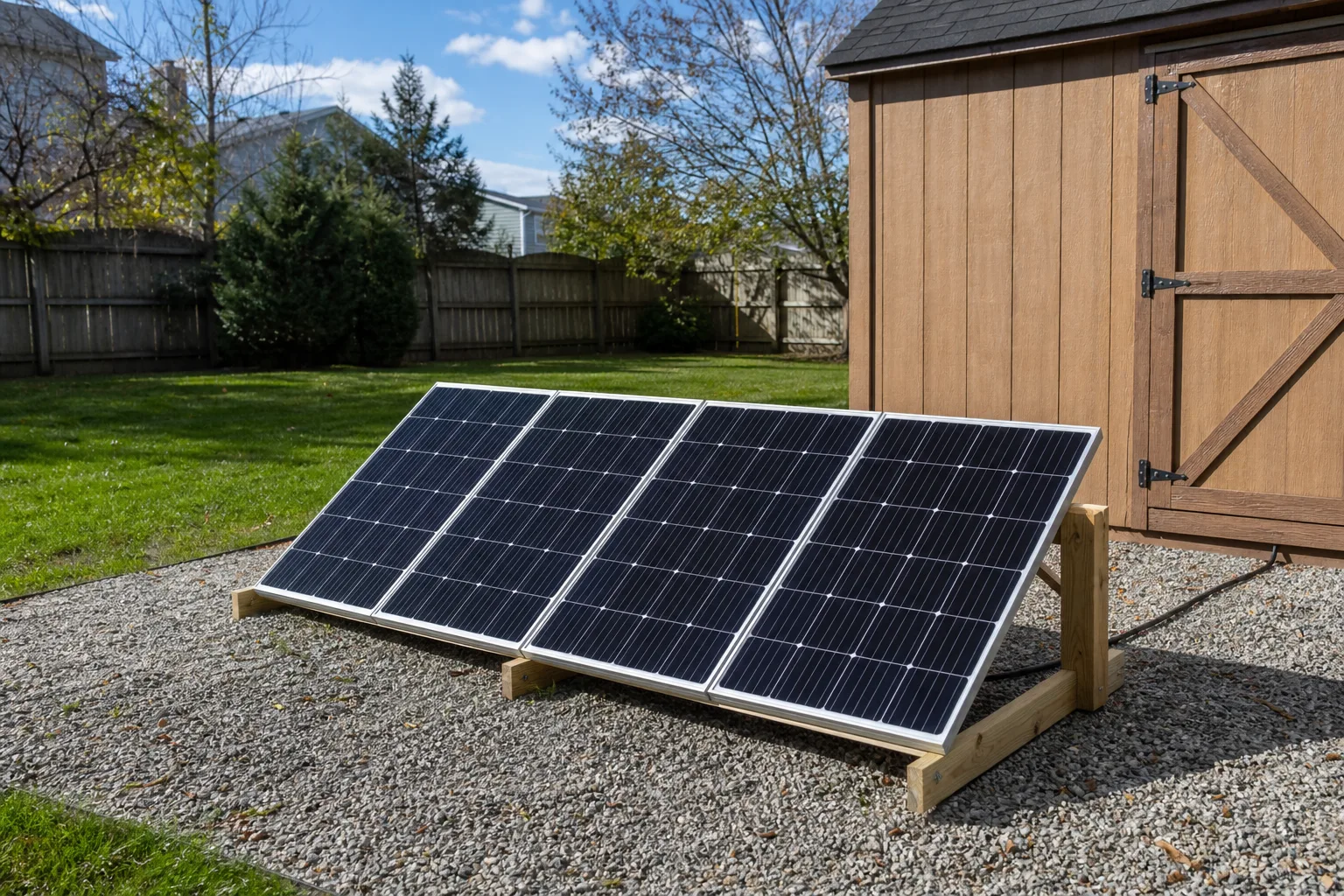
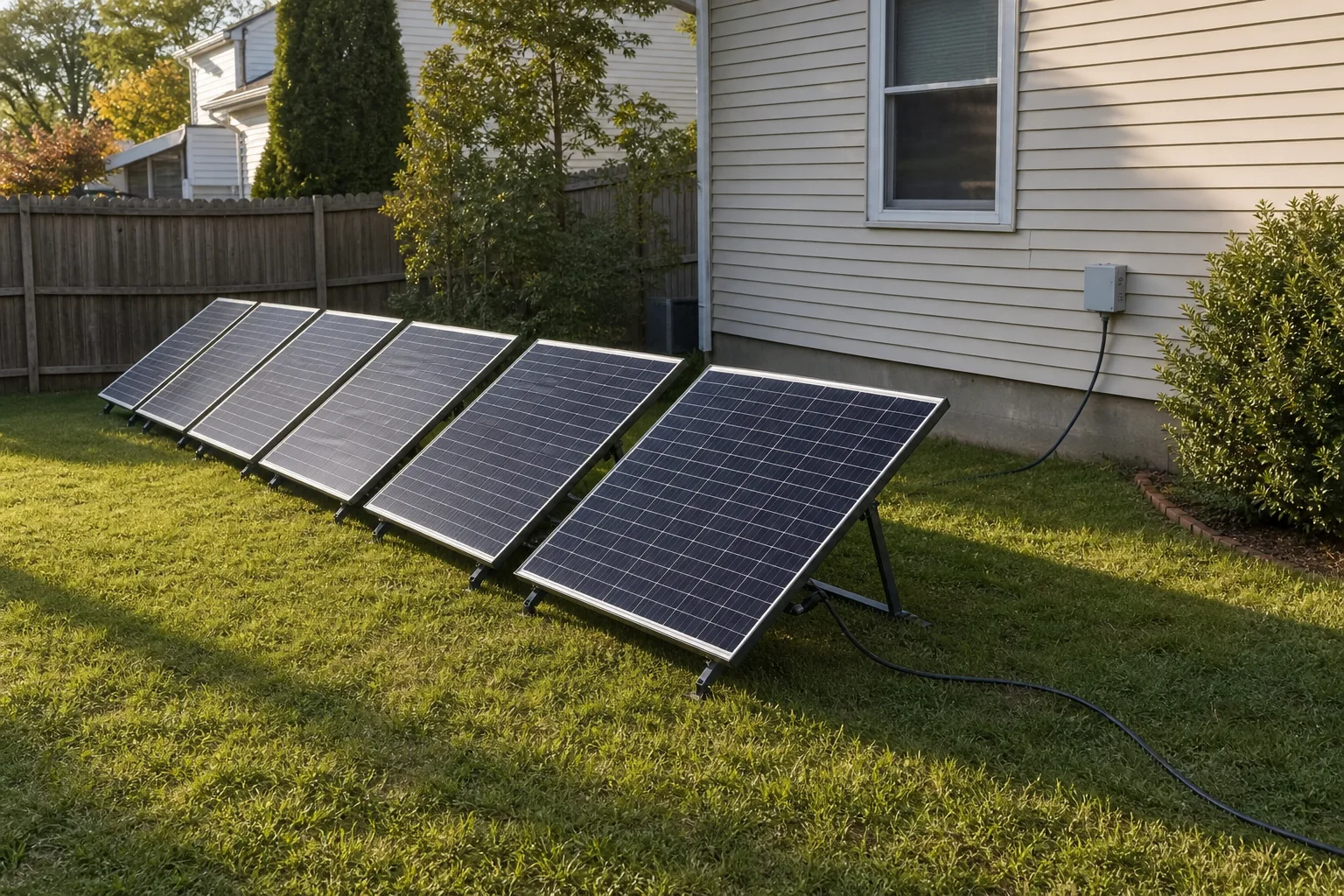
For multi-day outages, solar is what keeps these running. The DELTA Pro Ultra's high-voltage input takes 80 to 450 V, so a string of full-size residential panels wired in series works, for up to 5,600 W across both inputs. The Jackery's high-voltage input (135 to 450 V) took six 340 W panels in series at about 276 V and pulled roughly 1,340 W late on an afternoon. The Anker's two inputs accept 11 to 165 V each, up to 3,200 W total; the 165-volt ceiling means short strings or folding portable panels rather than one long roof-style string, and Anker warns that going over 165 V can damage the ports.
Moving them and other day-to-day quirks
All three ride on built-in wheels and are meant to roll on hard floors, not to be carried. The Jackery is one 134.5 lb case with a handle. The EcoFlow is a two-piece stack on a four-caster cart; moving it over rough ground takes EcoFlow's separate dolly-style trolley, and linking two inverters takes another accessory, so it gets the most done with extras. The Anker unit is 136.7 lb on its own, and each BP3800 expansion battery adds 72.8 lb. On the Anker, the 240-volt output can't be used while the unit charges from a 120-volt wall outlet, so plan to unplug it from the wall before feeding a panel.
How to connect one to your house safely
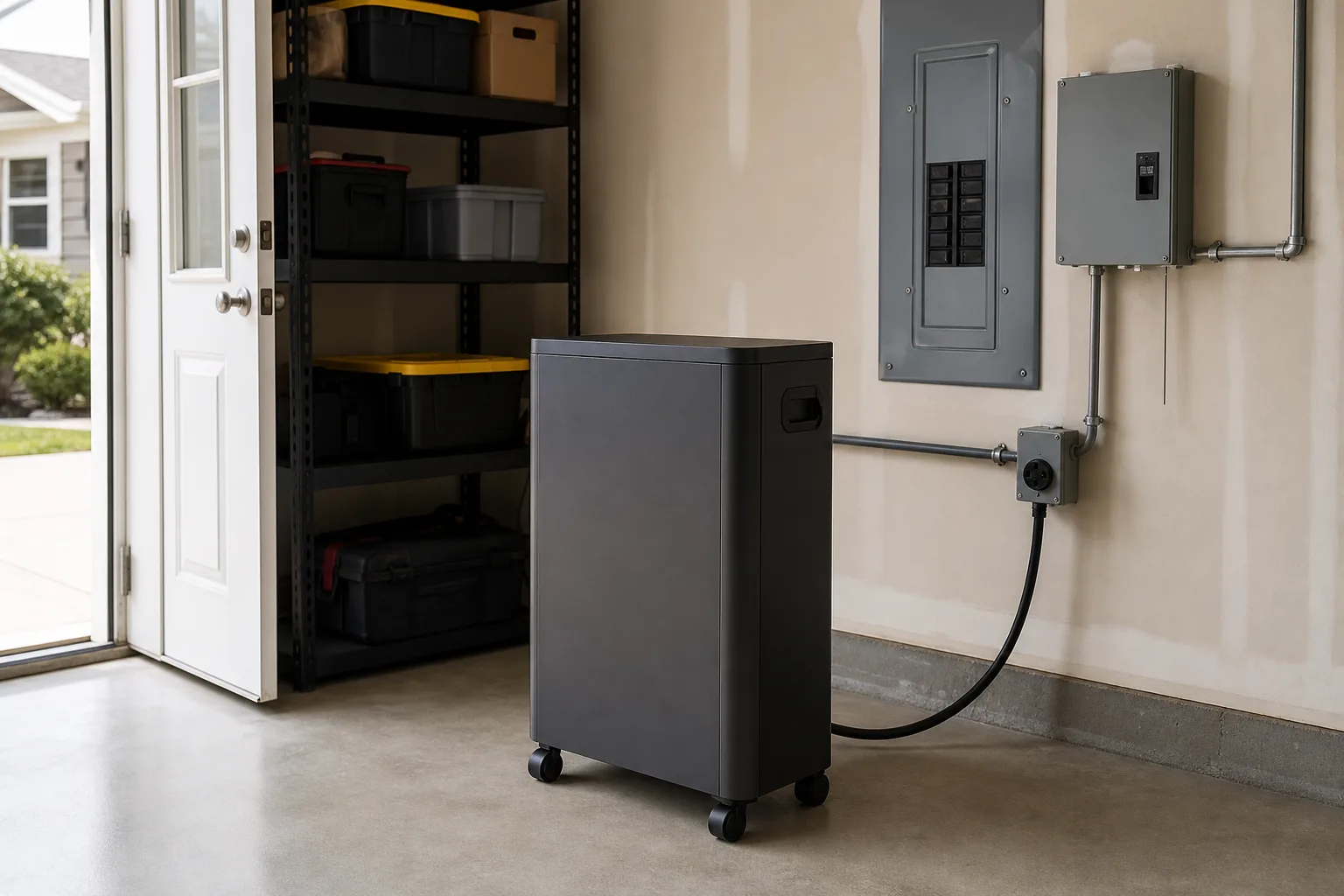
A home battery only powers your circuits through equipment made for it, installed by a licensed electrician: a generator inlet with a panel interlock, a manual transfer switch, or the maker's own panel or switch (EcoFlow Smart Home Panel 2, Anker Home Power Panel, Jackery Smart Transfer Switch). These keep the battery and the grid from ever being connected at the same time.
- Never backfeed through an outlet with a double-male cord. OSHA's portable generator safety fact sheet warns that attaching a generator to a building's wiring without a properly installed transfer switch can energize lines for great distances and electrocute utility workers. A battery's inverter carries the same risk.
- Even with an inlet already installed for a gas generator, the main breaker or interlock must be off before the battery feeds the panel. If you're unsure how your inlet was wired, have an electrician check it before plugging in. Many areas require a permit for this work.
- Keep the unit indoors and dry. The Jackery manual, for one, says indoor use only. These are made for a garage, basement or utility room, not the patio where a gas generator goes.
For broader outage planning, Ready.gov keeps a power outage checklist. A battery backup also pairs well with a battery backup sump pump and a small UPS for your router and PC, so the internet never drops while the big unit switches over.
Best one-box unit
Jackery Explorer 5000 Plus
An all-in-one 240-volt unit that plugs into a standard generator inlet and runs dryers, ovens and water heaters one at a time.
- 5,040 Wh
- 7,200 W at 120/240 V
- 4,000 W solar
Good for
- Homes with a generator inlet already installed
- All-electric houses
- A simple one-case setup
Skip it if
- You need it to start a standard central air conditioner without a soft starter
The picks in detail
EcoFlow DELTA Pro Ultra: best for long outages and big solar arrays
The EcoFlow DELTA Pro Ultra is a stack: a 70 lb inverter sits on a 111.8 lb, 6,144 Wh battery, on a cart with four locking casters. The 7,200 W split-phase inverter has an L14-30 outlet that delivers the full 30 amps at 240 V, four 120-volt 20-amp outlets and a TT-30 RV outlet. Two of the 120-volt outlets switch over in under 20 ms, and the other two plus the TT-30 are online UPS with a 0 ms transfer. It charges from AC and solar together, and its 5,600 W of solar input is the most here. One inverter takes five batteries (30 kWh), and EcoFlow's Smart Home Panel 2 links up to three inverters for 21.6 kW and 90 kWh. The batteries heat themselves below freezing. It's the best fit for long-term backup, but the hardest to move: hard floors only without the separate dolly.
Best for long outages
EcoFlow DELTA Pro Ultra
The most output, solar input and room to grow of the group, built to sit in a garage and run a house for days.
- 6,144 Wh
- 7,200 W at 120/240 V
- 5,600 W solar
Good for
- Long outages with solar
- Houses that may add batteries later
- Running loads off its 0 ms UPS outlets
Skip it if
- You need to roll it over grass or lift it into a vehicle
Jackery Explorer 5000 Plus: best single box for a generator inlet
The Jackery Explorer 5000 Plus packs a 5,040 Wh battery, the inverter and the solar charger into one 134.5 lb case with four wheels and a handle. Its 7,200 W split-phase output (14,400 W surge) ran every 240-volt appliance in an all-electric house except the central air, and hooking it to an existing 30-amp generator inlet with a standard L14-30 cord took about two minutes. It has four 120-volt 20-amp outlets, an L14-30 and a 14-50 (both capped at 30 amps), and app control over Wi-Fi or Bluetooth. Solar tops out at about 4,000 W across the high- and low-voltage inputs, and the Jackery Battery Pack 5000 Plus adds 5,040 Wh per pack, up to 60 kWh.
Best one-box unit
Jackery Explorer 5000 Plus
An all-in-one 240-volt unit that plugs into a standard generator inlet and runs dryers, ovens and water heaters one at a time.
- 5,040 Wh
- 7,200 W at 120/240 V
- 4,000 W solar
Good for
- Homes with a generator inlet already installed
- All-electric houses
- A simple one-case setup
Skip it if
- You need it to start a standard central air conditioner without a soft starter
Jackery Explorer 5000 Plus and Smart Transfer Switch: best for automatic switchover
The Jackery Explorer 5000 Plus and Smart Transfer Switch pairs the same power station with Jackery's switch, which mounts by the main panel and covers up to 12 essential circuits, such as the fridge, internet, sump pump and living room lights. When the grid drops, it moves those circuits to the battery within about 20 ms, so most devices keep running, and the app shows usage and lets you control circuits. It needs a certified electrician to install it; Jackery also arranges installation through partner companies in the U.S. This is the setup for a household that wants backup to happen on its own instead of plugging in a cord in the dark.

Best for automatic switchover
Jackery Explorer 5000 Plus and Smart Transfer Switch
The Explorer 5000 Plus with a 12-circuit smart transfer switch that moves key circuits to battery within about 20 ms.
- 5,040 Wh
- 12 circuits
- About 20 ms switchover
Good for
- Hands-off backup when the power drops
- Keeping a fridge, sump pump and internet on
Skip it if
- You want to plug in only during outages through an existing inlet
Anker SOLIX F3800 Plus: best for RV owners and pairing with a gas generator
The F3800 Plus is the model that replaced the original Anker SOLIX F3800, and the Anker SOLIX F3800 Plus Portable Power Station and BP3800 Expansion Battery listing pairs it with one expansion battery for 7,680 Wh. It keeps what made the F3800 useful at home: a wheeled one-piece unit, 6,000 W of 120/240-volt output and expansion up to six batteries per unit, or 53.8 kWh and 12 kW with two units. Outlets are an L14-30R (120/240 V, 25 A), a TT-30R RV outlet (120 V, 3,000 W), and six 120-volt 20-amp outlets, three of them UPS with a 20 ms switchover. Double-pressing the AC button turns on EV mode for charging a car with its rate set under 25 A. The Plus adds a 240-volt generator bypass, so a pure-sine 240-volt gas generator can run loads through it at up to 6,000 W, and its solar input rises to 3,200 W. It also works with Anker's Home Power Panel.
Best for RVs and generators
Anker SOLIX F3800 Plus Portable Power Station and BP3800 Expansion Battery
A 6,000 W split-phase unit with an expansion battery included, an RV outlet, EV mode and a 240-volt gas generator bypass.
- 7,680 Wh as listed
- 6,000 W at 120/240 V
- 3,200 W solar
Good for
- RV owners
- Homes that already own a 240-volt inverter generator
- Charging an EV in a pinch
Skip it if
- You want one long roof-style solar string over 165 V
Who should buy which
- Planning for outages of several days with solar on the roof or the ground? The EcoFlow DELTA Pro Ultra.
- Already have a generator inlet and an all-electric house? The Jackery Explorer 5000 Plus, plus an expansion battery.
- Want backup to switch on by itself for your key circuits? The Jackery Explorer 5000 Plus and Smart Transfer Switch.
- Want one unit for outages and RV trips, or to stretch a gas generator? The Anker SOLIX F3800 Plus.
- Want something that runs on fuel instead? See the inverter generator comparison.
Whichever you pick, book the electrician before the outage, not during it.
Posted by Kristopher Larson
Frequently asked questions
Can a portable power station run my whole house?
A large 120/240-volt unit such as the EcoFlow DELTA Pro Ultra, Jackery Explorer 5000 Plus or Anker SOLIX F3800 Plus can feed a home's panel through an inlet and interlock, a transfer switch or the maker's home panel. It can run most circuits, and big 240-volt appliances like a dryer or oven one at a time. Running everything at once, or a standard central air conditioner, is usually beyond a single unit.
Do I need an electrician to connect a battery backup to my house?
Yes. Connecting any power source to home wiring needs a generator inlet with an interlock, a transfer switch or the manufacturer's home panel, installed by a licensed electrician, and many areas require a permit. Never plug a power station into a wall outlet with a double-male cord: it can backfeed the utility lines and electrocute line workers.
How long will a 5 kWh home battery last in a power outage?
It depends on the load. Lights, a fridge, a TV and a router drawing about 460 W can run for roughly nine hours on a full 5 kWh battery, while an electric dryer pulling about 6,000 W drains it in under an hour. Expansion batteries and solar panels are what stretch a battery through a multi-day outage.
Can a home battery backup run central air conditioning?
Often not on its own. A standard 4- or 5-ton central air conditioner has a starting surge that is too high for a single 7,200 W unit like the Jackery Explorer 5000 Plus. A soft starter installed on the compressor lowers that surge. Mini-split and window air conditioners run easily on any of these units.
What is the difference between 120V and 120/240V split-phase output?
North American homes get two 120-volt legs that combine to 240 volts for ranges, dryers, water heaters and well pumps. A split-phase unit supplies both legs, so it can feed a whole panel and run 240-volt appliances. A 120-volt-only unit can only power selected 120-volt circuits, usually through a transfer panel.
Can I keep a home battery backup in the garage?
Yes, a garage, basement or utility room is the usual spot, close to the panel or inlet. Keep it dry and away from rain and standing water; the Jackery manual, for example, rates the Explorer 5000 Plus for indoor use only. Unlike a gas generator, it gives off no exhaust, so it doesn't need to sit outside.
Keep reading
More from the blog
Mobile Office for Real Estate Agents: Canon PIXMA TR160 vs. HP OfficeJet 250 vs. ScanSnap iX1300
Solar Generator Bundles Compared: Jackery 1000 v2 vs. Anker SOLIX C300 vs. Bluetti Elite 30 V2
Home Theater Room Setup: Best Projectors, Surround Sound, Screens and Lighting