Is the Great Salt Lake Drying Up? What It Means for Utah Home Buyers
The Great Salt Lake is below healthy water levels, raising real questions about dust, air quality, and water use along the Wasatch Front. This guide breaks down what buyers should actually evaluate before choosing a Salt Lake City, Utah County, Ogden, or Southern Utah community — and how location, from lakeshore proximity to Silicon Slopes to St. George, changes the risk.
The Great Salt Lake is facing a serious long-term water challenge, but the situation requires more nuance than either extreme headline suggests. The lake is low, exposed lakebed dust can carry harmful metals, and water conservation will shape life along the Wasatch Front for years to come.
At the same time, the evidence does not support the idea that Salt Lake City or the wider Wasatch Front is becoming unlivable. For home buyers, the more useful approach is to understand how lake conditions vary by location, how they affect air quality and water, and what practical steps can reduce uncertainty before buying. This mirrors the broader statewide water conversation covered in Is Utah Running Out of Water? What Home Buyers Should Know.
Why the Great Salt Lake's Water Level Matters
A healthy Great Salt Lake elevation is roughly 4,198 feet. Scientists have identified elevations below approximately 4,192 feet as a threshold where serious adverse effects become more likely, including ecosystem strain, greater exposed lakebed, and additional dust risk.
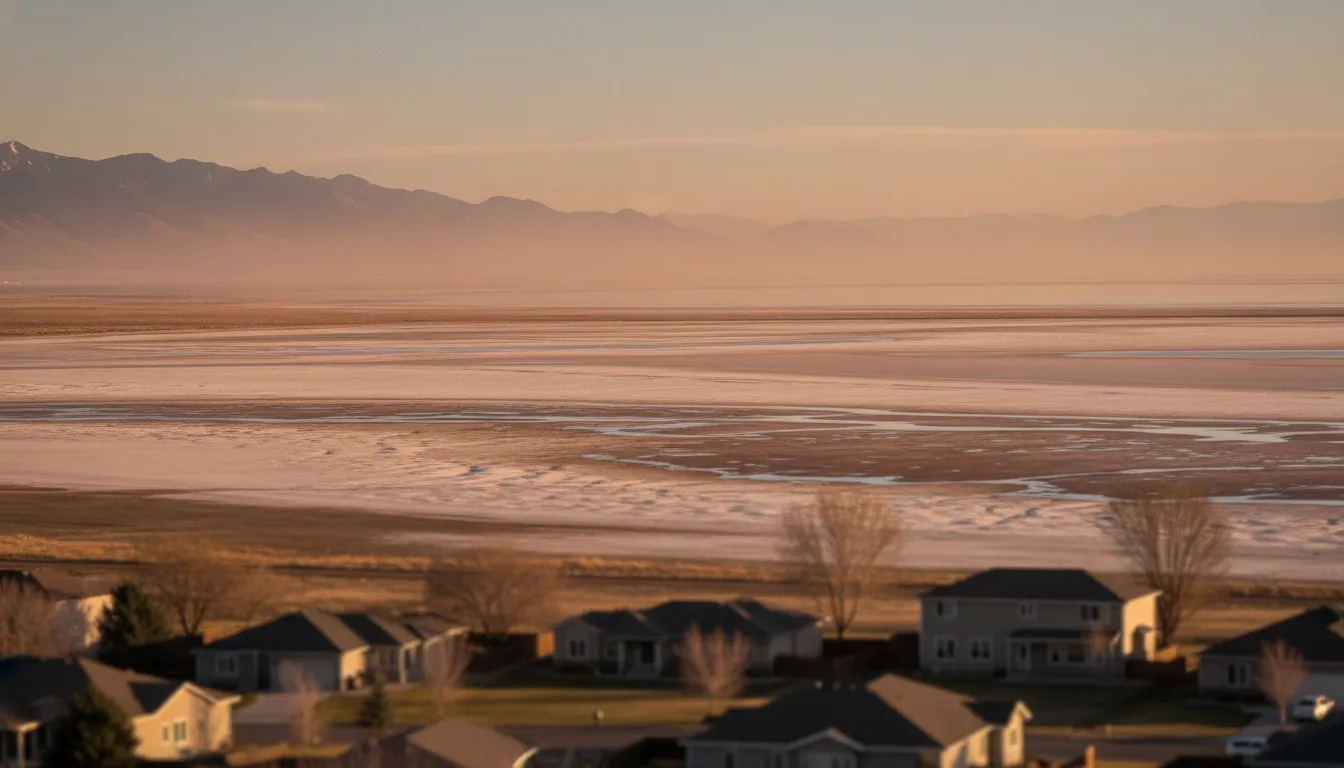
The lake reached a historic low of about 4,188.5 feet in November 2022. At the beginning of 2026, the ecologically important south arm stood near 4,191.6 feet. Its spring peak was around 4,192.6 feet, still below a healthy level and well short of the elevation needed for long-term stability.
Lake levels naturally decline through the warm months because of evaporation. A dry winter, weak snowpack, and hot summer can place more pressure on the lake. A strong snow year can help, but the long-term solution also depends on managing water use throughout the watershed.
What low lake levels change
More exposed lakebed: As water recedes, dry sediment becomes available for wind-driven dust events.
Ecosystem pressure: Lower water levels affect the lake's ecological balance.
Reduced lake-effect weather influence: A smaller lake surface can weaken the weather process that contributes moisture and snow to nearby mountains.
Water planning pressure: Cities, developers, homeowners, and agricultural users face increasing incentives to conserve water.
Is Great Salt Lake Dust Toxic?
Concern about dust from the exposed Great Salt Lake bed is legitimate. Sediment samples have identified arsenic, lithium, lead, and other heavy metals. Some sampled arsenic levels exceeded Environmental Protection Agency residential soil screening limits.
That does not mean every air-quality issue along the Wasatch Front comes primarily from the lake. Research tracing dust sources has found that the Great Salt Lake playa is only one contributor to airborne and deposited dust.
What research suggests about where dust comes from
A study using strontium isotope analysis estimated that Great Salt Lake playa dust contributed about 5% of dust along the southern Wasatch Front. Another analysis of dust deposited in the Wasatch Mountains attributed roughly 23% to the lake playa, with a larger share coming from other dry lakebeds and desert areas to the south.
Urban dust research has also connected some of the most concerning metals, including arsenic, lead, and zinc, to human sources such as mining, industrial activity, and vehicle brake dust. This distinction matters because it prevents an oversimplified conclusion that the lakebed alone explains Wasatch Front air quality.
Dust storms can temporarily raise particulate matter levels for several hours. However, the Utah Department of Environmental Quality has noted that more research is needed to firmly establish the relationship between lakebed metals and residents' health outcomes.
Lakebed Dust Is a Location-Specific Home Buying Risk
Great Salt Lake dust is not distributed evenly across northern Utah. The highest direct exposure concern is generally associated with communities closest to the lakeshore and areas directly downwind of exposed lakebed, including portions near Farmington Bay.
As a home search moves farther south and east, particularly toward higher bench areas and into Utah County, the lakebed's direct contribution to dust generally becomes less significant. That does not eliminate broader air-quality concerns, but it changes the specific risk profile connected to the lake.
A practical due diligence step before buying
Before committing to a specific property, buyers can review Utah Division of Air Quality dust and PM10 monitoring data for nearby stations. Comparing recorded exceedance events with a home's distance from the lakeshore, prevailing wind exposure, and surrounding land uses can provide more useful context than a statewide headline.
Two homes separated by a short drive can have meaningfully different exposure considerations. Buyers who prioritize environmental conditions should evaluate the exact neighborhood, not merely the city or county name.
Where This Leaves Buyers Weighing Salt Lake County vs. Points South
For buyers specifically worried about lake-driven dust and inversion exposure, the practical response isn't to write off the Wasatch Front — it's to be strategic about where along it you settle. Salt Lake City proper and communities hugging the lakeshore, like parts of West Valley City, carry the most direct exposure to both lakebed dust and winter inversion. Moving into Utah County — Provo, Lehi, and the broader "Silicon Slopes" tech corridor — puts more distance and elevation between a home and the lake, while still keeping residents close to the same job market, mountain access, and Wasatch Front amenities. Buyers weighing this exact tradeoff in more depth may find it useful to compare Salt Lake County vs. Utah County lifestyle differences side by side.
For those who'd rather sidestep Great Salt Lake dynamics almost entirely, Southern Utah offers a genuinely different environmental profile. St. George, Washington, and Toquerville sit in a desert basin hundreds of miles from the lake, with their own water story tied to the Colorado River basin and reservoirs like Sand Hollow rather than lake-effect snowpack. Buyers curious about that region's own water planning can read about getting to St. George from Las Vegas or browse specific communities such as Washington, Utah and Toquerville, Utah, both within easy reach of St. George's job market and Zion National Park. Farther up the Wasatch Back, mountain towns like Midway, Utah offer four-season living and Park City-adjacent recreation with essentially no lakebed dust exposure at all. If Utah is on your shortlist, you can browse homes across the Wasatch Front and southern Utah at Best Utah Real Estate.
Ogden and Northern Davis County: A Different Kind of Lakefront Tradeoff
It's worth noting that proximity to the Great Salt Lake isn't automatically a dealbreaker for buyers who love the lake's recreation and scenery, either. Communities like Ogden sit close enough to benefit from marina access, birding at wetlands preserves, and easy trips to Antelope Island, while still offering meaningfully lower home prices than much of Salt Lake County — a tradeoff covered in more depth in Why So Many People Are Moving to Ogden, Utah in 2026. The right call really does come down to individual priorities: proximity and price versus distance and dust exposure. For buyers still mapping out which side of the Wasatch Front makes sense for their budget and lifestyle, Where to Live in Utah (2026): The Wasatch Front Corridor Map lays out the tradeoffs city by city.
The Wasatch Front's Larger Air Quality Issue: Winter Inversions
Lakebed dust deserves attention, but it is not the only air-quality issue prospective residents should understand. The Wasatch Front also experiences winter inversions, when cold air becomes trapped in the valleys and holds vehicle and industrial pollution close to the ground.
For many residents, winter inversion conditions are a more frequent air-quality concern than lakebed dust events. Families, retirees, and households with respiratory sensitivities should evaluate both factors when deciding where to live. Buyers weighing an overall relocation to the state, not just the lake question, may also want to read Will You Actually Like Living in Utah? A Relocation Guide.
Home buyers can use local monitoring data to compare neighborhoods, especially if a household has children, older adults, or anyone whose health may be affected by elevated particulate pollution.
A Shrinking Great Salt Lake Can Affect Snowpack and Water Supply
The Great Salt Lake is not only a scenic feature of northern Utah. It also influences regional weather. During fall and early winter storms, cold air crossing relatively warm lake water can gather moisture and contribute to lake-effect snow in nearby mountains.
That snow matters beyond skiing and winter recreation. Mountain snowpack supplies reservoirs and water systems through the dry season. In a desert state, snowpack functions as a critical water reserve.
A smaller lake has less surface area to support that weather process. The long-term effect is not a simple one-to-one prediction, but a declining lake adds another layer of uncertainty to a water system already dependent on snow, reservoir storage, and conservation.
How water issues may affect homeowners
Water rates may rise over time as infrastructure and conservation needs increase.
Communities may continue adopting stronger water conservation requirements.
Large, nonfunctional turf areas may become less practical and less aligned with local development standards.
Drought-tolerant landscaping may become a stronger long-term ownership and resale consideration.
New construction buyers should review landscaping obligations, irrigation systems, and HOA rules before closing.
Water conservation is increasingly a financial and property-use issue, not just an environmental preference. Buyers considering Southern Utah or other water-conscious markets can also review the broader discussion of Southern Utah's water future, reservoirs, reuse, and conservation.
What Utah Is Doing to Protect the Great Salt Lake
The Great Salt Lake's future is not being ignored. Since 2022, Utah lawmakers have directed more than $300 million toward Great Salt Lake conservation efforts. Those measures include funding for agricultural water optimization and a dedicated watershed enhancement trust designed to acquire or lease water rights for the lake.
Agriculture is the largest water user in the Great Salt Lake Basin, making voluntary efficiency improvements and water leasing central to lake restoration efforts. Recent policy efforts have also focused on making it easier to lease water to the lake, increasing transparency around water-intensive data centers, and creating mechanisms for municipalities to send conserved water to the lake.
A federal wetlands settlement added another $60 million in 2026. These actions do not guarantee a full recovery, particularly during dry years, but they show that the challenge is being actively addressed through funding, policy, and water management.
Why the 2034 Winter Olympics matter
Utah's planned 2034 Winter Olympics create a major public deadline for safeguarding the region's environmental and recreation assets. The event adds attention and urgency to water planning, snow reliability, air quality, and Great Salt Lake restoration efforts.
For homeowners and investors, that distinction matters. A low lake remains a real risk factor, but the state is not treating the issue as an abandoned or inevitable decline.
How Great Salt Lake Conditions May Affect Home Values
Environmental conditions can influence housing demand, but the impact is rarely uniform across an entire metropolitan area. Great Salt Lake concerns are more likely to affect real estate through location-specific perceptions and operating costs than through an immediate, regionwide loss of housing value.
Properties closest to exposed lakebed or situated directly downwind may receive more scrutiny from buyers concerned about dust. Homes with highly water-intensive landscaping may also face greater long-term operating and maintenance questions as conservation becomes more important.
Conversely, homes with efficient irrigation, drought-aware landscaping, and a location farther from direct lakebed exposure may be better positioned for changing buyer preferences. Home buyers should consider these features alongside the usual priorities of commute, schools, property condition, neighborhood character, and budget.
Questions to ask before making an offer
How close is the property to the Great Salt Lake shoreline or exposed lakebed?
Is the neighborhood commonly downwind during significant dust events?
What do nearby PM10 and dust-monitoring records show?
Does the property rely on a large turf lawn or water-intensive landscape?
Are there irrigation restrictions, water budgets, or HOA landscape rules?
How does the location perform during winter inversion periods?
Does the household have health needs that make air quality a higher priority?
For a broader starting point when comparing Utah communities and available housing, buyers can use Utah real estate and homes for sale resources to research local markets and active listings.
Common Mistakes When Evaluating Great Salt Lake Risks
Treating the lake as either completely fine or permanently doomed
Both assumptions overlook the data. The lake is below a healthy elevation and remains vulnerable to drought, heat, and water demand. Yet it has also responded when snowfall improved and more water reached the lake. The more accurate conclusion is that the outcome depends on ongoing weather conditions and sustained conservation efforts.
Assuming all Wasatch Front neighborhoods have the same dust exposure
Distance from the lakeshore, wind direction, elevation, and nearby sources of pollution all matter. A location-specific review is more valuable than a generalized concern about an entire county.
Ignoring routine winter air quality
Lakebed dust may attract more attention, but winter inversions can be a more regular issue for many Wasatch Front households. Buyers should assess both short-duration dust events and seasonal pollution patterns.
Buying a water-intensive property without reviewing its long-term practicality
Large lawns and high irrigation demands may become more expensive or subject to more restrictions over time. Drought-conscious landscaping is increasingly relevant to daily costs, local compliance, and future market appeal.
Will Salt Lake City Become Unlivable If the Great Salt Lake Shrinks?
Current evidence does not support the conclusion that Salt Lake City will become unlivable because of Great Salt Lake decline. The lake's condition is serious, and the risks connected to dust, snowpack, water availability, and regional air quality should be taken seriously.
However, the most alarming version of the claim, that toxic lakebed dust is the sole or dominant explanation for dangerous air across the entire Wasatch Front, is not supported by available source-tracing research. Lakebed dust is one issue among several, and its direct effects vary substantially by location.
The more realistic outlook is that Utah faces a manageable but consequential environmental challenge. Residents and buyers should expect water conservation, changing landscaping norms, continued monitoring, and public investment to remain part of life along the Wasatch Front.
Those considering a move can benefit from balancing environmental due diligence with the many other factors that shape a successful relocation. For a wider perspective on statewide tradeoffs, see the discussion of the pros and cons of living in Utah.
Key Takeaway for Utah Home Buyers
The Great Salt Lake is low enough to warrant attention, but not panic. Buyers should avoid treating the issue as a simple yes-or-no reason to move to Utah. Instead, they should evaluate the exact property location, check nearby dust and PM10 records, understand winter inversion conditions, and consider water-efficient landscaping as part of a home's long-term value.
A well-informed purchase accounts for real environmental conditions without assuming that every Wasatch Front neighborhood faces the same exposure or future. The most sensible strategy is to buy with clear information, practical expectations, and an understanding that Utah's water future will remain an important part of homeownership.
Frequently asked questions
Is the Great Salt Lake actually drying up?
Does Great Salt Lake dust make Salt Lake City unsafe to live in?
Which Salt Lake City neighborhoods are most affected by lake dust?
What is the biggest air quality concern on the Wasatch Front?
How can a home buyer check environmental risk before buying near the lake?
Will Great Salt Lake water restrictions affect Salt Lake City home values?
Keep reading
More from the blog

Utah Property Taxes: How Your Assessed Value Really Gets Set
Why Identical Houses Get Different Property Tax Bills

Your First Month in a New Utah Home: A Fall Settling-In Guide