Is Utah Running Out of Water? What the Great Salt Lake Crisis Means for Buyers
Utah's water challenges, centered on the shrinking Great Salt Lake, raise real questions about air quality, growth, and long-term livability. This guide breaks down what buyers should actually evaluate before choosing a Utah community.
Utah is not on the verge of household taps running dry, but the state does face a serious and urgent water allocation challenge. The shrinking Great Salt Lake is the clearest signal of that challenge, with consequences that extend beyond the shoreline to air quality, public health, infrastructure planning, and long-term real estate decisions.
For people considering a move to Utah, the most useful question is not simply whether Utah has enough water. It is which water system serves a particular community, how growth is being managed, and how environmental conditions may affect quality of life over time.
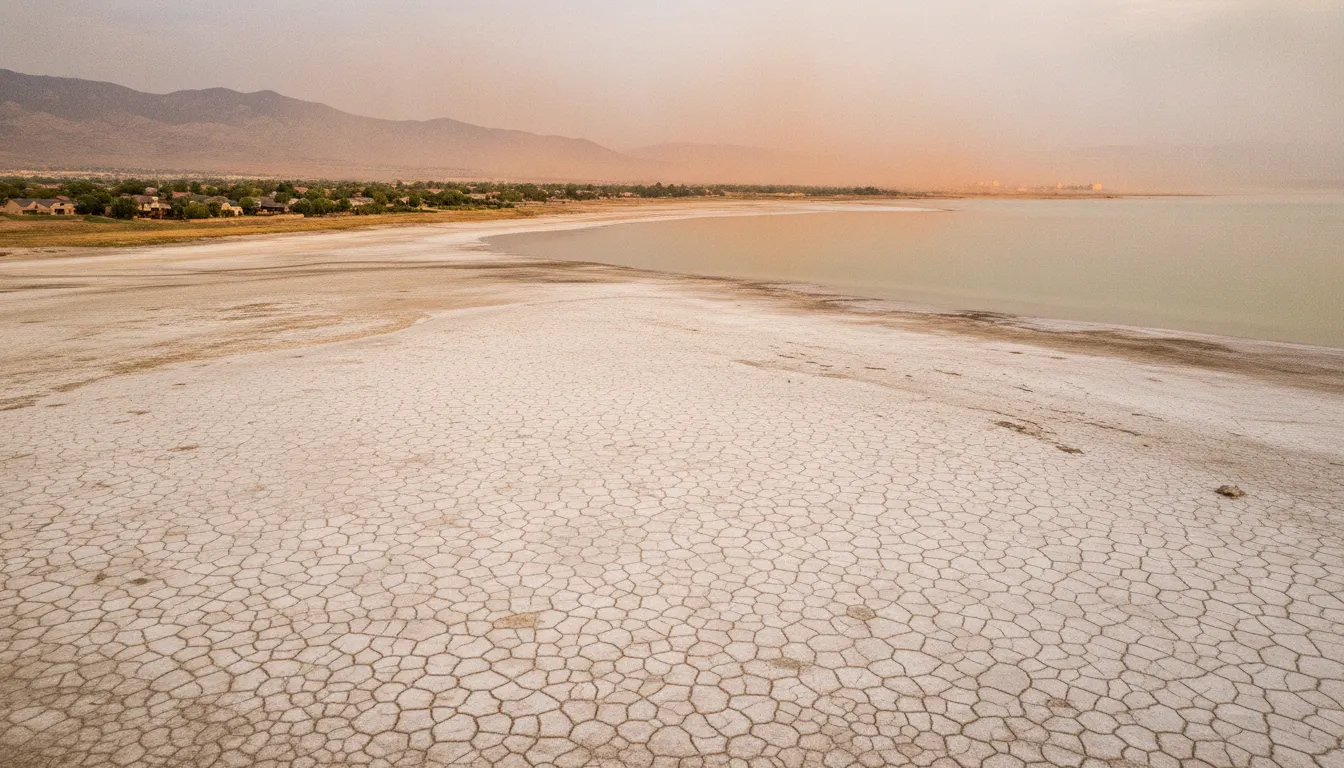
The Great Salt Lake began 2026 only about three feet above its record low after roughly 120 years of measurement. Since the lake can lose about three feet to evaporation in a typical summer, another dry winter could place it near or below that low point. That deserves attention, but it does not mean that every Utah home faces the same level of risk.
Is Utah Actually Running Out of Water?
Utah's water situation is best understood as a problem of water management and allocation, rather than a simple countdown to an empty reservoir. The state receives snowpack and precipitation each year, but a substantial share of water that would otherwise flow toward the Great Salt Lake is diverted before reaching it.
Research summarized by the University of Utah's Kem C. Gardner Policy Institute, the U.S. Geological Survey, and Great Salt Lake-focused state efforts indicates that roughly 62% of river water naturally headed toward the lake is diverted for human use. Of that diverted water, about 71% goes to agriculture. A large share of agricultural water use supports alfalfa and hay production for livestock feed.
Residential, commercial, and industrial water use still matters. Conserving water at homes and businesses is worthwhile, particularly in fast-growing communities. However, household lawns and new housing construction are not the dominant cause of the lake's decline. A durable solution requires meaningful changes in the much larger agricultural portion of the water budget.
This distinction matters for real estate decisions. Water used for lower-value agricultural production can potentially be conserved, leased, or redirected through policy changes. That creates a real path toward improvement, even though the pace of change has not yet matched the scale of the problem.
Why the Great Salt Lake Is So Important to Utah
A declining lake is not only an environmental concern. It can affect the daily conditions of communities across the Wasatch Front, where much of Utah's population growth is concentrated.
Exposed lakebed can create dust and air-quality concerns
As lake levels fall, more lakebed becomes exposed. The Great Salt Lake has collected minerals and contaminants over many decades, including heavy metals such as arsenic. Strong winds can lift dust from exposed playa and move it toward populated areas along the Wasatch Front.
Dust events are episodic rather than constant. Their severity depends on wind conditions, the amount of exposed lakebed, and seasonal weather patterns. Still, they add to air-quality concerns already associated with winter inversions, traffic, and valley geography.
The risk should be evaluated realistically. It is not accurate to treat every Utah community as immediately unlivable, but it is equally unwise to dismiss the issue. The public-health impact of airborne dust is one of the most immediate consequences of a shrinking lake because it can affect millions of residents.
Environmental conditions can influence housing demand
Environmental risk does not necessarily cause a sudden market collapse. More often, it can create gradual differences in buyer preferences and property demand. Over time, areas perceived as having cleaner air, stronger infrastructure, and better resilience may hold appeal more consistently than areas with greater exposure.
This pattern is not unique to Utah. Flood risk can shape demand in coastal markets, while wildfire exposure can affect buyer decisions in parts of California and the Mountain West. In Utah, air quality, water reliability, elevation, and local growth management deserve a place in a buyer's due diligence process.
What Utah Is Doing to Protect the Great Salt Lake
Utah has begun implementing structural changes that address water allocation. The progress is meaningful, but it should not be mistaken for a completed solution.
Water-right reforms changed conservation incentives
For decades, the "use it or lose it" approach to water rights created a harmful incentive. A water-right holder who did not use the full allocation could risk losing the right. In practical terms, that could discourage conservation because using less water came with legal uncertainty.
A 2022 law changed that dynamic by allowing water-right holders to conserve water and dedicate it to the Great Salt Lake without forfeiting their water rights. This is a major policy shift because it makes conservation compatible with retaining the underlying right.
Leasing and management tools are now available
The state has also created mechanisms to lease water rights and direct water to the lake, established a Great Salt Lake commissioner's office, and used a berm to help manage salinity while longer-term restoration efforts take shape.
These tools matter because they create a practical route for moving water back to the lake. A strong snow year has demonstrated that lake levels can recover by several feet when inflows improve. Yet recovery from a single wet period is not a substitute for lasting changes in water use.
More conservation is still needed
Early measures have recovered only a fraction of the water needed for long-term lake health. One analysis cited in Great Salt Lake discussions estimated that roughly a 15% reduction in water use may be needed to stabilize the lake, while reductions closer to 35% could be needed to restore it to a healthier level over time.
The central issue is therefore not whether Utah has recognized the problem. It has. The remaining question is whether conservation and reallocation efforts can move quickly enough to protect lake ecology and reduce dust exposure.
What Utah's Water Challenges Mean for Real Estate
Buying a home in Utah does not require predicting the future of the entire state. It does require examining the resilience of the specific city, neighborhood, and utility system under consideration.
Utah's projected growth is concentrated rather than evenly distributed. The Wasatch Front, Salt Lake County, Utah County, and Washington County in the southwest are among the areas expected to absorb substantial growth. These regions do not share the same water sources or development pressures.
For example, the Great Salt Lake Basin affects northern Utah, while St. George and much of southwest Utah rely on the Colorado River Basin, which has its own long-term water constraints. Buyers considering homes in St. George should evaluate local water planning separately from the Great Salt Lake discussion.
Statewide listing and market comparisons can help buyers identify different growth patterns, pricing conditions, and locations. Utah real estate market comparisons provide a starting point for evaluating cities before narrowing a search to specific neighborhoods, and the latest Utah real estate market report can add helpful statewide context.
A Three-Part Framework for Evaluating Utah Neighborhoods
Water and environmental resilience should be considered alongside price, commute, schools, lot size, and home condition. The following framework can help buyers compare two otherwise similar areas.
1. Identify the local water system
Buyers should determine which municipal system serves the property and how established that system is. A mature city with long-developed infrastructure has different considerations than a newer district expanding into former agricultural or desert land.
Useful questions include:
Which water provider serves the neighborhood?
What water sources does the provider rely on?
Is the area already built out, or is it growing rapidly?
Are water delivery and storage systems expanding alongside new development?
Are conservation requirements or landscaping restrictions in place?
2. Consider elevation, topography, and air quality
Air quality varies considerably by location. Valley floors can be more affected by inversion conditions, while benches and foothill communities may sit above some of the worst trapped winter air. No location is immune from regional conditions, but elevation and terrain can shape day-to-day exposure.
Home features can also matter. Efficient HVAC systems, well-maintained filtration, and suitable indoor air filtration can be practical priorities for households concerned about smoke, dust, pollen, or inversion-related conditions.
3. Compare growth with infrastructure capacity
Rapid growth is not automatically negative. It can bring new roads, amenities, housing choices, and employment. The concern arises when homes are added faster than water systems, transportation networks, schools, and public services can keep pace.
Before purchasing in a rapidly developing area, buyers should look beyond the model home or new kitchen and consider whether the community's infrastructure plan supports its projected growth.
Established Areas and New Growth Areas Have Different Tradeoffs
Established neighborhoods often benefit from mature utility systems, completed roads, and a clearer record of how the area functions through dry years and seasonal air-quality events. They may also have less available land and fewer new-construction choices.
Newer communities can offer modern homes, energy-efficient features, and planned amenities. However, they deserve additional research into water delivery, road capacity, schools, HOA rules, landscaping requirements, and the pace of surrounding development.
This does not make new construction a poor choice. It simply means buyers should evaluate the broader community as carefully as the house itself. A detailed search through Utah homes for sale can help households compare established and emerging areas based on their own location and property requirements.
Why Snowpack Is an Important Water Indicator
For households following Utah's water outlook, winter snowpack is often a more useful leading indicator than a single lake-level measurement. Snowpack typically peaks in late March or April, and spring runoff helps determine how much water enters rivers, reservoirs, and watersheds during the following months.
A strong snow year can provide meaningful relief and allow the Great Salt Lake to rise. A dry winter, by contrast, can increase pressure on the lake and the broader water system. Snowpack is not the whole story, since diversions and water policy determine how much runoff reaches the lake, but it remains an important part of the annual picture.
Current hydrology, reservoir conditions, and water planning information can be monitored through the Utah Division of Water Resources and the U.S. Geological Survey.
Common Mistakes to Avoid When Buying a Home in Utah
Treating Utah as one water market: Northern Utah and southwest Utah operate within different water systems and face different constraints.
Assuming new homes caused the Great Salt Lake decline: Residential use matters, but agricultural diversions represent the far larger share of water use affecting lake inflow.
Ignoring air quality: Location, elevation, valley geography, and indoor filtration can materially affect comfort and long-term livability.
Buying based only on finishes: Water infrastructure, road capacity, school growth, and municipal planning deserve equal attention.
Assuming policy reform means the issue is solved: Utah has created useful tools, but implementation and conservation results remain crucial.
Relying on headlines alone: The situation is serious, but "the lake is low" and "municipal taps will soon fail" are not the same claim.
Bottom Line: Is It Still Reasonable to Buy a Home in Utah?
Buying a home in Utah can still be a reasonable decision for households whose finances, lifestyle, and location needs align with the state. The Great Salt Lake's decline is not a reason to ignore Utah altogether, but it is a reason to choose carefully and stay informed.
The state's water challenge is real. Agricultural water use is the central driver of reduced Great Salt Lake inflows, dust exposure is an urgent concern, and conservation policy must produce larger results. At the same time, Utah has begun changing the laws and management systems that previously discouraged conservation.
For buyers, the practical response is clear: evaluate the individual community rather than making a decision based on a statewide headline. A home's local water system, air-quality profile, elevation, and infrastructure capacity may matter as much over the next decade as its floor plan or curb appeal. Understanding whether it's a good time to buy or sell in Utah's current market is a useful next step once you've narrowed down a location.
For broader property research across the state, Best Utah Real Estate offers Utah MLS listings and market resources that can support a more location-specific search.
Frequently asked questions
Will Utah homes run out of water if the Great Salt Lake reaches another record low?
Are new homes and lawns the main reason the Great Salt Lake is shrinking?
Does the Great Salt Lake affect property values in Salt Lake City or the Wasatch Front?
Which parts of Utah have the greatest water risk for home buyers?
What should a buyer ask before purchasing in a fast-growing Utah community?
Can the Great Salt Lake recover, and what would that mean for Utah real estate?
Keep reading
More from the blog
Utah ADU Rules in 2026: State Law and City-by-City Limits
Inherited a House? The Order to Tackle Each Step
Utah's New Detached ADU Law and Garage Apartments