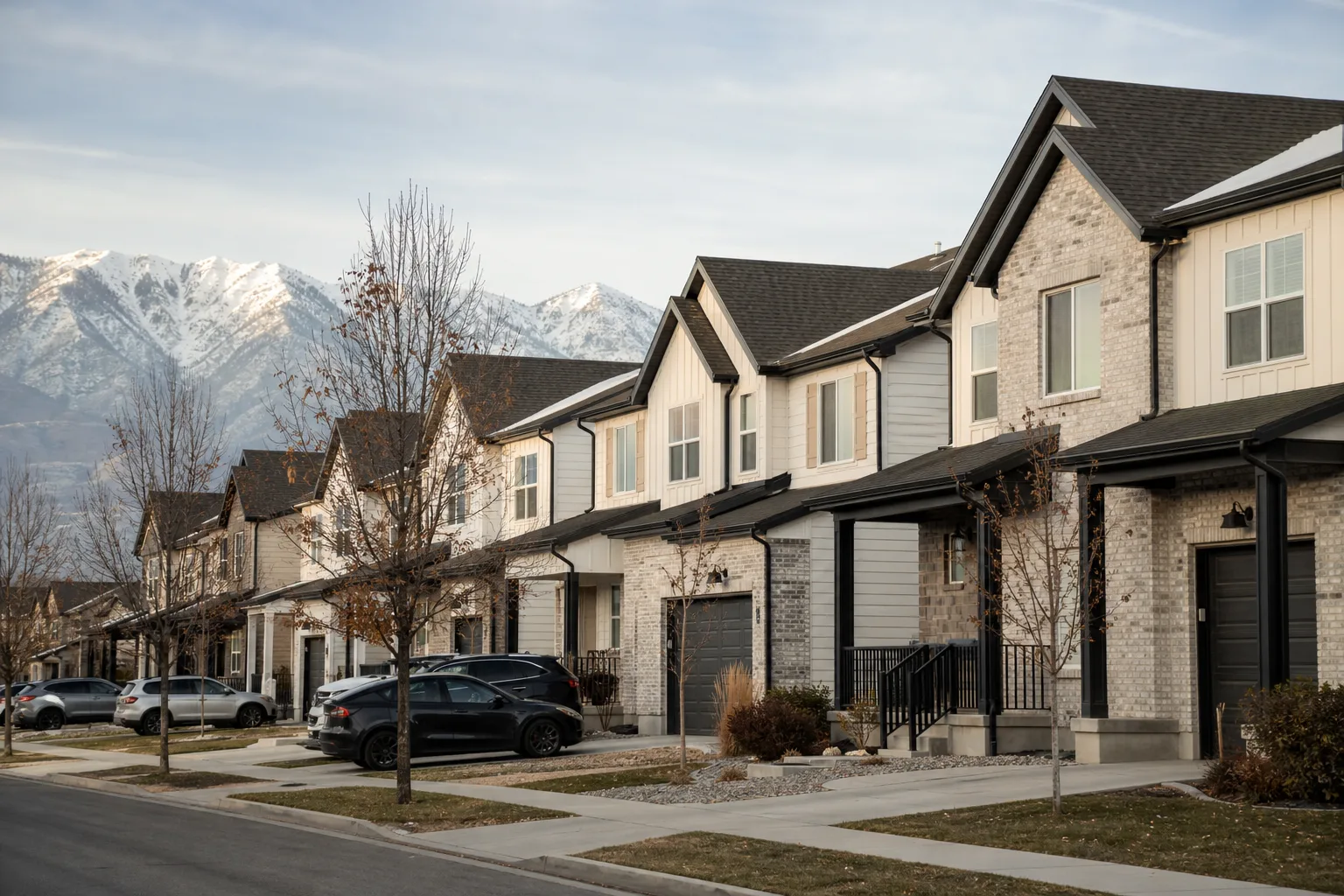
Half of Young Utahns Own a Home. Most Renters Can't Afford One. What Still Works for First-Time Buyers
Half of Utah households headed by 25- to 34-year-olds own a home, yet about 91% of renters cannot afford the $3,669 payment on a median-priced one. Here is what the two reports found and the practical ways first-time buyers are still getting in.
Half of Utah households headed by someone aged 25 to 34 own the home they live in. The exact figure was 50.1% in 2024, almost 10 points above the national rate of 40.4% for the same age group. In the same season that number was published, a University of Utah report estimated that about 91% of Utah renters cannot afford the payment on a median-priced home.
Both numbers are accurate, and they describe the same market. One counts people who already bought, many of them when mortgage rates were far lower. The other measures what it takes to buy now. For a renter in their late 20s or early 30s, the useful question is what sits between those two figures, and which routes into ownership are still open.
What the Two Reports Found
The homeownership figures come from a report by economist James Wood, commissioned by the Salt Lake Board of Realtors and released in late October 2026. It uses U.S. Census Bureau data. The affordability figures come from "State of the State's Housing Market: 2025-2026," published in September 2026 by the Kem C. Gardner Policy Institute at the University of Utah.
| Measure | Figure | Source |
|---|---|---|
| Utah homeownership rate, ages 25 to 34 | 54.3% in 2010, 51.5% in 2019, 50.1% in 2024 | Wood report |
| U.S. homeownership rate, ages 25 to 34 (2024) | 40.4% | Wood report |
| Utah's rank among states for young homeownership | 3rd in 2010 and 2019, tied for 10th in 2024 | Wood report |
| Median income, young Utah householders | $102,400, compared with $93,200 nationally | Wood report |
| Estimated monthly payment on a median-priced Utah home | $3,725 in 2025, a preliminary $3,669 in 2026 | Gardner Institute |
| Income needed to buy the median-priced home with 10% down | $147,000 in the first half of 2026, down from $149,000 in 2025 | Gardner Institute |
| Utah renters who cannot afford that payment | About 91% | Gardner Institute |
| Homes sold in 2025 that a median-income renter household ($64,000) could afford | 4.9% | Gardner Institute |
Why Both Numbers Can Be True
The 50.1% rate is a count of owners, not of recent buyers. Wood's report says the low mortgage rates of 2019 through 2022 allowed many young households to buy. Those owners are still in the count, with payments set when rates were under 3% at their lowest. The Deseret News reported in late October that rates have since more than doubled, to above 7%.
The Gardner figure looks only at today's prices and today's rates. Its estimated payment on the median-priced home is more than $1,200 a month higher than it was in 2021. The income needed to buy that home with 10% down was $58,000 in 2016 and is $147,000 now.
Put the two reports side by side and the gap is plain. The median young Utah household earns $102,400. That is a strong income by national standards, and it is still about $45,000 short of what the median-priced home requires. A household at that income is not shopping for the median home. It is shopping below it.
The Trend Is Down, Slowly
Utah's young homeownership rate has slipped about four points since 2010, and the state's rank has fallen from third to a tie for tenth. Wood's report warns the rate may dip below 50% in 2026 and 2027 if mortgages get harder to qualify for. Across all ages, Utah's homeownership rate was 68.3% in 2025 against 65.3% nationally, and the Gardner Institute notes the lead is narrowing, especially for households under 35.
State Housing Coordinator Steve Waldrip told the Deseret News that "the headwinds are getting tougher" as interest rates rise. Gardner Institute senior research fellow Dejan Eskic said recent stability in the market "should not be mistaken for affordability." Neither statement is a reason to quit looking. Both are a reason to be realistic about which homes are in range.
Paths That Still Work
1. Buy the home type that fits the income
Wood's report credits condos, townhomes and twin homes for much of Utah's edge. They made up 23% of new homes built and 27% of existing home sales, and their 2025 median price was $410,000, about 30% below the $575,000 single-family median in the report. The first-time buyers profiled by the Deseret News and the Salt Lake Tribune this fall mostly bought this way: a condo in Herriman, an attached unit in Saratoga Springs, an older remodeled house in Springville. The trade-off is an HOA fee, which counts in the monthly payment, and less yard.
2. Look where prices are lower
The statewide median hides a wide spread between cities. These four are common starting points for buyers priced out of Salt Lake County and the Lehi area. The figures update automatically from recent sales.
| City | Median sale price | Median days on market | Homes for sale |
|---|---|---|---|
| Ogden | $370,163 | 41 days | 422 |
| Logan | $374,619 | 33 days | 190 |
| Cedar City | $387,200 | 62 days | 341 |
| Eagle Mountain | $500,000 | 37 days | 550 |
A lower price is not free. Eagle Mountain means a long drive to most Salt Lake Valley jobs, and Logan and Cedar City only work for someone whose job is there or remote. Commute costs belong in the budget next to the mortgage. Buyers who want new construction at the low end can start with townhomes for sale in Eagle Mountain.
3. Use the state's down payment help
Utah's First-Time Homebuyer Assistance Program, created by the Legislature in 2023 and run by Utah Housing Corporation, lends up to $20,000 toward a down payment, closing costs or a permanent interest rate buydown. The limits are tight:
- The home must be newly built and priced at $450,000 or less. Condos and townhomes qualify.
- The buyer must have lived in Utah for at least a year.
- The money is a loan at 0% interest with no monthly payment. It comes due when the home is sold or refinanced, and the amount owed is the lesser of the loan or half of the home's equity.
- Funding is limited. Utah Housing Corporation's program FAQ, dated July 2026, says the Legislature has appropriated $80 million, enough for about 3,900 buyers. Buyers should confirm with a participating lender that funds are still available.
Utah Housing Corporation also has loan programs for existing homes. Other help reported by buyers this fall was less formal: a seller who paid $10,000 toward closing costs, a gift from parents, a loan from a workplace retirement account. Borrowing from retirement savings has real costs and deserves a conversation with a financial adviser first. The basics of grants and loan types are covered in the Utah first-time home buyers guide.
4. Take over a seller's lower-rate loan
FHA loans can be assumed by a new buyer who passes the lender's credit review, under U.S. Department of Housing and Urban Development rules. With new loans above 7%, taking over a loan written a few years ago can cut the payment by hundreds of dollars a month. The catch is cash: the buyer has to cover the difference between the sale price and the remaining loan balance, either in savings or with a second loan at current rates. An owner who has built a lot of equity leaves a big gap to fill. Current listings that advertise this option are on the Utah assumable homes page, and the math is worked through in rate buydowns, assumable loans and ARMs compared.
5. Buy a house with a rental unit
Under Utah Code 10-9a-530, a basement apartment or other internal accessory dwelling unit is a permitted use in areas zoned mainly for residential use, as long as the house is a detached single-family home and the owner lives there. Rent from the unit can offset a payment that would otherwise be out of reach.
The limits matter. Cities may ban these units on lots of 6,000 square feet or less, exclude part of their residential area, require an extra parking space and require a rental permit. The unit must be rented for 30 days or longer and has to meet building and fire codes. A basement with a second kitchen is not automatically a legal apartment, so buyers should ask the city before counting on the rent. City rules are compared in Utah ADU rules by city.
What Has Not Gotten Easier
- Single-family homes close to Salt Lake City jobs. At a $102,400 income, the single-family median in Wood's report is out of range without a large down payment or a second strong income.
- Buying on one moderate income. The Gardner report found only 26.1% of homes sold in 2025 were affordable to a household earning the area median income.
- The payment shock. One couple who bought in Salt Lake County told the Tribune their mortgage and utilities are nearly triple their old rent, after seven years of saving.
- Starter-home supply. Gov. Spencer Cox set a goal of 35,000 new starter homes by the end of 2028. The state is about a quarter of the way there, with building slowed by higher rates; details are in where Utah's starter home goal stands.
The president of the Salt Lake Board of Realtors told the Deseret News that buyers should plan on saving at least $15,000, improving their credit and having a steady income before they start. That is a floor, not a guarantee, and it lines up with what recent buyers describe.
A Realistic Plan for a Buyer in Their Late 20s or Early 30s
- Get preapproved before browsing. The number a lender gives sets the search, and it is often different from what an online calculator suggests.
- Price the whole payment. Principal, interest, property tax, insurance, mortgage insurance and any HOA fee. A wider look at monthly costs is in whether Utah is still affordable.
- Ask about every program at once. The state loan, lender programs, seller-paid closing costs and assumable loans can sometimes be combined, and sometimes cannot.
- Widen the map and the home type before stretching the budget. A townhome or a city 30 minutes farther out is a smaller risk than a payment that leaves nothing at the end of the month.
- Keep renting if the numbers do not work. Apartment asking rents in Utah's five largest counties fell 2.3% between March 2024 and March 2026, according to the Gardner report. Waiting and saving is a legitimate choice.
The first home most young Utahns buy today is smaller, attached or farther out than the one their parents started in. The data says about half of them still get there. Current listings in every Utah city, including condos and townhomes, can be searched on Best Utah Real Estate.
Sources: James Wood report for the Salt Lake Board of Realtors (October 2026), as reported by the Deseret News (Oct. 27, 2026) and the Salt Lake Tribune (Nov. 5, 2026); Kem C. Gardner Policy Institute, "State of the State's Housing Market: 2025-2026" (September 2026); KSL; Utah Housing Corporation; Utah Code 10-9a-530; U.S. Department of Housing and Urban Development.
Posted by Kristopher Larson
Frequently asked questions
What share of young Utahns own a home?
In 2024, 50.1% of Utah households headed by someone aged 25 to 34 owned their home, according to a report by economist James Wood for the Salt Lake Board of Realtors. The national rate for that age group was 40.4%. Utah's rate was 54.3% in 2010 and 51.5% in 2019, so it has been falling slowly.
What is the monthly payment on a median-priced home in Utah?
The Kem C. Gardner Policy Institute estimated the payment at a preliminary $3,669 in 2026, down slightly from $3,725 in 2025. That is more than $1,200 a month above the 2021 level. The institute estimates a household needs about $147,000 in income to buy the median-priced home with 10% down.
Why do reports say 91% of Utah renters cannot afford a home?
The figure comes from the Gardner Institute's "State of the State's Housing Market: 2025-2026" report. It compares renter incomes with the estimated payment on a median-priced home at current prices and mortgage rates. It does not mean nine in ten renters can never buy, since many first-time buyers purchase condos, townhomes and homes priced below the median.
Does Utah offer down payment help for first-time buyers?
Yes. Utah's First-Time Homebuyer Assistance Program, run by Utah Housing Corporation, lends up to $20,000 for a down payment, closing costs or a rate buydown on a newly built home priced at $450,000 or less. The loan carries no interest or monthly payment and is repaid when the home is sold or refinanced. Funding is limited, so buyers should confirm availability with a participating lender.
Which Utah cities are more affordable for a first home?
Prices vary widely by city. Recent median sale prices are $370,163 in Ogden, $374,619 in Logan, $387,200 in Cedar City and $500,000 in Eagle Mountain. Buyers should weigh commute time and local jobs along with price.
Can a first-time buyer in Utah rent out a basement apartment to help with the mortgage?
Often, yes. Utah Code 10-9a-530 makes an internal accessory dwelling unit a permitted use in residential zones when the owner lives in the detached single-family home. Cities can still require a permit and extra parking, ban units on lots of 6,000 square feet or less, and exclude some areas, so buyers should check with the city before counting on rental income.
Keep reading
More from the blog

Utah Property Taxes Are Due Nov. 30, 2026: How to Pay, What Late Costs and What 2026 Buyers Should Check
Utah's 35,000 Starter Home Goal Is a Quarter Done: What First-Time Buyers Can Use in 2026
Utah Had the Nation's Highest Rate of Dropped Home Insurance Policies in 2025: What Owners and Buyers Should Do