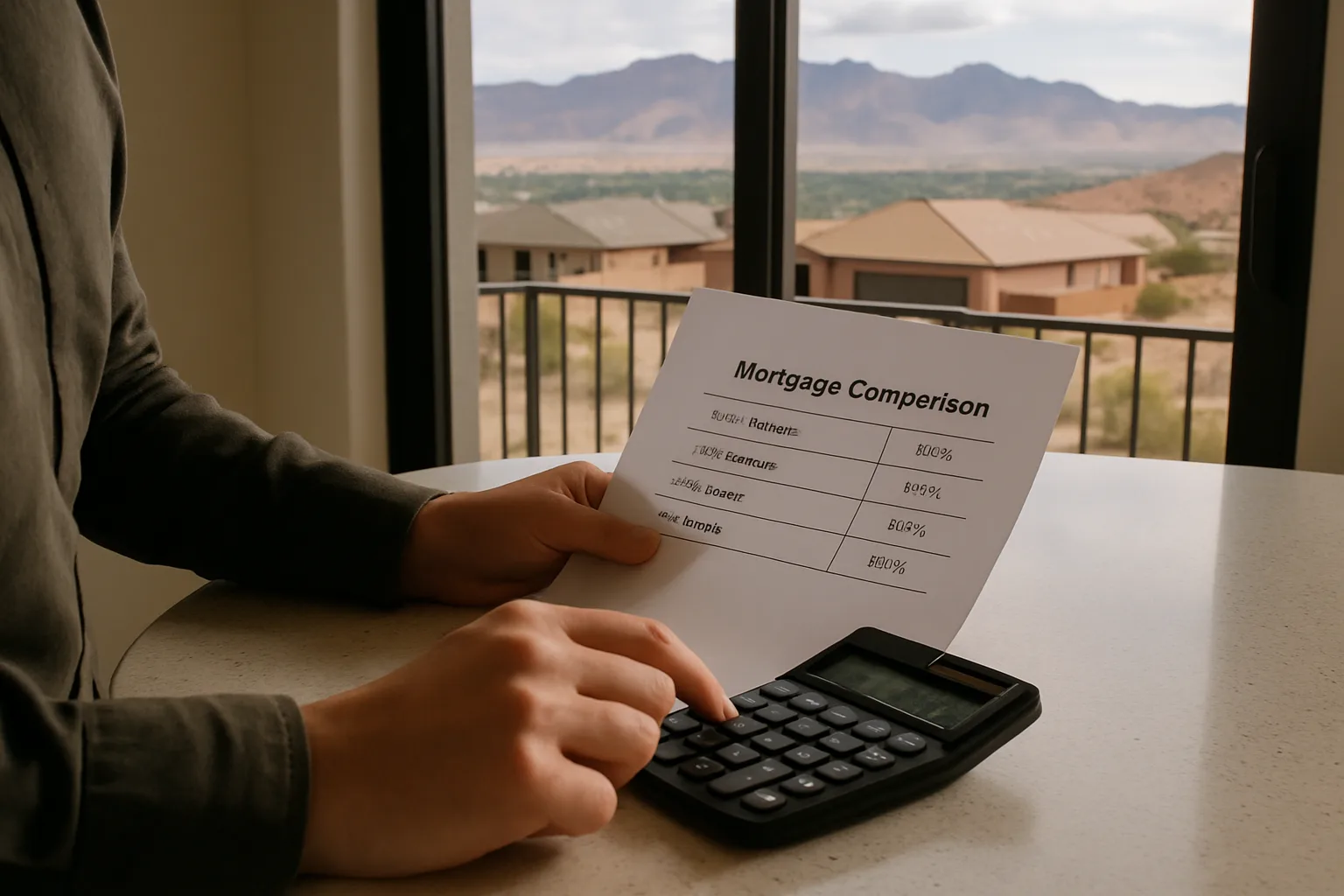
Rate Buydowns, Assumable Loans or an ARM: Worked Examples for Utah Buyers in 2026
Mortgage rates climbed above 7% this fall. Here is how permanent buydowns, seller-paid 2-1 buydowns, assumable FHA and VA loans and ARMs compare on the same $450,000 loan in 2026.
On October 8, 2026, Freddie Mac's weekly survey put the average 30-year fixed mortgage rate at 7.40%, up from 7.28% a week earlier and 6.30% a year earlier. The 15-year average was 6.73%. For a Utah buyer borrowing $450,000, the gap between 6.30% and 7.40% is roughly $330 a month in principal and interest. That is the problem the four tools below try to solve, each in a different way and each with a different catch.
This comparison covers permanent buydowns, temporary 2-1 buydowns, assumable FHA and VA loans, and adjustable-rate mortgages. Non-QM, asset-based and seller-financed purchases are separate strategies and are not repeated here. Every dollar figure below comes from a single labelled example so the options can be compared side by side. Actual pricing changes daily and differs by lender, credit score and loan type, so the numbers are a method, not a quote.
The Baseline Example Used Throughout
All four worked examples start from the same hypothetical purchase:
- Price: $500,000, a primary residence
- Down payment: 10%, or $50,000
- Loan amount: $450,000 on a 30-year term
- Baseline rate: 7.40%, the October 8, 2026 national average
- Baseline principal and interest: about $3,116 a month
Taxes, insurance, HOA dues and mortgage insurance are left out so the financing effect stays visible. Those costs still belong in a real budget, and mortgage insurance in particular can change the math on the FHA option.
Option 1: A Permanent Buydown With Discount Points
A permanent buydown means paying the lender up front, in the form of discount points, for a lower rate that lasts for the life of the loan. One point equals 1% of the loan amount, so on $450,000 one point costs $4,500. How much each point lowers the rate is not fixed. The Consumer Financial Protection Bureau notes that it depends on the lender, the loan type and the market that day, which is why two lenders can quote very different trade-offs.
Worked example: two points
Assume, for illustration only, that two points ($9,000) bring the rate from 7.40% to 6.90%.
- Payment at 6.90%: about $2,964 a month
- Monthly savings: about $152
- Break-even: $9,000 divided by $152 is roughly 59 months, or just under five years
The break-even month is the number that matters. A buyer who sells or refinances before then has paid more for points than the lower rate returned. In a market where many buyers hope to refinance if rates fall, points are a bet that the loan will be kept for a long time. Sellers can pay for points as part of their concessions, which shifts the bet onto someone else's money.
Option 2: A Temporary 2-1 Buydown Paid by the Seller or Builder
A 2-1 buydown lowers the payment for the first two years only. The rate is reduced by two percentage points in year one and by one point in year two, then returns to the note rate from year three onward. The difference is prepaid into a custodial account at closing, usually by a seller or a builder.
Worked example: 2-1 on the baseline loan
- Year 1 at 5.40%: about $2,527 a month
- Year 2 at 6.40%: about $2,815 a month
- Years 3 to 30 at 7.40%: about $3,116 a month
- Total subsidy the seller or builder funds: about $10,677
The rules that limit it
Under Fannie Mae's Selling Guide, temporary buydowns are allowed on primary residences and second homes but not investment properties or cash-out refinances. The rate can step up no more than 1% a year, the buydown period cannot exceed three years, and the borrower must qualify at the full note rate rather than the reduced first-year rate. That last rule matters: a 2-1 buydown does not help a buyer qualify for a bigger loan. It only eases the first two years of payments.
When a seller or builder pays for the buydown, the cost counts toward interested party contribution limits. For conventional loans on a primary residence, Fannie Mae caps those contributions at 3% of the price with more than 90% loan-to-value, 6% between 75.01% and 90%, and 9% at 75% or less. In this example the loan-to-value is exactly 90%, so the cap is 6%, or $30,000. The $10,677 buydown fits, but it uses more than a third of the room left for other closing-cost help.
Temporary or permanent: the same dollars, two outcomes
A seller willing to spend about $10,000 could fund the 2-1 buydown or roughly two points of permanent buydown under the assumption above. The 2-1 saves more in the first two years (about $10,700 in combined payment relief versus about $3,650 from points). From year three on, the permanent buydown keeps saving about $152 a month while the 2-1 has ended. A buyer expecting to refinance within a few years usually gets more from the temporary version. A buyer planning to keep the loan gets more from the permanent one. Buyers shopping new-construction communities in places such as Eagle Mountain new construction can ask a builder to price both, since builder incentives are often flexible about how the money is applied.
Option 3: Assuming an Existing FHA or VA Loan
FHA and VA loans are generally assumable, which means a qualified buyer can take over the seller's existing loan, rate and remaining term. Freddie Mac's 30-year average fell to a record low of 2.65% in January 2021, and loans originated in that period can carry rates under 3%. That makes an assumption the only one of these four tools that can deliver a rate far below today's market.
Worked example: a 2021 FHA loan
Assume the seller financed $340,000 at 3.25% in 2021 and has made five years of payments.
- Remaining balance: about $303,600
- Existing principal and interest: about $1,480 a month
- Gap between the $500,000 price and the balance: about $196,400
That gap is the catch. The buyer has to cover it with cash or a second loan. If the buyer brings the same $50,000 and finances the remaining $146,400 with a second loan at an assumed 8.5% over 30 years, the second loan adds about $1,125 a month. Combined principal and interest comes to about $2,605, roughly $510 a month less than the baseline. The savings shrink quickly when the seller's balance is smaller or the second-loan rate is higher, and not every servicer or second-lien lender will work with an assumption. FHA mortgage insurance also stays with the loan.
What the process involves
- Credit review: FHA assumptions require the servicer to check that the buyer is creditworthy, much as a new loan would.
- Fees and timing: In May 2024 FHA doubled the maximum fee servicers may charge to process an assumption, from $900 to $1,800, after the industry reported transactions taking 30 to 60 days or more. The National Association of Realtors summary of the FHA fee change explains why the cap was raised.
- VA funding fee: The VA charges a 0.5% funding fee on loan assumptions.
- VA entitlement: A non-veteran can assume a VA loan, but the seller's VA entitlement stays tied to the loan until it is paid off unless an eligible veteran buyer substitutes their own entitlement. Veteran sellers often weigh this before agreeing to an assumption.
Buyers can browse listings that mention an assumable loan, such as assumable homes in Lehi, assumable homes in St. George and assumable homes in Ogden. The listing remark is a starting point only. The servicer's written approval, the exact balance and the assumption terms need to be confirmed before an offer depends on them.
Option 4: An Adjustable-Rate Mortgage
An ARM starts with a fixed rate for a set period, often five, seven or ten years, then adjusts based on an index plus a margin. ARM start rates are typically lower than 30-year fixed rates, but the spread varies week to week.
Worked example: a 7-year ARM
Assume a 7-year ARM at 6.60%, with caps of 5% on the first adjustment, 1% on later adjustments and 5% over the life of the loan.
- Payment for years 1 to 7: about $2,874 a month, about $242 less than the baseline
- Savings over seven years: about $20,300
- Balance at the first adjustment: about $407,500
- If the rate rises one point at the first reset, to 7.60%: about $3,129 a month
- If it hits the 11.60% lifetime cap: about $4,237 a month
How the caps and qualifying rules work
The CFPB describes three caps: an initial adjustment cap (commonly 2% or 5%), a subsequent adjustment cap (commonly 1% or 2%) and a lifetime cap (commonly 5%). Qualifying rules are stricter for shorter fixed periods. Fannie Mae requires 5-year ARMs to be qualified at the higher of the fully indexed rate or the note rate plus 2% in its automated underwriting system, while 7- and 10-year ARMs are generally qualified at the note rate. A 5-year ARM may therefore not stretch buying power the way buyers expect.
Side-by-Side Summary
- Baseline fixed at 7.40%: about $3,116 a month, no rate risk.
- Permanent buydown (2 points, assumed 6.90%): about $2,964, costs $9,000, breaks even near month 59.
- Temporary 2-1 buydown: about $2,527, then $2,815, then $3,116 from year three; about $10,677 funded by the seller or builder; qualifies at 7.40%.
- FHA assumption plus second loan: about $2,605 combined; requires covering a large equity gap and a 30- to 60-day-plus servicer process.
- 7-year ARM at an assumed 6.60%: about $2,874 for seven years, then adjusts within its caps.
Questions to Ask Before Choosing
- How long will the loan likely be kept? Under five years favors a temporary buydown or ARM; over five favors points or a fixed rate.
- Can the full note-rate payment be carried today? If not, a temporary buydown only delays the problem.
- What happens if rates do not fall? Plans built on a future refinance should still work at today's rate.
- Who is paying? Seller and builder money counts against concession limits, so compare how each option uses that budget.
- Is the lender quoting the same day? Ask at least two lenders for written estimates with and without points on the same date.
Rates in fall 2026 have moved quickly enough that the best structure for a buyer in October may differ from the best one in December. Running the numbers for the specific home, loan and timeline is what separates these tools. Current listings, assumable-loan searches and local market data across the state are available at Best Utah Real Estate. For more on how builders are using incentives in this market, see this look at mortgage rates, new homes and Utah inventory.
Frequently asked questions
What is a 2-1 buydown on a mortgage?
A 2-1 buydown lowers the interest rate by two percentage points in the first year and one point in the second year, then the loan returns to its full note rate for the rest of the term. The cost is prepaid into a custodial account at closing, usually by a seller or builder. Under Fannie Mae rules, the borrower still has to qualify at the full note rate.
Is a permanent buydown better than a temporary buydown?
It depends on how long the loan will be kept. A temporary buydown delivers more payment relief in the first two years, while a permanent buydown with discount points keeps lowering the payment for the life of the loan. Divide the cost of the points by the monthly savings to find the break-even month; if a sale or refinance is likely before then, the points usually do not pay off.
How much can a seller pay toward a buydown on a conventional loan?
A seller-paid buydown counts toward Fannie Mae's interested party contribution limits. For a primary residence or second home, the cap is 3% of the price when the loan-to-value is above 90%, 6% between 75.01% and 90%, and 9% at 75% or less. Investment properties are capped at 2%, and temporary buydowns are not allowed on them.
Can anyone assume an FHA or VA loan in Utah?
FHA and VA loans are generally assumable, but the buyer must pass the servicer's credit review and cover the difference between the price and the loan balance. FHA allows servicers to charge up to $1,800 to process an assumption, and the VA charges a 0.5% funding fee. A non-veteran can assume a VA loan, but the seller's entitlement stays tied to it unless an eligible veteran substitutes their own.
How long does a mortgage assumption take?
Industry groups reported that FHA assumptions often took 30 to 60 days or more, which was one reason FHA raised its servicer fee cap in 2024. Timelines depend on the servicer, so buyers should build extra time into the purchase contract and get the servicer's requirements in writing early.
Are adjustable-rate mortgages risky when rates are above 7%?
An ARM's risk is what happens after the fixed period ends. Caps limit how far the rate can rise at the first adjustment, at later adjustments and over the life of the loan, commonly 5% lifetime. Buyers should calculate the payment at the lifetime cap and confirm it is survivable before choosing an ARM, rather than assuming a refinance will be available.
Keep reading
More from the blog
Utah's 2026 Property Tax Rate Increases: Eagle Mountain, Roy and What Owners Actually Pay

Roof Drainage Upgrades to Prevent Foundation Erosion

Utah Holiday Lights 2026: Displays by Region, Dates and Tips