Best Tripod and Geared Head for Real Estate Photography: Peak Design, Benro and K&F Concept Compared
Peak Design Travel Tripod and Benro Mach3 legs plus Benro and K&F Concept geared heads, compared for interiors, HDR brackets and tight rooms.
A tripod is the least exciting item in a listing photographer's bag, and one of the most used. Interiors are shot at small apertures and as bracketed sets, so every frame in a bracket has to land in exactly the same spot or the HDR blend and the window pulls won't line up. The tripod also sets how straight the verticals start out, how quickly each room gets done, and how tired the photographer is after the fifth house of the day.
This guide covers two sets of carbon fiber legs and two geared heads that suit real estate work, and the setup habits that matter more than the brand: camera height, leg sections, the center column and the plate under the camera.
Quick verdict
The choice comes down to how the houses are shot. For speed and tight rooms, pick a compact tripod and accept its ball head. For the straightest verticals with the least fiddling, pick full-size legs and put a geared head on them.
- Fastest through a house: the Peak Design Travel Tripod (Carbon Fiber). Light, at full height in about ten seconds, and narrow enough to stand behind a toilet or on a countertop.
- Geared head with the grippier plate: the Benro GD3WH Precision Geared Head. Gears that stay tight for years and a plate that doesn't slip; the clamp knob needs a gentle hand.
- Geared head with the sturdier clamp: the K&F Concept 3-Way Geared Tripod Head. A solid all-metal clamp, let down by the plate in the box. Replace the plate and it is a strong head.
- Tall, planted legs for a geared head: the Benro Mach3 Carbon Fiber Series 3 Long Tripod (TMA38CL). Very solid and the tallest here, but bulky to carry and slower to set.
The tripods and heads side by side
| Product | Shop | Type | Height or movement | Weight | Rated load | Suits |
|---|---|---|---|---|---|---|
| Peak Design Travel Tripod (Carbon Fiber) | 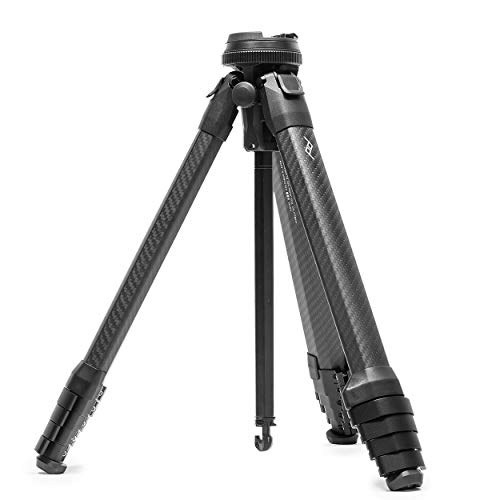 View on Amazon | Legs with built-in ball head, 5 sections | Up to 60 in; folds to 15.4 in | About 2.8 lb | 20 lb | Tight rooms, stairs, travel |
| Benro GD3WH Precision Geared Head |  View on Amazon | Geared head, Arca-type clamp | Three geared axes, three bubble levels | 1.6 lb | 13.2 lb | Straight verticals, fine framing |
| K&F Concept 3-Way Geared Tripod Head |  View on Amazon | Geared head, Arca-type clamp | Three geared axes | 1.8 lb | 13.2 lb | Geared control with a single-stage clamp |
| Benro Mach3 Carbon Fiber Series 3 Long Tripod (TMA38CL) |  View on Amazon | Legs only, 4 sections, twist locks | Up to 69.7 in; folds to 23.2 in | 4.5 lb | 35.3 lb | Tall rooms, commercial spaces |
Fastest in tight rooms
Peak Design Travel Tripod (Carbon Fiber)
A light tripod that reaches full height in seconds and fits into corners and onto countertops where full-size legs can't stand.
- About 2.8 lb
- 15.4 in folded
- 60 in max height
Good for
- Small bathrooms, tight corners and countertop angles
- Carrying through several houses a day
- Flying with gear
Skip it if
- Geared-head precision is the priority
- The most planted feel at full height matters
What a listing shoot asks of a tripod
A camera position that repeats
Most listing photos are bracketed: several frames of the same view at different exposures, blended later. The frames only blend cleanly if the camera doesn't move between them. The same goes for a window pull or a flash-and-ambient blend. A wobbly tripod can still produce sharp brackets if it is left to settle and fired with a remote or a shutter delay, but every room takes longer and the day gets more tiring. A good tripod doesn't change the photos so much as the pace of the shoot.
Start at light-switch height
For most residential rooms, set the camera at about the height of a standard light switch, roughly 48 inches from the floor to the lens. Higher than that and the frame fills with ceiling while counters and furniture flatten out. Lower and the floor and the backs of sofas take over. It is a starting point: go a little higher in a kitchen so the counters don't block the room, and adjust around mirrors in a bathroom.
That makes maximum height the wrong number to shop by. The head and camera add several inches, so the legs themselves sit well under 48 inches most of the day. What matters is how quickly the tripod reaches that working height with one or two leg sections out. Framing is the other half, covered in the guide to lenses for real estate photography.
Fewer leg sections, thicker legs
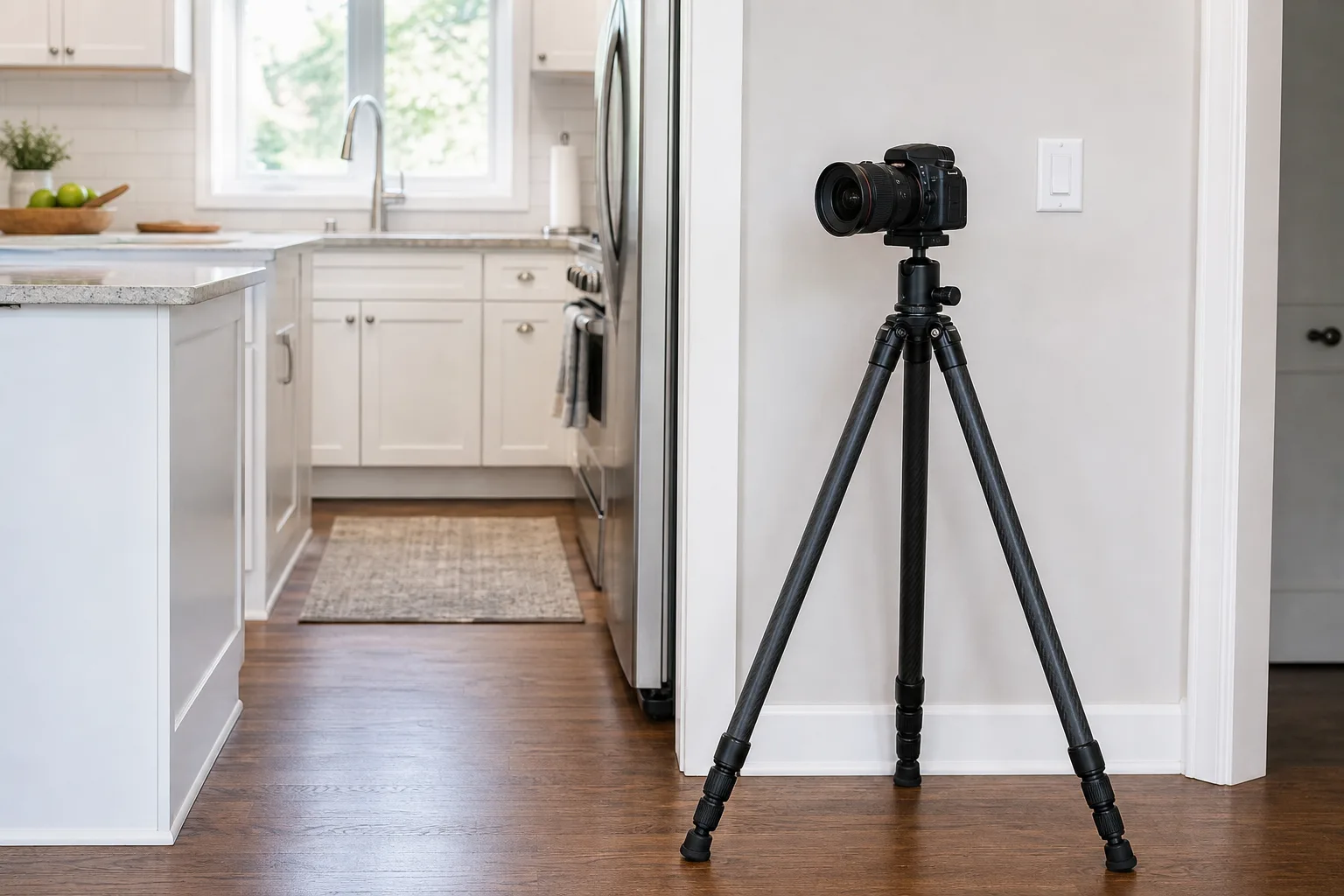
Every extra leg section adds a lock to open and a thinner tube at the bottom. Travel tripods use four or five sections so they fold short, which matters on a plane and much less between a car and a front door. Carbon fiber suits this work because it is stiff and damps vibration at a lower weight than aluminum, and the weight is felt on every staircase.
Use the legs for height, the column for trim
A raised center column puts the camera on a single narrow pole above the legs. Get to working height with the legs and use the column only for small changes.
Geared head or ball head
A ball head frees every axis at once. That suits wildlife and landscape work, and it makes leveling an interior slow. A three-way geared head has one knob per axis, so side-to-side level, forward tilt and pan are each adjusted in small, exact steps, and each axis can be released for a large move by hand without disturbing the other two. For keeping verticals vertical, that control is why a geared head is the standard choice for interiors. A ball head still works in practiced hands; it asks for more care on every frame.
Two things decide how long a geared head stays useful. One is the gearing, which wears on every head eventually. The other, which fails sooner, is the clamp and the plate that hold the camera.
- Stay with Arca-type plates. A head that takes the common Arca-style dovetail lets one plate work across every tripod and backup rig. The long-running Manfrotto 410 Junior uses Manfrotto's own plate instead and is rated for 11 lb, lower than the two heads here.
- Use a 70 mm plate. Small plates have too little contact area to grip a camera body.
- Check the plate before the shoot and after turning the camera vertical. Without an L-bracket, the weight of a camera on its side works the plate screw loose. Keep a small hex key or screwdriver in a pocket.
- Test the clamp. After tightening, lift the camera until the tripod comes off the floor and give it a light shake.
- Pick a plate in a color. In a dim room, a black plate under a black camera on a black head makes it hard to see whether the dovetail is seated. A blue, orange or gray plate shows.
Geared head, grippier plate
Benro GD3WH Precision Geared Head
Durable gearing and a plate that holds the camera still, with a two-stage clamp knob that should not be over-tightened.
- 13.2 lb load rating
- 3 bubble levels
- 70 mm Arca-type plate
Good for
- Keeping verticals straight room after room
- Photographers who want a plate that tightens by hand
Skip it if
- You tend to crank clamps hard
- You prefer a simple single-stage clamp
The picks in detail
Peak Design Travel Tripod (Carbon Fiber)
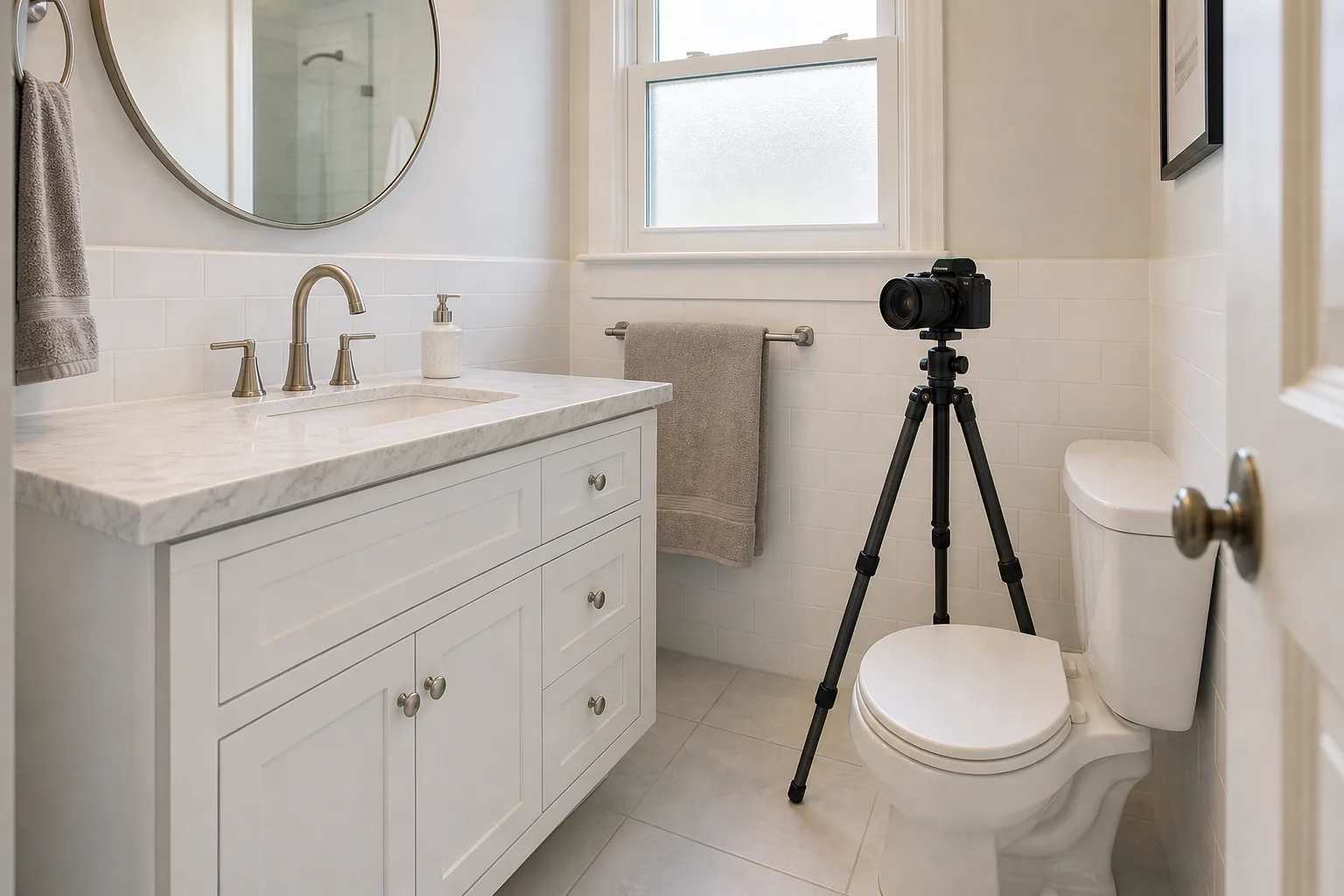
The Peak Design Travel Tripod is built to be small: about 2.8 lb, 15.4 inches folded, and still 60 inches tall with the column raised. Speed is the reason to own it. It goes from folded to full height in about ten seconds, which a full-size tripod with a carry case can't match, and over a day of houses that adds up. It also fits where big legs won't: behind a toilet, in a tight corner, or standing on a kitchen counter for an angle across the worktop instead of over it. And it lasts. After years of steady professional use it looks and works much as it did out of the box.
The trade-offs come from the same design. It has five leg sections, so the lowest tubes are thin and it feels less planted than full-size legs. Its built-in head is a compact ball head, not a geared one, so getting verticals straight depends on the photographer's care and practice.
Fastest in tight rooms
Peak Design Travel Tripod (Carbon Fiber)
A light tripod that reaches full height in seconds and fits into corners and onto countertops where full-size legs can't stand.
- About 2.8 lb
- 15.4 in folded
- 60 in max height
Good for
- Small bathrooms, tight corners and countertop angles
- Carrying through several houses a day
- Flying with gear
Skip it if
- Geared-head precision is the priority
- The most planted feel at full height matters
Benro GD3WH Precision Geared Head
The Benro GD3WH is rated for 13.2 lb, weighs 1.6 lb and has three bubble levels. Its gearing is the strong point: it stays tight and wobble-free through years of daily adjustment. The included 70 mm plate, which Benro lists as the PU70, is equally good: a large D-ring that tightens by hand and a firm grip on the camera.
The weak point is the clamp knob. It has a two-stage safety stop: it unscrews to a stop, then has to be pulled out to open further. The mechanism inside is light, and heavy torque can break it or leave it sticking. Tighten it firmly, not hard, and use the lift test.
Geared head, grippier plate
Benro GD3WH Precision Geared Head
Durable gearing and a plate that holds the camera still, with a two-stage clamp knob that should not be over-tightened.
- 13.2 lb load rating
- 3 bubble levels
- 70 mm Arca-type plate
Good for
- Keeping verticals straight room after room
- Photographers who want a plate that tightens by hand
Skip it if
- You tend to crank clamps hard
- You prefer a simple single-stage clamp
K&F Concept 3-Way Geared Tripod Head
The K&F Concept geared head matches the Benro's 13.2 lb rating in a CNC-machined aluminum body, and its gearing has proved reliable as well. It reverses the Benro's strengths. The clamp is the better one: solid metal, a clean dovetail and a single-stage knob with nothing delicate inside. The plate in the box is the problem. Its grip surface is poor and its D-ring is small, so a camera twists on it no matter how tight the clamp is.
The fix is simple. Treat the supplied plate as packaging and mount the camera on a good 70 mm Arca-type plate in a visible color, tightened with a hex key.
Geared head, sturdier clamp
K&F Concept 3-Way Geared Tripod Head
A geared head with reliable gearing and a solid single-stage clamp that needs a better plate than the one supplied.
- 13.2 lb load rating
- 1.8 lb
- CNC-machined aluminum
Good for
- Photographers who have had clamp knobs fail
- Rigs that already use good Arca-type plates
Skip it if
- You want to use the plate in the box
Benro Mach3 Carbon Fiber Series 3 Long Tripod (TMA38CL)
Benro's Mach3 carbon legs are a traditional full-size design, and the Series 3 Long (TMA38CL) is a tall version: four sections with twist locks, a 35.3 lb load rating and 69.7 inches at full extension. Mach3 legs are solid under a three-way geared head and do not move during a bracket, they carry a video fluid head just as well, and the extra reach helps in lobbies and community rooms.
Size is the complaint. The legs fold to 23.2 inches and travel in a long carry case, they are bulky to move from room to room, slower to set than a compact tripod, and too wide to stand in the tightest spots.
Tallest reach
Benro Mach3 Carbon Fiber Series 3 Long Tripod (TMA38CL)
Tall, traditional carbon legs that hold a geared head steady and trade away speed and compactness.
- 4 sections, twist locks
- 69.7 in max height
- 35.3 lb load rating
Good for
- Tall rooms and commercial spaces
- A geared head or a video fluid head
Skip it if
- Shoots are mostly small rooms
- Carrying a long case is a nuisance
Other legs to know
Two more sets of full-size carbon legs fit the geared-head role. The Manfrotto 055 Carbon Fiber 3-Section Tripod (MT055CXPRO3) has three sections with lever locks, so there are few locks to work per setup. Manfrotto lists a 44 lb safety payload, 66.9 inches of height with the column up and 55.1 inches with it down, a weight of 4.6 lb and a folded length of 24.8 inches. The Gitzo Mountaineer Series 2 GT2542 is a four-section carbon design at 3.7 lb. Both are sold as legs only, so a head is a separate purchase. For the camera to put on top, see the comparison of cameras for real estate photography.
Geared head, sturdier clamp
K&F Concept 3-Way Geared Tripod Head
A geared head with reliable gearing and a solid single-stage clamp that needs a better plate than the one supplied.
- 13.2 lb load rating
- 1.8 lb
- CNC-machined aluminum
Good for
- Photographers who have had clamp knobs fail
- Rigs that already use good Arca-type plates
Skip it if
- You want to use the plate in the box
Who should buy which
- Anyone who shoots several houses a day, tight homes, condos and short-term rentals, or flies to jobs: the Peak Design Travel Tripod, accepting a ball head and thinner lower legs.
- Photographers who want level, repeatable frames with the least fiddling: full-size carbon legs with a three-way geared head on top.
- Choosing a geared head: the Benro GD3WH if a hand-tightened plate matters most; the K&F Concept if a tough clamp matters most and a replacement plate is no bother.
- Commercial and tall-ceiling work: the Benro Mach3 Series 3 Long under a geared head.
- Agents shooting their own listings: either set of legs works. Put the camera at light-switch height, level it, and fire the bracket with a remote or a short shutter delay.
Sellers preparing a home for photos can start with a home valuation, and anyone shooting staging details or products at home will find the same gear at work in the guide to setting up a home photo and video studio.
Adding light to the kit? See the best flash for real estate photography comparison of Godox's AD200Pro II, AD200Pro, AD300Pro and AD400Pro.
Once the tripod is sorted, the HDR real estate photography guide walks through settings and a bracketed shoot room by room.
Posted by Kristopher Larson
Frequently asked questions
What is the best tripod for real estate photography?
It depends on how the houses are shot. A compact carbon tripod such as the Peak Design Travel Tripod is the quickest through small rooms and several houses a day. Full-size carbon legs such as the Benro Mach3 Series 3 Long, paired with a three-way geared head, give the steadiest platform and the easiest leveling, and suit tall and commercial spaces.
How high should the camera be for interior real estate photos?
Start with the lens at about light-switch height, roughly 48 inches off the floor. Raise it slightly in kitchens so the counters don't hide the room, and adjust in bathrooms to manage mirrors. Setting the camera much higher shows too much ceiling; much lower puts the emphasis on floors and furniture.
Is a geared head better than a ball head for real estate photography?
Yes, for most interior work. A geared head adjusts each axis separately with a knob, so the camera can be leveled precisely and vertical lines stay vertical. A ball head releases every axis at once, which makes exact leveling slower. A ball head is still workable on a compact tripod when speed and size matter more, as long as the photographer takes care to level each frame.
Do you need a tripod for HDR real estate photos?
Yes. HDR listing photos are blended from several bracketed exposures of the same view, and the frames have to line up exactly. A tripod holds the camera in one position for the whole bracket. Using a remote or a short shutter delay keeps the press of the shutter button from shaking the camera.
Is carbon fiber better than aluminum for a real estate tripod?
Carbon fiber is stiffer for its weight and damps vibration well, so a carbon tripod can be rigid without being heavy. That matters to anyone who carries a tripod through several houses a day. Aluminum tripods can be just as stable; they weigh more for the same stiffness.
Why does the camera keep twisting on the tripod plate?
The plate screw has worked loose, or the plate is too small or has a poor grip surface. Use a 70 mm Arca-type plate, tighten it with a hex key or screwdriver, and check it again after turning the camera vertical, since the weight of a camera on its side loosens the screw. An L-bracket avoids the problem.
Keep reading
More from the blog
Best Indoor Air Quality Monitor: Aranet4 vs. Airthings View Plus vs. Qingping vs. Amazon
Instax vs. Polaroid: Which Instant Camera to Buy
Reencle vs. FoodCycler vs. GEME: Which Electric Kitchen Composter Actually Makes Compost?