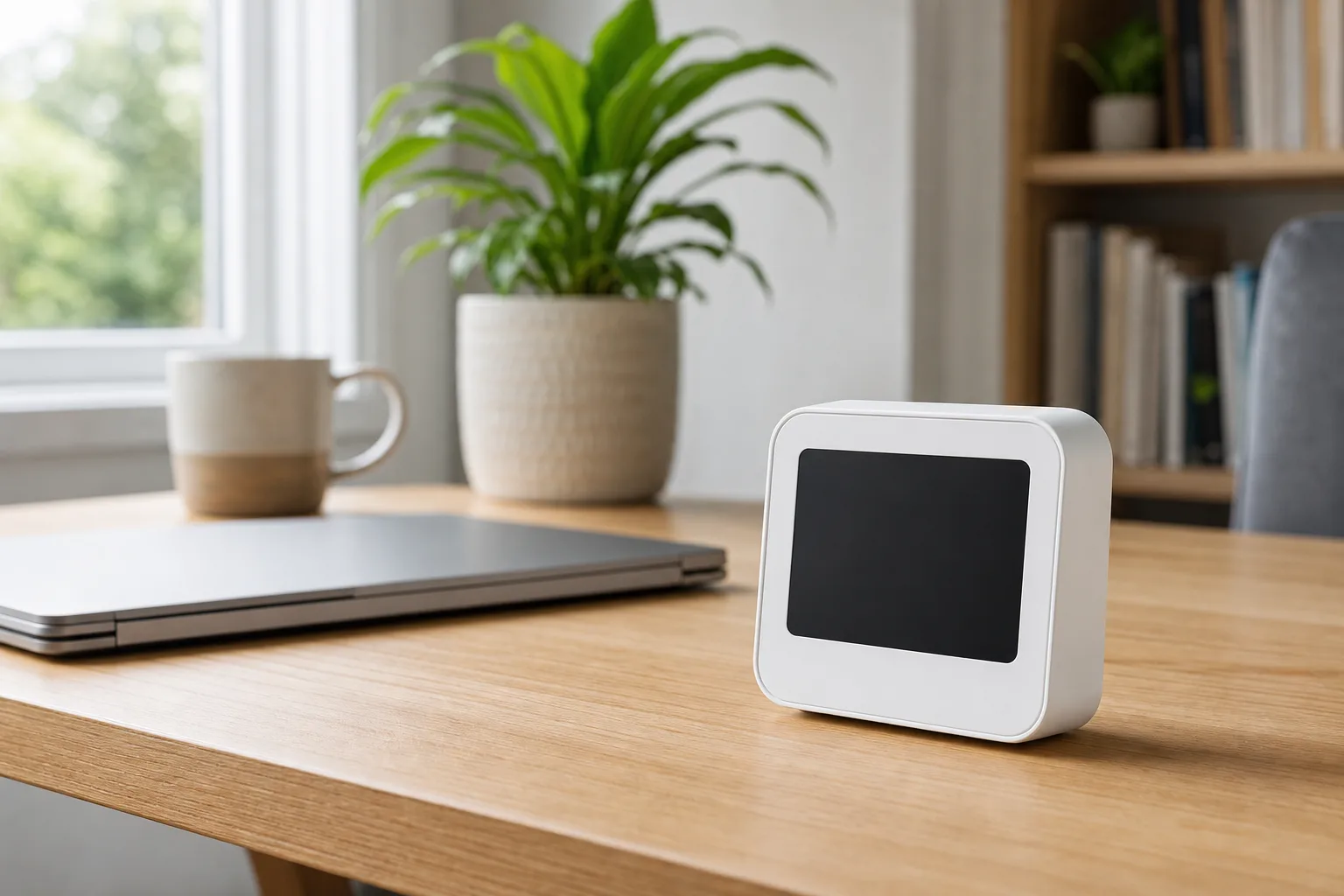
Best Indoor Air Quality Monitor: Aranet4 vs. Airthings View Plus vs. Qingping vs. Amazon
Which air quality monitor to buy for CO2, wildfire smoke, radon or Alexa: Aranet4, Airthings View Plus, Qingping, Dylos and Amazon compared.
An indoor air quality monitor puts numbers on things you can't see: how stale a bedroom gets overnight, how much smoke a seared steak leaves in the kitchen, whether the basement has a radon problem. The catch is that "air quality" covers very different measurements. A CO2 reading, a particle reading, a VOC score and a radon level each need a different kind of sensor, and the easiest way to get a wrong answer is to buy a monitor built for the wrong one.
This guide covers what each sensor actually tells you, the flaws that make some popular monitors frustrating, and which one fits a CO2 check, wildfire smoke, radon or an Alexa home.
Quick verdict
- Best for CO2 and ventilation: the Aranet4 Home. A true NDIR CO2 sensor that's factory calibrated, so it reads correctly from day one, plus an E Ink screen and a battery rated for up to four years.
- Best all-in-one, and the pick for radon: the Airthings View Plus. Radon, PM2.5, CO2, VOCs, humidity, temperature and pressure in one battery-or-USB-C unit with a clean app.
- Best plug-and-play particle monitor: the Qingping Air Monitor Lite. Fast PM2.5 and PM10 readings on its own screen, CO2 too, Apple Home support and no account needed to start reading.
- Best for seeing small changes in dust and smoke: the Dylos DC1100 Pro, a particle counter that reacts to activity mass-based monitors barely register.
- Best for Alexa automations: the Amazon Smart Air Quality Monitor, a simple plug-in sensor that can switch on a purifier or fan through Alexa routines. It does not measure CO2.
The air quality monitors side by side
| Monitor | Shop | Measures | CO2 sensor | Power | Screen | Smart home |
|---|---|---|---|---|---|---|
| Aranet4 Home | 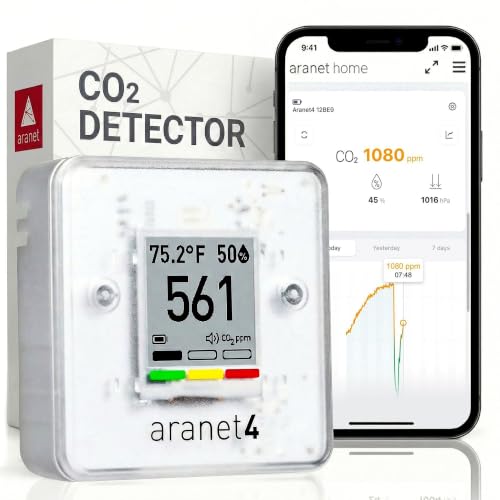 View on Amazon | CO2, temperature, humidity, pressure | NDIR, factory calibrated | Battery, rated up to 4 years | E Ink | Bluetooth app only |
| Airthings View Plus |  View on Amazon | Radon, PM2.5, CO2, VOCs, humidity, temperature, pressure | NDIR, self-calibrating | 6 AA or USB-C | E Ink, up to 4 values | Wi-Fi; Alexa, Google Assistant, IFTTT |
| Qingping Air Monitor Lite |  View on Amazon | PM2.5, PM10, CO2, temperature, humidity | Yes | Built-in rechargeable battery | Built-in screen, one page at a time | Wi-Fi; Apple Home |
| Dylos DC1100 Pro |  View on Amazon | Particle counts, small (0.5 micron+) and large (2.5 micron+) | None | Plug-in | LCD with bar graph | None; 30 days of on-board history |
| Amazon Smart Air Quality Monitor |  View on Amazon | PM2.5, VOCs, carbon monoxide, humidity, temperature | None | Plug-in | Color status light only | Alexa app, Echo, routines |
Best for CO2
Aranet4 Home
A factory-calibrated NDIR CO2 monitor with an E Ink screen and years of battery life, accurate from the first day.
- NDIR CO2 0–9,999 ppm
- Up to 4-year battery
- E Ink display
Good for
- Bedrooms and home offices
- Travel and moving room to room
- Anyone tired of waiting for a monitor to calibrate
Skip it if
- You want particle or radon readings
- You need Wi-Fi automations
Do you need a monitor at all?
For outdoor air, no. The EPA's free AirNow service gives local air quality and smoke readings, and Google Maps shows air quality too. Indoors is where a monitor earns its place.
What the sensors actually tell you
CO2: the ventilation gauge
For most people the most useful single number is CO2. People exhale it, so a closed bedroom or office climbs steadily, and the reading shows how well a room is ventilated. Look for a true NDIR (non-dispersive infrared) sensor. Many basic monitors show "eCO2," an estimate calculated from a VOC sensor rather than a CO2 measurement, and those estimates can be far off; some no-name units barely change even when breathed on.
Calibration matters as much as the sensor. Airthings and AirGradient monitors use automatic baseline calibration: the monitor spends about a week or two learning what fresh air looks like in your home, then keeps adjusting. Until it settles, the CO2 number is a work in progress, and in some homes it never settles well. In houses with constant mechanical ventilation, readings from the Airthings View Plus and AirGradient ONE can sit around 100 ppm off a calibrated reference, even after opening windows near them. The Aranet4 Home avoids the wait because it ships factory calibrated, and it holds its calibration well over time.
PM2.5 and particles: smoke, cooking and dust
Particle sensors catch wildfire smoke, cooking fumes, candles and dust. Most home monitors report mass concentration (micrograms of particles per cubic meter), which is what air quality standards and the AQI use. Particle counters such as the Dylos report how many particles are in the air instead, and that makes them far more sensitive at low levels. Shake out a dusty towel near both kinds, and a particle counter climbs past 2,000 while a mass-based monitor like the AirGradient ONE can stay at 0 to 2 µg/m³, a "good" reading. Mass is still the number to compare against smoke advisories.
Two practical details: particle sensors have a fan and wear out over several years, so a monitor with a user-replaceable sensor lasts longer. And for PM accuracy, the South Coast Air Quality Management District's AQ-SPEC program publishes field evaluations of consumer sensors against reference instruments; it's worth checking a model there before choosing a big-name monitor that uses the same sensor as lesser-known ones.
VOCs: the least reliable number
Nearly every all-in-one monitor shows a total VOC score, and it's the reading to trust least. These are general gas sensors: they drift, react to humidity, and can't tell a harmless compound from a harmful one. Don't use one to judge whether a carbon filter works. For VOCs, your nose is still the better first check.
Radon: a separate question
Radon is an odorless radioactive gas that seeps up from the ground, and only a radon test or radon monitor will find it. The EPA calls radon the number one cause of lung cancer among non-smokers and recommends fixing a home at 4 pCi/L or higher. A continuous monitor needs time: Airthings rates the View Plus radon reading at about 10% accuracy after 7 days and closer to 5% after two months, so judge it on long-term averages, not a single day.
Best for radon
Airthings View Plus
Seven sensors including radon in one battery or USB-C unit, with the clearest app and dashboard of the group.
- Radon, PM2.5, CO2, VOC
- 6 AA or USB-C
- Alexa and Google Assistant
Good for
- Radon monitoring in basements and lower floors
- One monitor that covers everything
- Homes with other Airthings sensors
Skip it if
- You need an accurate CO2 reading on day one
- You want fast reaction to short smoke spikes
The picks in detail
Aranet4 Home: best for CO2 and ventilation
The Aranet4 Home does one job very well. Its NDIR sensor reads CO2 from 0 to 9,999 ppm and is calibrated at the factory, with automatic calibration switched off by default, so the first reading is a real one. It also shows temperature, humidity and pressure, and its temperature and humidity readings match dedicated thermometers closely. Setup takes two AA batteries and a few small switches in the battery compartment for Fahrenheit or Celsius, Bluetooth and calibration. The E Ink screen reads well from an angle, flashes black for a moment when it refreshes and uses so little power that the battery is rated for up to four years.
The app pulls readings over Bluetooth and graphs each value by day or week, with a calendar to jump back to any date. You choose a 1-, 2-, 5- or 10-minute interval; 5 minutes, the default, balances detail against battery life and keeps about 15 days on the device. You can also set custom color thresholds, switch to an extended Bluetooth range that reaches through more walls, and have the buzzer sound once or every time CO2 passes 1,400 ppm or your own limit. To sanity-check it, take it outside: fresh air reads about 420 ppm. After moving it to a new room, give it 10 to 15 minutes to settle. It can stand on a desk or hang on a wall, as long as the side vents stay uncovered.
It measures no particles, VOCs or radon, and it has no Wi-Fi, so it won't trigger automations without extra hardware.
Best for CO2
Aranet4 Home
A factory-calibrated NDIR CO2 monitor with an E Ink screen and years of battery life, accurate from the first day.
- NDIR CO2 0–9,999 ppm
- Up to 4-year battery
- E Ink display
Good for
- Bedrooms and home offices
- Travel and moving room to room
- Anyone tired of waiting for a monitor to calibrate
Skip it if
- You want particle or radon readings
- You need Wi-Fi automations
Airthings View Plus: best all-in-one and best for radon
The Airthings View Plus is the only monitor here that covers radon alongside PM2.5, CO2, VOCs, humidity, temperature and pressure. Its E Ink screen shows up to four values with a red, yellow or green glow, and the Airthings app and web dashboard are clean and easy to read. It runs on six AA batteries, rated for up to two years depending on settings and Wi-Fi, or on USB-C. Plugged in, it also acts as a hub for other Airthings sensors. It connects to Alexa, Google Assistant and IFTTT, but not Apple Home.
Its weak spots: CO2 relies on automatic calibration, so expect a week or more before that number settles, and in some homes it stays off. It also updates particles less often than the Qingping, so a quick cooking spike shows up later and flatter.
Best for radon
Airthings View Plus
Seven sensors including radon in one battery or USB-C unit, with the clearest app and dashboard of the group.
- Radon, PM2.5, CO2, VOC
- 6 AA or USB-C
- Alexa and Google Assistant
Good for
- Radon monitoring in basements and lower floors
- One monitor that covers everything
- Homes with other Airthings sensors
Skip it if
- You need an accurate CO2 reading on day one
- You want fast reaction to short smoke spikes
Qingping Air Monitor Lite: best plug-and-play particle monitor
The Qingping Air Monitor Lite is the easy way to watch smoke and dust. Take it out of the box and it starts reading PM2.5, PM10, CO2, temperature and humidity on its own screen, with no login or dashboard to set up first. It reacts quickly, so it's a good way to watch a purifier clear the air after cooking or during a smoke day, and its PM2.5 readings track reference-grade instruments closely, though they run a little low. It pairs with Apple Home and the Qingping+ app, and the built-in 2,000 mAh battery means it can move off the charger for a while.
The screen shows one page at a time; you tap or slide the bar on top to switch readings. The particle sensor isn't user-replaceable, so when it wears out the monitor is done. It doesn't work with Alexa or Google.
Best plug-and-play
Qingping Air Monitor Lite
A compact monitor that shows PM2.5, PM10 and CO2 the moment it's switched on, with fast reactions to smoke and cooking.
- PM2.5, PM10, CO2
- 2,000 mAh battery
- Apple Home
Good for
- Wildfire smoke and cooking checks
- Apple Home users
- Watching an air purifier work
Skip it if
- You use Alexa or Google Home
- You want every reading on one screen
Dylos DC1100 Pro: best for seeing small changes
The Dylos DC1100 Pro is a laser particle counter rather than an all-in-one. It splits the air into small particles (0.5 micron and up) and large particles (2.5 microns and up) and shows both counts with a bar graph, plus 30 days of history on the unit. Because it counts particles instead of weighing them, it reacts to vacuuming, shaking out bedding or cooking that mass-based monitors often score as zero.
It's an older, plain design: no app, no Wi-Fi, no CO2 and no VOCs, and its counts don't convert directly to AQI. Exporting data needs the PC-interface version and a serial (COM port) connection; the DC1700 is the battery-powered model.
Best for small changes
Dylos DC1100 Pro
A laser particle counter that reacts to dust and smoke mass-based monitors barely register.
- Small and large particle counts
- 30-day history
- LCD bar graph
Good for
- Tracking how cleaning, cooking and doors affect the air
- Checking a purifier or filter upgrade
Skip it if
- You want CO2, VOCs or an AQI number
- You want an app
Amazon Smart Air Quality Monitor: best for Alexa automations
The Amazon Smart Air Quality Monitor is a small plug-in sensor with a colored status light and no screen. It reads PM2.5, VOCs, carbon monoxide, humidity and temperature, and everything else happens in the Alexa app: trends, phone alerts, Echo announcements, an air score on an Echo Show, and routines that turn on a purifier or fan when the air gets worse.
There's no CO2 sensor, and you can't export its data to compare against other monitors, which limits it as a measuring tool. Its carbon monoxide reading is not a substitute for a listed CO alarm; see the smoke and CO alarm guide for those.
Best for Alexa
Amazon Smart Air Quality Monitor
A simple plug-in sensor that feeds air readings into Alexa routines, alerts and Echo announcements.
- PM2.5, VOC, CO
- Plug-in
- Alexa app
Good for
- Alexa homes that want automations
- A basic particle and VOC check
Skip it if
- You need CO2 readings
- You want to export or compare data
Other monitors worth knowing
- PurpleAir Touch and PurpleAir Zen. Among the most accurate consumer particle sensors, and their particle sensors are user-replaceable. They're built around PurpleAir's map, with an LED light ring instead of a screen, and pulling your own history takes some technical work.
- AirGradient ONE. Open and data-friendly, with a screen showing CO2, PM and TVOC and a clear policy that you own your data. It shares the automatic-calibration and low-end particle sensitivity limits described above.
- Awair Element. A good-looking monitor for PM2.5, CO2, VOCs, temperature and humidity, but it has no battery and must stay plugged in, while the Qingping monitors cover the same readings with battery backup.
Best plug-and-play
Qingping Air Monitor Lite
A compact monitor that shows PM2.5, PM10 and CO2 the moment it's switched on, with fast reactions to smoke and cooking.
- PM2.5, PM10, CO2
- 2,000 mAh battery
- Apple Home
Good for
- Wildfire smoke and cooking checks
- Apple Home users
- Watching an air purifier work
Skip it if
- You use Alexa or Google Home
- You want every reading on one screen
How to choose
- Checking whether a bedroom or home office needs more fresh air? Buy a CO2 monitor with an NDIR sensor. The Aranet4 Home is the one that's accurate out of the box.
- Worried about radon? The Airthings View Plus monitors it continuously alongside everything else. Follow EPA guidance and act on long-term readings of 4 pCi/L or more.
- Watching wildfire smoke or cooking fumes? A particle monitor with fast updates, like the Qingping Air Monitor Lite. Pair it with a properly sized purifier from the air purifier CADR guide.
- Humidity running high or low? Every monitor here except the Dylos shows it; see the humidifier guide if winter air runs dry.
Posted by Kristopher Larson
Frequently asked questions
Is an indoor air quality monitor worth it?
Yes, if you want answers about your own home rather than your region. Free services like EPA's AirNow cover outdoor air. A monitor shows how stale a bedroom or office gets, whether cooking or wildfire smoke is lingering indoors, and whether a purifier is clearing it. For most homes a CO2 monitor is the most useful first purchase.
What is the difference between NDIR CO2 and eCO2?
An NDIR (non-dispersive infrared) sensor measures carbon dioxide directly. eCO2 is an estimate calculated from a VOC gas sensor, and it can be far from the real level. For checking ventilation, buy a monitor that lists an NDIR CO2 sensor, such as the Aranet4 Home or Airthings View Plus.
What CO2 level is too high indoors?
Fresh outdoor air sits around 400 to 450 ppm. Indoors, a rising number means the room isn't getting enough fresh air. The Aranet4 Home turns red at 1,400 ppm by default, and many people aim to keep bedrooms and offices well below that by opening a window, running a fan or improving ventilation.
Can an air quality monitor detect radon?
Only one with a dedicated radon sensor. Among popular all-in-one monitors, the Airthings View Plus measures radon along with particles, CO2 and VOCs. The EPA recommends fixing a home when radon is 4 pCi/L or higher, and a continuous monitor needs at least a week before its reading is reliable, so judge it on long-term averages.
What is the best air quality monitor for wildfire smoke?
A monitor with a fast-updating PM2.5 sensor. The Qingping Air Monitor Lite reacts quickly and shows PM2.5 on its own screen, which makes it easy to see when smoke gets inside and how fast a purifier clears it. A CO2-only monitor like the Aranet4 Home won't detect smoke.
Are VOC readings on air quality monitors accurate?
Not very. Home monitors use general gas sensors that estimate total VOCs. They drift, react to humidity, and can't tell harmless compounds from harmful ones, so a high number after cleaning or cooking isn't a diagnosis. Treat the VOC score as a rough hint, and don't rely on it to judge a carbon filter.
Keep reading
More from the blog
Instax vs. Polaroid: Which Instant Camera to Buy
Reencle vs. FoodCycler vs. GEME: Which Electric Kitchen Composter Actually Makes Compost?
Best Laser Measure for Real Estate: Bosch GLM400CL vs. Mileseey S50C vs. Stabila LD 530 BT