How to Choose an Air Purifier by Room Size and CADR: Coway vs. Levoit vs. Winix
How to size an air purifier with CADR, why box coverage claims mislead, what filters do, plus Coway Mighty2, Levoit Vital 200S, Winix and Airmega picks.
An air purifier is basically a fan pushing room air through a filter. How well it works comes down to how much air it moves through that filter, how quietly it does it, and what the filter can catch. The box rarely makes that clear. Coverage claims of "up to 1,800 square feet" are common on mid-size units that are really sized for a large bedroom or a modest living room.
This guide explains how to size a purifier with CADR, which features are worth paying for, what to avoid, and which current models fit which rooms.
As an Amazon Associate, Best Utah Real Estate earns from qualifying purchases. Product picks are based on published specs and independent testing data, not paid placement.
Quick verdict: the best air purifier for each room
- Best for most bedrooms and medium rooms: Coway Airmega Mighty2 (AP-1512N). Smoke CADR 240, a laser particle sensor, and a pre-filter that slides out without opening the cover.
- Best with app control: Levoit Vital 200S-P. AHAM Verifide, smoke CADR 250, VeSync app scheduling and optional specialty filters.
- Best value with voice assistants: Winix 5510. AHAM Verifide for a 392-square-foot room, with Alexa and Google Assistant support.
- Best for large living rooms: Coway Airmega 400S. Smoke CADR 328, Energy Star certified, with a 5-year limited warranty.
- Best for open-plan spaces: Coway Airmega ProX. Smoke CADR 567 from twin fans and filters at 65 watts.
CADR: the number that matters most
Clean Air Delivery Rate (CADR) measures how many cubic feet per minute of filtered air a purifier delivers, tested separately for smoke, dust and pollen. Smoke particles are the smallest and hardest to catch, so the smoke CADR is the most conservative figure to size by. Ratings are measured at top fan speed.
How to size a purifier to a room
The EPA's Guide to Air Cleaners in the Home gives a simple chart for rooms with 8-foot ceilings. The minimum CADR works out to about two-thirds of the floor area:
| Room size | Minimum CADR (EPA chart) |
|---|---|
| 100 sq ft | 65 cfm |
| 200 sq ft | 130 cfm |
| 300 sq ft | 195 cfm |
| 400 sq ft | 260 cfm |
| 500 sq ft | 325 cfm |
| 600 sq ft | 390 cfm |
Turned around, a purifier's smoke CADR divided by 0.65 gives the largest room it suits at full speed. The EPA also advises sizing up for ceilings higher than 8 feet and treating an open floor plan as one connected space.
Why box coverage claims look so big
The "up to 1,800 sq ft" figures on many listings usually mean the purifier can filter that much air once in an hour. The EPA chart, by contrast, works out to roughly five air changes per hour. Coway's own Mighty2 listing shows the gap: 900 square feet in 30 minutes, or 1,800 in 60 minutes, from a smoke CADR of 240. That CADR fits a room of about 370 square feet by the EPA chart. Winix states the conservative number up front: the 5510 is AHAM Verifide for a 392-square-foot room, even though it also lists 1,882 square feet in an hour.
Spec comparison
| Model | CADR (smoke / dust / pollen) | Room size by EPA chart | Max power | Smart features | Warranty |
|---|---|---|---|---|---|
| Coway Airmega Mighty2 | 240 / 242 / 249 | About 370 sq ft | 56 W | Laser PM1/2.5/10 sensor, auto mode | 3 years |
| Levoit Vital 200S-P | 250 / 254 / 289 | About 385 sq ft | 51 W | VeSync app, auto mode, pet mode | Check listing |
| Winix 5510 | 253 / 252 / 247 | 392 sq ft (AHAM) | 65 W | Winix app, Alexa, Google Assistant | Check listing |
| Coway Airmega 400S | 328 / 328 / 400 | About 505 sq ft | 66 W | App, Alexa, smart and eco modes | 5 years |
| Coway Airmega ProX | 567 / 580 / 450 | About 870 sq ft | 65 W | PM1/2.5/10 sensor, auto mode | 5 years |
CADR, wattage and warranty figures are from each manufacturer's listing. Room sizes in the third column are calculated from smoke CADR using the EPA chart, except where AHAM states one.
Bigger runs quieter
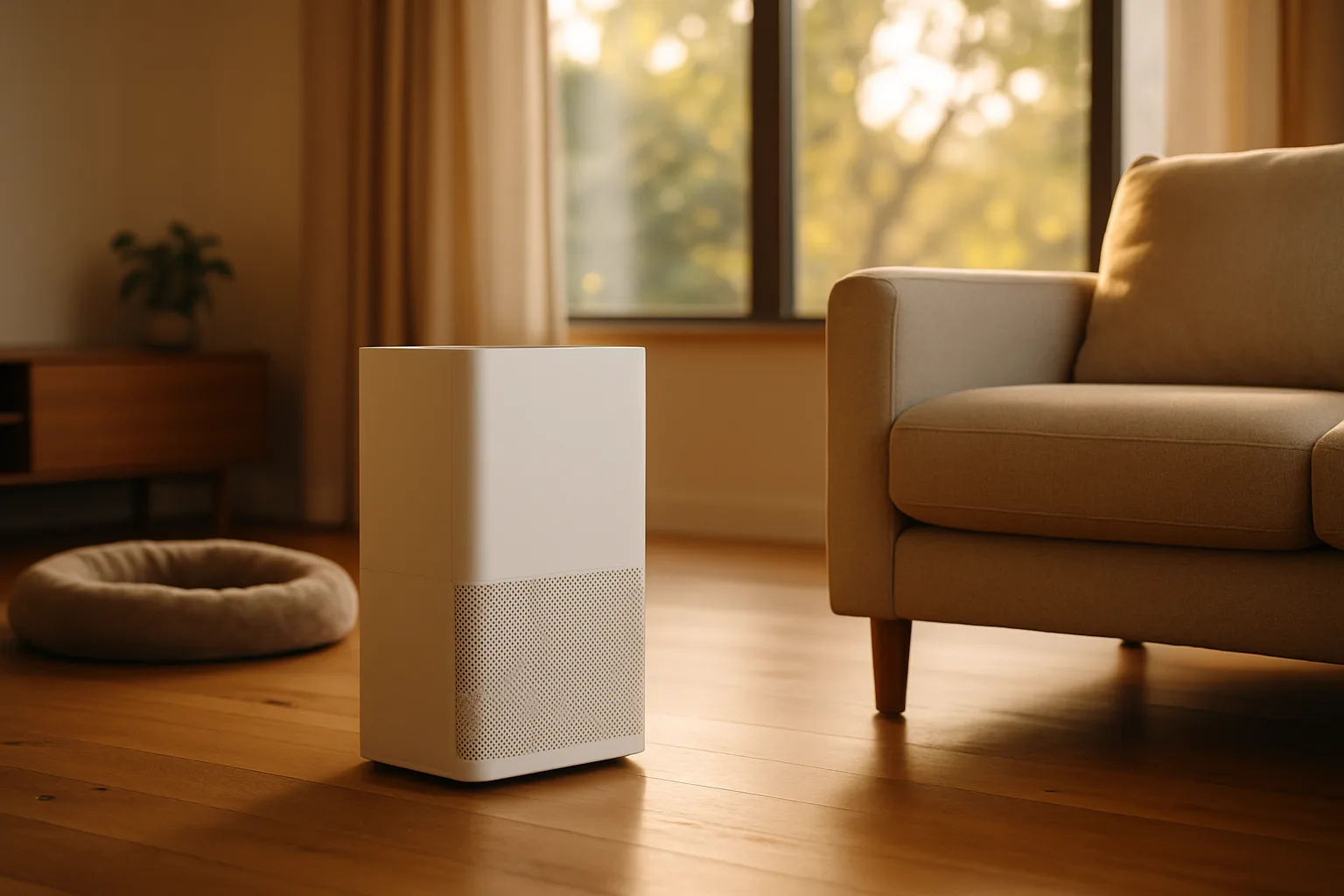
CADR is rated at top speed, and top speed is loud. A purifier sized right at the edge for a room has to run flat out to deliver its rating. A unit with more CADR than the room needs can run on a low or middle setting, which is quieter and uses less power while still cleaning the air well. That is why a mid-size purifier is usually a better bedroom choice than a tabletop mini, and why a 400S or ProX makes sense in a large living room even when a smaller unit "covers" it on paper.
Low-speed noise is listed on many spec sheets: 19 dB in sleep mode for the Mighty2, 27 dB for the Vital 200S-P and Winix 5510, and 22 dB at the lowest setting for the 400S. For reference, the EPA notes a modern refrigerator runs at about 50 decibels.
Filters: what each layer does
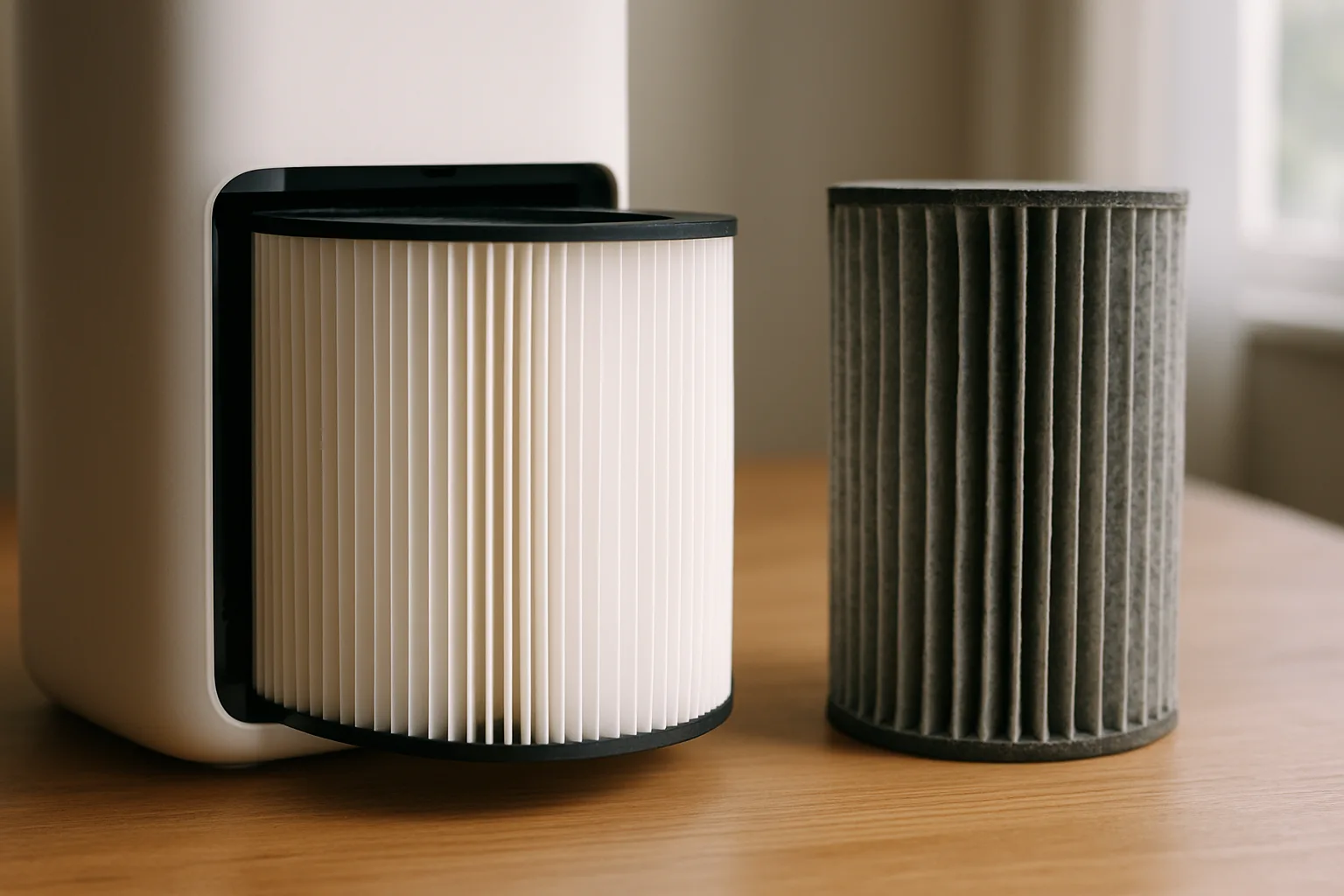
- Pre-filter: a washable mesh that catches hair and lint so the main filter lasts longer. Pet owners should look for one that is easy to reach. The Mighty2's slides out without opening the front cover.
- HEPA: the main particle filter. True HEPA captures 99.97% of particles at 0.3 microns, the hardest size to catch. All five picks list HEPA filtration; Coway notes its Mighty2 filter is certified to the IEST-RP-CC007 test standard.
- Activated carbon: HEPA does nothing for gases or odors. Carbon adsorbs cooking smells and some volatile organic compounds (VOCs), but the thin carbon layers in most combination filters fill up fast. Levoit sells alternative Vital 200S filters aimed at pet allergens, smoke and toxins. Serious odor or chemical problems need a unit built around a heavy carbon bed, plus better ventilation.
Filters are the real running cost. Before buying, check the replacement filter price and the maker's replacement interval (Coway rates the Mighty2 filter for up to a year). Wash pre-filters on schedule, and replace the main filter when the indicator says to. As the EPA puts it, a dirty, overloaded filter won't work well.
Ozone, ionizers and certifications
Some purifiers add ionizers, "plasma," or UV features. The EPA advises avoiding air cleaners that intentionally produce ozone, a lung irritant, and notes that ionizers, electrostatic precipitators and plasma devices may emit some. The agency's page on ozone generators sold as air cleaners notes that no federal agency has approved them for use in occupied spaces.
What to look for:
- CARB certification. California's Air Resources Board limits ozone emissions from air cleaners. All five picks list CARB certification.
- AHAM Verifide. Independent verification of the CADR claim. The Levoit and Winix listings carry it.
- Energy Star. Certified to use less energy than standard models. The Airmega 400S and ProX listings show it.
- Ionizer controls. The Winix 5510 includes PlasmaWave. Owners who prefer filtration only should confirm in the manual how to switch it off.
Placement and everyday use
- Put the purifier in the room where people spend the most time, usually the bedroom.
- Keep it clear of curtains, walls and furniture that block intake or outlet vents.
- Run it continuously on auto or a low speed. Air quality drops quickly after a purifier is switched off.
- Keep doors and windows closed while it runs, and fix sources (smoking indoors, a gas range with no range-hood use, damp spots) instead of expecting the purifier to keep up.
- Rely on central HVAC filtration as a complement only. The EPA notes that furnace and HVAC filters clean air only when the system is running, which is often less than a quarter of the time.
Who should buy which
Bedrooms and home offices up to about 350–400 sq ft: the Coway Airmega Mighty2 is the pick for pet owners and anyone who runs auto mode, thanks to its laser sensor and slide-out pre-filter. The Levoit Vital 200S-P offers similar CADR plus app scheduling and filter options. The Winix 5510 suits homes already using Alexa or Google Assistant.
Coway Airmega 400S Smart Air PurifierView on Amazon →
Living rooms around 500 sq ft: the Coway Airmega 400S shown above has the CADR to run quietly at middle speeds.
Open kitchens, great rooms and allergy-heavy households: the Coway Airmega ProX delivers more than twice the CADR of a mid-size unit. Two mid-size purifiers in separate rooms are a reasonable alternative.
A purifier works best as part of a broader plan. That includes regular HVAC maintenance and filter changes, humidity and comfort control (see year-round indoor comfort tips), and the source-control steps in this guide to improving home air quality.
Posted by Kristopher Larson
Frequently asked questions
What size air purifier does a room need?
Use the smoke CADR. The EPA's chart for rooms with 8-foot ceilings calls for a CADR of about two-thirds of the floor area, so a 300-square-foot bedroom needs roughly 195 cfm and a 450-square-foot living room about 290 cfm. Size up for taller ceilings or open floor plans.
What does CADR mean on an air purifier?
CADR stands for Clean Air Delivery Rate, the volume of filtered air a purifier delivers in cubic feet per minute at its top speed. It is tested separately for smoke, dust and pollen. Higher numbers mean faster cleaning and a larger suitable room.
Why do air purifier boxes claim such large coverage areas?
Many listings quote the area a purifier can filter once per hour, which is a light level of cleaning. Sizing guidance such as the EPA chart works out to about five air changes per hour, so the practical room size is often a fifth of the headline coverage figure.
Do air purifiers remove odors and VOCs?
HEPA filters remove particles, not gases. Odor and VOC reduction depends on activated carbon, and most combination filters contain only a thin layer that saturates quickly. For strong odors or chemical fumes, a unit with a large carbon bed plus better ventilation and source control works better.
Are ionizer air purifiers safe?
The EPA advises avoiding air cleaners that intentionally produce ozone, a lung irritant, and notes that ionizers, plasma and electrostatic devices may emit some. Choosing a CARB-certified model and turning off optional ionizer features keeps ozone exposure low.
Should an air purifier run all the time?
Yes, for best results. Running continuously on auto or a low, quiet speed keeps particle levels down, while indoor air quality drops back quickly after a unit is switched off. Modern mid-size units draw roughly 50 to 66 watts at top speed and much less on low settings.
Keep reading
More from the blog
Robot Vacuum and Mop Buying Guide: Mop Types, Docks, Obstacle Avoidance and Top Picks
Best Cordless Stick Vacuums by Home Type: Shark vs. Dyson vs. Dreame vs. Levoit
Electric Pressure Washers: Which PSI and GPM Matter, and Budget vs. Premium Picks