Robot Vacuum and Mop Buying Guide: Mop Types, Docks, Obstacle Avoidance and Top Picks
How to choose a robot vacuum and mop: suction, mop types, self-emptying docks, obstacle avoidance and height, plus Roborock, eufy, Dreame, Ecovacs picks.
A robot vacuum that also mops can take daily crumbs, dust and pet hair off the to-do list, but the spec sheets are crowded with suction numbers, sensor acronyms and dock features that are hard to compare. The parts that change day-to-day life are simpler: how the robot handles hair, what kind of mop it uses, how much the dock does on its own, and whether it can see a phone charger cable before it eats one.
This guide sorts those features into what matters and what is mostly marketing, then matches six current models to the homes they suit best.
As an Amazon Associate, Best Utah Real Estate earns from qualifying purchases. Product picks are based on published specs and independent testing data, not paid placement.
Quick verdict: which robot vacuum and mop to buy
- Tightest budget with a self-emptying dock: Roborock Q7 M5+. LiDAR mapping, a 2.7-liter dust bag and a simple mop pad. Floors need to be picked up first.
- Cheapest full "hands-off" station: eufy Omni C20. Spinning mops that lift on carpet, plus a dock that empties, washes and dries.
- Homes with door tracks or raised thresholds: Dreame L40s Ultra. Climbing wheels rated for obstacles up to 1.57 inches, plus extending mops and side brush.
- Low furniture and lots of edges: Ecovacs Deebot T50 Pro Omni. A 3.19-inch body and a side brush and mop that reach out toward walls.
- Mostly hard floors, frequent spills: Ecovacs Deebot T80 Omni. A roller mop that rinses itself while it cleans instead of dragging dirty pads around.
- Cluttered homes and very low sofas: Roborock Qrevo CurvX. Camera plus structured-light object recognition in a body just under 8 cm tall.
Spec comparison
| Model | Rated suction | Mop type | Dock does | Body height | Obstacle sensing |
|---|---|---|---|---|---|
| Roborock Q7 M5+ | 10,000 Pa | Flat pad, 3 water levels | Auto-empty (2.7 L bag) | Standard | LiDAR mapping |
| eufy Omni C20 | 7,000 Pa | Dual spinning pads, auto-lift | Empty, wash, air-dry | 3.35 in (85 mm) | Laser navigation |
| Dreame L40s Ultra | 19,000 Pa | Dual spinning pads, extending | Empty, hot-water wash, dry, refill | Standard | AI obstacle avoidance |
| Ecovacs T50 Pro Omni | 15,000 Pa | Dual spinning pads, extending | Empty, 167°F wash, hot-air dry, refill | 3.19 in | AIVI 3D 3.0 |
| Ecovacs T80 Omni | 18,000 Pa | Self-rinsing roller, extending | Empty, hot-water wash, hot-air dry, refill | Standard | AIVI 3D 3.0 |
| Roborock Qrevo CurvX | 22,000 Pa | Dual spinning pads | Empty, 176°F wash, warm-air dry, refill | 7.98 cm (3.14 in) | Structured light + RGB camera |
Specs come from each manufacturer's listing. Check the current model page before buying, because brands often sell several variants under nearly identical names.
Suction numbers: useful, but not the whole story
Suction is listed in pascals (Pa), and the numbers keep climbing. Brands rate it themselves, though, and there is no shared test method, so a 19,000 Pa robot from one company is not automatically twice as strong as a 10,000 Pa robot from another. On hard floors and the top of carpet, almost any LiDAR robot does a decent job with surface dust and crumbs.
Where the differences show up is grit buried in carpet and long hair. Independent lab reviews keep finding that robots have closed much of the gap with upright vacuums on carpet, but they still trail a good corded or cordless vacuum on deep cleaning. Homes with wall-to-wall carpet should plan on a handheld or upright pass now and then, no matter which robot they buy.
Brush design matters more for pet hair
Hair wraps around the main brush and slowly kills pickup. Two things help. First, a brush with some bristles mixed in, which digs into carpet fibers better than an all-rubber roller. Second, an anti-tangle design: twin rollers, a tapered single roller that pushes hair toward the intake, or a built-in comb or cutter. The Dreame L40s Ultra pairs one bristled roller with one rubber roller, and the Qrevo CurvX is rated to handle hair up to 40 cm long. In homes with a shedding dog, those details matter more than an extra few thousand pascals.
The onboard bin matters too. A small bin fills fast with pet hair, and once it is packed, pickup drops. A self-emptying dock solves most of that by pulling the bin out into a bag after every run.
The three mop types
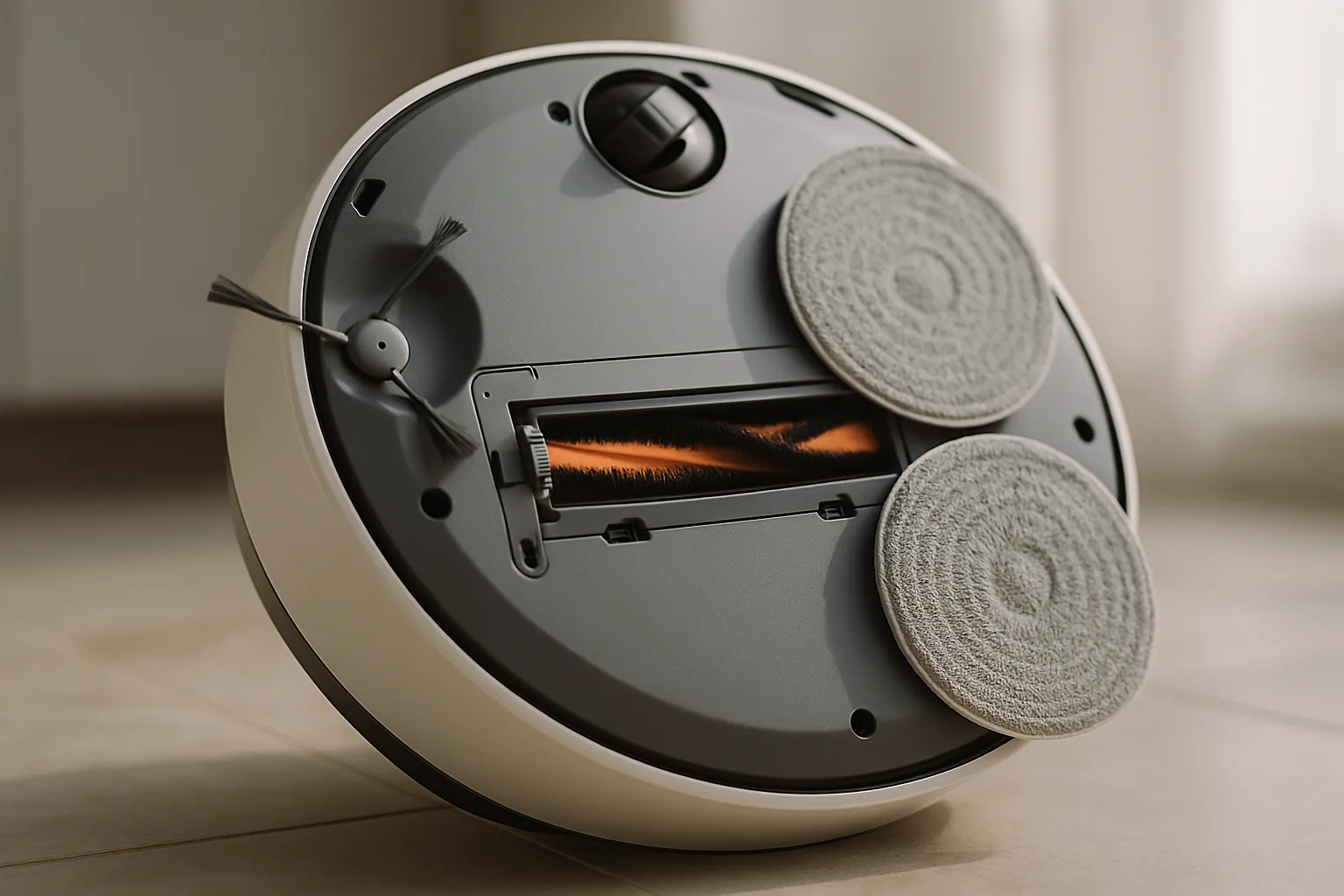
Flat pads
A flat cloth drags behind the robot while a tank drips water onto it. It handles light dust and footprints, not dried coffee or sticky kitchen spots. Budget models like the Roborock Q7 M5+ use this design. The pad usually has to be attached for mopping runs and taken off for carpet-only runs, then washed by hand.
Dual spinning pads
This is the most common style on mid-range and premium robots. Two round pads spin against the floor and, on some models, press down with measurable force (eufy lists 6 newtons at 180 RPM for the Omni C20). Spinning pads scrub much better than a flat cloth, and when they can lift off the floor the robot can vacuum carpet and mop hard floors in one run.
Roller mops
A roller is fed clean water constantly while a scraper pulls dirty water back into a tank. Because it is not reusing the same wet pad across the whole house, it is better at liquid spills and less likely to smear grime from the kitchen into the hallway. Ecovacs rates the T80 Omni roller at 220 RPM. The trade-off is more parts to keep clean and, on some models, a taller body.
Whatever the mop type, too much water leaves streaks and can be rough on wood floors that are not well sealed. Look for adjustable water flow and use the lowest setting that gets the job done.
Lifting and extending mops
Two hardware features decide how hands-off mopping really is:
- Mop lift: pads that rise when the robot detects carpet (eufy lists a lift on the C20, and Ecovacs lists 10 mm on the T80 Omni). Without it, mopping and vacuuming carpeted rooms have to be separate runs, or the rugs need no-go zones. Homes with thick rugs should check the lift height against the pile.
- Extending mops and brushes: the pad or roller swings out toward baseboards and cabinet kicks. Round robots otherwise leave a thin dirty strip along every wall. The Dreame L40s Ultra, Ecovacs T50 Pro Omni and T80 Omni all list this.
Dock automation: where most of the price goes
Docks come in three tiers:
- Charging only. The cheapest robots. The bin and water tank are emptied by hand after each run.
- Auto-empty. The dock pulls debris into a bag or bin. The Roborock Q7 M5+ uses a 2.7-liter bag Roborock rates for up to 7 to 9 weeks. Bagless docks avoid the cost of bags but need their own bin emptied and rinsed.
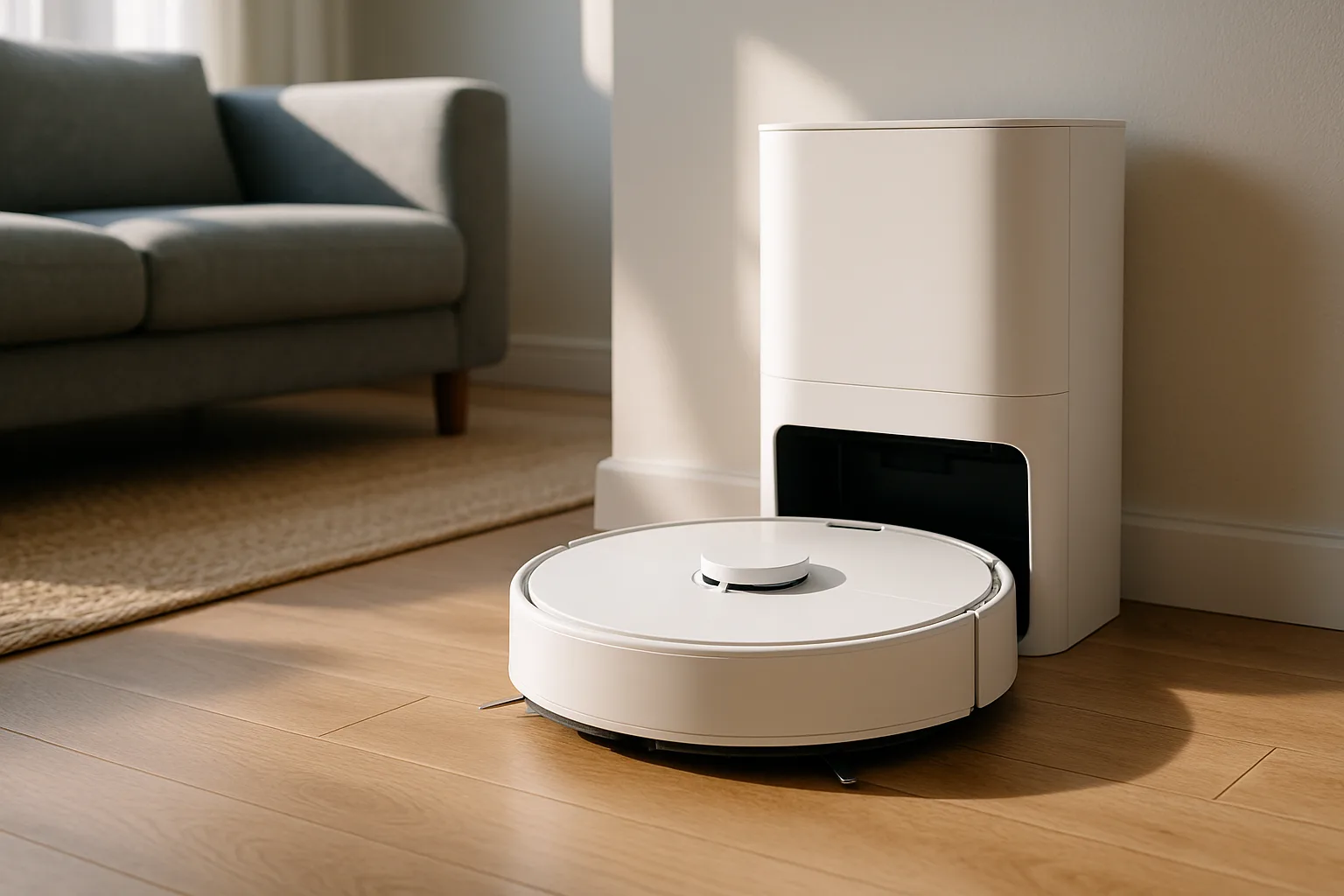
- All-in-one. The dock empties the robot, washes the mop pads, dries them, and refills the robot's water tank from a clean-water tank, collecting dirty water in a second tank. Hot-water washing (167°F on the T50 Pro Omni, 176°F on the Qrevo CurvX) does a better job on greasy kitchen residue. Drying matters most, because damp pads sitting in a dock start to smell within a day or two.
All-in-one docks still need attention. Someone has to fill the clean tank, dump the dirty one, swap bags, and rinse the wash tray. They also take up real floor space, so measure the spot before buying. Few docks plug into a water line, so "fully automatic" usually means "every few days" rather than "never."
Navigation, obstacles and getting stuck
Navigation is mostly solved
LiDAR or laser mapping is now standard even on budget robots, and it lets the robot clean in neat rows, remember room layouts, and support no-go zones in the app. Most models also recharge and resume, returning to the dock mid-job and picking up where they left off. Differences in navigation efficiency between brands are small.
Obstacle avoidance is not
The navigation laser sits high on the robot, so it misses things lying flat on the floor: socks, cords, toys and pet messes. Basic laser-only systems avoid little. Adding structured light (projected lines that measure shape) helps, and adding a camera helps more. The Qrevo CurvX combines structured light with an RGB camera and lists 108 recognized object types; the Ecovacs models use the AIVI 3D system. Even the best systems still miss things, so picking up the floor before a run remains the only sure way to avoid tangles.
Camera robots raise a fair privacy question. Look for local image processing, the option to turn off remote video, and a brand with a track record of firmware updates. The FTC's guide to securing internet-connected devices at home covers router passwords and update settings that apply to any app-controlled robot.
Height and thresholds
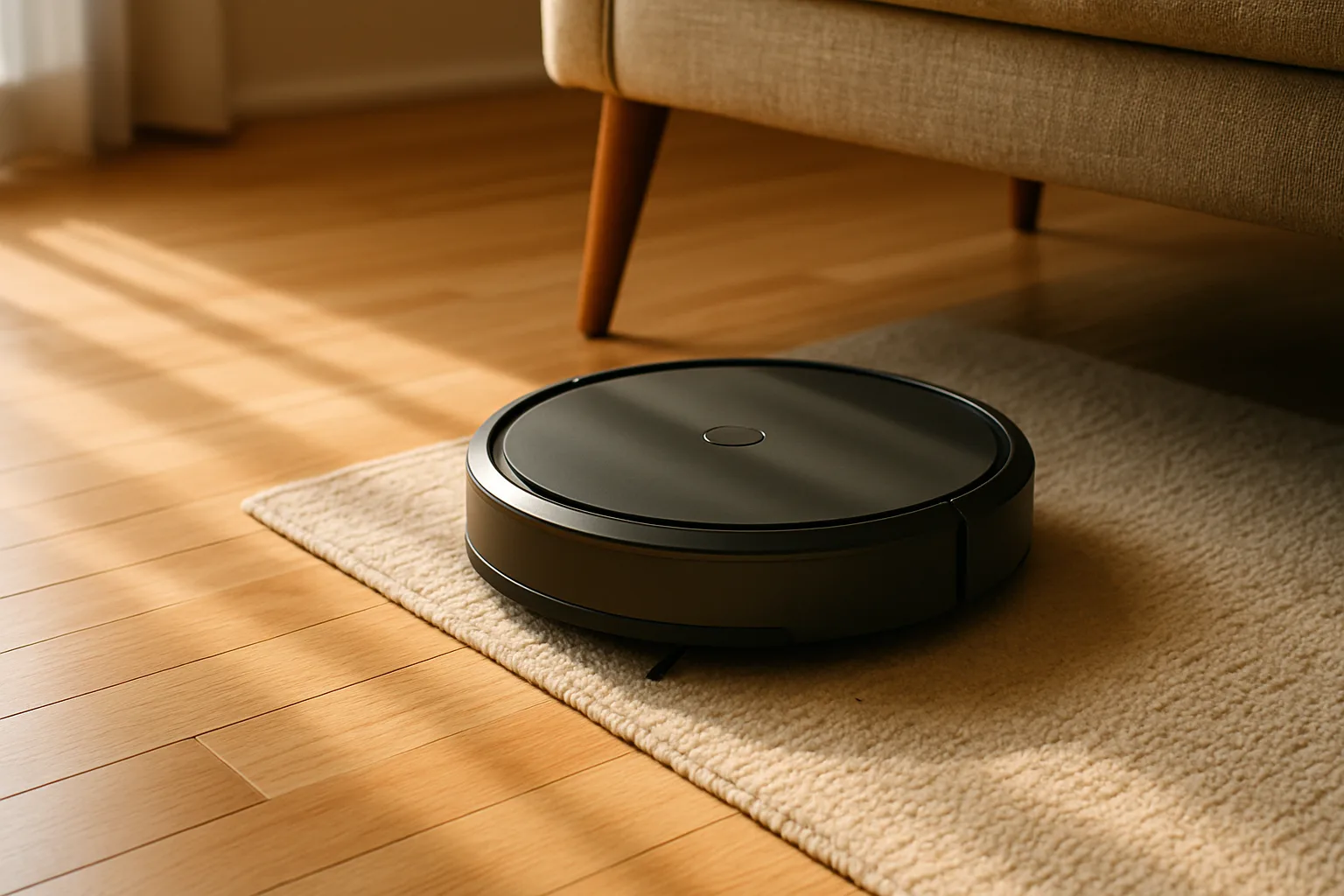
A typical robot stands close to 4 inches tall. Slim models fit under more sofas and beds: the eufy Omni C20 is 3.35 inches, the Ecovacs T50 Pro Omni is 3.19 inches, and the Qrevo CurvX is 7.98 cm (about 3.14 inches), helped by a LiDAR turret that retracts under furniture. Measure the gap under the lowest piece of furniture and check the minimum clearance in the spec sheet, which is a bit more than body height.
Thresholds are the other common trap. Many robots handle about 2 cm (roughly 0.8 inch) unless a higher rating is listed. Brands that advertise taller climbs, like the Dreame L40s Ultra at 1.57 inches or the Qrevo CurvX's lifting chassis at up to 4 cm, usually mean a stepped obstacle such as a sliding-door track, not a single tall lip. Homes with tall single thresholds or U-shaped chair bases should read owner reviews for those exact situations.
Setup details that trip people up
- 2.4 GHz Wi-Fi: most robots, including the eufy, Dreame and Roborock models above, list 2.4 GHz only. Mesh routers that combine bands under one name sometimes need a temporary separate 2.4 GHz network for setup.
- Running costs: budget for dust bags, filters, side brushes and mop pads or rollers. Ecovacs, Roborock, eufy and Dreame all sell replacement kits.
- Cleaning solution: use only what the maker approves for the dock. Other cleaners can foam or damage seals.
Who should buy which
A small apartment with mostly hard floors and few rugs can get by with a budget robot and a flat pad. Pick up the floor, run it daily, and empty the bag every couple of months.
A family home with pets, rugs and a busy kitchen gets the most out of an all-in-one dock with lifting spinning pads. The eufy Omni C20 is the entry point. Step up to the Dreame or Ecovacs models for hot-water washing and edge reach.
A home with a lot of tile or LVP and frequent spills is where the roller design of the Ecovacs Deebot T80 Omni makes the most sense.
Roborock Qrevo CurvX Robot Vacuum and MopView on Amazon →
A house with low sofas, kids' toys and cords on the floor should put obstacle avoidance and height first, which points to the Roborock Qrevo CurvX shown above.
Robots handle upkeep, not deep cleaning. Washable area rugs (compared in this guide to machine-washable vs. traditional rugs) make life easier for mops that lift. Owners getting ready to list a house will still want a hands-on pass over the places people forget to clean before listing. More connected-home picks are in this roundup of smart home products worth watching for deals.
Posted by Kristopher Larson
Frequently asked questions
Is a robot vacuum and mop combo worth it over a robot vacuum alone?
For homes with mostly hard floors, yes. A combo with spinning pads or a roller mop keeps kitchens and entryways from building up a film of dust and footprints between deep cleans. Homes that are mostly carpet get little from the mop and can save money with a vacuum-only robot and a self-emptying dock.
Does a higher Pa suction rating mean a robot cleans better?
Not always. Suction in pascals is rated by each manufacturer with no shared test method, so numbers are not directly comparable across brands. Brush design, anti-tangle features and how well the robot seals against the floor often matter as much for carpet and pet hair as the headline Pa figure.
Which robot mop type cleans best: flat pad, spinning pads or roller?
Flat pads handle light dust only. Dual spinning pads scrub dried spots much better and are the most common choice. Roller mops that are rinsed with clean water as they run handle wet spills best and spread less dirty water around, but they have more parts to maintain.
Do robot vacuums work on 5 GHz Wi-Fi?
Most do not. The majority of current models, including popular eufy, Dreame and Roborock robots, list 2.4 GHz only. Homes with mesh routers that merge both bands under one network name may need to set up a temporary 2.4 GHz network during pairing.
How tall a threshold can a robot vacuum climb?
Many robots handle about 2 cm (roughly 0.8 inch) unless the spec sheet lists more. Models advertised for higher climbs, such as 1.57 inches or 4 cm, usually reach that figure on stepped obstacles like sliding-door tracks rather than a single tall lip, so it is worth reading owner reviews for the specific threshold in question.
How much upkeep does an all-in-one robot vacuum dock need?
Less than a basic robot, but not zero. Owners still fill the clean-water tank, empty the dirty-water tank every few runs, replace dust bags, rinse the wash tray and swap filters, brushes and mop pads on the maker's schedule. Docks that dry the mops with warm air help prevent odors.
Keep reading
More from the blog
Electric Pressure Washers: Which PSI and GPM Matter, and Budget vs. Premium Picks
Best Cordless Stick Vacuums by Home Type: Shark vs. Dyson vs. Dreame vs. Levoit
How to Choose an Air Purifier by Room Size and CADR: Coway vs. Levoit vs. Winix