Instax vs. Polaroid: Which Instant Camera to Buy
Instax or Polaroid? How the films differ in print size, development time, colour and shots per pack, plus six cameras from the Mini 12 to the Polaroid Now.
An instant camera is really a film choice with a camera attached. Fujifilm's Instax film and Polaroid's film differ in print size, in how long a picture takes to appear, in how they handle colour and contrast, and in how many shots come in a pack. Pick the film first and the camera decision gets short.
Below, the two systems are compared where they differ, then six cameras are sorted by who they suit: four for Instax film and two for Polaroid film.
Fujifilm now also lists an Instax Mini 13 and a Mini Evo 2. They are not compared here yet; this guide covers the Mini 12 and the Mini Evo, which are still sold new.
Quick verdict
- Instax suits most people. The film develops in about 90 seconds in plain view, looks the same from pack to pack, and comes 10 shots to a pack. Polaroid gives a large square print with softer, less predictable colour and asks for more patience.
- Creative control on Instax Mini film: the Fujifilm Instax Mini 99. The flash can be switched off, brightness adjusts in five steps and the focus has three zones.
- Automatic point-and-shoot: the Fujifilm Instax Mini 12. Automatic exposure, a selfie mirror and a close-up mode, with nothing to set.
- See the photo before printing: the Fujifilm Instax Mini Evo, a hybrid that prints only the shots worth keeping.
- Biggest Instax print: the Fujifilm Instax Wide 400, for groups and landscapes.
- Full-size Polaroid prints: the Polaroid Now Generation 3, an autofocus point-and-shoot for i-Type and 600 film.
- Polaroid in a coat pocket: the Polaroid Go Generation 2, the smallest of the six.
The instant cameras side by side
| Camera | Shop | Type | Film and image size | Shots per pack | Controls | Power |
|---|---|---|---|---|---|---|
| Fujifilm Instax Mini 99 |  View on Amazon | Analog | Instax Mini, 62 x 46 mm | 10 | Three focus zones, five brightness levels, six colour effects, flash off | Rechargeable NP-70S battery |
| Fujifilm Instax Mini 12 |  View on Amazon | Analog | Instax Mini, 62 x 46 mm | 10 | Automatic; close-up mode from 0.3 to 0.5 m; flash always fires | Two AA batteries |
| Fujifilm Instax Mini Evo |  View on Amazon | Hybrid (digital sensor) | Instax Mini, 62 x 46 mm | 10 | 3-inch screen, 10 lens and 10 film effects, prints on demand | Built-in battery, about 100 prints a charge |
| Fujifilm Instax Wide 400 |  View on Amazon | Analog | Instax Wide, 99 x 62 mm | 10 | Automatic; two focus ranges; self-timer | Four AA batteries |
| Polaroid Now Generation 3 |  View on Amazon | Analog | Polaroid i-Type or 600, 79 x 77 mm | 8 | Two-zone autofocus, self-timer, double exposure | Built-in battery, up to 15 packs a charge |
| Polaroid Go Generation 2 |  View on Amazon | Analog | Polaroid Go, 47 x 46 mm | 16 per double pack | Fixed focus, selfie mirror, self-timer, double exposure | USB-C rechargeable, up to 15 packs a charge |
Creative control on Mini film
Fujifilm Instax Mini 99
An analog Instax Mini camera with three focus zones, a five-step brightness dial, six colour effects and a flash that can be turned off.
- 62 x 46 mm image
- Three focus zones
- Flash can be turned off
Good for
- Creative shooters who want control over flash and exposure
- Small, light everyday carry
Skip it if
- A camera with nothing to set is the goal
Instax vs. Polaroid film: what actually differs
Print size and shape
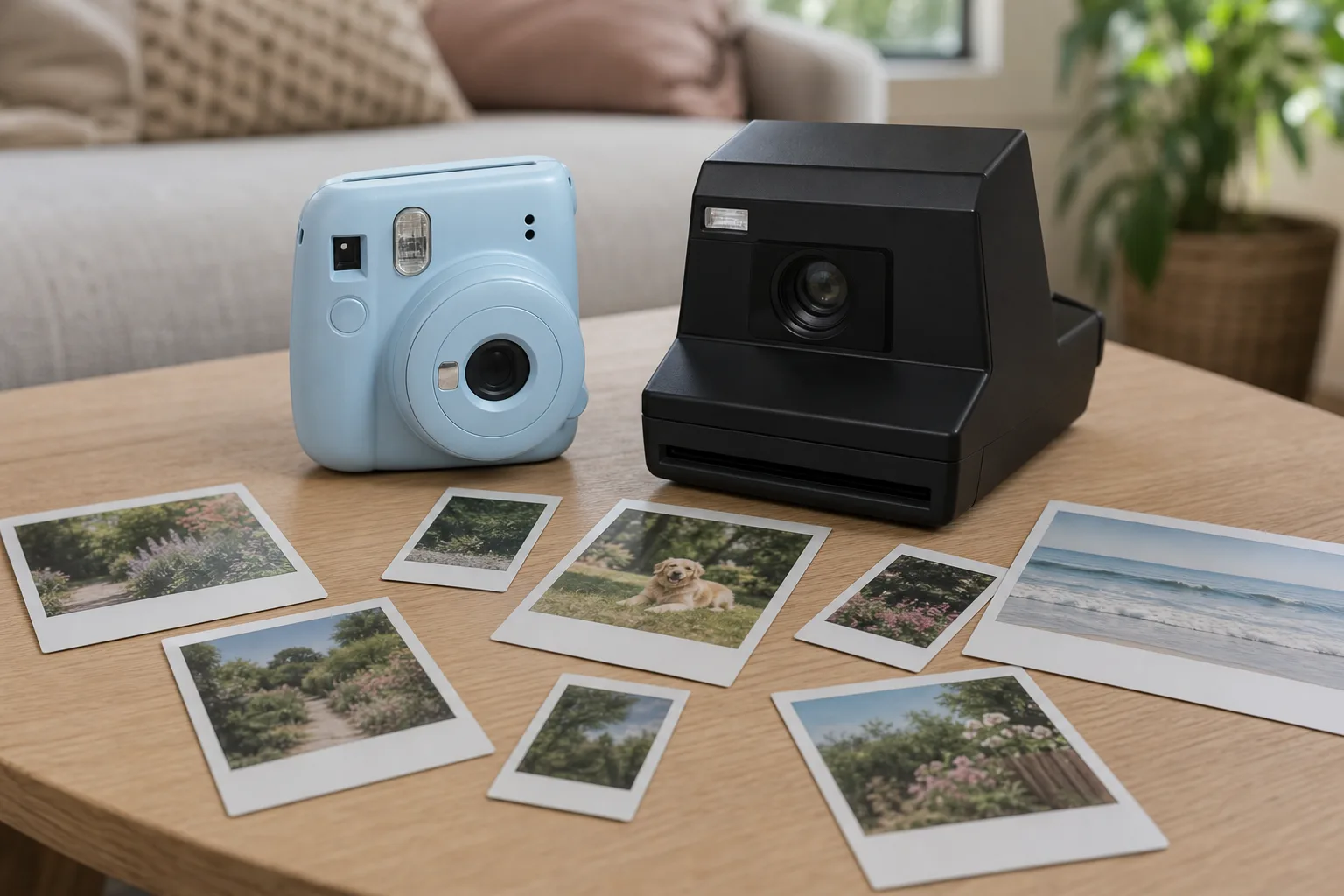
A full-size Polaroid print has a nearly square 79 x 77 mm image on a 107 x 88 mm sheet. Instax comes in three formats. Mini is about the size of a credit card with a 62 x 46 mm upright image, Square has a 62 x 62 mm image, and Wide has a 99 x 62 mm image on a sheet close to the Polaroid's outer size. Wide comes close to a Polaroid for image area but is a much longer rectangle that suits horizontal pictures; held upright, the thick border ends up on the side. Polaroid Go film is the smallest of all, with a 47 x 46 mm image.
Development time and handling
Instax film develops in about 90 seconds and can sit in daylight while it does, so everyone watches the picture appear. Polaroid colour film takes 10 to 15 minutes and is sensitive to light as it leaves the camera. Polaroid's own advice is to leave the print under the camera's film shield for ten seconds, then put it somewhere cool and dark, and not to shake it. Temperature matters more with Polaroid too: by the company's account, film that gets warmer than 82°F turns out pink and film colder than 55°F turns out blue.
Colour, contrast and consistency
Side by side, the two films look nothing alike. Instax is punchy and close to lifelike, with strong contrast, reddish blacks and whites that clip to pure white. Polaroid has lower contrast and a softer, pastel palette, with shadows that lean cyan-green and bright areas that roll off into a creamy tone. Instax is also the more predictable film: one pack looks like the next, while Polaroid varies from batch to batch.
Neither film forgives a bad exposure: both lose detail quickly in highlights and shadows and look their best in even light. On Instax, a very bright light source in the frame, such as a bare bulb or the sun, can print as a black spot. In black and white the gap narrows: Polaroid's monochrome film is sharper and holds more tonal range than its colour film, while Instax Monochrome prints with a slightly blue cast.
Why the flash fires on almost every shot
Most Instax cameras fire the flash every time and offer no way to stop it. The reason is the film's narrow latitude: a flash-lit person a few feet away is the picture these cameras expose well every time. The trade is that every photo has the same look. A camera that lets the flash be switched off or the brightness nudged, like the Instax Mini 99, opens up window light and sunsets, with more missed shots along the way.
Shots per pack
An instant camera keeps needing film, and pack sizes differ. An Instax cartridge holds 10 shots, and Mini, Square and Wide film are all sold in twin packs of 20. A pack of Polaroid i-Type film holds 8. Polaroid Go film is sold as a double pack with 16 photos in total. i-Type film does not work in vintage Polaroid cameras.
Analog or hybrid?
In an analog instant camera, light passes through the lens and strikes the film, and each print is a one-off. A hybrid such as the Mini Evo captures a digital image on a small sensor and prints it onto Instax film on request, so nothing is wasted on blinks and blur. The prints look different, though: the tiny sensor needs a wide lens, so nearly everything is in focus and the image looks flatter than an analog Instax shot.
Automatic point-and-shoot
Fujifilm Instax Mini 12
A fully automatic Instax Mini camera with a selfie mirror and a close-up mode that focuses from 0.3 to 0.5 m.
- 62 x 46 mm image
- Close-up mode
- Two AA batteries
Good for
- Selfies and close-up portraits
- Anyone who wants no settings
Skip it if
- Photos without flash or with adjusted brightness matter
The picks in detail
Fujifilm Instax Mini 99
The Fujifilm Instax Mini 99 is the Instax for someone who wants a say in the picture. It keeps the same 60 mm lens as the simpler Mini cameras but focuses in three zones, adds a five-step brightness dial (from L+ to D-), a vignette switch, double-exposure and bulb modes, and a flash that can be turned off. A second dial adds six colour effects, among them warm tone, sepia and light leak, applied to the film by lights inside the camera. The brightness dial takes some guessing, since the only way to judge a shot is to take it and try again. The body is small and light enough to wear all day, and it runs on a rechargeable battery.
Creative control on Mini film
Fujifilm Instax Mini 99
An analog Instax Mini camera with three focus zones, a five-step brightness dial, six colour effects and a flash that can be turned off.
- 62 x 46 mm image
- Three focus zones
- Flash can be turned off
Good for
- Creative shooters who want control over flash and exposure
- Small, light everyday carry
Skip it if
- A camera with nothing to set is the goal
Fujifilm Instax Mini 12
The Fujifilm Instax Mini 12 is the plain point-and-shoot of the Mini range. Twist the lens to switch it on and once more for close-up mode, which focuses from 0.3 to 0.5 m. Exposure is automatic and the flash fires on every shot. The close-up mode is worth having on a print this small, where filling the frame with a face is what makes the photo work, and there is a selfie mirror. There is no brightness control at all. It runs on two AA batteries.
Automatic point-and-shoot
Fujifilm Instax Mini 12
A fully automatic Instax Mini camera with a selfie mirror and a close-up mode that focuses from 0.3 to 0.5 m.
- 62 x 46 mm image
- Close-up mode
- Two AA batteries
Good for
- Selfies and close-up portraits
- Anyone who wants no settings
Skip it if
- Photos without flash or with adjusted brightness matter
Fujifilm Instax Mini Evo
The Fujifilm Instax Mini Evo is a small digital camera with an Instax printer inside. Shots appear on a 3-inch screen, and pulling the print lever prints the one on screen. A dial around the lens and a second dial on the body combine 10 lens effects with 10 film effects. The dials and lever feel good to use. It also prints photos sent from a phone over Bluetooth and stores images on internal memory or a microSD card. Its prints are digital images on Instax film, not analog exposures. Fujifilm rates the built-in battery at about 100 prints a charge.
Hybrid that prints on demand
Fujifilm Instax Mini Evo
A digital camera that prints on Instax Mini film, so only the keepers use a sheet, and it prints phone photos too.
- Digital sensor, 3-inch screen
- 10 lens and 10 film effects
- About 100 prints a charge
Good for
- Anyone who hates wasting film
- Printing phone photos on Instax Mini film
Skip it if
- One-of-a-kind analog prints are the point
- Digital files that match a phone are expected
Fujifilm Instax Wide 400
The Fujifilm Instax Wide 400 shoots the largest Instax film and does almost nothing else. Twisting the lens powers it on, focus is a choice of two ranges, 0.9 to 3 m and 3 m and beyond, and a close-up lens comes in the box for nearer subjects. There is no brightness control and no flash control. Its one extra is a self-timer, useful on a camera made for group shots. The body is big, as any Wide camera is.
Biggest Instax print
Fujifilm Instax Wide 400
A simple automatic camera for Instax Wide film, with two focus ranges, a self-timer and a supplied close-up lens.
- 99 x 62 mm image
- Self-timer
- Four AA batteries
Good for
- Group shots and landscapes
- A larger print with Instax colour and speed
Skip it if
- A camera that fits a small bag is needed
- Control over flash or brightness is wanted
Polaroid Now Generation 3
The Polaroid Now Generation 3 is the standard way into full-size Polaroid film. It is an autofocus point-and-shoot with two lenses, one for 0.4 to 1.3 m and one for 1 m to infinity, and it has a self-timer, a double-exposure mode and a tripod mount. It takes both i-Type and 600 film. Polaroid describes Generation 3 as having a better-placed light meter and an improved ranging sensor, aimed at sharper pictures in bright light. It is the plain, easy choice for this film, not an enthusiast camera like the I-2. The real decision is the film itself: large square prints, softer colour, a 10 to 15 minute wait and 8 shots a pack. The linked listing is a bundle that includes film with the camera.
Full-size Polaroid prints
Polaroid Now Generation 3
An autofocus point-and-shoot for Polaroid i-Type and 600 film, with a self-timer, double exposure and a tripod mount.
- 79 x 77 mm image
- Two-zone autofocus
- 8 shots a pack
Good for
- The large, soft-toned Polaroid print
- Autofocus with nothing to set
Skip it if
- Prints need to be ready in a couple of minutes
- Consistent colour from pack to pack matters
Polaroid Go Generation 2
The Polaroid Go Generation 2 is small enough for a coat pocket or a small bag, which is the reason to buy it. A camera that is always along takes pictures a bigger one misses, and it invites loose, quick shooting at parties and get-togethers. It has a fixed-focus lens, a selfie mirror, a self-timer and a double-exposure mode, and it charges over USB-C. The prints are tiny, and Go film fits only Go cameras; it develops in 10 to 15 minutes like other Polaroid film. The linked listing is a bundle that includes film with the camera.
Pocket-size Polaroid
Polaroid Go Generation 2
The smallest camera here, with a selfie mirror, self-timer and double exposure, shooting 16 small prints per double pack.
- 47 x 46 mm image
- 16 photos per double pack
- USB-C charging
Good for
- Parties and gatherings
- Carrying a camera everywhere
Skip it if
- A large print is the goal
- Fast development matters
Other instant cameras worth knowing
- Instax Mini 41. The same lens, close-up mode and always-on flash as the Mini 12 in a body with a more solid, textured feel. The choice between the two is about looks and feel.
- Instax Square SQ1 and SQ40. Automatic cameras for the square format with the flash always on. The print shape is the closest Instax gets to a classic Polaroid, at a smaller size.
- Polaroid I-2. Polaroid's enthusiast camera, with manual controls and a more advanced lens than the point-and-shoots.
Hybrid that prints on demand
Fujifilm Instax Mini Evo
A digital camera that prints on Instax Mini film, so only the keepers use a sheet, and it prints phone photos too.
- Digital sensor, 3-inch screen
- 10 lens and 10 film effects
- About 100 prints a charge
Good for
- Anyone who hates wasting film
- Printing phone photos on Instax Mini film
Skip it if
- One-of-a-kind analog prints are the point
- Digital files that match a phone are expected
Tips for better instant photos
- Get closer. The prints are small. Fill the frame and use the close-up setting for faces.
- Mind the temperature. Fujifilm rates Instax film to work from 41 to 104°F, and Polaroid film is touchier still, so keep packs out of the heat and inside a jacket in the cold.
- Shoot candids. People relax in front of a toy-like camera, and those shots are often the keepers.
For phone photos that never get printed, a digital picture frame does the same job on a shelf, and for planned portraits with proper lighting there is the home photo and video studio guide.
Who should buy which
- Nothing to set, for selfies and snapshots: the Instax Mini 12.
- A creative hobby camera on Mini film: the Instax Mini 99.
- No wasted shots, plus prints from a phone: the Instax Mini Evo.
- Groups and views: the Instax Wide 400.
- The big print and the softer Polaroid look: the Polaroid Now Generation 3.
- The smallest camera to carry: the Polaroid Go Generation 2.
Posted by Kristopher Larson
Frequently asked questions
Is Instax or Polaroid better?
It depends on the print wanted. Instax film develops in about 90 seconds, looks consistent from pack to pack and holds 10 shots a pack, which makes it the easier system for most people. Polaroid film gives a larger square print with softer, pastel colour, takes 10 to 15 minutes to develop and holds 8 shots a pack. Choose Instax for speed and reliability and Polaroid for the look.
How long does instant film take to develop?
Instax film develops in about 90 seconds and can be watched in normal light. Polaroid colour film takes 10 to 15 minutes and should be shielded from light as it comes out of the camera, then kept somewhere cool and dark until it finishes.
How many photos are in a pack of instant film?
An Instax cartridge holds 10 shots, and Instax Mini, Square and Wide film are all sold in twin packs of 20. Polaroid i-Type film holds 8 photos a pack. Polaroid Go film is sold as a double pack with 16 photos in total. An instant camera keeps needing film, so pack size is worth checking before choosing a system.
Should a Polaroid picture be shaken?
No. Polaroid advises against shaking a developing photo because it can disturb the chemistry. Leave the print under the camera's film shield for about ten seconds, then keep it in a cool, dark place while it develops.
Is the Instax Mini Evo a real instant camera?
It is a hybrid. The Mini Evo takes a digital photo with a small sensor, shows it on a screen and prints it on real Instax Mini film only when asked to. The film is the same, but the print is a digital image exposed onto it, not light captured directly through the lens, and it looks flatter than a print from an analog Instax camera.
Which instant camera makes the biggest prints?
Full-size Polaroid film and Instax Wide film are the two largest formats, with images of about 79 x 77 mm and 99 x 62 mm. The Polaroid print is nearly square and the Instax Wide print is a long rectangle. Instax Mini and Polaroid Go prints are much smaller, and each film only fits cameras made for that format.
Keep reading
More from the blog
Best Indoor Air Quality Monitor: Aranet4 vs. Airthings View Plus vs. Qingping vs. Amazon
Reencle vs. FoodCycler vs. GEME: Which Electric Kitchen Composter Actually Makes Compost?
Best Laser Measure for Real Estate: Bosch GLM400CL vs. Mileseey S50C vs. Stabila LD 530 BT