Best Lens for Real Estate Photography: Sony 12-24mm f/4 G vs. Canon RF 14-35mm f/4 L vs. Nikon Z 14-30mm f/4 S
Sony FE 12-24mm F4 G, Canon RF14-35mm F4 L and Nikon Z 14-30mm f/4 S compared for interiors: focal length, f/4 vs. f/2.8, distortion, filters and video.
The lens does more for a listing photo than the camera behind it. Most interiors are shot from a tripod, stopped down, as a bracketed set of exposures blended into one HDR frame, so fast autofocus and a wide maximum aperture barely matter. What matters is how wide the lens goes, how straight it keeps walls, how sharp the corners are at f/8, and how it handles on a tripod or gimbal.
For most full-frame shooters that means an ultra-wide zoom that starts at 14 or 16 mm, with a 12 mm option for homes full of tight rooms. This guide covers what 12, 16 and 24 mm each do to a room, what an f/4 zoom gives up against an f/2.8, and five lenses for Sony E, Canon RF and Nikon Z bodies.
Quick verdict
The camera mount decides most of it:
- Sony, especially with tight rooms: the Sony FE 12-24mm F4 G. It covers small bathrooms at 12 mm and normal rooms at 16 to 24 mm without a lens change. It takes no front filters.
- Canon RF: the Canon RF14-35mm F4 L IS USM. At f/8 its files are hard to tell from those of Canon's larger f/2.8 zoom, and it is far lighter on a gimbal.
- Nikon Z, compact kit: the Nikon NIKKOR Z 14-30mm f/4 S. Sharp toward the corners and able to take 82 mm filters, with distortion that is corrected in software.
- Nikon Z, corner detail: the Nikon NIKKOR Z 14-24mm f/2.8 S. Floor grain and trim detail hold up at the very edge of the frame.
- Sony, with regular walkthrough video: the Sony FE PZ 16-35mm F4 G. Its power zoom gives smooth zoom moves, and its 72 mm thread takes ND and polarizing filters.
The lenses side by side
| Lens | Shop | Focal range | Max aperture | Weight | Minimum focus | Filters |
|---|---|---|---|---|---|---|
| Sony FE 12-24mm F4 G (Sony E-mount) |  View on Amazon | 12-24 mm | f/4 | 565 g | 0.28 m | No front thread (fixed hood) |
| Canon RF14-35mm F4 L IS USM (Canon RF-mount) |  View on Amazon | 14-35 mm | f/4 | 540 g | 0.2 m | 77 mm screw-in |
| Nikon NIKKOR Z 14-30mm f/4 S (Nikon Z-mount) |  View on Amazon | 14-30 mm | f/4 | 485 g | 0.28 m | 82 mm screw-in |
| Nikon NIKKOR Z 14-24mm f/2.8 S (Nikon Z-mount) |  View on Amazon | 14-24 mm | f/2.8 | 650 g | 0.28 m | 112 mm on the supplied hood, rear gel slot |
| Sony FE PZ 16-35mm F4 G (Sony E-mount) | 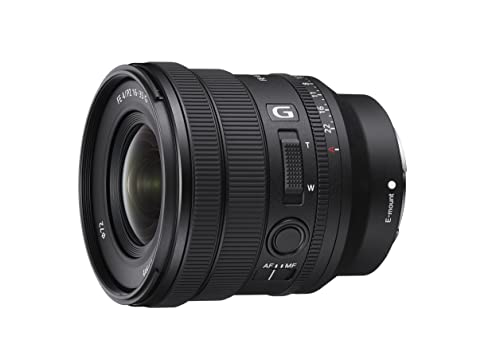 View on Amazon | 16-35 mm | f/4 | 353 g | 0.28 m wide, 0.24 m at 35 mm | 72 mm screw-in |
Widest, for tight rooms
Sony FE 12-24mm F4 G (Sony E-mount)
Covers tiny bathrooms at 12 mm and normal rooms at 16 to 24 mm in one 565 g lens, with well-controlled distortion.
- 12-24 mm
- f/4
- 565 g
Good for
- Small and awkward rooms
- Shooting a whole house without a lens change
Skip it if
- ND or polarizing filters are needed for video
- Every room would be shot at 12 mm
Which focal length a listing shoot needs: 12, 16 or 24 mm
Wider shows more of a room and stretches more of it. Longer looks truer and shows less. On a full-frame camera:
- 16 mm is the working width. Cabinets, floors and ceilings keep their proportions, and the room still reads as large. It suits the large majority of listing frames.
- 12 mm is the exception. It stretches whatever sits near the edges: ceilings and floors spread out, cabinets at the side of the frame grow longer, and a chair in the corner widens. That comes from the angle of view, so no lens fixes it. Keep 12 mm for the small bathroom, the narrow laundry room or the bedroom where the bed leaves no place to stand. In a set of 50 photos, that is often two or three frames.
- 14 mm is the useful middle. In a small bathroom it usually fits the shower, vanity and toilet where 16 mm cuts one of them off. Even one millimeter shows: 14 mm instead of 15 can bring a lamp fully into the frame and reveal the doorway to the next room.
- 24 mm looks the most natural. It gives the composed look of interior design photos and suits a single feature such as a fireplace. It cannot show a tight room.
The rule that follows: shoot each room at the longest focal length that still shows it. A zoom makes that fast. From one tripod position, 14 mm takes in a whole kitchen, 18 mm tightens on the range and backsplash, and 24 mm picks out the island. Framing in the camera removes cropping later, and fewer lens changes mean less dust on the sensor.
f/4 or f/2.8 for bracketed interiors
Interiors are shot at f/8 or f/9 so the room is sharp from the nearest counter to the far wall. On a tripod, the shutter can run as long as each bracketed frame needs, so the extra stop of an f/2.8 lens goes unused. The same holds for the flash-plus-ambient method: both frames are shot stopped down.
What an f/4 zoom does not give up on a tripod is detail. At f/8, files from Canon's f/4 and f/2.8 RF ultra-wides are hard to tell apart even at 200 percent magnification. The f/2.8 lens shows slightly more contrast and fine detail, a gap no listing photo reveals.
What it does give up is one stop of light, and that counts once the camera leaves the tripod. Handheld in a basement or a dim north-facing room, f/2.8 allows a lower ISO or a faster shutter speed, which means less noise to clean up later.
The build differs too. Wide f/4 zooms are designed to be small: some lengthen as they zoom, and several lean on software to correct distortion and dark corners. Wide f/2.8 zooms carry more glass, which generally means less optical distortion before correction and more weight to carry through several houses in a day.
Canon RF pick for photo and video
Canon RF14-35mm F4 L IS USM (Canon RF-mount)
Files at f/8 that are hard to tell from Canon's f/2.8 ultra-wide, 14 mm at the wide end and a 540 g build that suits gimbal work.
- 14-35 mm
- f/4
- 540 g
Good for
- Several houses a day
- Stills and gimbal video with one lens
Skip it if
- Handheld work in dim rooms calls for f/2.8
- Manual focus is the habit and a bumped ring would ruin frames
Straight walls and the built-in lens profile
Straight verticals come first from the camera position. A level camera keeps walls and door frames parallel, and a tilted one bends them no matter what lens is mounted.
Lens distortion is the second part, and here the raw file can mislead. With some mirrorless lenses, the camera writes a correction profile into the file, and Lightroom Classic applies it with no switch to turn it off. Files from the NIKKOR Z 14-30mm f/4 S open looking nearly distortion-free for that reason. Convert the same file in software that ignores the profile, such as DxO PureRAW or RawTherapee, and it shows clear barrel distortion and heavy vignetting. That is no reason to avoid such a lens, since the corrected file is the one that gets delivered.
Corner sharpness, flare and focus
Corners matter in interiors because that is where floors, baseboards and countertops sit. Judge them with normal raw sharpening applied, since every raw file looks soft at zero.
Flare is a risk whenever a bright window or low sun is in the frame, most of all with a large, bulging front element, and a strong flare can throw off autofocus. So can a blank wall with little contrast, which means a green confirmation box is not proof of focus. A focus distance readout, on the camera's screen or on the lens, settles it. A listing shoot gets one pass at each room, so check before each bracket.
Compact Nikon Z pick
Nikon NIKKOR Z 14-30mm f/4 S (Nikon Z-mount)
Sharp toward the corners at working apertures, 14 mm at the wide end and an 82 mm filter thread.
- 14-30 mm
- f/4
- 485 g
Good for
- Carrying a light kit through a house
- Using filters at 14 mm
Skip it if
- A lens that needs little software correction is the goal
The picks in detail
Sony FE 12-24mm F4 G (Sony E-mount)
The Sony FE 12-24mm F4 G is the one-lens answer for a photographer who shoots a lot of small or awkward homes. Distortion is well controlled for a lens this wide, and it stays sharp toward the edges, where architecture needs it. At 565 g it is light for a full-frame ultra-wide zoom and easy on a tripod head.
The trade-off is filters. The front element is strongly curved and the hood is fixed, so nothing screws onto the front. For bracketed stills that rarely matters. For video, it means a bulky add-on filter holder.
Widest, for tight rooms
Sony FE 12-24mm F4 G (Sony E-mount)
Covers tiny bathrooms at 12 mm and normal rooms at 16 to 24 mm in one 565 g lens, with well-controlled distortion.
- 12-24 mm
- f/4
- 565 g
Good for
- Small and awkward rooms
- Shooting a whole house without a lens change
Skip it if
- ND or polarizing filters are needed for video
- Every room would be shot at 12 mm
Canon RF14-35mm F4 L IS USM (Canon RF-mount)
The Canon RF14-35mm F4 L IS USM makes the case for f/4 on Canon bodies. At f/8, its interior files sit so close to those of the RF15-35mm F2.8 L IS USM that the gap shows only at extreme magnification. The extra millimeter at the wide end is easier to see. Bright light fixtures also render cleaner, with smaller starbursts than the f/2.8 lens draws at f/8.
Weight is the bigger difference. Canon lists the f/4 lens at 540 g and the f/2.8 at 840 g, which shows by the last house of the day and puts less strain on a gimbal. Walkthrough video is commonly shot at f/4 anyway, the lens is stabilized, and it takes 77 mm filters.
The weak spot is handling. The zoom and focus rings are similar in size and sit close together, so manual focus is easy to nudge while zooming.
Canon RF pick for photo and video
Canon RF14-35mm F4 L IS USM (Canon RF-mount)
Files at f/8 that are hard to tell from Canon's f/2.8 ultra-wide, 14 mm at the wide end and a 540 g build that suits gimbal work.
- 14-35 mm
- f/4
- 540 g
Good for
- Several houses a day
- Stills and gimbal video with one lens
Skip it if
- Handheld work in dim rooms calls for f/2.8
- Manual focus is the habit and a bumped ring would ruin frames
Nikon NIKKOR Z 14-30mm f/4 S (Nikon Z-mount)
The Nikon NIKKOR Z 14-30mm f/4 S is a common choice for interiors on Nikon bodies. With normal sharpening, its files show wood grain and small objects clearly out toward the corners. It takes 82 mm filters, unusual for a lens that reaches 14 mm, and at 485 g it packs small thanks to a retracting barrel.
The compact design has drawbacks. The barrel has to be extended before shooting and it moves as the lens zooms, and the straight look of its files depends on the built-in profile described above.
Compact Nikon Z pick
Nikon NIKKOR Z 14-30mm f/4 S (Nikon Z-mount)
Sharp toward the corners at working apertures, 14 mm at the wide end and an 82 mm filter thread.
- 14-30 mm
- f/4
- 485 g
Good for
- Carrying a light kit through a house
- Using filters at 14 mm
Skip it if
- A lens that needs little software correction is the goal
Nikon NIKKOR Z 14-24mm f/2.8 S (Nikon Z-mount)
The Nikon NIKKOR Z 14-24mm f/2.8 S is the choice when corner detail is the priority. Hardwood grain and small flaws in baseboard trim stay visible in the extreme corners of the frame, and color holds up in views through windows.
The barrel's information panel shows focal length, focus distance, depth of field and aperture. Nikon's supplied hood accepts 112 mm filters, and there is a rear slot for gel filters. The f/2.8 aperture does nothing for a bracket at f/8. It pays off when the same lens also works handheld in dim rooms.
Corner detail on Nikon Z
Nikon NIKKOR Z 14-24mm f/2.8 S (Nikon Z-mount)
Holds floor grain and trim detail into the extreme corners, with a focus distance readout on the barrel.
- 14-24 mm
- f/2.8
- 650 g
Good for
- Detail-heavy interiors
- Handheld shooting in dim rooms
Skip it if
- The lens will only ever be used at f/8 on a tripod
Sony FE PZ 16-35mm F4 G (Sony E-mount)
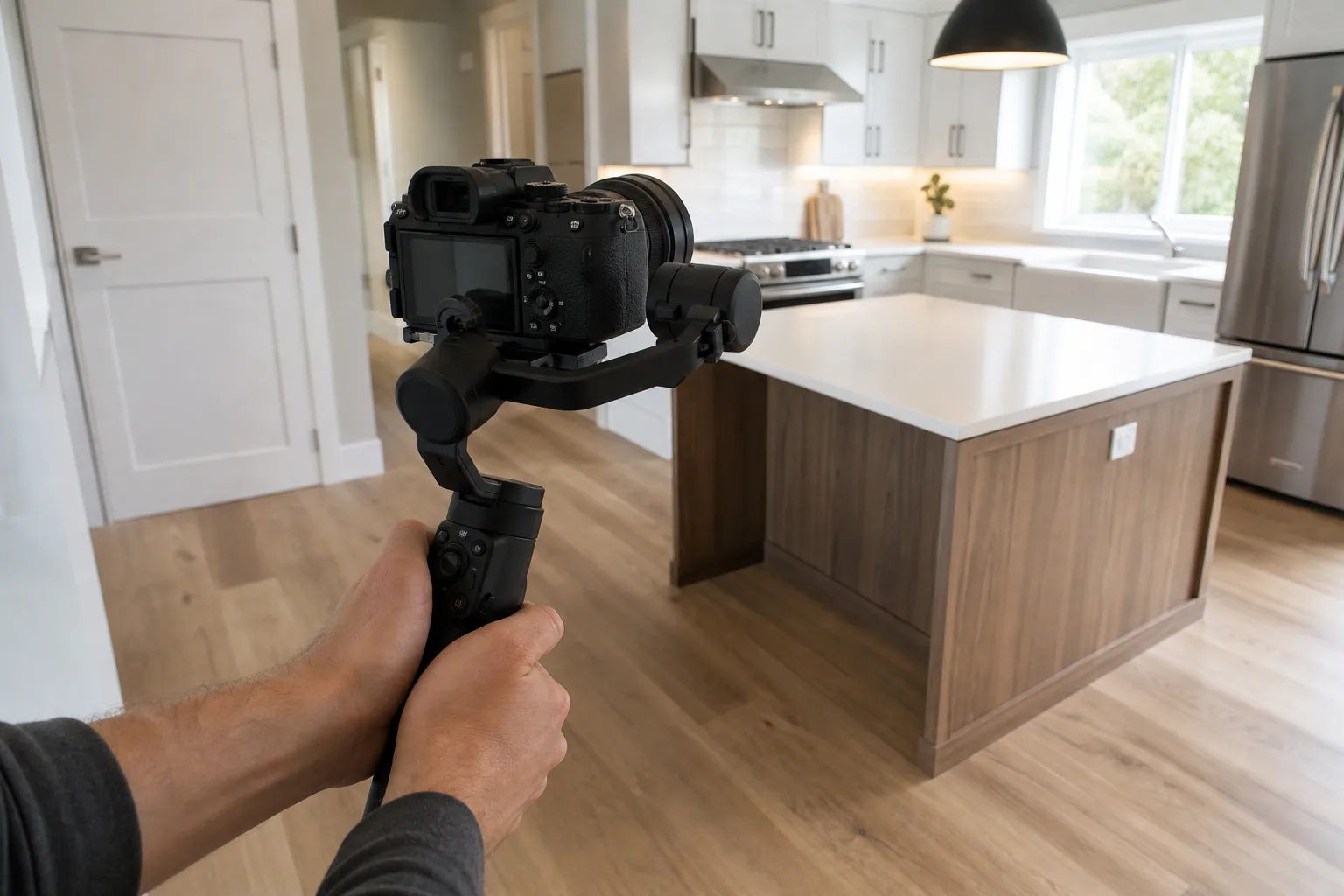
A 16-35 mm f/4 zoom is the classic first lens for listing work, and the Sony FE PZ 16-35mm F4 G is the version to pick when walkthrough video is a regular part of the job. The power zoom gives smooth zoom moves during a clip, and at 353 g the lens is light on a gimbal. Zoom and focus are internal, so the balance doesn't shift, and the 72 mm thread takes ordinary screw-in filters.
What it lacks is width. In a house with several cramped rooms, 16 mm will leave a few shots that can't be framed.
Power zoom for walkthrough video
Sony FE PZ 16-35mm F4 G (Sony E-mount)
A 16-35 mm range that covers most rooms, a power zoom for smooth moves on a gimbal and a 72 mm thread for video filters.
- 16-35 mm
- f/4
- 72 mm filters
Good for
- Stills and walkthrough video on one body
- Gimbal work
Skip it if
- Most of the homes have very small rooms
One discontinued lens to know
The Sigma 14-24mm F2.8 DG HSM Art is a DSLR-mount zoom that, used on mirrorless bodies through an adapter, shows almost no optical distortion even with corrections off and is sharp corner to corner. It also weighs 1,150 g, and Sigma has discontinued it. The mirrorless Sigma 14-24mm F2.8 DG DN Art for Sony E-mount and L-mount is a different optical design.
Corner detail on Nikon Z
Nikon NIKKOR Z 14-24mm f/2.8 S (Nikon Z-mount)
Holds floor grain and trim detail into the extreme corners, with a focus distance readout on the barrel.
- 14-24 mm
- f/2.8
- 650 g
Good for
- Detail-heavy interiors
- Handheld shooting in dim rooms
Skip it if
- The lens will only ever be used at f/8 on a tripod
Who should buy which
- Sony, mostly stills, many small rooms: Sony FE 12-24mm F4 G.
- Sony, stills plus regular video: Sony FE PZ 16-35mm F4 G.
- Canon RF, stills and gimbal video: Canon RF14-35mm F4 L IS USM.
- Nikon Z, a light kit that takes filters: NIKKOR Z 14-30mm f/4 S.
- Nikon Z, maximum corner detail or handheld work: NIKKOR Z 14-24mm f/2.8 S.
- Just starting out, any mount: an f/4 zoom that starts at 14 or 16 mm. Move to 12 mm only after real shoots show the current lens keeps falling short.
Sellers getting a home ready to list should also get a home valuation before the photos are booked. For the body to put behind the lens, see the comparison of cameras for real estate photography, and for product and detail shots at home, the guide to setting up a home photo and video studio.
Want straight verticals in camera? See the tilt-shift lens guide for real estate photography.
For the full workflow, the HDR real estate photography guide covers settings, bracketing and the gear around the lens.
Posted by Kristopher Larson
Frequently asked questions
What focal length is best for real estate photography?
On a full-frame camera, 16 mm is the working width for most rooms, and a zoom that starts at 14 or 16 mm covers a typical house. Go wider only when a room leaves no place to stand, and use 24 mm for a more natural view of a single feature. Pick the longest focal length that still shows the room, because very wide angles stretch objects near the edge of the frame.
Is 16-35mm wide enough for real estate interiors?
For most homes, yes. A 16-35 mm zoom on a full-frame body can shoot the living areas, kitchens and bedrooms of a normal house. It falls short in very small bathrooms, laundry rooms and narrow kitchens, which is where a 12-24 mm, 14-30 mm or 14-35 mm zoom helps.
Do I need an f/2.8 lens for real estate photography?
Not for tripod work. Interiors are shot at around f/8, usually as bracketed exposures, so the extra stop of f/2.8 goes unused, and at f/8 an f/4 zoom shows practically the same detail. An f/4 ultra-wide is also lighter. An f/2.8 lens makes sense if it will be used handheld in dim rooms, where the extra stop keeps ISO and noise down.
Is 12mm too wide for real estate photos?
As a default, yes. At 12 mm on full frame, furniture near the edges looks stretched and rooms can look larger than they are. It is useful as a fallback for tiny rooms where 16 mm can't show the space. Keep the camera level and keep objects away from the frame edges when shooting that wide.
What lens should I use on an APS-C camera for real estate photos?
Divide the full-frame focal length by the crop factor. On a 1.5x APS-C body, a 10 or 11 mm setting gives about the same view as 16 mm on full frame, so look for an ultra-wide zoom that starts around 10 mm. The same rules apply: tripod, about f/8 and a level camera.
How do I keep vertical lines straight in interior photos?
Level the camera so it points straight ahead, not up or down. A tilted camera makes walls lean no matter which lens is mounted. Fix any remaining lean with the upright or transform tool in the editor, and leave lens profile corrections on so barrel distortion is removed. A shift lens does the same job optically, but it is not required for listing photos.
Keep reading
More from the blog
Best Indoor Air Quality Monitor: Aranet4 vs. Airthings View Plus vs. Qingping vs. Amazon
Instax vs. Polaroid: Which Instant Camera to Buy
Reencle vs. FoodCycler vs. GEME: Which Electric Kitchen Composter Actually Makes Compost?