Best Flash for Real Estate Photography: Godox AD200Pro II vs. AD200Pro vs. AD300Pro vs. AD400Pro
Godox AD200Pro II, AD200Pro, AD300Pro and AD400Pro compared for flambient interiors: power for ceiling bounce, color, heat and when a speedlight is enough.
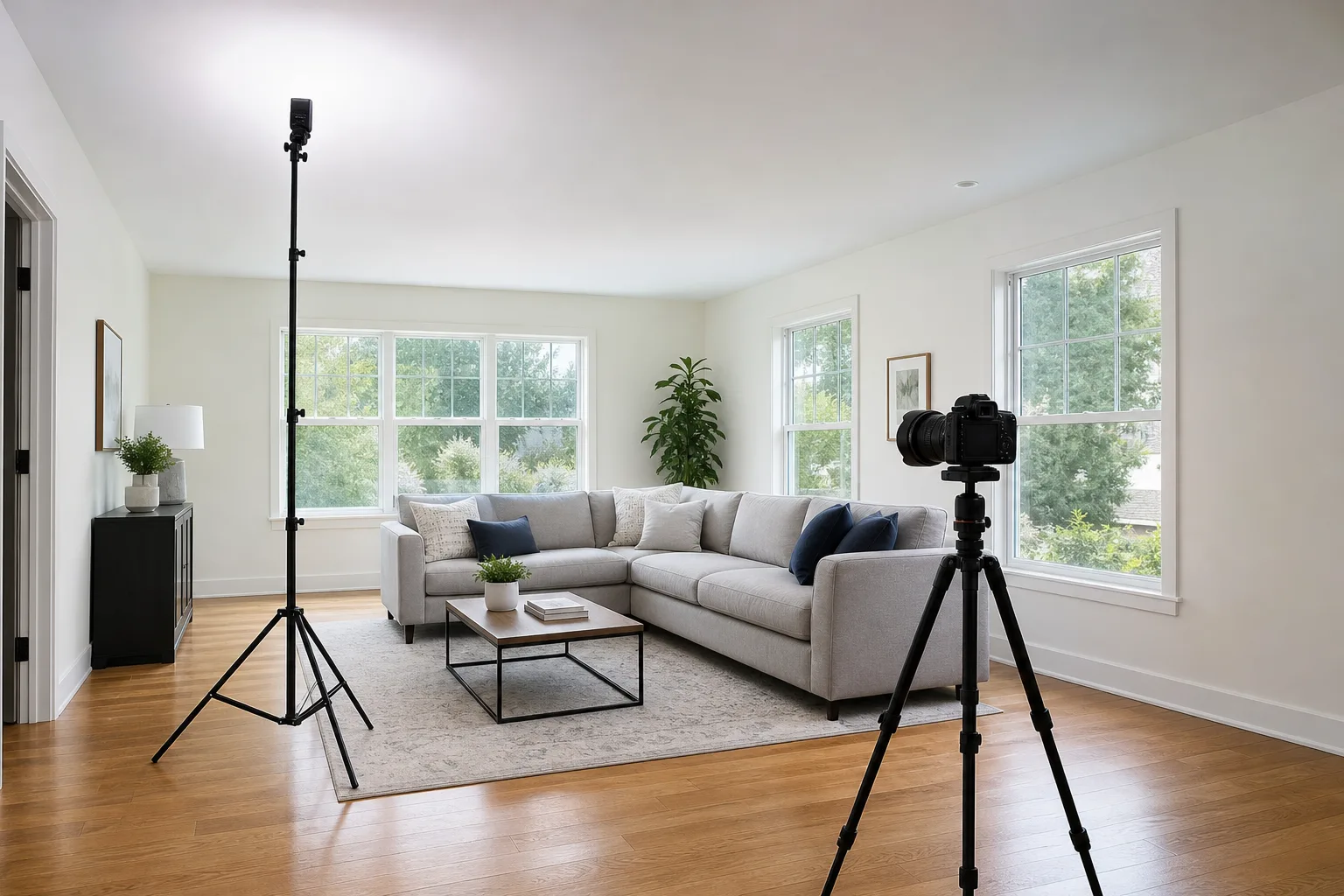
Bracketed HDR gets a house photographed quickly, but it leaves the color to whatever the room's bulbs, walls and windows produce. Flash fixes that. The flash-plus-ambient method, usually shortened to flambient, adds one or more frames lit by a strobe to the ambient exposure, and the frames are blended afterwards. The flash frame supplies neutral light, so whites come out white and the view through the windows holds.
This guide compares four battery-powered Godox strobes for interiors, from the pocket-size AD200 pair to the 400 Ws AD400Pro, and covers how much power a room needs, when a speedlight is enough, and what changed between the AD200Pro and the AD200Pro II.
Quick verdict
For houses, a 200 Ws pocket strobe does most of the work. More power is needed only in large or dark rooms, and it brings size and weight.
- First light to buy: the Godox AD200Pro II Pocket Flash. Enough power to bounce off a white ceiling in most rooms, small enough to clip to a belt, and its closed head all but removes the stray light and mixed color of the earlier model.
- Same output, earlier head: the Godox AD200Pro Pocket Flash. Still a capable workhorse. It leaks some cooler light from the head, runs hotter and has a power switch that can wear out.
- For large rooms: the Godox AD300Pro Outdoor Flash. Its frosted tube cover gives very soft light through a shoot-through umbrella. It belongs on a stand.
- Most power, least portable: the Godox AD400Pro Outdoor Flash. Useful in very large, dark, wood-heavy spaces and rarely needed anywhere else.
The four strobes side by side
| Product | Shop | Power | Full-power flashes per charge | Recycle time | Weight | Radio groups | Suits |
|---|---|---|---|---|---|---|---|
| Godox AD200Pro II Pocket Flash |  View on Amazon | 200 Ws, 1/512 to full | 500 | 0.01 to 1.8 s | About 2 lb with battery and Fresnel head | 16 | Ceiling bounce in most rooms, handheld pops |
| Godox AD200Pro Pocket Flash |  View on Amazon | 200 Ws, 1/256 to full | 500 | 0.01 to 1.8 s | 1.3 lb without head and battery | 5 | The same jobs, with more care over stray light |
| Godox AD300Pro Outdoor Flash |  View on Amazon | 300 Ws, 1/256 to full | About 320 | 0.01 to 1.5 s | 2.8 lb with battery | 5 | Large rooms, umbrella work |
| Godox AD400Pro Outdoor Flash |  View on Amazon | 400 Ws, 1/256 to full | 380 | 0.01 to 1 s | 4.6 lb with battery | 5 | Very large or dark spaces |
All four have Godox's 2.4 GHz radio receiver built in, so one trigger on the camera's hot shoe sets the power of every light. Adorama sells the same lights in the United States under its Flashpoint name (the eVOLV 200 Pro is the AD200Pro, and the XPLOR 300 Pro and XPLOR 400 Pro are the AD300Pro and AD400Pro), and the two brands work with each other's triggers. Another maker's flash usually needs its own trigger, so pick one system and stay in it.
First light to buy
Godox AD200Pro II Pocket Flash
A 200 Ws pocket strobe with a closed Fresnel head that all but removes the light leak and mixed color of the earlier AD200Pro.
- 200 Ws
- 500 full-power flashes
- 16 radio groups
Good for
- Ceiling bounce in most rooms
- Carrying on a belt through a large property
- Photographers bothered by color shifts from the earlier head
Skip it if
- The space is very large or very dark
- A bare bulb in a softbox is the main use
Flambient or HDR?
HDR is less work on site: the camera fires a bracket and software blends it. Flambient takes longer in each room and makes editing simpler, because the flash frame controls both brightness and color. It pays off most in rooms with mixed light, strongly colored walls, dark wood, and bright windows with a view worth keeping.
The settings are simple. Everything is manual. TTL metering fails when a light sits around a corner, and high-speed sync is not needed indoors, even for a window pull. Set the ambient frame about two stops under so the window view looks right, then add flash until the room comes up. At ISO 100 and f/9, a speedlight bounced off the ceiling of a living room barely registers until it reaches full power. Raising the ISO to 400 is worth two stops of flash power, which is why ISO 400 at f/8 to f/11 is a sensible working setting. Either method needs a camera that stays put between frames, which is the job of a tripod with a geared head.
How much power a room needs
As a rule of thumb, a speedlight puts out roughly 100 Ws. A 200 Ws strobe is about two speedlights, and a 400 Ws strobe is about two of those.
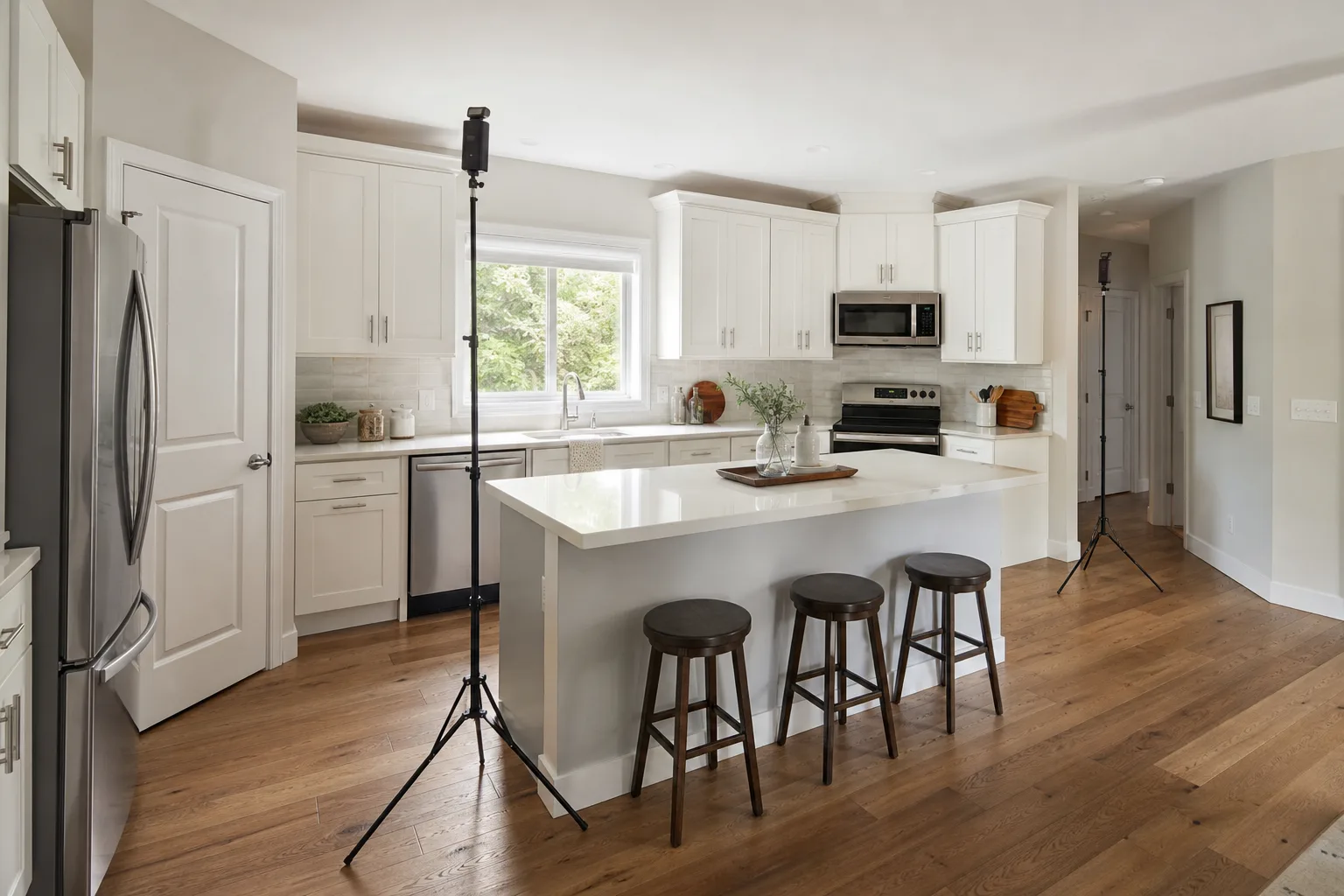
More power in one spot is not the answer for a house. A single very strong light bounced off one patch of ceiling over-lights the nearest furniture and can leave a color cast. A 600 Ws strobe at full power and ISO 400 lights the room and blows out the sofa beneath it. Two or three smaller lights spread through the scene give a more even result with cleaner color. A typical setup is two 200 Ws strobes on stands, one each side of a kitchen, plus a speedlight in hand. Three lights is the most a room normally needs.
Weight matters as much as output, because lights move constantly on a listing shoot, often within one photo. A 600 Ws strobe carried by hand wears out an arm within a shoot or two, and a 400 Ws head needs a stand wherever it goes.
Same output, earlier head
Godox AD200Pro Pocket Flash
A proven 200 Ws pocket strobe that does the same work as the Pro II, with some stray light and a switch that can wear out.
- 200 Ws
- 500 full-power flashes
- 5 radio groups
Good for
- A second or third light to match an existing AD200 kit
- Umbrella work where the leak does not show
Skip it if
- Mixed color from the head is already causing editing trouble
- Long runs at full power
AD200Pro II vs. AD200Pro: what changed
Both are 200 Ws and both are rated for 500 full-power flashes, so the specifications look alike. The differences show up in use.
- Stray light. The AD200Pro's Fresnel head has open slots along the top and bottom. Light escapes through them as two bars that are cooler in color than the main beam. They can show up in the frame, now and then cause a hot spot in an umbrella, and put two color temperatures into one exposure. The AD200Pro II has a closed head with almost no leak and more even color across the beam.
- Power switch. The AD200Pro's sliding switch is its known weak point after years of daily use. The Pro II turns on with a press-and-hold of the test button, a design with less mechanical wear.
- Heat. The earlier head can get hot enough after a heavy shoot to melt the lining of a camera bag. The Pro II adds a cooling fan. The table in Godox's AD200Pro II manual has over-temperature protection starting after 50 full-power flashes in a row with the Fresnel-style speedlite head, where the same table in the AD200Pro manual gives 40. The popular dome diffuser partly covers the fan, so go easy at full power with it fitted.
- Screen and groups. The Pro II screen is brighter and readable from across a room. Group and channel are set in the wireless menu, each group has its own color on the screen and a side LED, and there are 16 groups against 5.
- Stand mount and charger. The Pro II's mount ships with its lock and tilt knobs on the same side, where they collide. The lock knob unscrews and fits the other side. The charger is a compact USB-C unit.
Both have a stable color temperature mode that holds color within about 100 K across the power range, against roughly 200 K without it. The mode asks for a test pop after each power change before the next real frame. Skip that step and the first frame can differ in color, so for fast-moving listing work it is reasonable to leave the mode off.
The bare-bulb head supplied with both flashes spreads light well but is fragile for room-to-room work. The Fresnel head survives knocks and drops, which is why it stays on for listing shoots.
When a speedlight is enough
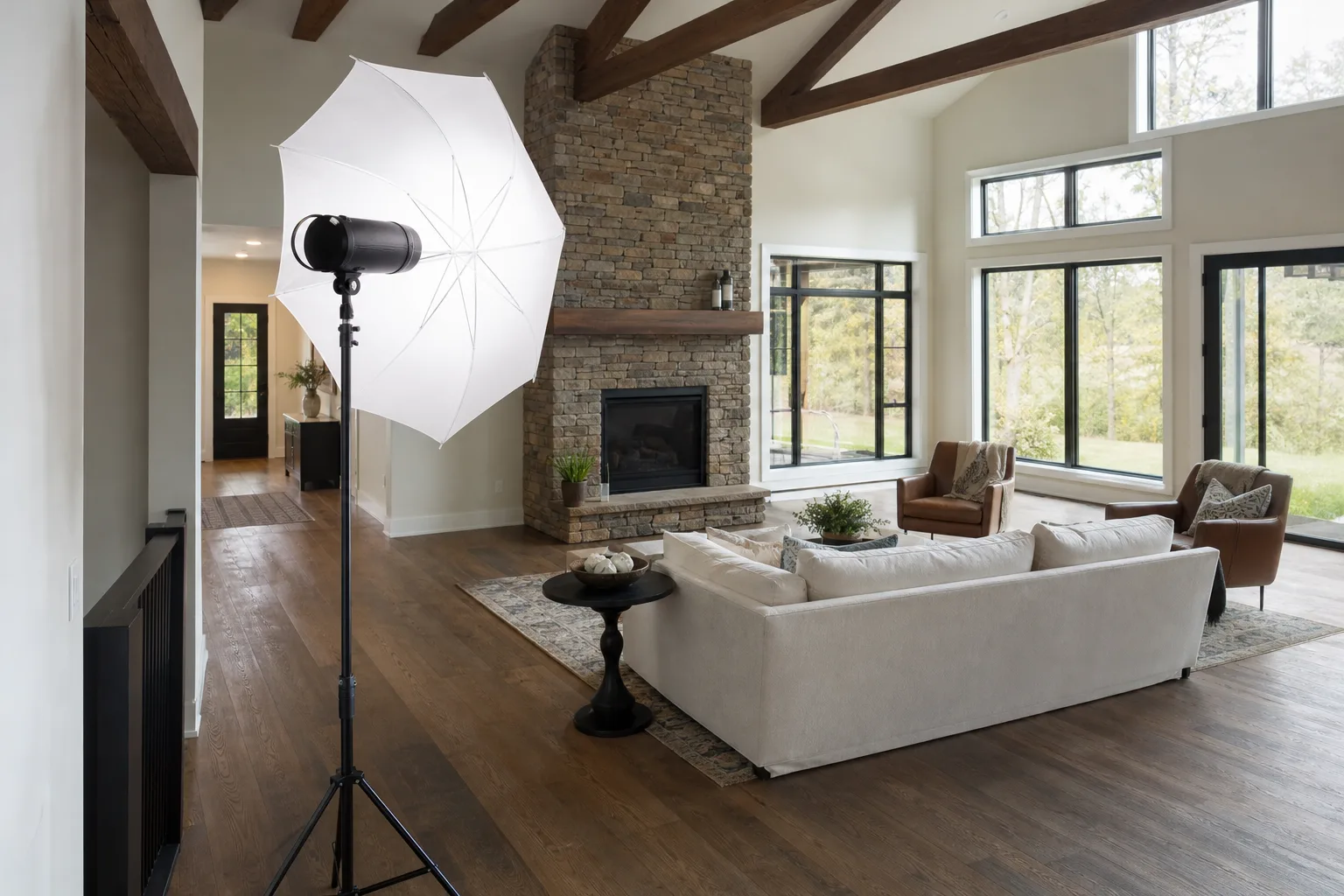
A basic manual speedlight such as the Godox TT600 can't light a living room alone at low ISO, but it ends up in nearly every photo. Clipped to a belt, it adds a quick pop into a shower or a small room while the larger lights stay where they are. It is also the second light for a two-sided blend when the kit has only one strobe. The round AD100Pro puts out about the same light as a speedlight, so it adds little to a real estate kit.
For large rooms
Godox AD300Pro Outdoor Flash
A 300 Ws strobe with a frosted tube cover that gives soft, even light through an umbrella in big spaces.
- 300 Ws
- About 320 full-power flashes
- 2.8 lb with battery
Good for
- Great rooms, lobbies and open-plan spaces
- Shooting straight into a room through an umbrella
Skip it if
- Most jobs are average-size houses
- The light has to ride on a belt
The picks in detail
Godox AD200Pro II Pocket Flash
The Godox AD200Pro II is the light to start with and the one that gets the most use afterwards. It is compact enough to clip to a belt through a big building, and it bounces off a white ceiling or fires through an umbrella equally well. It comes with both the Fresnel and bare-bulb heads. Photographers with working AD200Pro units have no need to replace them at once: add one Pro II and keep the earlier lights as backups.
First light to buy
Godox AD200Pro II Pocket Flash
A 200 Ws pocket strobe with a closed Fresnel head that all but removes the light leak and mixed color of the earlier AD200Pro.
- 200 Ws
- 500 full-power flashes
- 16 radio groups
Good for
- Ceiling bounce in most rooms
- Carrying on a belt through a large property
- Photographers bothered by color shifts from the earlier head
Skip it if
- The space is very large or very dark
- A bare bulb in a softbox is the main use
Godox AD200Pro Pocket Flash
The Godox AD200Pro has the same output, the same battery rating and the same pocket size. Its leak bars matter less than they sound. Bounced off a ceiling they are usually out of frame, and inside a shoot-through umbrella they mostly disappear. After years of regular work, the sliding power switch is the part known to fail. Let the head cool before packing it away.
Same output, earlier head
Godox AD200Pro Pocket Flash
A proven 200 Ws pocket strobe that does the same work as the Pro II, with some stray light and a switch that can wear out.
- 200 Ws
- 500 full-power flashes
- 5 radio groups
Good for
- A second or third light to match an existing AD200 kit
- Umbrella work where the leak does not show
Skip it if
- Mixed color from the head is already causing editing trouble
- Long runs at full power
Godox AD300Pro Outdoor Flash
The Godox AD300Pro is the step up for big spaces. Its tube sits behind a frosted cover, so through a shoot-through umbrella the light is diffused twice and comes out very soft, close to a softbox. One AD300Pro in an umbrella is enough for a flambient frame of a very large room, and it also bounces off a white ceiling without trouble. It is far smaller than a 400 Ws head but still belongs on a stand.
For large rooms
Godox AD300Pro Outdoor Flash
A 300 Ws strobe with a frosted tube cover that gives soft, even light through an umbrella in big spaces.
- 300 Ws
- About 320 full-power flashes
- 2.8 lb with battery
Good for
- Great rooms, lobbies and open-plan spaces
- Shooting straight into a room through an umbrella
Skip it if
- Most jobs are average-size houses
- The light has to ride on a belt
Godox AD400Pro Outdoor Flash
The Godox AD400Pro has the same frosted cover and soft umbrella light with more output. It suits very large rooms with a lot of dark wood, which soaks up light. For most residential work it stays at home. It is bulky, slow to move on stands, and seldom needed alongside the 200 and 300 Ws lights. Even on a large commercial property, the smaller strobes are easier to carry and quicker to set up.
Most power, least portable
Godox AD400Pro Outdoor Flash
A 400 Ws strobe for the occasional very large or very dark space, too bulky for everyday house shoots.
- 400 Ws
- 380 full-power flashes
- 4.6 lb with battery
Good for
- Very large rooms lit from a stand
- Dark, wood-heavy rooms lit through an umbrella
Skip it if
- The work is mostly houses
- Gear is carried room to room by hand
Godox also sells Pro II versions of the 300 and 400 Ws lights. They are separate models with their own specifications, and nothing in this guide describes them.
Battery and heat care
These strobes run on removable lithium battery packs. Godox's safety instructions and the AD200Pro II manual say to use only the specified charger, never to charge a pack for more than 24 hours at a stretch, to keep batteries dry and away from fire, not to use a damaged battery, and to avoid touching the fluid if one leaks. The manual sets 45°C as the highest working temperature, says not to cover the heat vents, and calls for about 10 minutes of rest when the over-temperature warning appears.
Most power, least portable
Godox AD400Pro Outdoor Flash
A 400 Ws strobe for the occasional very large or very dark space, too bulky for everyday house shoots.
- 400 Ws
- 380 full-power flashes
- 4.6 lb with battery
Good for
- Very large rooms lit from a stand
- Dark, wood-heavy rooms lit through an umbrella
Skip it if
- The work is mostly houses
- Gear is carried room to room by hand
Who should buy which
- Trying flambient for the first time: one AD200Pro II, a trigger for the camera brand, a light stand and a white shoot-through umbrella.
- A working kit for houses: two 200 Ws pocket strobes on stands and a manual speedlight on the belt.
- Large homes and commercial interiors: add an AD300Pro for umbrella work.
- Very large, dark spaces now and then: the AD400Pro, accepting that it will spend most weeks unused.
- Agents shooting their own listings: bracketed HDR is the faster start. The guides to cameras and wide-angle lenses for real estate photography cover that side of the kit.
The two larger strobes also suit portrait work, covered in the guide to setting up a home photo and video studio.
Not sure whether to bracket or use flash? The HDR real estate photography guide compares both methods and lists the kit for each.
Posted by Kristopher Larson
Frequently asked questions
What is flambient real estate photography?
Flambient is short for flash plus ambient. The photographer takes one frame with the room's existing light and one or more frames lit by flash from the same camera position, then blends them. The ambient frame keeps the natural feel of the room and the flash frame supplies clean, neutral color and detail. The camera must not move between frames, so the method needs a tripod.
How many watt-seconds does a flash need for real estate interiors?
About 200 Ws covers most rooms in a house when the flash is bounced off a white ceiling, especially at ISO 400. Large or dark rooms are easier with 300 Ws through a shoot-through umbrella. Strobes of 400 Ws and above are seldom needed for residential work, and several smaller lights spread through a room give more even results than one very strong one.
Is a speedlight enough for real estate photography?
A speedlight alone struggles in anything larger than a small room at low ISO. It puts out roughly half the light of a 200 Ws pocket strobe. It is still worth carrying as a second light for small bathrooms, showers, closets and quick fill, alongside at least one larger strobe.
Is the Godox AD200Pro II worth it over the AD200Pro?
For full-time real estate work, yes. The AD200Pro II's closed Fresnel head all but removes the stray bars of cooler light that the AD200Pro's head lets out, and it adds a cooling fan, a brighter screen and a press-button power control in place of the sliding switch. Output and battery ratings are the same, so a working AD200Pro does not need replacing right away.
Are Godox and Flashpoint flashes the same?
Flashpoint is the name Adorama uses for Godox-made lights in the United States. The Flashpoint eVOLV 200 Pro, for example, is the Godox AD200Pro under another label. The two brands use the same 2.4 GHz radio system, so Godox and Flashpoint triggers and flashes work together.
Is TTL or high-speed sync needed for interior real estate photos?
No. Interior flash work is done in manual mode, with the power of each light set from the trigger. TTL metering is unreliable when lights are placed around corners, and shutter speeds indoors normally stay within the camera's sync speed, even when exposing for a bright window.
Keep reading
More from the blog
Best Indoor Air Quality Monitor: Aranet4 vs. Airthings View Plus vs. Qingping vs. Amazon
Instax vs. Polaroid: Which Instant Camera to Buy
Reencle vs. FoodCycler vs. GEME: Which Electric Kitchen Composter Actually Makes Compost?