Best Camera Gimbal for Real Estate Video: DJI RS 4 vs. RS 4 Mini vs. RS 4 Pro, Plus Settings for Smooth Walkthroughs
DJI RS 4, RS 4 Mini and RS 4 Pro compared for listing walkthroughs: payload with a wide lens, vertical clips, battery life and settings for smooth video.
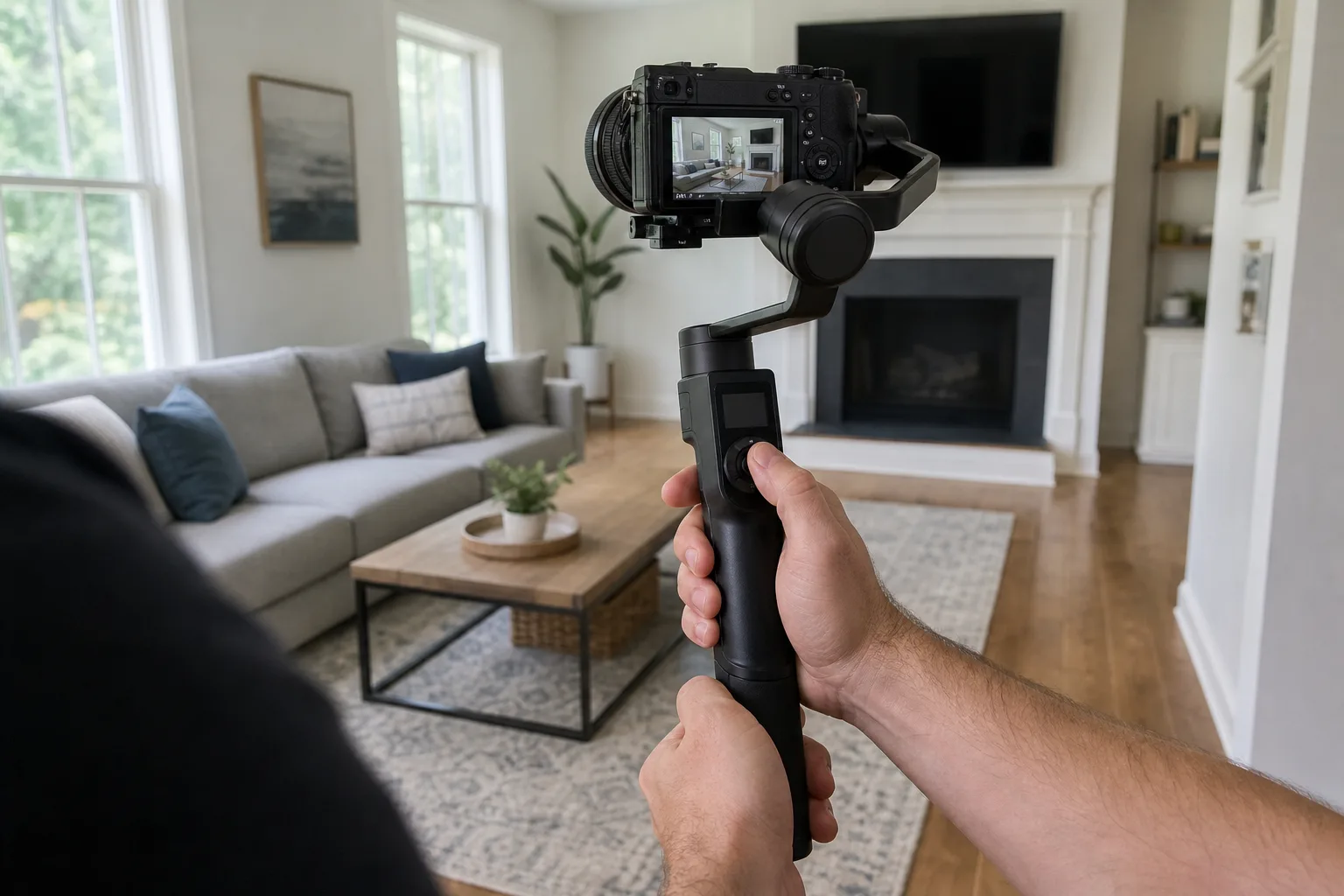
A listing walkthrough shot on a mirrorless camera with a wide lens only looks better than a phone clip if the camera glides. A three-axis gimbal does that work, and the choice comes down to how much it has to carry, how fast it sets up at each house, and how it is configured.
This guide compares three DJI camera gimbals for listing video, the RS 4, the RS 4 Mini and the RS 4 Pro, explains where the DJI RS 5 fits, and gives the settings that keep a walkthrough smooth.
Quick verdict
- Horizontal walkthroughs and vertical clips at the same house: the DJI RS 4 Camera Gimbal. It carries a full-frame body and an ultra-wide lens with room to spare, flips to vertical in seconds, and goes about three shooting days between charges.
- A light mirrorless kit that has to fit in one bag: the DJI RS 4 Mini Camera Gimbal. It handles a full-frame body with a small or medium lens and rides in the camera bag, with a built-in battery and a 2 kg limit.
- Cinema bodies, cages and heavy zooms: the DJI RS 4 Pro Camera Gimbal. It carries 4.5 kg, and its bulk is why it tends to stay home on listing days.
- The DJI RS 5 adds a fine-tuning knob on every axis and a faster charge. It had no Amazon listing when this guide was written, so it has no pick card here.
The four gimbals side by side
| Product | Shop | Payload rating | Weight | Runtime | Full charge | Fine-tuning knobs | Vertical switch |
|---|---|---|---|---|---|---|---|
| DJI RS 4 Camera Gimbal |  View on Amazon | 3 kg | About 1,066 g plus a 203 g grip | Up to 12 hours, removable grip | About 2.5 hours | Tilt axis | No extra parts, rebalance after |
| DJI RS 4 Mini Camera Gimbal |  View on Amazon | 0.4 to 2 kg | About 890 g with plate, tripod 140 g more | Up to 13 hours, built-in battery | About 1 hour 50 minutes | Tilt axis | No extra parts |
| DJI RS 4 Pro Camera Gimbal |  View on Amazon | 4.5 kg | About 1,242 g plus a 265 g grip | Up to 13 hours, removable grip | About 1.5 hours | Tilt axis | No extra parts, rebalance after |
| DJI RS 5 | 3 kg | About 1,193 g plus a 274 g grip | About 14 hours, removable grip | About 1 hour with a 65 W charger | All three axes | No rebalance on tilt and pan |
All figures are DJI's. Runtime is measured standing still, so walking shots drain it faster.
For horizontal and vertical at every listing
DJI RS 4 Camera Gimbal
Carries a full-frame body and an ultra-wide lens with room to spare, flips to vertical in seconds and goes about three shooting days between charges.
- 3 kg payload
- About 1,066 g plus grip
- Up to 12 hours
Good for
- Videographers shooting several listings a week
- Clients who ask for both formats at one house
- Kits that swap a wide lens for a standard zoom
Skip it if
- The whole kit has to fit in one camera bag
- The camera is caged with a long lens and focus motors
How much gimbal a listing camera needs
Payload is the first filter. A walkthrough kit is usually one of the bodies from the camera comparison with an ultra-wide from the real estate lens guide.
The RS 4 has room to spare for that. A Sony FX3 with Laowa's 12 mm Zero-D cine lens, a heavier pairing than most listing kits, balances without fuss inside the 3 kg rating. Swapping that lens for a Sony 24-70 mm f/2.8 GM II for detail shots needs no rebalance, because the two weigh nearly the same.
The RS 4 Mini's rating is 2 kg. DJI's own examples for it include a Sony A7-series body with a 24-70 mm f/2.8 GM II. In use it carries a full-frame body with a small or medium lens without strain and starts to run out with a large lens on a flagship body. A Nikon Z6 III with a 135 mm Viltrox prime balances on the RS 4 and will not balance on the Mini with the eyepiece attached.
The RS 4 Pro's 4.5 kg is for caged cameras, focus motors and long lenses. Weight is only half of it: a long or front-heavy lens can run out of room on the arms before it reaches the limit, so look up the exact body and lens in DJI's Ronin compatibility search before ordering.
Setup and rebalancing between houses
All four have automated axis locks: switch the gimbal off and the arms lock, switch it on and they release. Teflon surfaces on the arms of the three RS 4 models cut friction, so the camera slides to its balance point without sticking, and a knob on the tilt axis makes the last small adjustment.
A Sony FX3 in a cage with an Arca-type rail slides straight onto the RS 4's plate, so the camera comes off for tripod stills and goes back at the same balance point. Still calibrate every time the camera or lens changes, holding the base firmly on a table while it runs. The Mini is especially sensitive: it does not always warn when calibration is off, and footage is visibly less stable when it is.
All three RS 4 models pair with supported cameras over Bluetooth, so the record button on the grip starts and stops the camera without a cable. If a control cable is used instead, watch it after a triple press of the trigger turns the camera to face the operator. On the way back the head makes a full rotation and can wind the cable around the arm.
Easiest to carry between houses
DJI RS 4 Mini Camera Gimbal
Handles a full-frame body with a small or medium lens, locks itself when switched off and fits in the camera bag, with a built-in battery and a 2 kg limit.
- 0.4 to 2 kg payload
- About 890 g
- Up to 13 hours
Good for
- Photographers adding video to a stills shoot
- Full-frame bodies with a compact wide zoom
- Tight bathrooms and hallways
Skip it if
- The lens is large or front-heavy
- A swappable battery is required
Settings that keep walkthroughs smooth
Gimbal defaults are quicker than interiors need. Menu scales differ between models and brands, so treat these numbers as starting points.
- Follow speed. Open a custom profile and set follow speed between 10 and 15. On the RS 4, 12 on every axis works with a wide lens.
- Deadband and response. Set a deadband so small hand tremors are ignored: on the RS 4, about 7 for pan and 10 for tilt. On gimbals with Smooth and Responsive follow modes, such as the RS 4 Mini, choose Smooth. The camera then lags the hands slightly, so start each move deliberately and resist correcting.
- Mode. Pan follow for pushes, slides and orbits. Tilt and roll stay locked, the lens stays parallel to the walls, and door frames stay vertical. Pan-and-tilt follow only for tilting up a staircase or toward a light fixture. FPV mode rolls the horizon and belongs in deliberate shots at a slow follow speed.
- Joystick. Set joystick speed to about 12. With smoothness at zero, holding the stick fully over gives one constant, slow tilt. For a rising shot of a faucet or countertop, hold the stick and match the lift of the arms to that tilt. With smoothness set high, the tilt eases in and out, which suits a gentle tilt while rounding a corner.
Check in-camera stabilization too. Electronic stabilization should be off: it crops the frame and can warp the image. Sensor-shift stabilization helps on some bodies and hurts on others. With an ultra-wide lens on a Sony body it can warp the corners, and with it switched off RS 4 footage rarely needs stabilizing afterward. Also turn off any mode built to hold a static handheld frame, such as Panasonic's Boost I.S. It fights the move, then jumps to catch up.
Walking shots, doorways and stairs
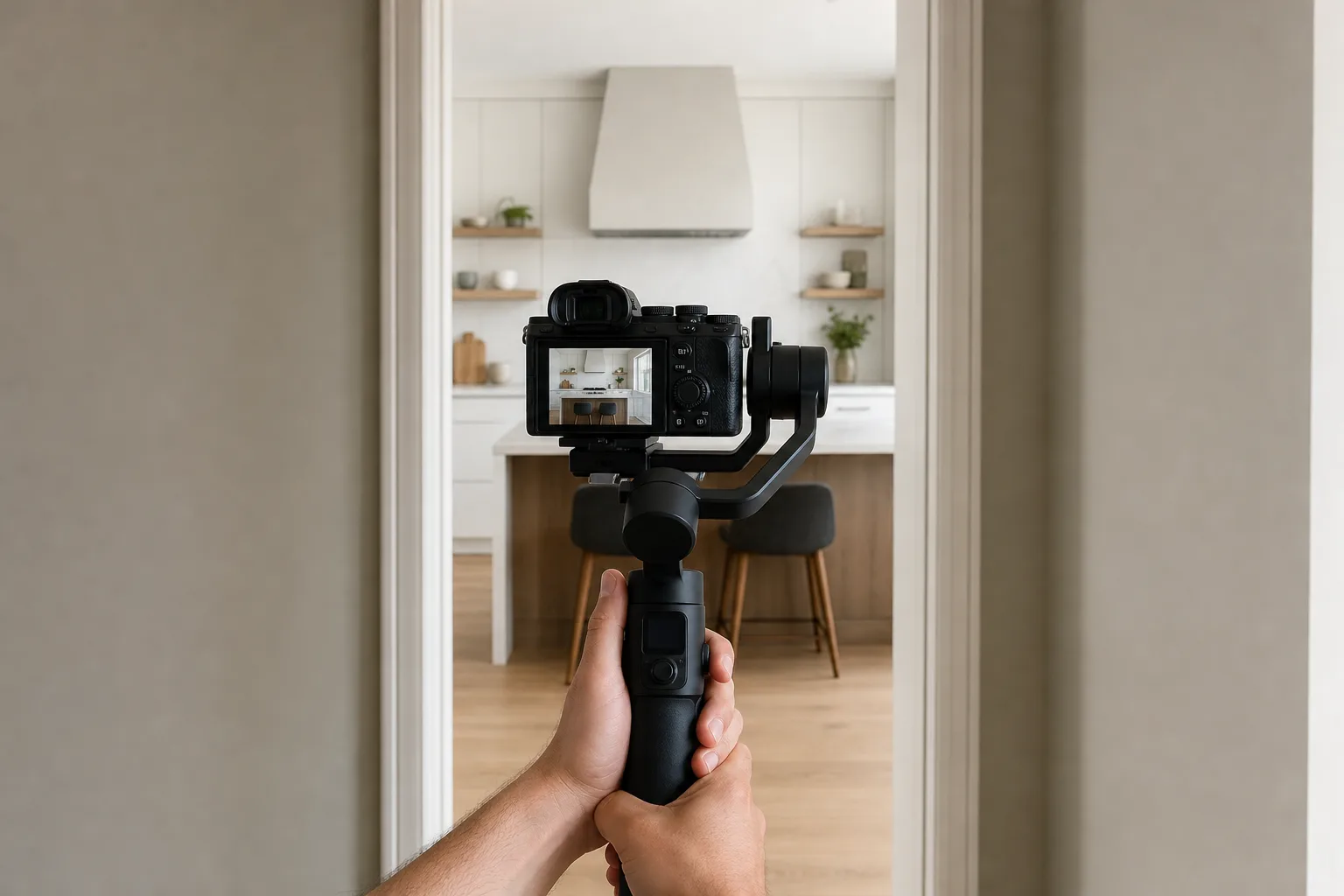
A three-axis gimbal steadies pan, tilt and roll. It does nothing about the camera rising and falling with each step, so walk with knees bent and steps short and even.
Shoot each room wide, then medium, then tight, and keep consecutive shots moving in the same direction so the edit flows. For the front-door shot, walk backward out of the house while pulling the door shut, then reverse the clip. For a straight push through an interior doorway, stay in pan follow and keep the hands still.
Subject tracking is for people. DJI's RS Intelligent Tracking Module attaches magnetically, starts with a raised palm and follows a person up to 10 m away. On the RS 4 Mini it holds an agent in frame for a walk-and-talk, leaving the operator to keep the distance. DJI sells the module separately, and it also fits the RS 4 and RS 4 Pro.
For the heaviest camera setups
DJI RS 4 Pro Camera Gimbal
Carries 4.5 kg on carbon fiber arms, with a size and accessory load that calls for a separate bag.
- 4.5 kg payload
- About 1,242 g plus grip
- Up to 13 hours
Good for
- Cinema bodies, cages and heavy zooms
- Crews that also shoot commercial work
Skip it if
- The kit is a mirrorless body and a wide lens
- Everything has to fit in one bag
Vertical clips for social
All four switch to vertical without an extra bracket by moving the camera plate to the upright position. On the RS 4 the swap takes seconds, quick enough to do at the door when a client asks for the other format, with no second rig kept set up for vertical. Shooting vertical natively keeps the full width of the lens, where cropping a horizontal clip throws most of the room away.
DJI says the RS 4 and RS 4 Pro need rebalancing after the switch and puts the RS 4 Mini's swap at about 10 seconds. Check the balance and calibrate again in every case. Readers who only need vertical clips can do it with less gear using a phone gimbal.
Battery and carrying it between houses
In steady listing work the RS 4 goes about three shooting days between charges and still shows roughly 30 percent, and its grip detaches so a spare can be swapped in. The RS 4 Mini has a built-in battery that charges over USB-C. Switched off between shots, it lasts a full day, and it recharges overnight.
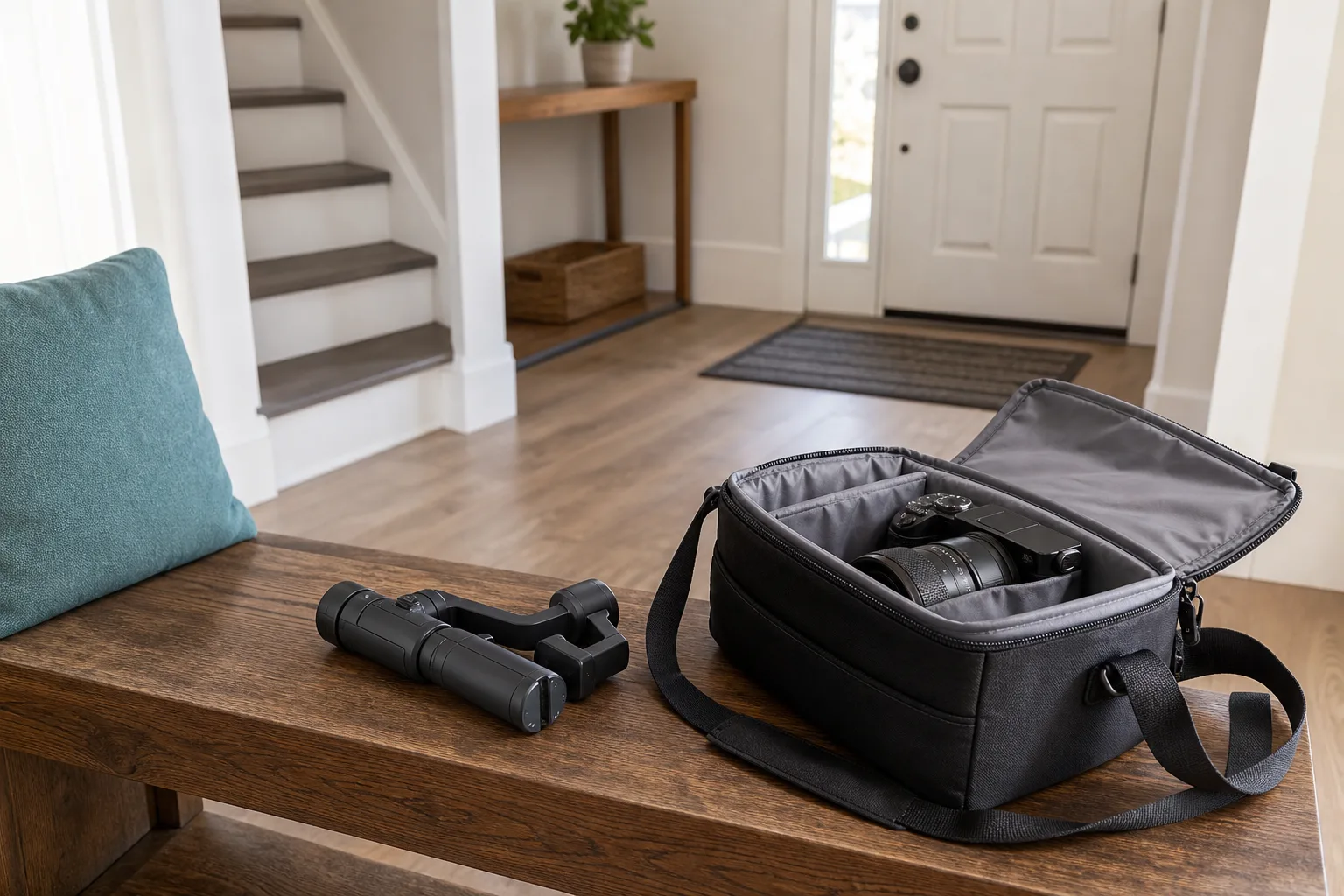
Size decides whether the gimbal comes along at all. The RS 4 Pro and its accessories fill a second bag, and bought alongside an RS 4 it is the one left behind. The RS 4 goes on the back seat or in a carry-on with the rest of the kit. The Mini fits the camera bag once its tripod foot is off and is easier to move through a tight bathroom or hallway. Stills still belong on a tripod with a geared head.
For horizontal and vertical at every listing
DJI RS 4 Camera Gimbal
Carries a full-frame body and an ultra-wide lens with room to spare, flips to vertical in seconds and goes about three shooting days between charges.
- 3 kg payload
- About 1,066 g plus grip
- Up to 12 hours
Good for
- Videographers shooting several listings a week
- Clients who ask for both formats at one house
- Kits that swap a wide lens for a standard zoom
Skip it if
- The whole kit has to fit in one camera bag
- The camera is caged with a long lens and focus motors
Where the DJI RS 5 fits
The RS 5 has the same 3 kg rating as the RS 4. DJI lists a fine-tuning knob on each axis arm, a Z-axis indicator that gives feedback on how steady the walk is, a full charge in about an hour with a 65 W charger, and a vertical switch that keeps the tilt and pan balance. Its electronic briefcase handle is sold separately or in a combo. It had no Amazon listing when this guide was written, while all three RS 4 models did.
The picks in detail
DJI RS 4 Camera Gimbal
The DJI RS 4 is the one that does the daily listing work: strong enough for a full-frame body with a heavy wide lens and quick to flip between formats. The recurring chore is calibrating after every lens change. DJI says the RS 4 Combo adds a DJI Focus Pro Motor, which a wide lens at a fixed focus does not need.
For horizontal and vertical at every listing
DJI RS 4 Camera Gimbal
Carries a full-frame body and an ultra-wide lens with room to spare, flips to vertical in seconds and goes about three shooting days between charges.
- 3 kg payload
- About 1,066 g plus grip
- Up to 12 hours
Good for
- Videographers shooting several listings a week
- Clients who ask for both formats at one house
- Kits that swap a wide lens for a standard zoom
Skip it if
- The whole kit has to fit in one camera bag
- The camera is caged with a long lens and focus motors
DJI RS 4 Mini Camera Gimbal
The DJI RS 4 Mini adds little to the bag and is ready the moment it powers on. Its limits are a built-in battery, a payload that stops short of a large lens on a flagship body, and a light gray finish where the RS 4 is black. DJI says its compact briefcase handle requires a specific combo.
Easiest to carry between houses
DJI RS 4 Mini Camera Gimbal
Handles a full-frame body with a small or medium lens, locks itself when switched off and fits in the camera bag, with a built-in battery and a 2 kg limit.
- 0.4 to 2 kg payload
- About 890 g
- Up to 13 hours
Good for
- Photographers adding video to a stills shoot
- Full-frame bodies with a compact wide zoom
- Tight bathrooms and hallways
Skip it if
- The lens is large or front-heavy
- A swappable battery is required
DJI RS 4 Pro Camera Gimbal
The DJI RS 4 Pro has carbon fiber arms and a 4.5 kg rating meant for cinema cameras and heavy zooms. For a mirrorless listing kit it is more gimbal than the job needs. Its Combo also adds a Focus Pro Motor.
For the heaviest camera setups
DJI RS 4 Pro Camera Gimbal
Carries 4.5 kg on carbon fiber arms, with a size and accessory load that calls for a separate bag.
- 4.5 kg payload
- About 1,242 g plus grip
- Up to 13 hours
Good for
- Cinema bodies, cages and heavy zooms
- Crews that also shoot commercial work
Skip it if
- The kit is a mirrorless body and a wide lens
- Everything has to fit in one bag
Who should buy which
- Real estate videographers delivering walkthroughs and vertical clips: the RS 4.
- Photographers adding a short walkthrough to a stills shoot, and agents filming their own listings on a small mirrorless camera: the RS 4 Mini.
- Production teams with cinema cameras: the RS 4 Pro.
Posted by Kristopher Larson
Frequently asked questions
What size gimbal does a full-frame camera with a wide-angle lens need?
A gimbal rated for 3 kg, such as the DJI RS 4, covers a full-frame body with an ultra-wide lens with room left for a standard zoom. A compact 2 kg gimbal such as the DJI RS 4 Mini is enough for a body with a small or medium lens. Check the exact body and lens in DJI's Ronin compatibility search, because a long or front-heavy lens can run out of balancing room before it reaches the weight limit.
Should in-camera stabilization be on or off when the camera is on a gimbal?
It depends on the camera and the mode. Electronic stabilization should be off, since it crops the frame and can warp the picture. Sensor-shift stabilization helps on some bodies and warps the corners with an ultra-wide lens on others, so shoot a short clip each way. Any mode designed to hold a static handheld frame should be off, because it resists the gimbal's movement and then jumps to catch up.
Which gimbal mode works for a real estate walkthrough?
Pan follow for most shots. The camera turns left and right with the handle while tilt and roll stay locked, which keeps the lens parallel to the walls and door frames vertical. Switch to pan-and-tilt follow for a tilt up a staircase or toward a light fixture, and keep FPV mode, which lets the horizon roll, for deliberate stylized shots.
How is the DJI RS 5 different from the DJI RS 4?
Both are rated for a 3 kg payload. DJI lists a fine-tuning knob on each axis arm of the RS 5, where the RS 4 has one on the tilt axis, plus a Z-axis indicator for walking steadiness, a full charge in about an hour with a 65 W charger and a vertical switch that keeps the tilt and pan balance. The RS 5 had no Amazon listing when this guide was written, while the RS 4 models did.
Does a gimbal need rebalancing for vertical video?
Usually, yes. DJI says the RS 4 and RS 4 Pro need rebalancing after the camera plate is moved to the vertical position. The plate swap itself takes seconds and needs no extra bracket. Whatever the model, check the balance and run calibration again after the switch, with the base held firmly on a table, because the camera's weight sits differently across the motors.
How long does a camera gimbal battery last on listing shoots?
Longer than a shooting day. DJI rates the RS 4 at up to 12 hours and the RS 4 Mini at up to 13 hours, both measured standing still. In steady listing work the RS 4 goes about three shooting days between charges. The RS 4 Mini lasts a full day when it is switched off between shots, and its battery is built in, so it recharges over USB-C overnight instead of swapping grips.
Keep reading
More from the blog
Best Wireless Microphone for Real Estate Video: Rode Wireless GO (Gen 3) vs. Wireless PRO vs. DJI Mic 3 vs. Hollyland Lark Max 2
Best Walkie Talkies: Rocky Talkie vs. Motorola Talkabout vs. Midland X-Talker for Hiking, Skiing and Outages
Best Robotic Pool Cleaners: Corded vs. Cordless, Beatbot vs. Aiper vs. Dolphin vs. ECOVACS