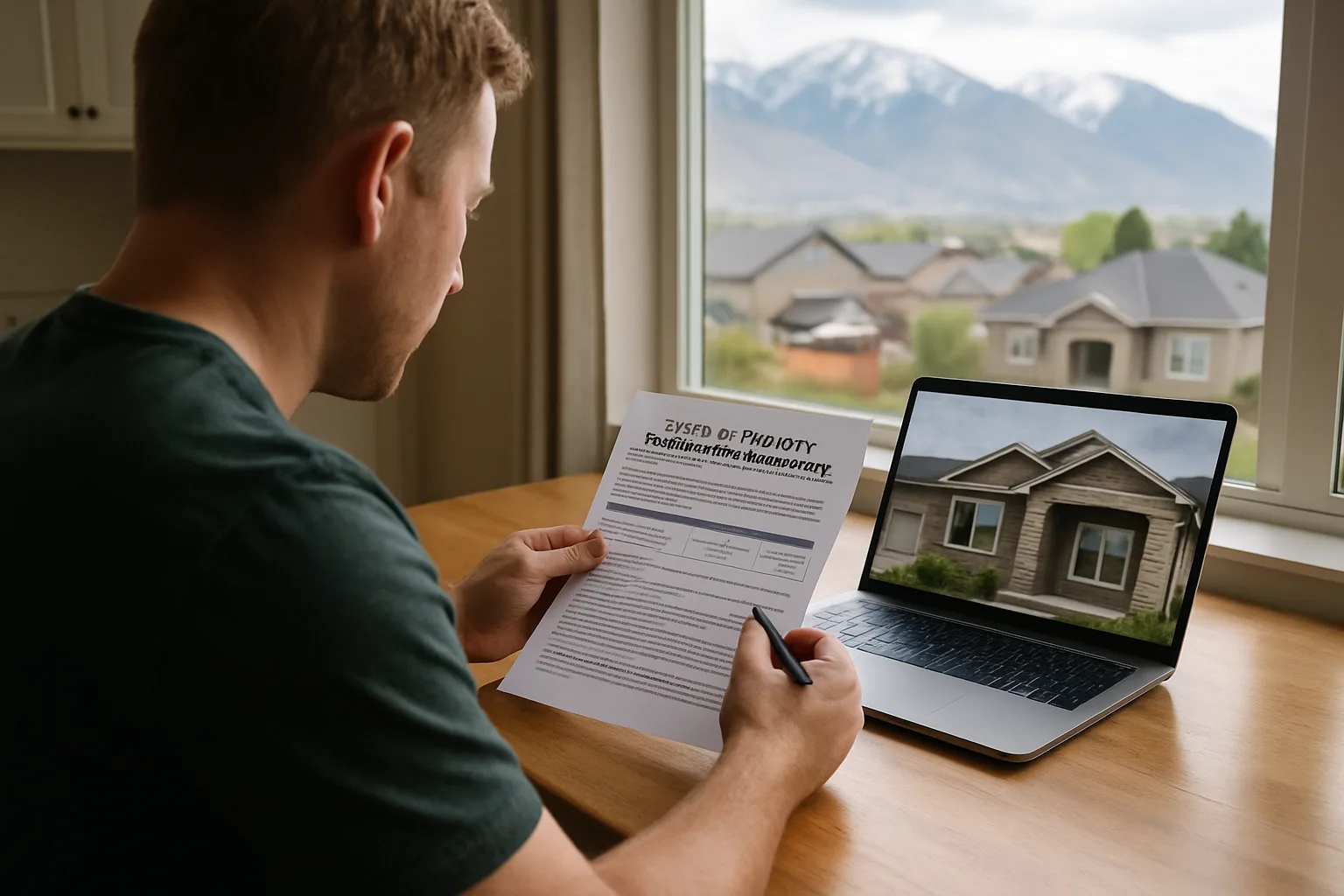
How Utah Property Values Get Set Before Your Tax Bill Arrives
Utah property tax bills are driven by assessed value, not just tax rates — and assessed value is a formula that can be wrong. This guide walks through how mass appraisal works, the four levers behind your bill, and a 15-minute weekend review to check your own numbers before the appeal deadline.
Two identical houses on the same street in Sandy can carry tax bills that differ by hundreds of dollars a year, and the rate has nothing to do with it. One owner just never looked at the notice.
Most Utah homeowners treat the county's value estimate like weather. It shows up, you grumble, you pay. That's backwards. The value is a number somebody typed in, and it's the single biggest lever on what you owe. Rates are set by processes you can't touch. Values get set by a process you can absolutely question.
So here's the plan. I'll walk you through how assessors actually build that number, the four parts of your bill that move independently of each other, and a fifteen minute review you can run this weekend before the deadline window closes. If your value is off, you'll know. If it isn't, you'll at least stop guessing. This is a close cousin to the issue we covered in Why Identical Houses Get Different Property Tax Bills, so read that one too if the mass-appraisal math interests you.
What the county is actually appraising
Your assessor isn't trying to figure out what you'd get if you listed tomorrow. They're building a mass appraisal model: one formula applied to thousands of parcels, tuned by neighborhood, square footage, age, lot size, basement finish, and whatever the local market did in the last cycle.
That's why your valuation letter can feel weirdly abstract. Nobody walked your hallway. Nobody counted the water damage under the upstairs window or noticed that your neighbor's "comparable" sale was a fully remodeled flip with a detached shop.
Utah runs this through all 29 counties, and every county assessor answers to the Utah State Tax Commission on how valuations get certified. Standards exist. The state reviews the ratios. It's not a black box with a padlock. It's a formula with inputs, and inputs can be wrong.
The thing that trips people up is timing. Utah values are set on a January 1 lien date, using sales the county already collected. So the number in your notice reflects last year's market, not this spring's. If your neighborhood cooled off after the valuation date, you can't argue that. You can argue the facts of your own property, which is a different fight entirely. If you're weighing whether now is even a good time to buy given where the broader market sits, our breakdown of Utah's 2026 housing market is worth a look.
The four levers that decide your bill
People say "my property tax went up" like it's one event. It's four separate mechanisms stacked, and knowing which one moved tells you whether you have any leverage at all.
Assessed value
This is the county's opinion of your market value. This is the lever you can contest. Everything else runs downhill from it.
Exemptions and credits
Utah's primary residence exemption takes 45% off your taxable value on your legal residence, and it's the one homeowners most often forget to claim after a purchase. There's a veteran exemption, a blind exemption, and a circuit breaker program tied to income and age. Miss one and you're paying on value that shouldn't be taxed.
Taxable value
Assessed value minus exemptions. Simple subtraction, and a complete disaster when the exemption never got filed.
Rate
Set by the taxing entities that serve you: county, city, school district, water district, library, mosquito abatement, and whatever else shows up on your notice. You don't negotiate these. You vote on the people who set them, which is the only honest answer.
The rate piece deserves a gut check, because it's where most of the confusion lives. Utah caps the property tax revenue a taxing entity can take in from existing property, so when total assessed value climbs, certified rates typically fall. There's a real debate in public finance circles about whether rate caps actually hold the line or just move the pressure into fees and other revenue. The Lincoln Institute of Land Policy tracks how these limits play out across states, and the pattern isn't as clean as either side claims. Rates can drop while your bill climbs. Both things are true at once.
A fifteen minute review you can run this weekend
Grab your latest valuation notice and your property tax bill. They're different documents and you need both.
Compare your assessed value to your own purchase price if you bought within the last few years. If you paid $465,000 and the county says $520,000, that gap is your opening.
Pull three to five comparable sales from your county assessor's public records, same subdivision, similar square footage, sold around the January 1 valuation date. Not last spring's sales. Not the neighbor's remodel.
Read the property characteristics section line by line. Square footage, bedroom count, basement finish, garage stalls, year built, lot acreage. Errors here are common and they're the easiest thing in the world to prove. I've seen a basement listed as finished when it's raw concrete, and that one line moved the value by five figures.
Confirm your primary residence exemption is listed. If it's missing, that's a call to the county, not an appeal.
Note the appeal deadline on the notice itself. Utah counties run their own windows, usually a set number of weeks after the notice mails, and missing it means waiting a full year.
If steps one through three turned up a real discrepancy, file. If they didn't, you saved yourself a wasted appeal, and you now understand your own bill better than most people on your block.
Why the appeal usually isn't about the rate
Here's where people go wrong. They show up angry about the total dollar amount and talk about how taxes are too high. County boards hear that all day and it doesn't move a number, because the board doesn't set rates. It hears valuation evidence.
Bring the characteristics sheet with the errors circled. Bring the comparable sales with addresses and dates. Bring photos if the county's description doesn't match reality. Keep it to one page if you can.
This is also where the category of tax on your notice matters. Broad based levies on property value are what most people mean when they talk about ad valorem taxes, the Latin phrase for "according to value," and that term covers everything from your house to the personal property return a Utah small business files on its equipment. Same principle, same appeal logic, different form.
On the business side, owners regularly overpay because nobody told them the equipment schedule from three years ago is still in the county's system. Sold the kitchen equipment, closed the second location, and the assessment never changed. That's not a rate problem either.
What I'd actually do
I'd set a calendar reminder for the week your notice historically lands, and I'd block thirty minutes for it. That's it. Not because appeals win constantly, but because the review takes so little time and the standing error rate on mass appraisal data is real enough to matter across a whole county.
You can also lean on data instead of instinct. The U.S. Census Bureau publishes housing and owner cost data at the county level, and it's a decent sanity check when a valuation feels wildly off the local pattern. Not proof. Context. If you're comparing notes with a home-buying friend across state lines, our piece on leaving California for Utah touches on how differently property taxes get structured in other states.
Two things kill more appeals than anything else. First, arguing sentiment: "this doesn't feel like a half million dollar house" is not evidence. Second, appealing the rate. The board can't help you with that and saying it out loud costs you credibility on the parts it can.
The homeowners who come out ahead treat this as an annual chore, not a crisis. Same as cleaning the gutters or checking the furnace filter — worth pairing this review with a broader roof inspection checklist if you're due for one anyway. Low effort, and the alternative is paying whatever number showed up in the mail.
So what's your number this year? Pull the notice out of the drawer and read the assessed value out loud. If you can't remember the last time it matched what you'd actually sell for, you already know what to do next.
Frequently asked questions
How do I know if my Utah home's assessed value is too high?
What is the deadline to appeal a property tax assessment in Utah?
Does Utah's primary residence exemption apply automatically after I buy a home?
Why did my property tax bill go up even though the tax rate went down?
Can I appeal my property taxes because the rate is too high?
How is my property's assessed value different from what I could sell it for?
Keep reading
More from the blog
Why Identical Houses Get Different Property Tax Bills

Your First Month in a New Utah Home: A Fall Settling-In Guide
Cold-Climate Heat Pumps: What Changed and What Still Matters