Utah Housing Market 2026: Crash, Boom, or a Stalled Market?
Utah's 2026 housing market isn't crashing or booming — it's stalled and split by county, city, and price range. This guide breaks down inventory signals, withdrawn listings, insurance and wildfire risk, and what buyers and sellers should do next.
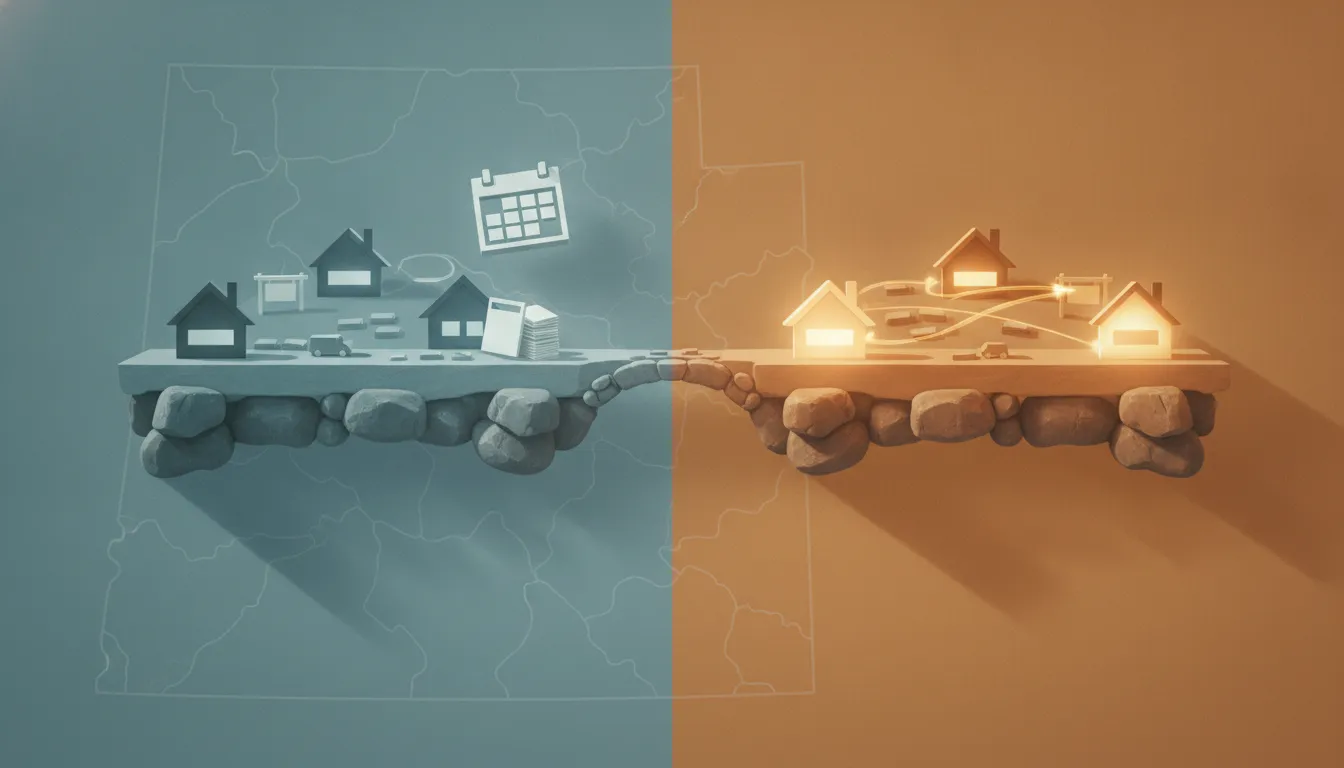
Utah’s housing market is not moving in one clear direction in 2026. More homes are available than during the peak frenzy, many listings take longer to sell, and buyers have greater room to negotiate in select areas. At the same time, statewide sale prices have remained resilient, largely because many homeowners have substantial equity and low fixed mortgage rates.
The most accurate description is a stalled and split market. Conditions vary sharply by county, city, neighborhood, price range, and even the long-term cost of owning a particular property. Buyers and sellers who rely on statewide headlines alone can miss the details that matter most.
Is the Utah Housing Market Going to Crash in 2026?
Current conditions do not resemble a broad statewide housing crash. Inventory has grown, sales activity has softened, and some sellers have needed meaningful price reductions. Those are real signs of a cooler market. They do not automatically mean prices are headed for a rapid collapse.
A widespread crash generally requires a large number of forced sellers. During the 2008 housing downturn, many owners had little or no equity, while risky lending left households unable to maintain their payments. When demand weakened, many owners had no practical option except to sell under pressure.
Utah’s situation is materially different. Many homeowners have built significant equity, and a large share hold mortgages with interest rates below 4%. Owners with manageable payments and equity are often able to wait rather than accept a steep discount. That limits the number of distressed listings entering the market.
Statewide median sale prices have remained near $574,742 in the state's largest county, representing an increase of roughly 3.5% from the prior year according to the market figures discussed for spring 2026. That does not mean every home is appreciating. It does suggest that Utah is not experiencing broad price freefall.
Why Buyers and Sellers Both Feel Frustrated
A balanced or stalled market can feel difficult for everyone involved.
Sellers may expect prices and speed similar to the 2021 and 2022 market, then find that showings are limited and offers take longer to arrive.
Buyers may see more listings but still struggle with high monthly payments, stubborn asking prices, and competition for well-priced homes.
Move-up buyers can feel trapped by the gap between their low existing mortgage rate and the rate available on a replacement home.
This environment creates a market where neither side has complete control. Sellers must price with current competition in mind, while buyers must distinguish between a listing that is merely overpriced and a property with a genuine value opportunity. Reviewing practical neighborhood filters before buying a home in Utah can help narrow that distinction.
How Withdrawn Listings Can Keep Prices From Falling
One reason prices can remain firm despite rising inventory is the growing number of sellers who remove their homes from the market instead of reducing the price enough to attract a buyer. These are often owners who want to sell but do not need to sell immediately.
This pattern is sometimes described as recycled inventory or shadow inventory. A home is listed at an ambitious price, remains unsold, and then disappears from public search results. The owner may relist later, wait for a different season, lease the property, or remain in place.
When unmotivated sellers withdraw rather than negotiate, the homes left on the market are more likely to belong to owners who need to complete a sale. That can make the visible market appear healthier than buyer sentiment feels. It also means buyers should not assume every stale listing will eventually become a bargain.
There Is No Single Utah Housing Market
Statewide averages are useful for broad context, but they do not determine conditions on a specific street. Utah contains several markets influenced by different sources of demand, affordability limits, housing supply, employment patterns, and buyer profiles.
Utah County and the Silicon Slopes Corridor
Utah County includes growth-oriented communities such as Lehi, Eagle Mountain, Saratoga Springs, and areas near Point of the Mountain. Technology employment, remote work, and continued population growth have supported demand in this corridor.
However, rapid construction can create more competition among similar homes, particularly in outer suburban locations. Buyers considering newer, high-supply communities should compare active listings, builder incentives, resale competition, commute patterns, and likely holding period before making an aggressive offer.
Salt Lake County
Salt Lake County is diverse enough to contain several distinct housing markets. A foothill property in Holladay or on the Draper bench can attract a very different buyer pool than an entry-level home in the western part of the county, such as West Valley City or West Jordan.
Job access, established neighborhoods, lot characteristics, school boundaries, commuting routes, and proximity to recreation all affect demand. A countywide percentage change cannot explain the bargaining power attached to any one neighborhood.
Summit County, Park City, and Deer Valley
Resort-oriented areas such as Park City and Deer Valley are influenced more by affluent, second-home, and lifestyle demand than by local wage levels alone. These buyers may be less sensitive to mortgage-rate changes than buyers in conventional owner-occupied markets.
That does not make resort properties risk-free. Luxury and second-home markets can have longer marketing periods and can be highly dependent on buyer preferences. Still, their pricing drivers are not identical to those of a starter-home market along the Wasatch Front.
Southern Utah and Washington County
Southern Utah remains a major relocation destination, but market conditions differ among St. George, Washington, Hurricane, Ivins, and surrounding communities. Retiree demand, second-home activity, new construction, recreation access, and water-related ownership costs can all affect value.
Households comparing communities can review St. George and Hurricane living differences and browse the broader St. George housing market and community overview before narrowing a search, along with the fast-growing Washington, Utah suburb and reasons people are moving to St. George in 2026.
Three Signals That Reveal a Soft Utah Submarket
Sale prices are a lagging indicator. A buyer or seller trying to understand local leverage should look for pressure signals that show whether supply is outpacing demand.
Months of supply: Statewide supply around 3.5 to 4 months is broadly balanced. Submarkets reaching 6 or 7 months of supply tend to offer buyers more negotiating power.
Days on market: Fewer than 45 days generally points to stronger seller conditions. Roughly 45 to 70 days is more balanced. When typical marketing time moves beyond 70 days, buyers often gain leverage.
Stale listings, price cuts, and concessions: A rising share of homes unsold after 30 days, combined with repeated price reductions and seller-paid concessions, can indicate a genuinely soft pocket.
One metric alone is not enough. A luxury neighborhood may naturally have longer marketing periods, while a lower-priced area may have quick sales despite broader market softness. The most meaningful conclusion comes from several signals pointing in the same direction.
Who Faces the Most Risk in a Flat Market?
The greatest risk is not necessarily buying during a statewide slowdown. The larger risk is buying a property with weak resale fundamentals while relying on a short ownership timeline.
A buyer should move carefully when all of the following apply:
The home is in a fast-built area with substantial competing inventory.
The purchase requires stretching the household budget to the limit.
The buyer may need to sell again within two or three years.
The property is purchased at a premium relative to recent comparable sales.
Demand depends heavily on incentives, speculation, or a narrow pool of buyers.
In a flat market, a household can lose money on a sale even if statewide prices are stable or slightly higher. Transaction costs, concessions, and a rushed resale can outweigh modest appreciation. Buyers with a shorter horizon should prioritize durable demand, reasonable monthly costs, and flexibility over maximum square footage.
The Hidden Cost That Can Affect Utah Home Values: Insurance and Wildfire Risk
Mortgage rates and listing prices receive most of the attention, but the cost of owning a Utah home can vary significantly based on insurance availability and wildfire exposure. This is especially important for homes near foothills, canyons, open space, and wildland boundaries.
Utah home insurance premiums have risen substantially since 2021, with figures discussed at roughly 59% statewide. Some insurance carriers have also sought additional rate increases for 2026. Higher premiums can change a buyer’s true monthly cost even when the purchase price remains the same.
House Bill 48 took effect on January 1, 2026, with updated wildfire risk mapping and a mitigation fee for structures in designated high-risk wildland urban interface areas. The initial annual fee ranges from $20 to $120, but the more important concern may be higher premiums, stricter underwriting, or limited insurance options for affected properties.
Two similar homes can have very different ownership economics if one is inside a higher-risk area. Over time, the more expensive or difficult-to-insure home may appeal to fewer buyers. Before making an offer near a wildland edge, buyers should check the address through the Utah Wildfire Risk Assessment Portal and obtain insurance quotes early in the due-diligence process.
Ownership-Cost Checklist Before Making an Offer
Confirm annual homeowners insurance cost and the carrier’s willingness to insure the property.
Review the home’s wildfire-risk designation and any required mitigation measures.
Verify property taxes and determine whether a public infrastructure district assessment applies.
Ask whether the property uses culinary water, secondary water, or both.
Review HOA dues, transfer fees, and community restrictions where applicable.
Estimate cooling, heating, and maintenance expenses based on the home’s location and condition.
More Utah home-search resources, active listings, and market information are available through Best Utah Real Estate.
What Utah Buyers Should Do in 2026
Buyers have more time to evaluate homes than they did during the bidding-war years, but careful preparation still matters.
Define the ownership timeline. A longer holding period can reduce the importance of short-term price movement.
Study the immediate neighborhood. Compare current listings, recent closed sales, price reductions, and days on market within the actual target area.
Separate house appeal from resale strength. Views, finishes, and a large floor plan matter, but location, supply, insurance cost, and buyer demand matter at resale.
Negotiate based on evidence. A listing that has been on the market for months or faces direct competition may support a lower price, concessions, or repair requests.
Budget for total ownership. The payment includes more than principal and interest. Taxes, insurance, HOA dues, utilities, and maintenance can materially change affordability.
Buyers considering newer homes should also compare the practical tradeoffs in Utah new construction purchases, including inventory, builder options, and the distinction between a new build and an established resale home.
What Utah Sellers Should Do in 2026
Sellers can still succeed, but a pricing strategy based on the market peak is more likely to lead to a withdrawn or stale listing.
Price against active competition, not only past sales. Buyers can see every comparable home currently available.
Prepare for a longer sale timeline. A well-priced home may sell promptly, but the market no longer guarantees multiple offers within days.
Address condition issues before listing. Deferred maintenance can make a home less competitive when buyers have choices.
Expect buyers to request concessions selectively. Closing-cost assistance, repairs, or rate-related concessions may be useful tools when supported by local conditions.
Do not confuse attention with demand. Online views do not replace showings, offers, and qualified buyers.
For sellers who need a structured preparation plan, the steps in getting a Utah house ready to sell can help identify improvements and presentation decisions that support a more competitive listing.
The Bottom Line on Utah Real Estate in 2026
Utah is not experiencing one universal housing outcome. Broadly, the market appears to be stalling rather than crashing or returning to the prior boom. Prices remain supported by equity and low-rate homeowners who can wait, while higher inventory and affordability pressure create negotiation opportunities in specific locations.
The strongest decisions will come from identifying the actual market around a property, not reacting to statewide predictions. Buyers should avoid overpaying in high-supply areas when a short resale timeline is likely. Sellers should align pricing with present competition. Both sides should factor insurance, wildfire exposure, taxes, and other recurring costs into the decision.
Frequently asked questions
Will Utah home prices go down in 2026?
Is 2026 a buyer's market in Utah?
Why are Utah home prices holding up despite higher inventory?
What should buyers check before purchasing a Utah home near the foothills?
How many months of housing supply is considered balanced in Utah?
Which Utah counties are seeing the softest housing conditions in 2026?
Keep reading
More from the blog
5 Neighborhood Filters to Use Before Buying a Home in Utah
How to Measure and Replace an Odd-Size Window

Protect Your Family Online While Searching for Utah Homes