How St. George Home Buyers Use Casitas and House Hacking to Afford More Home
Casitas and attached suites let St. George and Washington, Utah buyers offset mortgage costs through house hacking or multigenerational living. This guide covers what makes a casita functional, how to evaluate true monthly cost, and common mistakes to avoid.
Buying a home in Southern Utah can feel limiting when monthly payments, home prices, and the features buyers want do not line up. A household may find plenty of available properties but still struggle to locate one with the right neighborhood, usable space, quality finishes, parking, and affordable monthly carrying cost.
For many buyers in the St. George area, two approaches can help close that gap: multigenerational living and house hacking. Both strategies use a home's layout to share costs, create private space for relatives, or generate income from a separate living area.
Casitas, attached apartments, guest suites, and homes with large garages are especially relevant in communities such as St. George and nearby Washington, Utah. These properties can offer more than extra square footage. When configured properly, they can create flexibility that a standard single-family floor plan may not provide.
Why Affordability Is Changing the Home Search
Housing affordability remains a central issue for households shopping in 2026. With average mortgage payments cited around $4,500 per month in many markets, buyers are often rethinking the traditional model of purchasing a home for one household only.
The challenge is not always a lack of listings. In many cases, the available homes miss one or more essential requirements:
A better location or neighborhood setting
More private outdoor space
A larger garage for trucks, trailers, boats, or recreational equipment
Higher-end kitchen features and finishes
A private space for aging parents, adult children, or frequent guests
A payment that remains manageable after taxes, insurance, utilities, and maintenance
A home with a separate living space can change the financial conversation. Instead of limiting the search strictly to the purchase price supported by one household's income, buyers may be able to share costs with family or lease a permitted portion of the property.
That does not make every home with a casita a financial fit. It does, however, give buyers a practical way to evaluate properties based on net monthly housing cost, rather than mortgage payment alone. For context, buyers can review current cost of living in St. George figures before running the numbers on a house-hack scenario.
What Is House Hacking?
House hacking means occupying a property as a primary residence while renting out part of it. The rented space may be an attached casita, basement apartment, accessory dwelling unit, detached guest house, or a private bedroom and bath with suitable access.
The rental income can help offset the owner's housing costs. In the right property, a separate suite may be appealing because it gives both the owner and occupant more privacy than a room inside the main home.
How House Hacking Works With a Casita
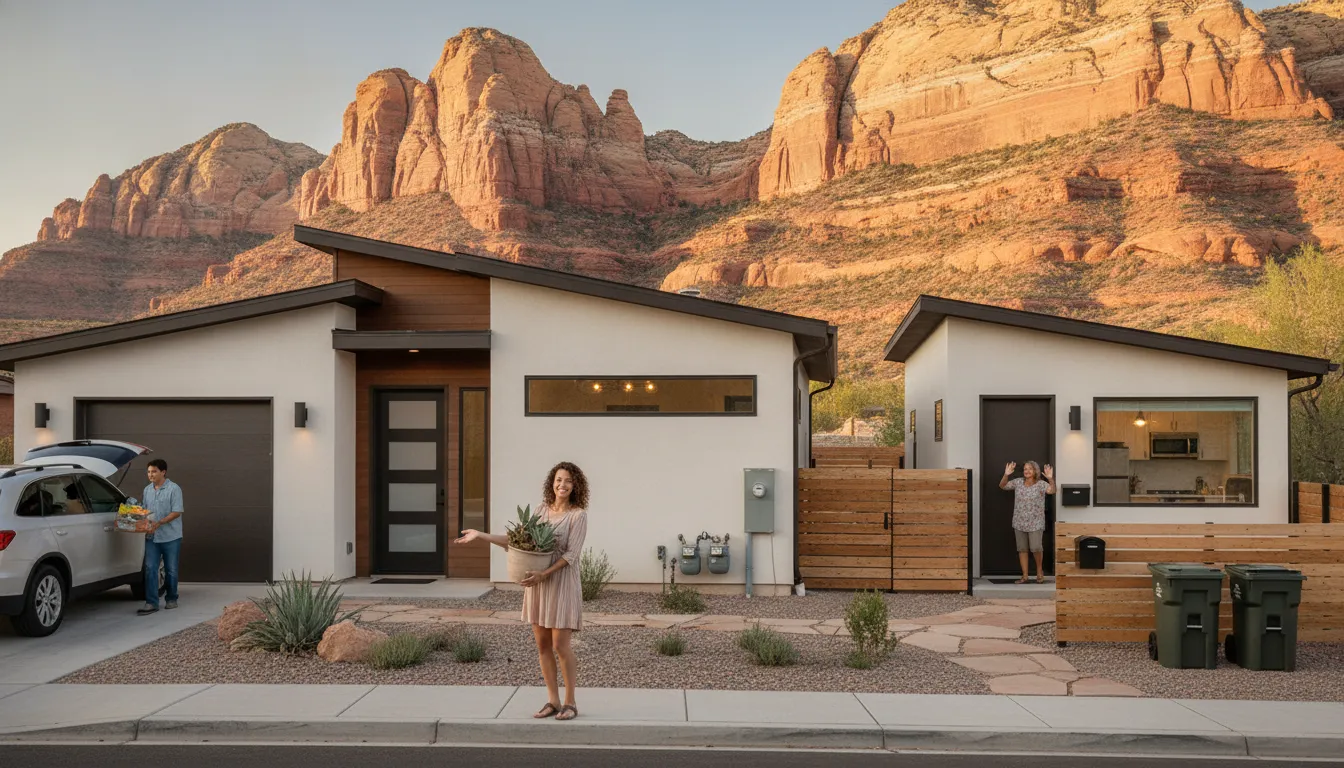
A casita is generally a smaller, self-contained living area that is attached to or located near the primary residence. The most functional house-hacking casitas typically include several of the following:
A separate exterior entrance
A lockable interior connection to the main residence
A bedroom or sleeping area
A private bathroom
A kitchenette or kitchen
Laundry facilities or dedicated laundry access
Independent climate control
An attached one-bedroom apartment with its own entrance, kitchenette, bathroom, and laundry creates substantially more independence than a conventional guest room. It can work for a long-term tenant, an adult family member, a caregiver, or guests who need a more private arrangement.
Potential Benefits of House Hacking
Lower effective housing costs: Rental income may offset a portion of the mortgage and other ownership expenses.
Access to a better home: Income from a separate unit may help a buyer consider homes with more desirable features than a standard budget would otherwise support.
Flexible future use: A suite can shift from rental space to guest quarters, a home office, or family housing as circumstances change.
Privacy for all occupants: Exterior access and separation from the main home can reduce day-to-day friction.
House Hacking Requires Careful Due Diligence
Rental income should never be assumed without confirming the property's legal and practical suitability. Buyers should review local zoning, city regulations, HOA documents, insurance needs, lender requirements, and the home's actual layout before relying on rent to qualify for or sustain a purchase.
Short-term rental rules can be particularly important in Southern Utah. A property that works for a long-term tenant may not be approved or appropriate for vacation-rental use. Buyers considering that route should first review the local considerations covered in St. George vacation rental regulations.
How Multigenerational Living Can Make a Home More Affordable
Multigenerational living occurs when more than one generation of a family shares a home. Common arrangements include parents living with adult children, adult children returning home, or relatives combining resources to purchase a property with enough separation for everyone.
Unlike house hacking, multigenerational living does not depend on rent from an outside tenant. Instead, participating family members may contribute toward the purchase, mortgage, utilities, repairs, or other household expenses.
Why a Separate Suite Matters
A multigenerational arrangement works best when a home supports both connection and independence. A self-contained casita or guest suite can give family members room to maintain routines, rest, prepare food, and receive visitors without turning the primary home into a crowded shared space.
Features that can improve the arrangement include:
A private entrance
A full or partial kitchen
A walk-in shower and private bath
Laundry access
Sound separation from the main living area
Independent heating and cooling zones
Accessible pathways and minimal steps, when mobility is a concern
For retirees relocating to Southern Utah, a private family suite can make it easier to host children and grandchildren for extended visits. For working households, it may offer a practical option for a parent or adult child while helping share the cost of ownership.
Set Expectations Before Combining Households
Shared ownership and shared living arrangements involve financial and personal decisions. Before purchasing, households should discuss how expenses will be handled, who occupies which areas, how long the arrangement is expected to last, and what happens if one contributor needs to move.
Written agreements and appropriate legal, tax, and lending guidance can help families understand ownership interests and avoid misunderstandings later. A home may be emotionally appealing, but the arrangement should also be workable on paper.
What Makes a Casita Property More Useful?
Not every extra room functions as a true second living space. The most valuable layouts provide meaningful separation while still allowing the main home to operate normally.
Private Exterior Access
An exterior entrance can be one of the most important features of a casita. It allows an occupant to come and go without crossing through the main home. This is useful for tenants, relatives with different schedules, and guests staying for long periods.
An interior door that locks between the casita and the main home can provide additional flexibility. The suite may remain connected for family use or separated when privacy is the priority.
A Functional Kitchenette or Kitchen
A kitchenette with a refrigerator, sink, cabinetry, dishwasher, microwave, and cooktop is more practical for long-term use than a simple wet bar. It allows an occupant to prepare meals independently and reduces pressure on the main kitchen.
A guest suite without a cooktop may still be useful for visitors or temporary arrangements, but it may be less suitable for a long-term tenant or a fully independent household member.
Laundry and Climate Separation
Dedicated laundry adds convenience and independence. Separate climate zones can also be important in Southern Utah, where cooling needs can be significant during the hottest months. A suite with its own temperature control is generally easier to manage for different occupant preferences.
Parking and Storage
Extra living space is most useful when parking is sufficient for the additional household member or tenant. An oversized driveway, side parking, gated storage area, and deep garage can be major advantages in Washington County, particularly for households with trailers, RVs, boats, side-by-sides, or multiple vehicles.
Buyers considering a home with recreational storage needs should confirm garage dimensions, door clearance, side-yard access, HOA restrictions, and local parking rules before making assumptions about vehicle or trailer storage.
Evaluating the True Monthly Cost of a House Hack
The goal is not simply to find the highest possible rent. The goal is to understand whether a property makes sense after all recurring expenses are considered.
A practical evaluation should include:
Mortgage principal and interest: Estimate the monthly payment based on the proposed loan terms.
Property taxes and insurance: Include these costs rather than focusing on principal and interest alone.
HOA dues: Review current dues and the community rules that accompany them.
Utilities: Consider water, power, internet, trash, and any separate metering or climate zones.
Maintenance reserve: Larger homes, multiple HVAC systems, extra plumbing, and extensive outdoor hardscape can increase long-term upkeep.
Conservative income estimate: Do not rely on a best-case rental scenario. Account for vacancies, turnover, repairs, and any management costs.
Financing treatment: A lender may have specific rules about whether and how projected rental income can be used for loan qualification.
A buyer may also want to compare several ownership scenarios: no rental income, long-term rental income, family contribution, and guest-suite use only. If the home works only under the most optimistic rental assumption, it may carry more risk than the buyer intends to take.
Large Garages Can Add More Than Vehicle Space
In Southern Utah, a large garage is often a high-priority feature rather than a luxury. Many households need space for full-size trucks, off-road equipment, trailers, camper vans, boats, tools, or hobby storage. A deep garage with taller doors can be difficult to find, especially in homes that also offer a casita and substantial main living area.
When comparing properties, buyers should look beyond the advertised number of garage bays. Useful questions include:
Are the bays wide enough for full-size vehicles?
Is the garage deep enough for trucks, a boat, or a lift?
What is the height of the garage door?
Is there side-yard access for trailers or RVs?
Are there utility sinks, water connections, or storage areas?
Are HOA rules compatible with the intended parking and storage use?
A property with a large garage and separate living space may better meet the needs of a relocation household than a larger home with limited storage. This is one reason buyers should evaluate the full functionality of the lot, not just bedroom count and interior square footage.
Common Mistakes When Buying a Home With a Casita
Assuming the Suite Can Always Be Rented
Separate access and a kitchenette do not automatically mean a suite can be rented in every way a buyer may envision. Local rules, deed restrictions, HOA policies, permits, and financing requirements can all affect use. Verification should happen before an offer is written, not after closing.
Overestimating Rental Income
Households should use conservative assumptions. The unit may be vacant between tenants, require repairs, or have utility costs that reduce the benefit of rent. Income should be treated as a helpful offset, not a guarantee.
Ignoring Privacy and Shared Access
A suite may look separate in listing photos but still require occupants to cross through shared living areas, use the same laundry, or share parking. A property should be toured with daily routines in mind.
Choosing Space Over Long-Term Suitability
A large home can be appealing, but buyers should consider cooling, maintenance, landscaping, insurance, and future mobility needs. A well-designed one-bedroom casita may be more useful than a larger but poorly separated extra bedroom wing.
Skipping HOA and Utility Review
HOAs can regulate parking, exterior changes, rental activity, and storage. Buyers should also determine whether the property has separate utility systems, water softeners, multiple HVAC units, or other features that may affect operating costs. Buyers weighing HOA-governed communities may also want to understand where HOA fees actually go before assuming a casita arrangement will be approved.
Who May Benefit Most From This Strategy?
House hacking and multigenerational living are not limited to one type of buyer. They can be especially relevant for:
Relocating retirees who want a private guest suite for visiting relatives or future care needs
Adult children and parents combining resources for a home with personal space for each household
Remote workers who want a separate office, guest space, or potential rental suite
Buyers with recreational equipment who need oversized garages and secure side parking
Investors who plan to occupy the home while using a portion of it to help offset ownership costs
Families needing flexible space for college-age children, caregivers, or long-term guests
Buyers weighing a move should compare the needs of the household today with likely needs several years ahead. A home that can shift from rental suite to family quarters may be more resilient than a property designed for only one life stage. New arrivals to the state may also find it useful to review this new homeowner's guide to settling into Utah alongside the house-hacking research.
Next Steps for Southern Utah Buyers
The strongest opportunities are often homes that solve several problems at once: a comfortable primary residence, a private casita, usable parking, outdoor privacy, and a layout that can adapt as household needs change.
Before pursuing a house-hacking or multigenerational property, buyers should build a realistic budget, verify allowable uses, inspect the separation between spaces, and evaluate the costs of operating a larger home. Careful planning can help a household purchase a property that delivers more flexibility without relying on unrealistic income assumptions.
Current listings, neighborhood information, and Utah housing resources are available through Best Utah Real Estate. Buyers considering the Washington and St. George area may also benefit from comparing the lifestyle tradeoffs outlined in St. George versus Hurricane and reviewing the cost of living in St. George before setting a final home budget.
Frequently asked questions
What is house hacking when buying a home in St. George?
Can a casita be used for multigenerational living in Southern Utah?
Can rental income from a casita help me qualify for a mortgage?
What should I verify before renting out part of a St. George home?
Is an attached casita better than a detached guest house?
How much does a home with a casita typically cost compared to a standard home in St. George?
St George, Utah housing market
A quick read on what homes are doing in St George right now — pulled live from the MLS.
Keep reading
More from the blog

Why People Are Moving to St. George, Utah in 2026

Moving to St. George Utah: Where to Live and What to Check
Pecan Valley Resort vs. Desert Color: St. George Rental Guide