Best Chef's Knife: Victorinox vs. Wüsthof vs. MAC vs. Mercer
The best chef's knife for your hand: Victorinox Fibrox Pro vs. Wüsthof Classic, MAC MTH-80 and Mercer, plus German vs. Japanese style, steel and care.
Nearly every chef's knife is sharp out of the box, and every one eventually dulls. What separates the knife you reach for every night from one that stays in the block is how it feels in your hand: weight, balance, where the handle meets the blade and how much room it leaves for your knuckles.
This guide covers the 8-inch chef's knives that stand out, from the budget workhorses restaurant kitchens rely on to premium German and Japanese knives. It also explains German vs. Japanese style, steel hardness, edge angle and handle fit, and settles Victorinox vs. Wüsthof.
As an Amazon Associate, Best Utah Real Estate earns from qualifying purchases.
Quick verdict
- Best value overall: the Victorinox Fibrox Pro 8 in Chef's Knife. Light, grippy, very sharp from the factory and comfortable for almost any hand.
- Best budget knife with more heft: the Mercer Renaissance 8 in Forged Chef's Knife, a forged blade that keeps up with the Victorinox and weighs about 2 ounces more.
- Best German-style knife: the Wüsthof Classic 8 in Chef's Knife, with a well-proportioned blade and a handle that is neither too thick nor too thin.
- Best Japanese-style knife: the MAC MTH-80 8 in Chef's Knife, light and agile with a profile that rocks and push-cuts equally well.
- Also worth a look: the Dalstrong Shogun 8 in Chef's Knife for very hard steel at a mid-range price, and the Misen 8 in Chef's Knife for a comfortable pinch grip on a budget.
The knives side by side
| Knife | Shop | Style | Weight and feel | Steel | Value tier |
|---|---|---|---|---|---|
| Victorinox Fibrox Pro 8 in Chef's Knife |  Buy on Amazon | Western, stamped | About 6 oz; very light | Soft (about 56 Rockwell); dulls sooner, resharpens fast | Budget |
| Mercer Renaissance 8 in Forged Chef's Knife |  Buy on Amazon | Western, forged | About 8 oz; more heft | Forged stainless | Budget |
| Misen 8 in Chef's Knife |  Buy on Amazon | Hybrid profile | Slim blade; curved bolster | Stainless | Budget to mid |
| Dalstrong Shogun 8 in Chef's Knife |  Buy on Amazon | Hybrid profile | Wide heel, thin tip | Among the hardest; holds an edge well | Mid |
| Wüsthof Classic 8 in Chef's Knife |  Buy on Amazon | German, forged, full bolster | Solid, balanced | Harder than Victorinox (58 Rockwell) | Premium |
| MAC MTH-80 8 in Chef's Knife |  Buy on Amazon | Japanese-Western blend | Light and agile; 4.5 in handle | Hard Japanese steel | Premium |
German vs. Japanese chef's knives
German-style knives such as the Wüsthof Classic and Zwilling Professional S have a forged blade, a curved belly made for rocking, and usually a bolster: the thick collar of steel where the blade meets the handle. They are heavier, and their softer steel flexes rather than chips and takes a new edge quickly, but it dulls sooner.
Japanese-style knives such as the MAC and Shun Classic use harder steel, thinner blades and a flatter edge. They feel nimble and stay sharp longer, but very hard blades like the Shun Classic can chip on bones and frozen food.
What steel hardness means
Hardness is measured on the Rockwell scale. Among popular 8-inch chef's knives, the Henckels Solution, Wüsthof Gourmet and Victorinox knives have the softest steel; Victorinox's sits around 56. Dalstrong Shogun, Cangshan's X-7 steel lines and the Cangshan Thomas Keller knife are among the hardest. In general, harder steel holds its sharpness longer and softer steel is more durable and less likely to chip.
Edge angle matters less than the factory finish
A narrower edge angle, around 12 or 13 degrees, can make a knife feel sharper. Among good budget chef's knives, edge angles run from 13 to 16 degrees, and some at the wider end are still among the sharpest. The Victorinox is one of them. Its edge angle sits at the wide end of that range, but its factory edge is ground and honed so smoothly and evenly that it glides through a tomato. A rougher factory edge has to be forced through, squashing the tomato.
How to choose a chef's knife
Blade length
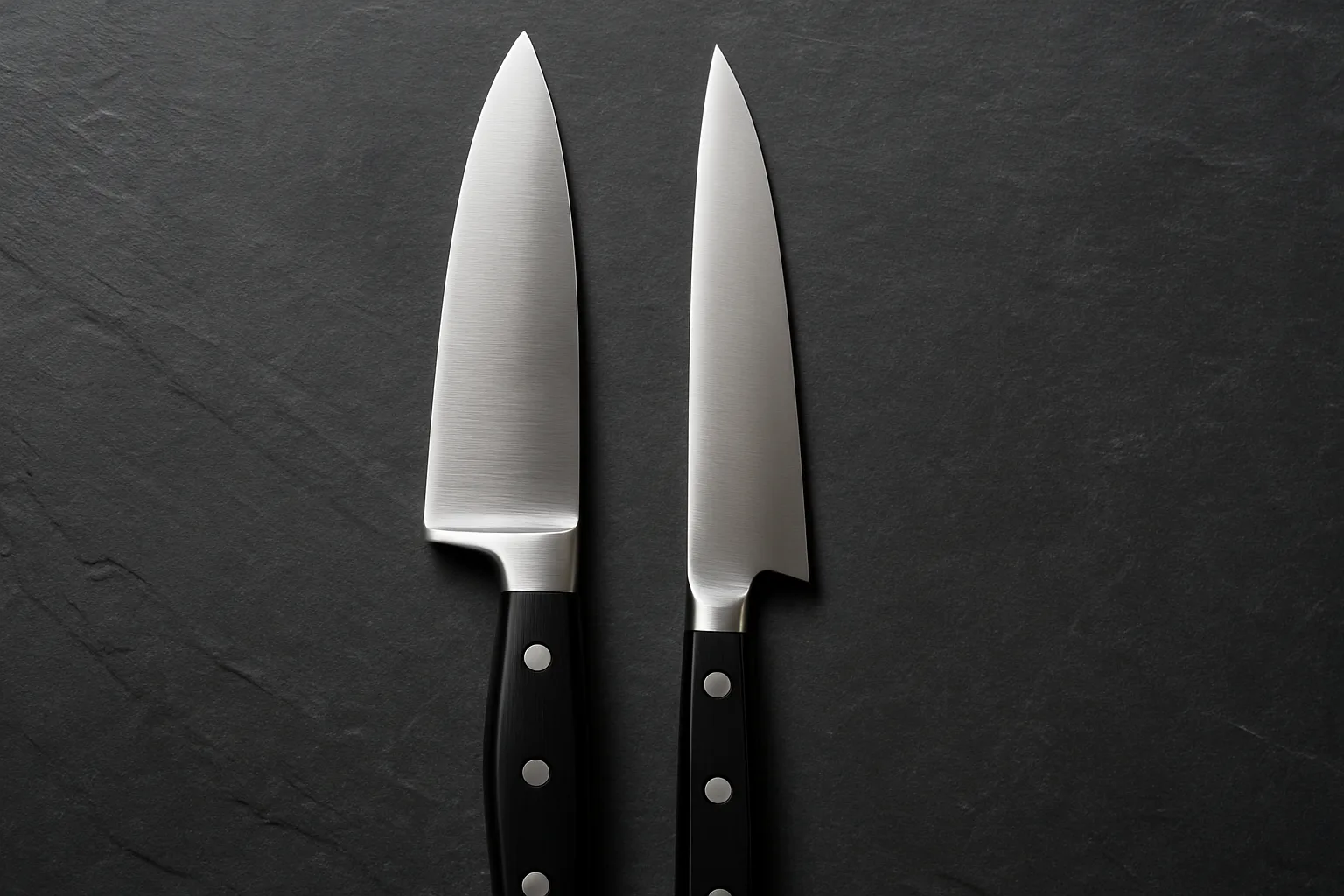
Eight inches is the most useful length for home cooks. It handles a whole chicken, a butternut squash and a pile of herbs without feeling unwieldy. A 7-inch knife like the Cangshan Yari suits vegetable and fish prep but is less suited to dense ingredients and rocking.
Blade height and knuckle clearance
Look for about 2 inches of height at the heel so your knuckles clear the board. Very slim blades like the HexClad, at 1.7 inches from spine to heel, are agile but leave little room. Wide blades like the Cangshan Helena, at 2.2 inches, scoop well but weigh more. A blade that is thicker at the heel and tapers toward the tip gives authority on tough cuts and finesse at the point.
Handle comfort and the pinch grip
Most good cooks hold a chef's knife with a pinch grip, thumb and forefinger on the blade just ahead of the handle. That makes the spine, the choil (the unsharpened notch at the heel) and the edges of the bolster matter. Thin stamped blades and sharp choils dig into the hand. The Zwilling Pro's sloped bolster is about as comfortable as a pinch grip gets, though its high tip makes fine tip work awkward. A rounded spine and a grippy handle that stays put when wet also help.
Weight and balance
Light knives like the Victorinox, under about 6 ounces, are easy to use for long stretches without fatigue. Heavier knives like the Lamson Premier Forged, at 9.6 ounces, can still feel natural when the weight is spread evenly, while blade-heavy knives feel clumsy when chopping up and down.
Victorinox vs. Wüsthof
Both are good knives that suit different cooks. The Victorinox Fibrox Pro is stamped from a sheet of steel, light at about 6 ounces and softer at about 56 Rockwell. It dulls sooner, but it comes back to sharp quickly on a stone or pull-through sharpener and shrugs off rough use. That's why it's a favorite in restaurant kitchens.
The Wüsthof Classic is forged, with a full bolster and a full tang. Its steel is harder, at 58 Rockwell, so it keeps a fine edge longer between sharpenings, but it needs more care around hard ingredients. The knock is the premium price, since cheaper forged knives use similar materials. Choose the Victorinox for lots of chopping, light hands and the lowest cost per year. Choose the Wüsthof for a heavier, classic German feel and an edge that lasts longer between sharpenings.
The picks in detail
Victorinox Fibrox Pro 8 in Chef's Knife
The Fibrox Pro's blade is well proportioned, with plenty of knuckle clearance at the heel, a gentle curve for rocking, and a factory edge that is smooth and very sharp. The textured handle suits most hand sizes and stays secure when wet. At about 6 ounces, it is one of the lightest chef's knives you can buy, easing long prep sessions. The downsides are softer steel that needs sharpening more often and a plain look.
Victorinox Fibrox Pro 8 in Chef's KnifeCheck today’s price on Amazon

 Buy on Amazon →
Mercer Renaissance 8 in Forged Chef's Knife
The Mercer Renaissance is the budget pick for cooks who find the Victorinox too light. It is forged and weighs about 8 ounces, and it matches the Victorinox for sharpness.
Mercer Renaissance 8 in Forged Chef's KnifeCheck today’s price on Amazon

 Buy on Amazon →
Wüsthof Classic 8 in Chef's Knife
The Wüsthof Classic is the benchmark German chef's knife. Its handle is slightly flatter side to side than the similar Zwilling Professional S, with a gentler curve at the butt, and the bolster edges are smoother, so it is kinder to the fingers in a pinch grip. The blade is neither too wide nor too narrow. The Wüsthof Classic Ikon has the same blade with a tapered bolster and longer handle, but its balance point sits about an inch behind the blade. The cheaper Wüsthof Gourmet has a thin stamped blade and softer steel that dulls faster.
Wüsthof Classic 8 in Chef's KnifeCheck today’s price on Amazon

 Buy on Amazon →
MAC MTH-80 8 in Chef's Knife
The MAC MTH-80 is light, agile and comfortable, and its blade profile is a balance between Western and Japanese designs. It has enough curve for rock chopping but is flatter than most Western knives, so more of the edge meets the board for clean push cuts through onions and herbs. The main complaint is the handle: at 4.5 inches it is shorter than the usual 5 inches, which can feel cramped in large hands.
MAC MTH-80 8 in Chef's KnifeCheck today’s price on Amazon

 Buy on Amazon →
Two more worth considering
The Dalstrong Shogun has a well-sized handle, a gently sloped bolster and a heel close to the handle for control. Its blade is wide at the heel and tapers to a thin tip, and its very hard steel holds an edge well. The Misen has a slim blade with a slight curve, straighter than a traditional German profile, and a curved bolster that gives the hand a comfortable resting spot. Its squared handle end can dig in if you hold it far back.
Knives to skip: the Henckels Solution (blade-heavy, dulls quickly, sharp choil), the Caraway (thin stamped blade, flat plastic handle), the Dalstrong Phantom (pointed choil) and the Zwilling Four Star (bulky handle, sharp bolster edges).
Honing vs. sharpening
Honing and sharpening are different jobs. A honing rod pushes a slightly rolled edge back into line without removing much metal; a few strokes before cooking keep a knife feeling sharp for longer. Sharpening grinds away steel to form a new edge, and every knife needs it eventually. Softer knives like the Victorinox need it more often but sharpen quickly; harder knives need it less often. This guide to the best knife sharpeners compares honing steels, electric sharpeners and whetstones.
Buying a whole block instead? This guide to whether knife sets are worth it covers which sets hold up and the three-knife alternative.
How to care for a chef's knife
- Hand wash and dry it right away. The dishwasher dulls edges and damages handles, especially wood.
- Use a wood or plastic cutting board. Glass, stone and ceramic blunt an edge fast.
- Keep hard steel off bones and frozen food. Japanese-style blades can chip; use a cleaver or a softer knife for those jobs.
- Store it protected. A block, magnetic strip or blade guard keeps the edge from banging around loose in a drawer. A clear drawer layout helps too; see these kitchen cabinet organizers.
Who should buy which
- First real chef's knife, or a cook who preps a lot: the Victorinox Fibrox Pro.
- Budget buyer who likes some weight: the Mercer Renaissance.
- Rock-chopper who wants a classic heavy knife that lasts: the Wüsthof Classic.
- Cook who wants a light, precise blade and keeps knives off bones: the MAC MTH-80.
- Edge retention at a mid-range price: the Dalstrong Shogun.
- Comfortable pinch grip on a budget: the Misen.
Fit is personal, so hold a couple before committing if you can. For more kitchen gear, see this comparison of KitchenAid Classic vs. Artisan vs. Artisan Plus stand mixers.
Posted by Kristopher Larson
Frequently asked questions
What is the best chef's knife for most home cooks?
The Victorinox Fibrox Pro 8 in Chef's Knife is the best value for most kitchens. It is light, very sharp from the factory, has a grippy handle that stays secure when wet, and leaves plenty of knuckle room. Cooks who want more weight can step up to a forged knife like the Mercer Renaissance or the Wüsthof Classic.
Is Wüsthof better than Victorinox?
Neither is better for everyone. Wüsthof Classic uses harder steel (58 Rockwell) and a forged, bolstered blade, so it holds an edge longer and feels heavier. Victorinox is lighter, softer at about 56 Rockwell, and costs far less; it dulls sooner but resharpens quickly. Pick Wüsthof for heft and edge life, Victorinox for value and easy upkeep.
Are Japanese chef's knives better than German knives?
They are built for different priorities. Japanese-style knives like the MAC MTH-80 are lighter, thinner and harder, so they stay sharp longer and make clean push cuts, but hard steel can chip on bones or frozen food. German-style knives are heavier and tougher, with a curved belly for rocking and steel that takes a new edge easily.
What size chef's knife should I get?
An 8-inch blade is the most useful size for home cooking. It is long enough for a whole chicken or a butternut squash and still easy to control. Look for about 2 inches of blade height at the heel so your knuckles clear the cutting board.
How often should I hone or sharpen a chef's knife?
Hone often, sharpen occasionally. A few strokes on a honing rod before cooking straighten a rolled edge without removing much metal. Sharpening removes steel to form a new edge and is needed only when honing no longer brings the knife back. Softer steel like Victorinox's needs sharpening more often than harder steel.
Can I put a chef's knife in the dishwasher?
It's best not to. Dishwasher heat, detergent and contact with other utensils dull the edge and can damage the handle, especially wood. Hand wash the knife, dry it right away, and cut on a wood or plastic board rather than glass or stone.
Keep reading
More from the blog
How to Turn Your Garage Into a Home Gym or Personal Training Studio: Flooring, Racks and Local Rules
How to Turn a Spare Room Into a Home Podcast Studio: Mic, Interface and Acoustic Treatment
Home Dog Grooming Setup: Shernbao vs Shelandy Dryers and the Right Table