Best Knife Sharpener: Honing Steel vs. Electric vs. Whetstone
Honing steel vs. sharpener, electric vs. whetstone: how each method works, how sharp it gets a knife, and the right pick for every home cook.
A sharp knife is the safer knife. It cuts with less pressure, so it is less likely to skid off a tomato skin or an onion and into a finger. Honing rods, pull-through sharpeners, electric machines, rolling sharpeners, belt grinders and whetstones all promise a keen edge, but they differ a lot in speed, mess and the skill they ask for.
Here is honing vs. sharpening, then each option from easiest to most skilled.
As an Amazon Associate, Best Utah Real Estate earns from qualifying purchases.
Quick verdict
- Best for most home cooks: the Chef'sChoice 15XV Electric Knife Sharpener. Three stages take a dull knife back to very sharp in minutes, with no angle to hold.
- Best manual sharpener: the Chef'sChoice Pronto 463 Manual Knife Sharpener, a drawer-sized pick with diamond wheels and deep guide slots.
- Best for weekly upkeep: the Kramer by Zwilling 12-Inch Double-Cut Honing Steel. Honing keeps a good edge cutting well much longer between sharpenings.
- Best results, if you will practice: a whetstone or a dual-grit diamond plate. The cleanest edges on any knife, with a real learning curve.
Knife sharpener types compared
| Option | Shop | What it does | Skill needed | Speed | Downsides |
|---|---|---|---|---|---|
| Kramer by Zwilling 12-Inch Double-Cut Honing Steel |  Buy on Amazon | Realigns the edge; removes no metal | Low | Seconds | Cannot fix a truly dull knife |
| Chef'sChoice Pronto 463 Manual Knife Sharpener | 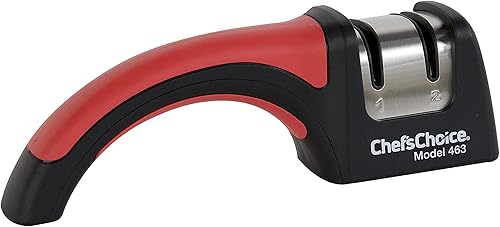 Buy on Amazon | Sharpens in a coarse slot, polishes in a fine slot | Very low | Fast | Fixed angle; less effective on very dull blades |
| Chef'sChoice 15XV Electric Knife Sharpener | 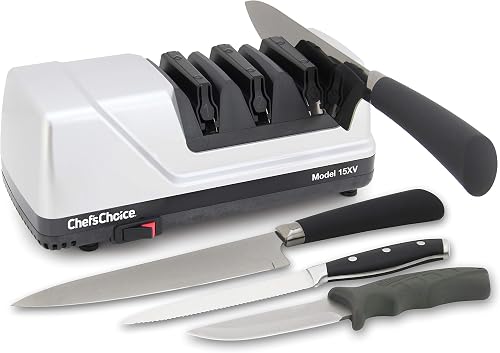 Buy on Amazon | Two diamond grinding stages plus a polishing stage | Low | Fastest | Loud; edge hidden in the slot; takes counter or cabinet space |
| Rolling sharpener | Diamond disc rolled along a magnetized knife | Low | Slow on dull knives | Can miss the tip and heel; better ones cost more | |
| Electric belt sharpener | Moving abrasive belt against an angle guide | Moderate | Fast | Loud; throws fine metal dust | |
| Fixed-angle system | Clamped knife, stone moved on a guide rod | Moderate | Slowest | Fiddly setup; cheap ones flex | |
| Whetstone or diamond plate | Freehand grinding on a flat stone | High | Fast once learned | Practice, water and slurry cleanup |
Honing vs. sharpening: which does your knife need?
Honing and sharpening fix different problems. A knife's very edge is thin metal, and hitting a board, a bone or frozen food rolls it to one side or flattens it slightly. The knife feels dull though the edge is still there. A honing rod pushes it back into line. It removes no metal and takes seconds. The surface you cut on matters too: a knife-friendly cutting board slows how fast the edge rolls in the first place.
Sharpening grinds away steel to form a new edge, needed once honing stops working or the edge has a nick.
Signs a knife is dull: you push harder than you should, tomatoes dent before the skin breaks, or the blade slides off an onion. The simplest check: hold up a sheet of printer paper and draw the knife down through it from heel to tip. A sharp edge glides through cleanly and quietly along its whole length; a dull one snags, tears and rasps.
Hone first. If the paper still snags after a few strokes on the rod, sharpen.
How sharp each method gets a knife
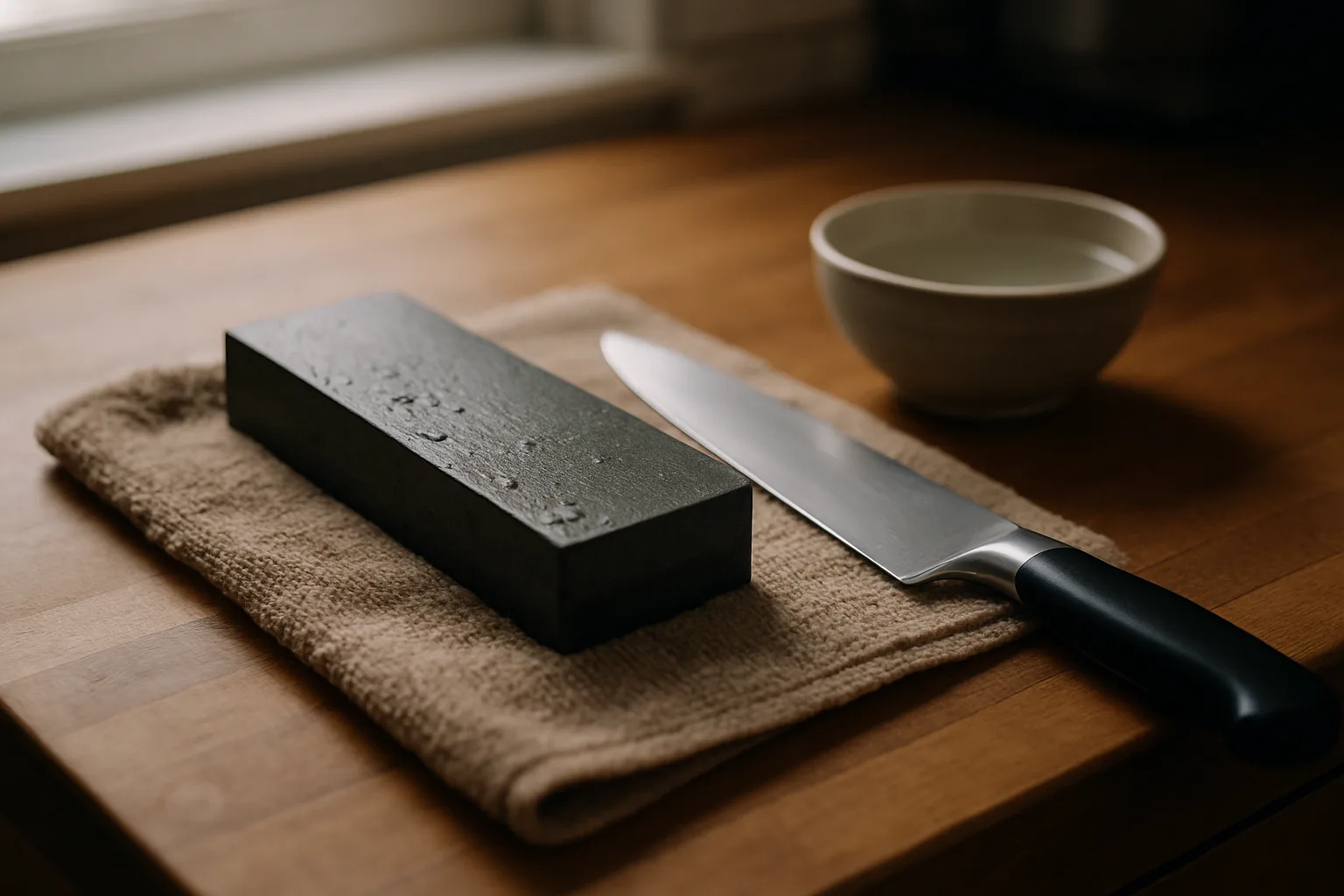
Edge sharpness can be measured as the grams of pressure a blade needs to cut through a thin calibrated wire. Lower is sharper. A reading above 400 means the knife still needs work, around 300 is sharp, and around 200 is very sharp. Here is how dulled knives came out with each method:
- Electric pull-through: a budget knife went from 924 to 173 in a handful of passes, and a harder-steel knife from 598 to 184. A softer Western-style knife needed a second round and finished at 144. All three then sliced tomatoes and paper cleanly.
- Whetstone: the budget knife went from over 1,000 to around 200, the softer knife from over 900 to 266, and the harder knife from 460 to 250. Tomato and pepper cuts were cleaner than from most other methods.
- Electric belt: 489 to 229 on the budget knife and 543 to 160 on the harder one. The softer knife reached 219 after a second round.
- Manual pull-through (fixed slots): 708 to 415, 753 to 439, and 700 to 318. A second round barely helped, and the harder knife got slightly worse.
- Rolling sharpener: the softer knife reached about 300 and the harder knife got sharper still, but the budget knife barely improved after more than six minutes and still tore paper.
In short, an electric pull-through gets close to whetstone results with almost no skill; a manual pull-through is for touch-ups.
The picks in detail
Kramer by Zwilling 12-Inch Double-Cut Honing Steel
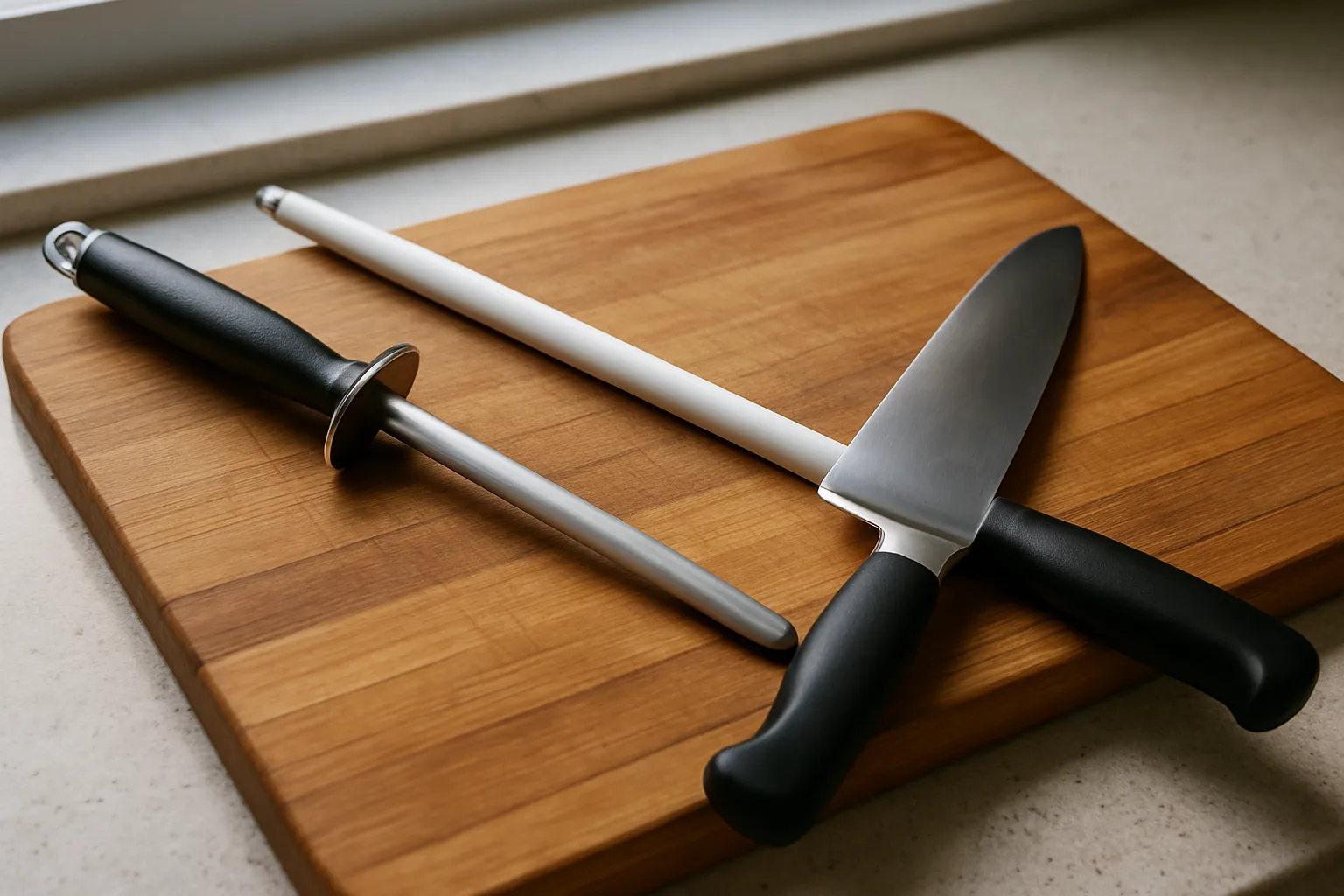
A honing steel is the first tool to own, because it extends the time between sharpenings. The Kramer rod is stainless steel with a double-cut surface, meaning two textures on one rod, which makes it more effective than single-texture rods. A ceramic Idahone rod is a good lower-cost pick with a single texture. Skip rough diamond-coated "sharpening steels"; they chew up an edge.
Skip the in-the-air flourish. Lay a folded towel on the cutting board and stand the rod upright with its tip on the towel so it cannot slip. Keep the rod still and move only the knife. Hold the blade at roughly 15 degrees: picture 90 degrees straight out from the rod, halve it to 45, halve again to about 22, then tip a bit lower. Draw the knife down and across from heel to tip, then repeat on the other side for a few strokes. About ten seconds of honing can make a knife that snagged on paper cut it noticeably cleaner.
Kramer by Zwilling 12-Inch Double-Cut Honing SteelCheck today’s price on AmazonBuy on Amazon →
Chef'sChoice Pronto 463 Manual Knife Sharpener
Manual pull-throughs are the easiest way to sharpen: no power, no setup, no angle to hold. Fixed V-shaped carbide or ceramic slots scrape the edge and can take off too much metal or scratch a blade under heavy pressure; rotating diamond wheels feel smoother and more controlled.
The Pronto 463 uses the wheel style. It has a coarse slot that reshapes the edge and a fine slot that polishes it, with two diamond-coated wheels in each, and the listing describes a 15-degree straight-edge angle. Deep slots keep the knife at the right angle and let the full blade reach the wheels, and it is sturdily built. It leaves a clean, polished edge for touch-ups, though no manual pull-through matches an electric machine or a stone on a knife that has gone very dull. For travel, the light AccuSharp 15-degree carbide sharpener packs easily.
Chef'sChoice Pronto 463 Manual Knife SharpenerCheck today’s price on Amazon

 Buy on Amazon →
Chef'sChoice 15XV Electric Knife Sharpener
For cooks who want sharp knives with the least time and effort, an electric sharpener does the work. The 15XV is a long-running favorite in this category and keeps beating newer machines. It has three sets of slots. Stage one is coarse diamond, stage two is finer diamond, and stage three is a stropping disc that polishes the edge and also works as a hone, so a knife that only needs a touch-up starts there. The listing describes 100% diamond abrasives and a 15-degree edge.
It can also grind past a small nick, a job that usually means mailing a knife to a professional. Knives sharpened on it can hold their own against a factory-new edge. It is about the size of a small bread loaf.
Read the manual and follow it every time. The pressure, the number of pulls and the speed through each slot all matter, and a knife shoved through carelessly will not come out right. Any electric pull-through is loud and hides the edge inside the slot, and too much pressure or too many passes removes extra metal. A thick bolster can keep the edge nearest the handle from reaching the wheels. Cheap powered pull-throughs with poor abrasives clog and wear out fast, so build quality matters.
Chef'sChoice 15XV Electric Knife SharpenerCheck today’s price on Amazon

 Buy on Amazon →
Whetstones and freehand sharpening
A whetstone is the simplest tool and the hardest to master. Nothing holds the angle; the cook does. The reward is flexibility: any knife, any shape, any size, any angle, and the cleanest edges of any method. Once learned, it is also one of the fastest methods.
Some stones soak until water beads on the surface; splash-and-go stones such as Shapton's need only a splash. The basic stroke: set the knife on the stone, tilt it up to the edge angle you want (15 to 20 degrees for most kitchen knives), rest your fingertips over the section being sharpened, and press lightly, about five pounds, in one direction only, easing off on the return. Work down the blade, then switch sides. A wobbling wrist sharpens unevenly, and expect slurry to rinse off afterward.
For beginners, a dual-grit plated diamond plate is easier to learn on than the cheap soak-type combination stones sold in starter kits, which are soft, messy and need precise angle control. A coarse side around 320 grit handles a knife that is duller than it looks, a fine side around 1200 grit refines it, and a leather strop with fine diamond compound finishes the edge. Whetstones suit cooks who enjoy learning their tools.
Rolling, belt and fixed-angle sharpeners
- Rolling sharpeners: the knife sticks to a magnetic angle block, edge up, and a diamond disc rolls along it, with a finer side for finishing. Easy and gentle, but slow on very dull knives. The roller can miss the curved tip, a handle can block about an inch of the heel, and the hand rolls near an exposed edge. Some discs wear out after a handful of knives; the good ones are expensive.
- Electric belt sharpeners: a moving belt sharpens fast and well. The popular Work Sharp model has two angles (20 and 25 degrees), suits right-handers, is loud and throws fine metal dust: a garage tool.
- Fixed-angle systems: the knife is clamped and a stone slides on a guide rod at a set angle. Cheaper ones flex, and all take time to set up.
Safety and care
- Hone often; sharpen only when honing stops helping, since sharpening removes steel.
- Anchor a honing rod on a towel and move only the knife.
- On any pull-through, use light, even pressure and the number of passes the manual gives.
- Store sharp knives in a block or on a magnetic strip, not loose in a drawer.
- Hard cutting surfaces, bones and frozen food bend an edge faster, so hone more often after that kind of work.
A sharpener only helps a knife worth keeping sharp. For blade picks, see the guide to the best chef's knife, and for building a kitchen kit, the comparison of a knife set vs. three good knives.
Who should buy which
- Everyone with a good knife: the Kramer by Zwilling honing steel, used weekly or before each cooking session.
- Fast, sharp results with no learning curve: the Chef'sChoice 15XV electric sharpener.
- Small kitchens and occasional touch-ups: the Chef'sChoice Pronto 463 manual sharpener, which fits in a drawer.
- Knife enthusiasts: a whetstone or dual-grit diamond plate plus a strop, and the patience to practice.
- Quiet sharpening with time to spare: a well-made rolling sharpener, used before knives get very dull.
Posted by Kristopher Larson
Frequently asked questions
What is the best knife sharpener for home cooks?
For most home cooks, an electric pull-through sharpener such as the Chef'sChoice 15XV is the best choice. It brings a dull knife back to very sharp in a few minutes with no angle to hold. Cooks willing to practice can get even cleaner edges on a whetstone, and a manual pull-through like the Chef'sChoice Pronto 463 suits small kitchens and quick touch-ups.
What is the difference between a honing steel and a knife sharpener?
A honing steel straightens an edge that has rolled or bent to one side; it removes no metal. A sharpener grinds away a thin layer of steel to make a new edge. Hone often, and sharpen only when honing no longer brings the knife back or the edge has a nick.
Is an electric sharpener or a whetstone better?
Both can produce a very sharp edge. A whetstone gives the cleanest results and works on any knife at any angle, but it takes practice to hold a steady angle and makes a wet mess. An electric sharpener is faster and needs almost no skill, though it is loud, hides the edge in the slot and can remove extra metal if pushed too hard. Choose the whetstone if you enjoy the craft and the electric if you just want sharp knives.
How often should you sharpen a kitchen knife?
Sharpen when honing stops working. Signs include pushing harder than usual, tomatoes that dent before the skin breaks, or a blade that slides off an onion. A paper check helps: a sharp knife slices printer paper cleanly from heel to tip, while a dull one snags and tears. Honing between sharpenings stretches the time between them.
Do electric knife sharpeners ruin knives?
Not when used correctly. The Chef'sChoice 15XV, run through its slots the way its manual directs, takes off no more metal than other methods. Problems come from pressing too hard, making too many passes or using cheap machines whose abrasives wear out or clog. Knives with a thick bolster may not get sharpened right up to the handle.
Are rolling knife sharpeners worth it?
Rolling sharpeners are easy to use and gentle, and the magnetic block holds a steady angle. They are slow on very dull knives, can miss the tip and the heel near the handle, and quality varies widely, with the better ones priced at the premium end. For speed and a full-length edge, an electric pull-through is usually the better buy.
Keep reading
More from the blog
Best Cutting Board for Knives: Teakhaus vs Epicurean vs Larch Wood
Best Electric Gooseneck Kettle: OXO vs Cosori vs Bodum
Best Toaster: Is a Smeg Worth It? Smeg vs KitchenAid vs Dash