Are Knife Sets Worth It? Martha Stewart Block vs. Mercer and Victorinox
Is a knife block set worth it? Which set holds an edge and resists rust, and the three-knife build (Mercer chef, Victorinox paring, Mercer bread) to buy.
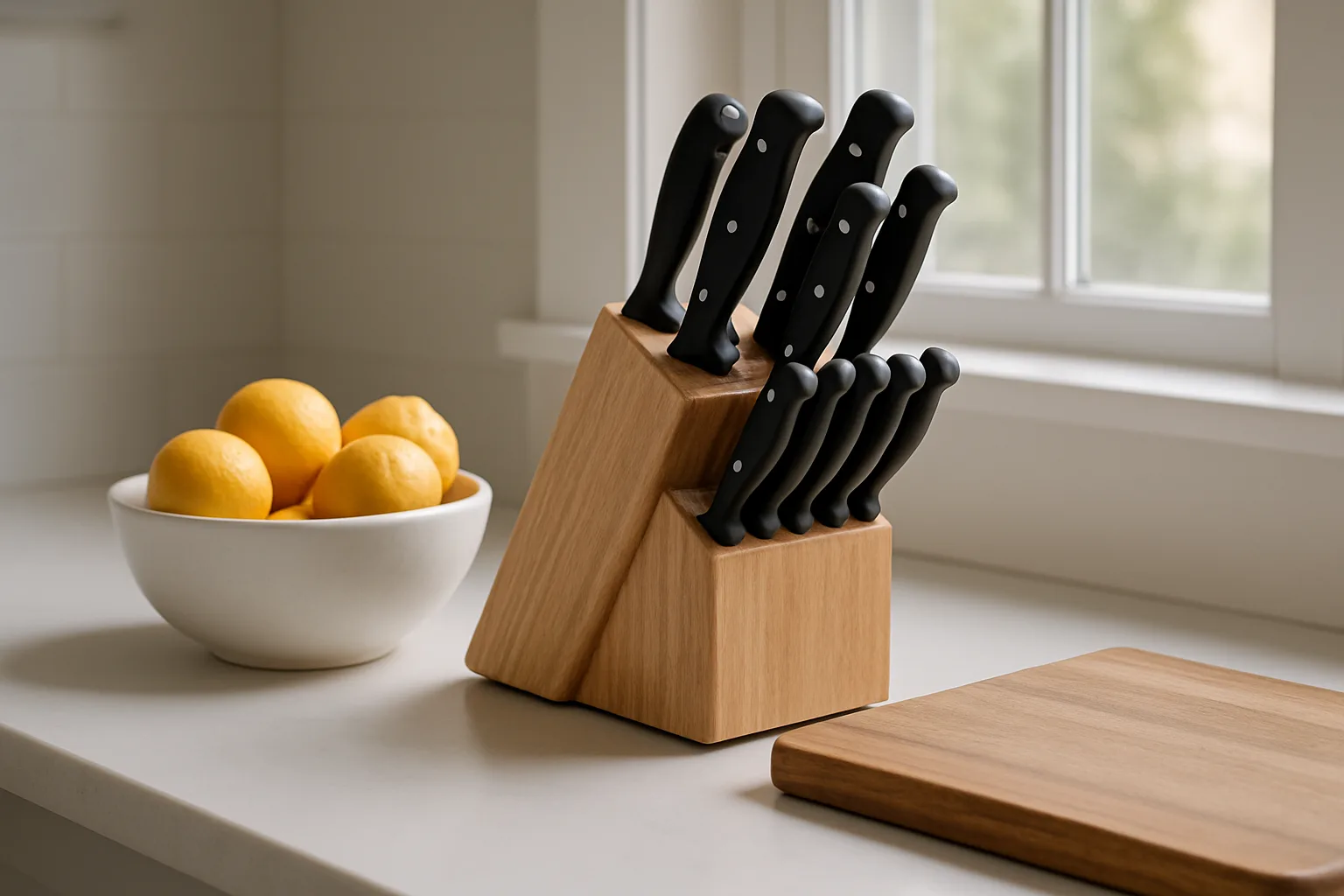
A knife block set looks like the sensible way to stock a kitchen: one box, a dozen or more matching knives and a block to keep them on the counter. The problem is that piece counts are a sales tool. Most of the knives in a typical block go unused, a few of them are worse than the knives you actually reach for, and the bread knife is often too short to do its one job well.
Here is whether a knife set is worth it, which set holds up if you still want one, and how to build a better kitchen from three knives bought one at a time.
As an Amazon Associate, Best Utah Real Estate earns from qualifying purchases.
Quick verdict
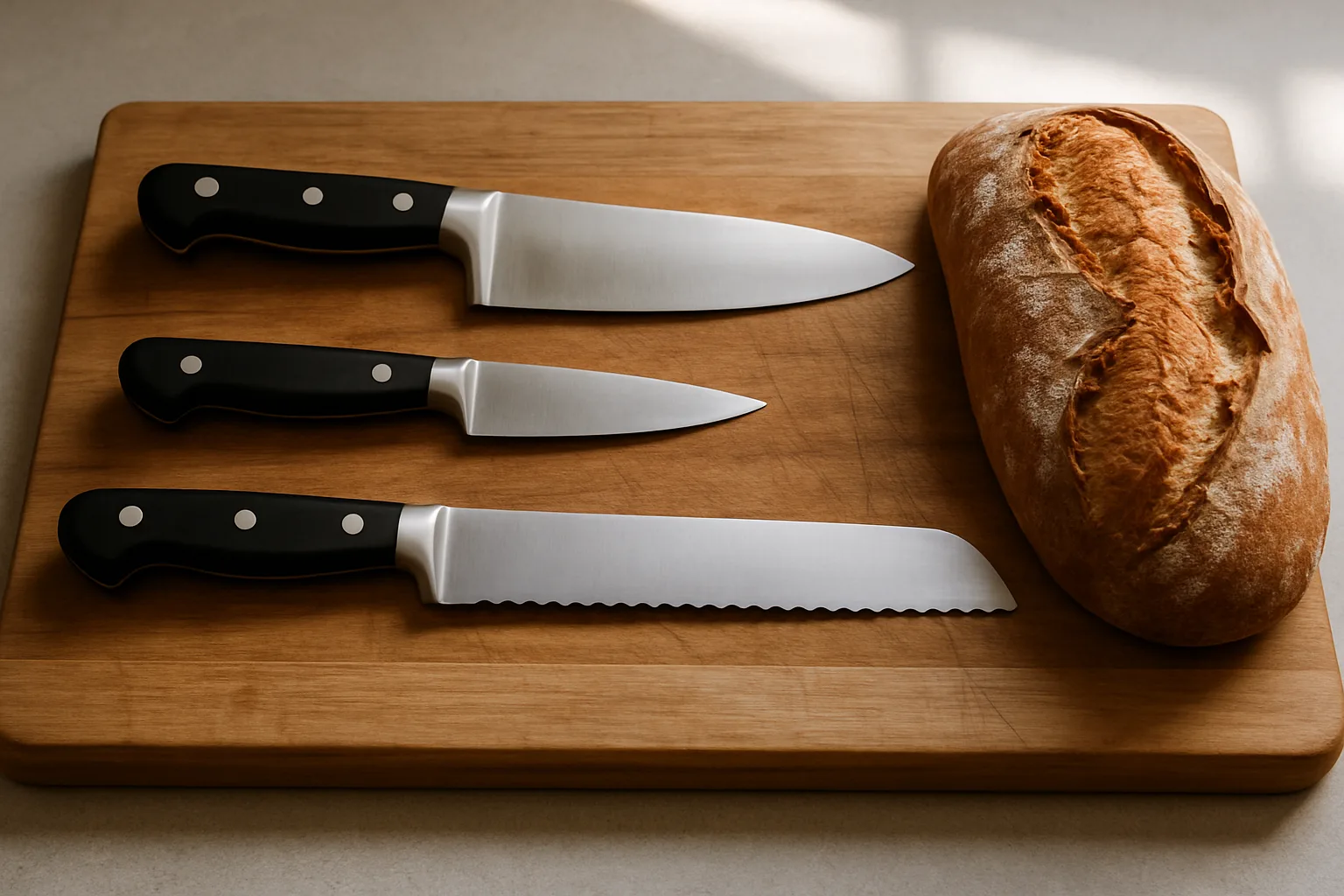
- For most kitchens, skip the block and buy three knives: the Mercer Culinary Millennia 8-Inch Chef's Knife (M22608), the Victorinox Swiss Classic 4-Inch Paring Knife and the Mercer Culinary Millennia 10-Inch Wide Bread Knife (M23210). Together they cover nearly every cutting job.
- If you want a full block on a budget: the Martha Stewart Eastwalk 14-Piece Knife Block Set. Its knives hold an edge better than most low-cost sets and resist rust well, as long as they are washed by hand.
- Money no object: Wüsthof's block sets have the sharpest factory chef's knife of the popular sets and the best all-round results. Global's Osaka set keeps its edge longest, but it rusts easily and its handle is uncomfortable for many hands.
Are knife block sets worth it?
Usually not, for reasons that have little to do with brand.
- Sets are built to a piece count, not to a kitchen. Retailers want the most pieces at a set price, so manufacturers fill the slots with small, cheap knives. The block itself counts as one of the pieces, and so do the shears and the honing steel.
- The bread knife is too short. Most block bread knives run 8 or 9 inches because a longer blade won't fit the slot, and shorter blades use less steel. A bread knife works best with a blade of at least 10 inches.
- The paring knife is often the wrong shape. Many set paring knives are too wide or too long for work held in the hand, such as peeling an apple or hulling a strawberry.
- The utility knife duplicates the chef's knife. It sits between the paring knife and the chef's knife in size, and on nearly every job the chef's knife does better. Most of the other extras simply go unused.
- Matching handles slow you down. Finding the right blade means pulling several out.
The good news in most sets is the 8-inch chef's knife, which generally performs fine. Now and then a set includes a useful boning knife or good shears. Everything else is filler.
Popular knife block sets side by side
Sharpness below is given on a common edge-sharpness scale: the downward force it takes the edge to cut through a standard medium. Lower numbers are sharper. A new double-edge razor blade lands around 50 to 75, a utility-knife blade around 150 to 200, and a butter knife near 2,000. Edge retention is the paring knife's score after 100 weighted passes across a very hard piece of Osage orange wood.
| Set | Shop | Pieces | Chef's knife, new | Paring edge, new → after wear | Rust resistance | Care |
|---|---|---|---|---|---|---|
| Martha Stewart Eastwalk 14-Piece Knife Block Set |  Buy on Amazon | 14 | 165 | 175 → 195 | Best of the group, no visible rust | Hand wash |
| Wüsthof block set | Varies | 130 (sharpest) | Not listed | A few rust spots | Not listed | |
| Global Osaka 6-Piece Bamboo Block Set | 6 | 135 | 180 → 180 (no loss) | Rusted badly (high-carbon steel) | Hand wash and dry | |
| Zwilling 6-piece set | 6 | 140 | 165 → 180 | Best of the group, no visible rust | Brand lists it as dishwasher safe | |
| Farberware 14-knife set | Buy on Amazon
| 14 knives plus extras | 605 | 400 → 440 | Rusted within an hour | Not meant to be sharpened |
What the numbers show
Factory sharpness is not the same as good steel. Once the paring knives were sharpened to roughly the same edge, around 110 to 115, every one of them, budget knives included, was sharper than any knife in the group when new. The difference showed up afterward: how fast that edge wore down. One low-cost set went from 110 to 315 after 100 passes across a cutting board. The Martha Stewart rose only to 155 and the Global only to 125.
Hard steel holds an edge but pays for it elsewhere. Global's knives are made in Japan, and the brand rates them at 56 to 58 on the Rockwell hardness scale. The paring knife lost nothing on the hard wood and had the sharpest santoku of any set, at 125. But high-carbon steel rusts: after a mild spray of hydrogen peroxide, vinegar and salt, the Global and another high-carbon Japanese set rusted heavily, while the Martha Stewart and Zwilling showed none. Global's handle is also among the least comfortable of the group.
"Never needs sharpening" is a red flag. Farberware's set makes that claim, yet its new paring knife scored 400 and its chef's knife 605, far duller than the rest. A knife that can't be sharpened is a knife you replace.
Thin tips bend. Dropped point-first onto metal from 50 inches, the heavier paring knives from Wüsthof and other German-style sets came through with minor damage. Several thinner budget blades, the Martha Stewart among them, bent badly at the tip. Protect the points in storage.
The three-knife build
A chef's knife, a paring knife and a serrated bread knife cover almost everything a home kitchen does. Cleavers, nakiri, boning and slicing knives are extras to add later if a job calls for one.
| Knife | Shop | Blade | What it handles | Why this one |
|---|---|---|---|---|
| Mercer Culinary Millennia 8-Inch Chef's Knife (M22608) |  Buy on Amazon | 8 in, Western-style curved blade | Chopping, dicing onions, mincing herbs and garlic, breaking down a chicken or a squash | Sharp, well-shaped blade and a grippy non-slip handle at a budget price |
| Victorinox Swiss Classic 4-Inch Paring Knife |  Buy on Amazon | About 4 in, thin and flexible | Peeling, hulling, coring, trimming, slicing cheese | Short and light for control in the hand; slim handle |
| Mercer Culinary Millennia 10-Inch Wide Bread Knife (M23210) | 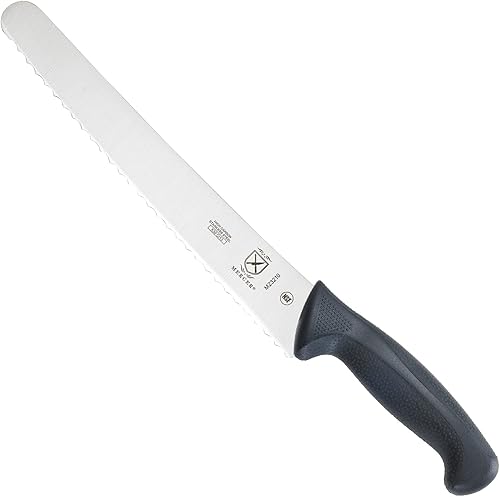 Buy on Amazon | 10 in, wide, deep serrations | Crusty bread, tomato skins, layered bars and cakes, chopping chocolate | Fewer, deeper teeth bite harder; long enough for wide loaves |
Mercer Culinary Millennia 8-Inch Chef's Knife (M22608)
The chef's knife does most of the work in any kitchen, which makes it the one knife worth thinking hardest about. The Millennia is a Western-style knife with a gently curved, triangular blade that rocks well for mincing. Its sharp edge and comfortable non-slip handle put it ahead of knives costing many times more.
The trade-off is feel. The blade is thick and the knife is on the heavy, chunky side, which helps when slicing through meat and fat but can tire the hand during long prep sessions. For everyday cooking it is a dependable workhorse; for long prep sessions, the chef's knife is the one place to spend more. The best chef's knife guide compares the upgrade options.
Mercer Culinary Millennia 8-Inch Chef's Knife (M22608)Check today’s price on Amazon

 Buy on Amazon →
Victorinox Swiss Classic 4-Inch Paring Knife
Paring knives are used off the board as often as on it, so lighter and shorter is better. The Victorinox blade runs about 4 inches, shorter than many paring knives, which makes it easier to steer around an apple or the core of a tomato. The blade is sharp and slightly flexible, and the slim handle sits in the fingers rather than filling the palm.
Victorinox Swiss Classic 4-Inch Paring KnifeCheck today’s price on Amazon

 Buy on Amazon →
Mercer Culinary Millennia 10-Inch Wide Bread Knife (M23210)
A good serrated knife has fewer, deeper and wider teeth, which bite into a hard crust instead of skating across it. The Millennia bread knife gets all three right and adds a grippy handle. At 10 inches it is longer than the bread knife in most blocks, so it handles a wide loaf with room to spare. The same teeth handle tomato skins, layered bars and chopped chocolate.


If you still want a block: Martha Stewart Eastwalk 14-Piece
A matching block makes sense as a gift or for a first kitchen. Among the low-cost sets, the Martha Stewart is the one that performed above its price. The knives are forged high-carbon stainless steel with full-tang, triple-riveted handles, and they are noticeably heavier than the cheapest sets: the paring knife weighs 63 grams and the chef's knife 203 grams.
The chef's knife and santoku both arrived at 165, among the sharpest budget edges. The paring knife lost just 20 points on hard wood, from 175 to 195, while several similarly priced sets lost 70 or more. It showed no visible rust when others rusted at the edge. The weak points: the thin paring-knife tip bent badly when dropped, and the knives need hand washing to stay rust-free. The block includes an 8-inch chef's knife and a 7-inch santoku. As with any block, expect a shorter bread knife than a dedicated 10-inch one.
Martha Stewart Eastwalk 14-Piece Knife Block SetCheck today’s price on Amazon

 Buy on Amazon →
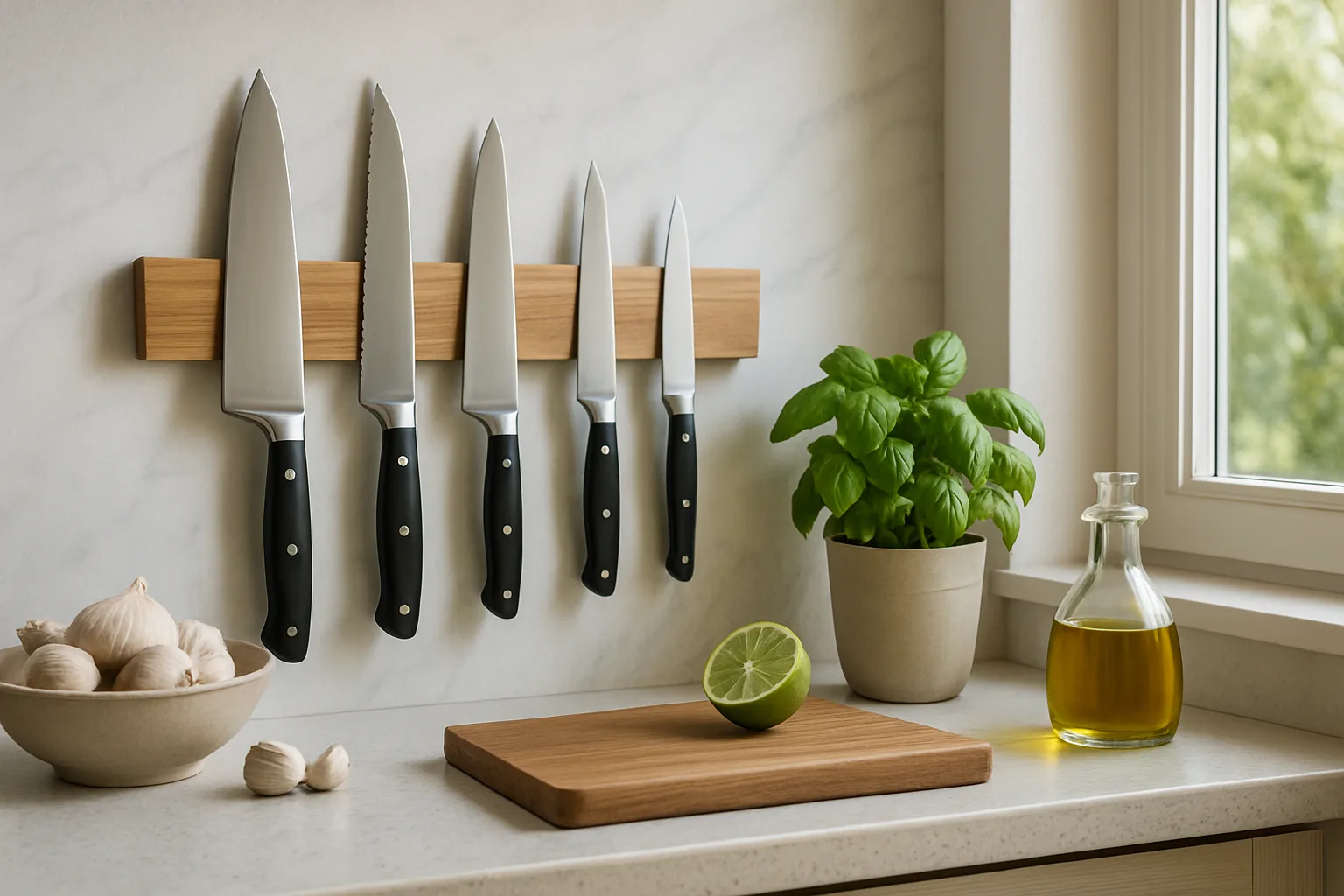
Storing knives without the set's block
The block is the one real convenience a set offers. Without it, the goals are the same: reach a knife without grabbing a blade, and keep edges from knocking into each other, which dulls them.
- Universal knife block: filled with rods or slots that take any mix of knives.
- Magnetic strip: mounts on the wall or backsplash and keeps knives visible and off the counter. It takes some installing.
- Covers in a drawer: a blade guard, or a free homemade cardboard sleeve, protects both the edge and your fingers. A sheet pan in a drawer keeps uncovered knives from sliding around.
- Dish towel: in a pinch, wrap the blade and secure it with a rubber band.
Short on drawer space? A few kitchen cabinet organizers can free a drawer for knives.
Care that keeps any knife sharp
- No dishwasher. Even knives labeled dishwasher-safe dull faster when they go through it. Wash by hand and dry right away.
- Dry high-carbon blades immediately. They are the ones that rust.
- Sharpen, don't replace. Nearly every set knife here took a sharper edge after sharpening than it had new.
Who should buy which
- Most home cooks: the three-knife build, Mercer chef's, Victorinox paring and Mercer bread knife, plus whatever storage fits the kitchen.
- A gift, a first apartment or a matching counter look: the Martha Stewart Eastwalk 14-Piece set, hand washed.
- Heavy prep and a bigger budget: keep the paring and bread knives and put the money into a better chef's knife.
Posted by Kristopher Larson
Frequently asked questions
Are knife block sets worth it?
For most kitchens, no. Sets are assembled to hit a piece count and a price, so they fill the block with small knives that go unused, a utility knife the chef's knife outperforms, and a bread knife cut short to fit the slot. Three good knives bought one at a time, a chef's knife, a paring knife and a 10-inch serrated bread knife, cover nearly every job for less.
What is the best knife set for the money?
The Martha Stewart Eastwalk 14-Piece Knife Block Set is the standout low-cost block. Its forged high-carbon stainless knives came sharper than most budget sets, lost little edge on hard wood and showed no visible rust, provided they are washed by hand. Its thin paring-knife tip bends if dropped point-first.
Which knives do you actually need in a kitchen?
Three: an 8-inch chef's knife for chopping, dicing and mincing; a paring knife of about 4 inches for peeling, coring and trimming in the hand; and a serrated bread knife of at least 10 inches for crusty loaves, tomatoes and layered desserts. Boning knives, cleavers and slicers are optional extras.
Which knife is worth spending the most on?
The chef's knife, because it does most of the cutting. A budget pick like the Mercer Millennia is sharp and dependable, but it is heavy and chunky, which can tire the hand during long prep. Paring and bread knives can stay inexpensive without much trade-off.
Do Wüsthof and Global sets hold an edge better than cheap sets?
Generally, yes. Wüsthof's set had the sharpest factory chef's knife and the best all-round results, and Global's paring knife kept its edge with no measurable loss after 100 weighted passes on very hard wood. Global's high-carbon steel rusts easily, though, and its handle is uncomfortable for many hands.
How should you store knives without a block?
A universal knife block that takes any mix of knives, a magnetic strip on the wall, or blade covers in a drawer all work. A homemade cardboard sleeve or a dish towel held with a rubber band protects an edge for free. The goal is to keep blades from knocking together, which dulls them, and to reach each knife by the handle. Keep knives out of the dishwasher.
Keep reading
More from the blog
Best Cutting Board for Knives: Teakhaus vs Epicurean vs Larch Wood
Best Electric Gooseneck Kettle: OXO vs Cosori vs Bodum
Best Toaster: Is a Smeg Worth It? Smeg vs KitchenAid vs Dash