Wasatch Fault Earthquake Risk: What Utah Homebuyers Should Check Before Making an Offer
Earthquake risk on the Wasatch Front depends on the soil, the distance to a mapped fault and how the house was built. Here is how to check an address on the state hazards map, recognize an unreinforced brick home, and decide on earthquake insurance.

Short answer: The risk is real, but it differs house by house. A 2016 forecast cited by the Utah Geological Survey gives a 43% chance of at least one magnitude 6.75 or larger earthquake in the Wasatch Front region between 2016 and 2066. Before an offer, look up the address on the free state hazards portal, check whether an older brick home is unreinforced masonry, and price earthquake insurance, which a typical homeowners policy doesn't cover.
That forecast was published in 2016 by the Working Group on Utah Earthquake Probabilities.
For a buyer, that figure says little about one house. Two homes a mile apart can face very different risks depending on the soil beneath them, how close they sit to a mapped fault, and above all when and how they were built. The sections below cover the hazard in plain terms, how to look up an address, how to spot an unreinforced brick house, and how earthquake insurance works in Utah.
What the Forecast Says and What It Does Not
The Wasatch fault runs about 240 miles from Malad City, Idaho, to Fayette, Utah, generally along the base of the Wasatch Range. Geologists divide it into 10 segments that average about 25 miles long, and each is thought to rupture on its own. The five central segments, Brigham City, Weber, Salt Lake City, Provo and Nephi, pass beside most of the state's population, including Ogden, Bountiful, Salt Lake City, Draper and Provo.
Three points keep the 43% figure in proportion:
- It covers a region, not one fault. The same study put the 50-year probability of a magnitude 6.75 or larger earthquake on the Wasatch fault zone itself at 18%. The rest comes from the Great Salt Lake fault zone and dozens of other faults.
- Smaller earthquakes are more likely. The working group estimated a 57% chance of a magnitude 6.0 or larger event and a 93% chance of a magnitude 5.0 or larger event over the same 50 years.
- The Salt Lake City segment is not on a schedule. State earthquake handbook figures give it an average of about 1,300 years between large earthquakes, with the last one about 1,400 years ago.
The March 18, 2020 Magna earthquake showed what a moderate event does. It measured magnitude 5.7, struck at 7:09 a.m., and was the largest earthquake along the Wasatch Front since settlement in 1847, according to the Utah Geological Survey. No deaths were reported. The Utah Division of Emergency Management reports that about 55,000 people lost power and nearly 150 historic buildings were damaged, with the worst damage in Magna. The fault did not break the ground surface, but survey teams found liquefaction along the Jordan River and near Great Salt Lake.
Which Earthquake Hazards Affect a Utah Home?
| Hazard | What it does | Where it matters most | How to check |
|---|---|---|---|
| Ground shaking | The most widespread and usually most damaging effect. Damage can start around magnitude 5.0. | Everywhere along the Wasatch Front. Thick, soft valley soils can amplify it. | Year built and construction type matter more than the map. |
| Surface fault rupture | In earthquakes of about magnitude 6.5 and larger, the ground breaks and offsets, forming a scarp that can be several inches to 20 feet high. Deformation can extend hundreds of feet. | Narrow bands along mapped faults, mainly on the foothill benches. | Surface-fault-rupture special-study zones on the state hazards map. |
| Liquefaction | Loose, water-saturated sandy soil loses strength, so buildings can settle or tilt and the ground can crack or shift sideways. | Near rivers, streams and lake shorelines, and in some old lake and river deposits with shallow groundwater. | Liquefaction layer on the hazards map, then a geotechnical report. |
| Unreinforced masonry | Brick walls with little or no steel can crack, shed bricks or collapse. Chimneys and parapets fail first. | Older neighborhoods. Utah codes have not allowed it since 1975. | Look at the brick pattern, then ask a structural engineer. |
| Landslide and rockfall | Shaking can trigger slope failures and falling rock. | Steep slopes, canyon mouths and hillsides with weak soils. | Landslide layers on the hazards map and the subdivision's geologic report. |
The survey's guidance for buyers stresses that distance from the fault is not the main question, because strong shaking can cause damage many miles away. Hillside lots get their own step-by-step treatment in how to check a Utah hillside home for landslide risk.
How Do You Check a Utah Address for Fault and Liquefaction Risk?
The Utah Geologic Hazards Portal is a free state map. A basic check follows five steps:
- Type the address into the search box and select it from the results.
- Under Earthquake Hazards, turn on the hazardous faults layer and the surface-fault-rupture special-study zones. A shaded zone means the survey recommends a site-specific fault investigation before development there.
- Turn on liquefaction susceptibility. The map rates soil from very low to very high.
- Turn on the landslide layers for any sloped lot.
- Use the report generator to create a PDF of every mapped hazard for the area selected, and keep it with the inspection file.
Two cautions apply. The maps are built for planning at neighborhood scale, not for judging a single lot, and not every hazard has been mapped in every area. A blank map is not a clearance. The survey's page of hazard information for homebuyers and real estate agents adds two more: Utah law does not require real estate agents to verify or disclose geologic hazards, and city approval of a subdivision or building permit does not guarantee safety from them.
Special-study zones are not regulated at the state level. Many cities and counties have adopted ordinances that require a fault investigation and building setbacks inside them, but the survey says use and enforcement vary by city and county. Its fault guidance suggests that buyers of homes built before 1985 check whether the house is within a few hundred feet of a mapped fault. For newer homes, ask the city or county whether a geologic study was done for the lot or subdivision, and read it. On liquefaction, the survey is clear that only a site-specific geotechnical investigation can say what the soil under one house will do.
How to Tell if a House Is Unreinforced Masonry
State and federal emergency planners estimate that more than 140,000 unreinforced masonry buildings, known as URMs, stand along the Wasatch Front, roughly 20% of occupied buildings in the state. They include single-family homes as well as apartments, schools and offices. The state's earthquake handbook, Putting Down Roots in Earthquake Country, says most of the injuries and deaths expected in a large Wasatch fault earthquake are linked to these buildings.
Utah adopted the Uniform Building Code in 1975, which prohibited new URM construction. The handbook also describes a long transitional period from the 1950s to the 1970s when some masonry was reinforced and some was not, so year built is a clue, not proof. The Utah Division of Emergency Management lists signs visible from the sidewalk:
- Header rows. Every five or six rows, a row of bricks is turned so the short ends face out. Those bricks tie two layers of brick together, which means there is no cavity where steel could be.
- Deeply recessed windows set back into the wall, which is more typical of this construction.
- Rows of bolt heads or metal rosettes on the outside wall.
None of these alone settles it. If every row of brick looks the same, the wall may be reinforced, or the brick may be a veneer over a wood frame, which is a different structure. When in doubt, the state's advice is to contact a licensed structural engineer.
What a retrofit involves
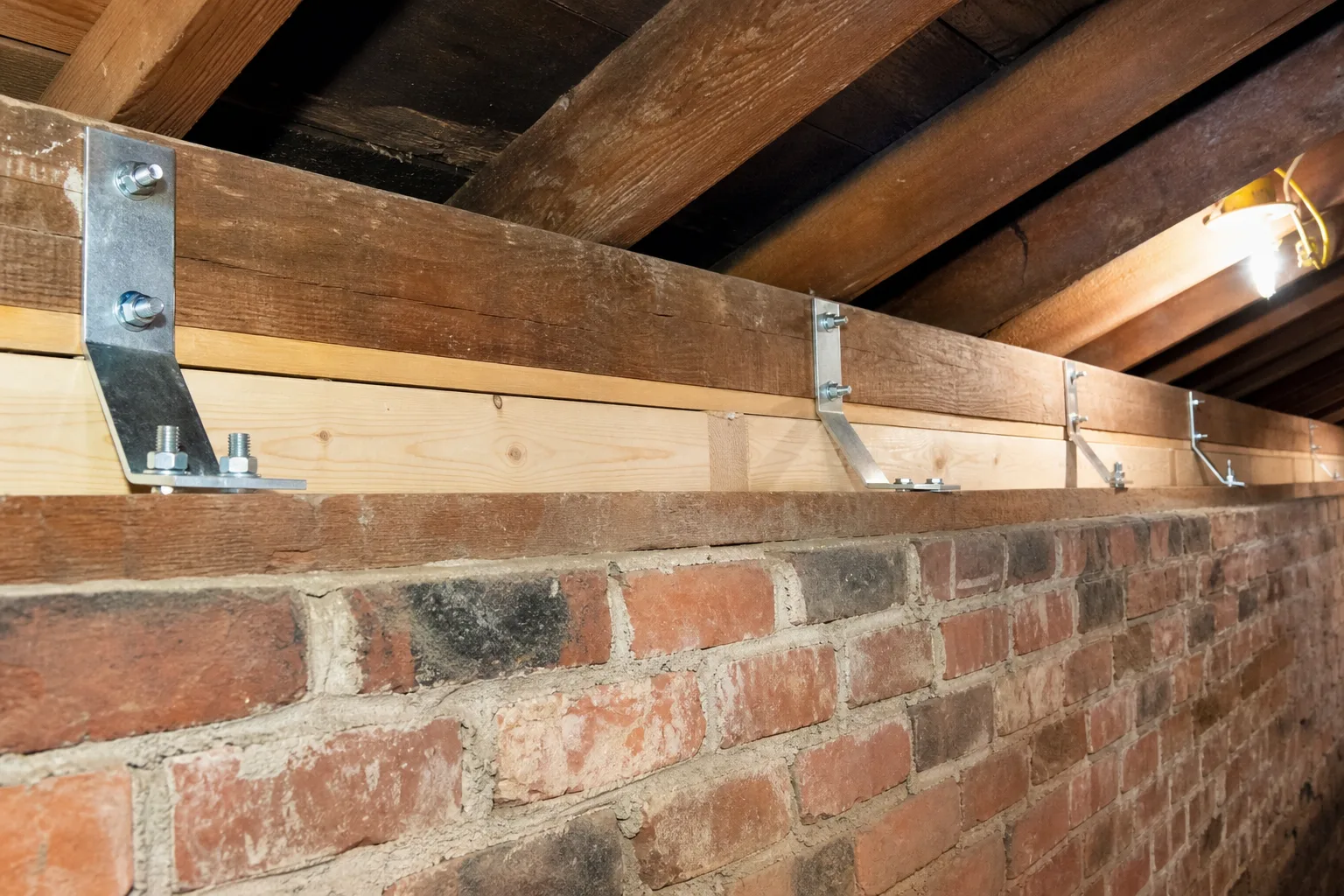
The Utah Seismic Safety Commission publishes the Utah Guide for the Seismic Improvement of Unreinforced Masonry Dwellings, a set of engineer-developed concept plans. Common measures include anchoring the roof and floor framing to the brick walls and bracing chimneys and parapets, the parts most likely to fall. The state and FEMA risk reduction strategy for the Wasatch Front notes that such work improves performance but may not prevent damage.
Salt Lake City's Fix the Bricks program pays for this kind of work on brick homes built before 1975 for low-income owners, with roof-to-wall connections and chimney bracing as the priorities. The city puts the average retrofit at $20,000. As of November 2026 the program is closed to new applications, and the city lists the wait at 10 years or more. A buyer should not count on it. A realistic plan is an engineer's review and a contractor bid during due diligence. The state handbook notes that some retrofits are cost effective when built into a reroofing or remodeling project.
Does Homeowners Insurance Cover Earthquakes in Utah?
The Utah Insurance Department states it plainly: earthquake damage is not covered by a typical homeowners or renters policy. Coverage is bought as an endorsement to a homeowners policy or as a separate policy. The state handbook says fewer than 20% of Utah homeowners carry it. The department's consumer guidance explains the parts that catch people off guard:
- The deductible is a percentage of the coverage limit, not of the loss. In most cases the base deductible is 5%, 10% or 20%. The department's example: a 5% deductible on a $100,000 policy is $5,000 whether the loss is $20,000 or $100,000.
- It can apply separately to the dwelling, personal property and loss of use. Ask whether the policy has one overall deductible or three.
- There is a waiting period, usually 10 to 30 days, before coverage starts.
- Insurers pause sales after an earthquake. Most place a moratorium on new earthquake coverage when there has been a recent quake in the area. It cannot be bought the week it feels urgent.
As an illustration, a 10% deductible on a home insured for $500,000 means the owner pays the first $50,000 of structural damage. Moderate damage may never reach that amount. The coverage is for the severe case, where a house is badly damaged or a total loss.
Owners with most of their net worth in the house, a brick home, or little savings for a rebuild have the most to protect. The department says pricing varies by company and depends on the building's construction, its location and the amount of coverage. Get the quote early in the contract along with the regular policy. Background on premiums is in what Utah buyers should budget for homeowners insurance and Utah's home insurance nonrenewal rate.
What Newer Construction Does Differently
The state handbook describes three periods. Before 1975 Utah had no statewide code requirements. From 1975 to 2000 the Uniform Building Code prohibited unreinforced masonry and required seismic design for all buildings. Since 2001 the International Building Code has applied, with significant changes to seismic design. The handbook cautions that a building from the 1980s is not as seismically safe as one built under current codes.
The handbook's checklist for any house asks whether it is properly connected to the foundation, whether there is plywood on the exterior walls, and whether anchors attach the roof and floors to the walls. The Utah Geological Survey adds that current codes call for a geotechnical investigation where liquefiable soils may lie beneath a building. One honest limit: the survey says building to code means a house is not expected to collapse in the earthquake it was designed for. It may still be badly damaged and need major repair.
Questions for the Inspector and the Seller
- What year was the house built, and are the outside walls solid brick, brick veneer or wood frame?
- Is the house bolted to its foundation, and are the roof and floor framing anchored to the walls?
- Is the chimney braced, lined or cracked? Is the water heater strapped?
- Has any seismic retrofit been done, by whom, and was a permit issued?
- Was a geologic or geotechnical report prepared for the lot or subdivision, and can the seller or the city provide it?
Judging a brick house or a lot inside a special-study zone takes a structural engineer or an engineering geologist, so leave time for that before the due diligence deadline.
Earthquakes are one item on a longer Utah checklist that also includes radon testing and mitigation and, on the foothills, wildfire risk. Current listings in every city named here are on Best Utah Real Estate.
Posted by Kristopher Larson
Frequently asked questions
What is the chance of a major earthquake on the Wasatch Front?
The Working Group on Utah Earthquake Probabilities estimated in 2016 that there is a 43% probability of at least one magnitude 6.75 or larger earthquake in the Wasatch Front region between 2016 and 2066. The probability for the Wasatch fault zone alone is 18%. The same study put the chance of a magnitude 6.0 or larger earthquake at 57%.
Does homeowners insurance cover earthquake damage in Utah?
No. The Utah Insurance Department says earthquake damage is not covered by a typical homeowners or renters policy. Coverage has to be added as an endorsement or bought as a separate policy, and most insurers stop writing new earthquake coverage for a time after a quake in the area.
How do earthquake insurance deductibles work in Utah?
The deductible is a percentage of the coverage limit, not of the loss. The Utah Insurance Department says the base deductible is usually 5%, 10% or 20%, and it often applies separately to the dwelling, personal property and loss of use. There is usually a waiting period of 10 to 30 days before coverage begins.
How can a buyer tell if a Utah house is unreinforced masonry?
Utah codes have not allowed unreinforced masonry since 1975, so older brick homes are the ones to check. The Utah Division of Emergency Management says to look for rows of bricks turned end-out every five or six rows, deeply recessed windows, and rows of bolts or rosettes on exterior walls. No single sign is proof, so a licensed structural engineer should confirm.
How can a buyer check whether a Utah home is near a fault or on liquefiable soil?
The Utah Geological Survey's free Utah Geologic Hazards Portal lets anyone search an address and turn on layers for hazardous faults, surface-fault-rupture special-study zones, liquefaction susceptibility and landslides. The maps are for planning, not for judging a single lot, and some areas are unmapped. A site-specific geotechnical or geologic investigation gives the real answer.
Is Salt Lake City's Fix the Bricks program accepting applications?
As of November 2026, Salt Lake City lists Fix the Bricks as closed to new applications, with a wait of 10 years or more for those on the list. The program funds seismic retrofits for low-income owners of brick homes built before 1975, focusing on roof-to-wall connections and chimney bracing. The city puts the average retrofit cost at $20,000.
Kristopher Larson
Realtor® since 2011 · Licensed in Utah & Nevada · Real Broker, LLC
Kris has sold Utah real estate since 2011 and been part of more than 350 transactions. He writes this site's guides from MLS data and public records, and says where every number comes from.
Keep reading
More from the blog
Taxes on Selling a House in Utah: What Sellers Owe
How Long Do Homes Take to Sell in Utah? Days on Market by City
Utah Short-Term Rental Rules by City in 2026: Check Before You Buy a Home for Airbnb