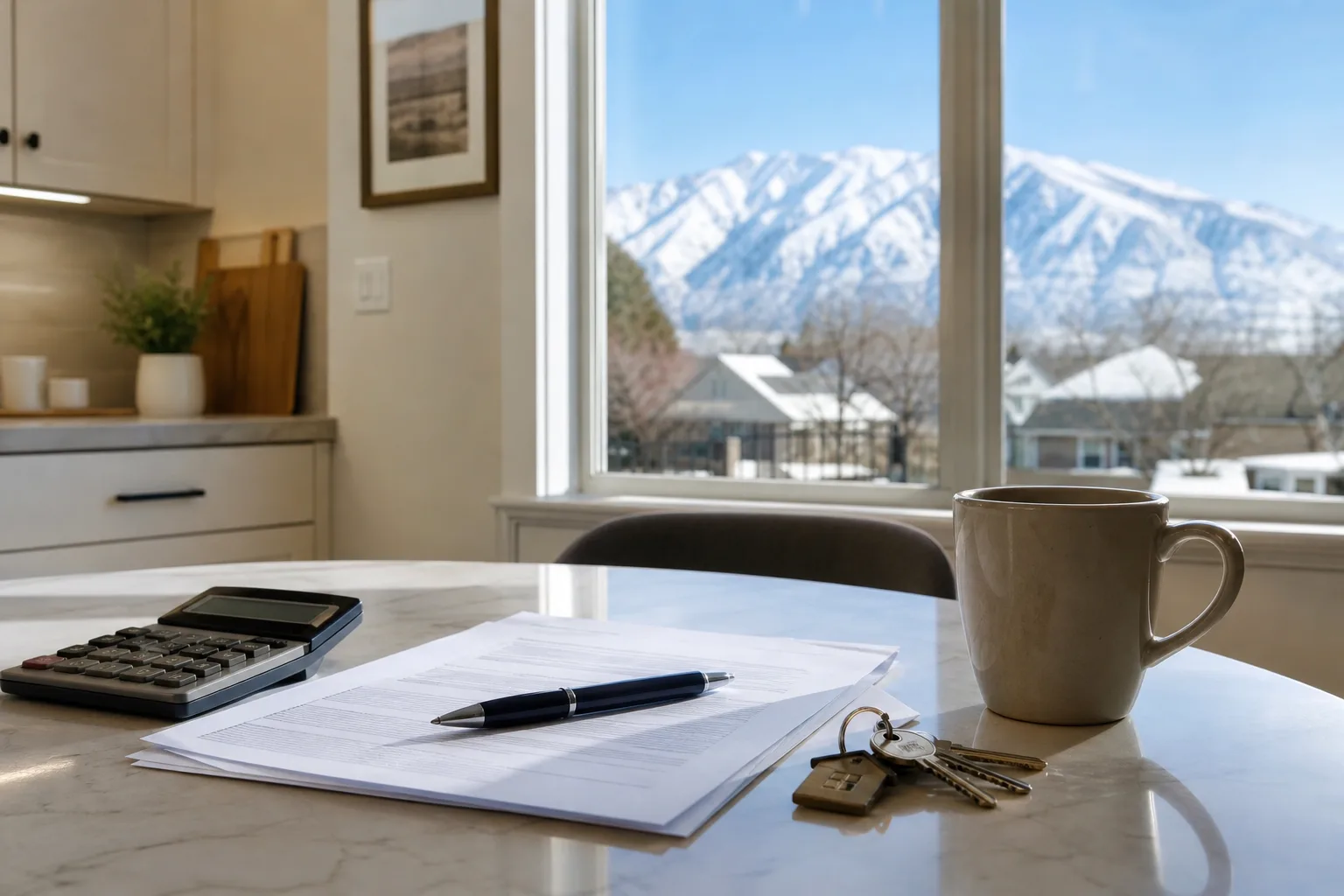
Taxes on Selling a House in Utah: What Sellers Actually Owe
Many Utah sellers owe no tax on their main home. Here's when federal capital gains and Utah income tax apply, with worked examples for a home, a big gain and a rental.

Short answer: if you're selling the home you live in, there's a good chance you owe no tax on the sale. If you owned the home and lived in it for at least two of the last five years, federal law lets you leave out up to $250,000 of profit, or $500,000 for a married couple filing jointly. Utah's income tax starts from your federal income, so profit the IRS leaves out is not taxed by Utah either. Utah has no real estate transfer tax, so there's no state or county tax on the deed changing hands, just the county's small recording fee.
You do owe tax when your profit is bigger than the exclusion, when you didn't live in the home long enough, or when the house was a rental or second home. The rest of this guide walks through each case with real numbers.
What Taxes Will I Pay When I Sell My House in Utah?
| Tax or charge | Does it apply when you sell a Utah home? |
|---|---|
| Federal capital gains tax | Only on profit above the $250,000 / $500,000 exclusion, or on the full profit if the home wasn't your main residence. Long-term rates are 0%, 15% or 20%. |
| Net investment income tax (3.8%) | Only on taxable gain, and only when your income is above $200,000 (single) or $250,000 (married filing jointly). Excluded home-sale profit doesn't count. |
| Depreciation recapture | Rentals and home offices only: depreciation you claimed is taxed at up to 25%. |
| Utah state income tax | Yes, on any gain that is taxable federally. Utah taxes it like the rest of your income at a flat 4.45% for the 2026 tax year. |
| Real estate transfer tax | No. Utah doesn't have one. |
| Estate or inheritance tax | No state estate or inheritance tax in Utah. |
| Property tax | Not a sale tax, but the current year's bill is split between you and the buyer at closing. |
How Utah taxes the gain
Utah doesn't have a separate capital gains tax. Your Utah return starts with your federal adjusted gross income, so a taxable home-sale gain simply becomes part of your Utah income. The state rate is a flat 4.45% for the 2026 tax year (it was 4.5% for 2025). Utah's taxpayer credit phases out as income rises, so the extra Utah tax on a taxable gain is 4.45% of the gain, or slightly more if the gain also shrinks that credit.
Property tax at closing
Utah counties bill property tax once a year, with payment due November 30. Because the bill covers the whole year, the standard Utah purchase contract splits the current year's taxes as of settlement: you pay for the days you owned the home, usually as a credit to the buyer on your settlement statement. Our Utah closing costs guide shows how that proration and the rest of a seller's costs add up, and how Utah sets your assessed value explains the bill itself.
How Do You Avoid Capital Gains Tax on Selling a House?
The main tool is the home sale exclusion in Section 121 of the tax code. To use the full amount you need to pass both tests in the five years before the sale:
- Ownership: you owned the home for at least 24 months.
- Use: you lived in it as your main home for at least 24 months. The months don't have to be in a row.
- Timing: you haven't used the exclusion on another home in the two years before this sale.
If you pass, you can exclude up to $250,000 of gain, or $500,000 on a joint return. Our post on how long you should live in a home before selling covers the two-year timing in more detail.
Other ways to shrink or delay the tax:
- Keep your improvement receipts. The cost of additions and improvements is added to your basis, which lowers your gain. A finished basement, new roof or addition counts; routine repairs generally don't.
- Count your selling costs. Your gain is figured on the amount you actually received after selling expenses like commission and title fees, not the contract price.
- Look at a partial exclusion if you have to sell early because of a job move, a health issue or an unforeseeable event. You may still get part of the exclusion.
- Use a 1031 exchange for rentals. A like-kind exchange defers the tax on business or investment property, not on a home you live in. See whether a 1031 exchange works on a primary residence and what selling an investment property really costs.
- Watch your income in the year you sell. Long-term gains can be taxed at 0% when total taxable income stays under the 0% limit ($49,450 single or $98,900 married filing jointly for the 2026 tax year).
How Much Capital Gains Tax Will I Pay? Three Examples
These are simplified examples to show how the math works. They assume the home was owned more than a year (long-term gain), use 2026 federal brackets and Utah's 4.45% rate, treat 'other income' as taxable income after deductions, and leave out deductions and credits that vary by household. They are not tax advice.
Example 1: Married couple, main home, gain under $500,000
- Bought for $310,000, plus $40,000 of improvements: basis $350,000
- Sold for $725,000, minus $43,500 in selling costs: $681,500 received
- Gain: $681,500 − $350,000 = $331,500
- They lived there more than two years, so up to $500,000 is excluded. Federal tax: $0. Utah tax: $0.
If the title company issues a Form 1099-S, they still report the sale on their return even though no tax is due.
Example 2: Single seller, main home, $300,000 gain
- Gain of $300,000, minus the $250,000 exclusion: $50,000 taxable
- Her other taxable income is $70,000, already above the 0% limit, so the $50,000 is taxed at 15%: $7,500 federal
- Her income stays under $200,000, so no 3.8% net investment income tax
- Utah: $50,000 × 4.45% = $2,225
- Estimated total: about $9,725
If the same $300,000 gain were on a second home she never lived in, none of it would be excluded. At 15% that's $45,000 federal and $13,350 in Utah tax, and with her income now above $200,000 she would also owe about $6,460 or more in 3.8% net investment income tax.
Example 3: Married couple selling a rental
- Bought for $300,000. They claimed $60,000 of depreciation over the years: adjusted basis $240,000
- Received $420,000 after selling costs. Gain: $420,000 − $240,000 = $180,000
- The $60,000 of depreciation is taxed at their ordinary rate, capped at 25%. At their income that's 22%: $13,200
- The other $120,000 is taxed at 15%: $18,000
- Their other taxable income was $120,000, so with the gain it reaches $300,000. The 3.8% tax applies to the $50,000 over $250,000: $1,900
- Utah: $180,000 × 4.45% = $8,010
- Estimated total: about $41,110, unless they defer it with a 1031 exchange into another investment property
Rental owners deciding whether to sell at all may want to read deciding to sell or keep your rental first.
What Is the 6-Year Rule for Capital Gains Tax?
There is no 6-year rule in U.S. tax law. The "six-year rule" comes from Australia, where a former home can keep its main-residence status for up to six years while it's rented out. People often find it online and assume it applies here.
The U.S. rule is the two-out-of-five-year test. It does give you some room: because you only need 24 months of living there within the five years before the sale, you can move out and rent the home for up to about three years and still qualify, though depreciation claimed while it was a rental is taxed. Members of the military and Foreign Service on qualified official duty can pause the five-year clock for up to 10 years.
Selling an Inherited House in Utah
An inherited home usually comes with a "stepped-up" basis: your starting point is the home's fair market value on the date of death, not what the original owner paid. If you sell soon after for about that value, there's often little or no gain. Any gain is treated as long-term no matter how long you held it, and Utah has no inheritance tax. Our guides on what to do first after inheriting a house and when a fast sale makes sense cover the rest.
What If I Sell at a Loss?
A loss on the sale of your own home can't be deducted. It does mean there's no tax on the sale. A loss on a rental or investment property is treated differently, so ask your CPA.
Before You List
Your tax bill starts with your sale price, so it helps to know what the home is likely to sell for. Get a free home value estimate, or look at the market numbers for Salt Lake City and St. George. Check how long homes take to sell in your city if your timing matters for the two-year test, and our Utah seller's guide walks through the full process.
Tax rules change and every household is different. Before you sell, talk to a CPA or tax professional, especially if your gain may be above the exclusion, the home was ever rented, or you're selling after a divorce or death in the family.
Sources: IRS Topic 701 and Publication 523; IRS Rev. Proc. 2025-32 (2026 brackets); Utah S.B. 60 (2026 General Session). Figures are for the 2026 tax year and are updated each January.
Posted by Kristopher Larson
Frequently asked questions
Do you pay taxes when you sell a house in Utah?
Usually not on a main home. If you owned it and lived in it for at least two of the five years before the sale, you can exclude up to $250,000 of profit ($500,000 married filing jointly) from federal income, and Utah follows that because its tax starts from your federal income. Utah has no real estate transfer tax. You'll owe federal and Utah income tax only on profit above the exclusion, or on rentals and second homes.
Does Utah have a capital gains tax?
Not a separate one. A taxable gain is added to your other income and taxed at Utah's flat individual rate, which is 4.45% for the 2026 tax year.
How much capital gains tax will I pay on $300,000?
On a main home you qualify for, a married couple filing jointly pays nothing, and a single seller pays tax only on the $50,000 above the $250,000 exclusion. At the 15% federal rate plus Utah's 4.45%, that's about $9,725. On a rental or second home the full $300,000 is taxable, which can mean about $45,000 federal and $13,350 Utah, plus 3.8% net investment income tax if your income tops $200,000 single.
What is the 6-year rule for capital gains tax?
It isn't a U.S. rule. The six-year rule is part of Australia's tax system. In the U.S. you need to have owned and lived in the home for two of the five years before the sale, which means you can move out and rent it for up to about three years and still qualify for the exclusion.
What if I have to sell before living in my home for two years?
You may still get part of the exclusion if the main reason for the sale was a change in where you work, a health issue or an unforeseeable event. The IRS explains how the reduced amount is figured in Publication 523. Otherwise the gain is taxable, and if you owned the home a year or less it's taxed at ordinary income rates.
Do I have to report the sale if I owe no tax?
If you received a Form 1099-S from the title company, yes. The IRS says you must report the sale on Form 8949 even if you have no taxable gain. If you didn't get a 1099-S and your whole gain is excluded, you generally don't need to report it.
Kristopher Larson
Realtor® since 2011 · Licensed in Utah & Nevada · Real Broker, LLC
Kris has sold Utah real estate since 2011 and been part of more than 350 transactions. He writes this site's guides from MLS data and public records, and says where every number comes from.
Keep reading
More from the blog
Wasatch Fault Earthquake Risk: What Utah Homebuyers Should Check Before Making an Offer
How Long Do Homes Take to Sell in Utah? Days on Market by City
Utah Short-Term Rental Rules by City in 2026: Check Before You Buy a Home for Airbnb