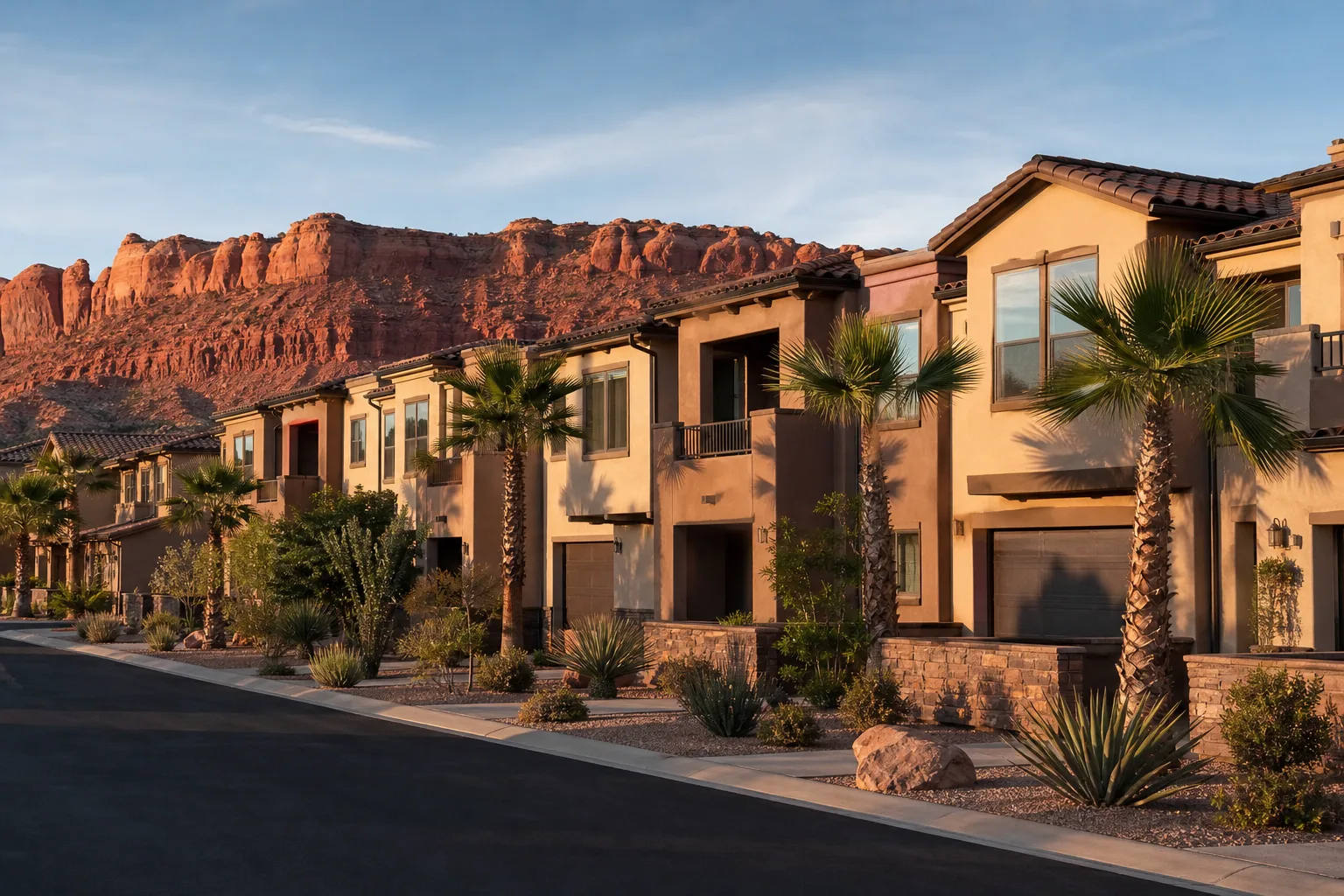
Utah Short-Term Rental Rules by City: What to Check Before Buying a Home for Airbnb or Vrbo
Nightly rental rules change from one Utah city to the next. This 2026 roundup shows where Airbnb and Vrbo rentals are allowed, what licenses are required, and how to verify a specific property before buying.

A home that earns nightly rental income in one Utah city can be an illegal rental two miles away in the next one. Provo's code makes it unlawful to run a short-term rental in any residential zone. Garden City allows them in every zone. Sandy allows them only in a home the owner lives in for at least 183 days a year. A buyer who plans to list a house on Airbnb or Vrbo needs to know which rule applies before writing an offer, not after closing.
This roundup covers the places that could be confirmed from city and county codes, official licensing pages or local news as of November 2026. Ordinances change often, and several of these were amended in 2025 or 2026, so treat the table as a starting point and confirm with the city or county before buying.
This article is general information, not legal advice. Ordinances change; verify current rules with the city or county.
What State Law Does and Does Not Do
Utah does not have a statewide right to operate a nightly rental. Zoning is local. What the state does limit is how cities enforce their rules. Utah Code 10-8-85.4 defines a short-term rental as a residential unit offered for fewer than 30 consecutive days and says a city may not:
- enact or enforce an ordinance that prohibits a person from listing or offering a short-term rental on a rental website, or
- use an ordinance against renting to fine, charge or prosecute someone solely for the act of listing.
The Legislature amended the section in 2025 through HB 256. Before that, the last change was in 2021. The current text says a city that regulates short-term rentals may use a listing as evidence that a rental took place, as long as it has additional information showing a violation. A city may require a business license or permit, and may ask a website to remove a listing that violates licensing or zoning rules, naming the listing's URL and the reason. Cities may not regulate the websites themselves. A city may also pass a listing to the county auditor as evidence that the owner may owe transient room tax. A parallel section applies to counties.
The takeaway for buyers: the listing protection is narrow. It does not make a rental legal where zoning prohibits it, and since 2025 a listing plus other evidence is enough for a city to act.
Nightly Rental Rules by City
| Place | Allowed in ordinary neighborhoods? | Where allowed | License | Source, checked Nov. 2026 |
|---|---|---|---|---|
| Salt Lake City | No | Listed mixed-use, downtown and similar zones (MU, D1 to D4, GMU and others) | Short-term rental business license, one per licensee | City Code ch. 5.13 (Ord. 38-26, 2026) |
| Park City | Varies by zone. In the Single Family district, only in Prospector Village | Set zone by zone in the Land Management Code | Nightly rental license after a building inspection | Municipal Code 4-5-3; LMC 15-2.11 |
| Summit County | Depends on the zone | Where the zoning designation allows rentals; not in accessory units | Nightly rental license, $350 | County business license page; County Code 3-1D |
| Heber City | Yes, with a license | Detached single-family homes | City business license | City Code ch. 5.26 (amended Oct. 2025) |
| Wasatch County | Only where zoning and the CC&Rs or development agreement allow | Jordanelle overlay: permitted in medium and high density areas, conditional in low density | County business license | County Code 11.08; Title 16 |
| Sandy | Owner-occupied homes only | Residential districts, with a cap per community | Special use permit plus business license | City Code 21-11-26 (amended Feb. 2025) |
| Provo | No | Non-residential zones only | Short-term rental business license | City Code ch. 6.33 (effective July 2024) |
| Ogden | Owner-occupied only in R-1 zones | Where the zoning district designates | City short-term rental license | City Code 15-13-38 |
| St. George | No, only on the approved list | Named communities in Green Valley, Entrada, The Ledges, Sun River, Redhawk and the Desert Color resort area | City business license | City approved properties list (June 2026) |
| Washington City | Only in approved subdivisions | Designated subdivisions and the city's overlay | Business license per unit, annual fire inspection | City short-term rentals page |
| Hurricane | New licenses only for owner-occupied hosting | Whole-home rentals in recreation resort areas | Vacation rental or residential hosting license | City licensing material dated December 2023; confirm current rules with the city |
| Grand County (Moab area) | No | Overnight accommodations overlay and existing legal rentals | Confirm with the county | Moab Sun News, Nov. 2026 |
| Kanab | Yes, with conditions | Residential zones, up to two rentals per single-family property | Short-term rental business license | City license application (2022); confirm current rules with the city |
| Garden City | Yes, unless an HOA prohibits | All zones | Short-term rental license; new applications Jan. 1 to April 30 | Town ordinance 8-603 (updated 2026) |
| Brian Head | Yes | R-1, R-3 and commercial zones | Nightly rental business license | Town licensing page |
Orem, Springdale, Cedar City, Santa Clara and Ivins are left out of the table because their current code language could not be confirmed for this article. That does not mean rentals are allowed or banned there. Call the planning office.
Notes on the Stricter Cities
Wasatch Front
Salt Lake City adopted a licensing chapter in 2026. A short-term rental is allowed only on property in a listed set of mixed-use, downtown and similar zones, which leaves out standard single-family neighborhoods. Each licensee may hold one license citywide. Buildings with 10 or fewer units get one license and larger buildings are limited to 10% of units. Operating without a license carries a $1,000 civil penalty that accrues every seven days.
Sandy ties its permit to the owner. The owner must live in the home as a primary residence at least 183 days a year, companies cannot hold a permit, a whole-home rental is limited to 182 nights a year, and each community has a permit cap with a waiting list. Provo limits short-term rentals to non-residential zones and to 10% of the units in a multifamily building. Ogden allows only owner-occupied rentals in R-1 zones and does not allow two non-owner-occupied rentals on the same block, with exceptions in two districts.
Park City and the Wasatch Back
Park City decides nightly rentals zone by zone. Some zones allow them, the Single Family district allows them only in Prospector Village, and parts of the historic district prohibit them or require a conditional use permit. Every unit must pass a building inspection and hold a license before it is offered, and a responsible party within an hour's drive has to be reachable around the clock.
Heber City allows short-term rentals in detached single-family homes with a license, one reservation at a time, a manager within 10 miles, and the owner living on site when only part of the home is rented. In unincorporated Wasatch County the zone must allow the use and the CC&Rs or development agreement must allow it too, which matters for the resort neighborhoods covered in this Jordanelle buyer checklist.
Southern Utah
St. George publishes a list of approved short-term rental properties. It includes Las Palmas, Sports Village, Estancia and other Green Valley communities, specific units at Entrada, three communities at The Ledges, and Desert Color marked "Resort ONLY." A home outside the list is not an approved nightly rental. More detail is in the guide to where vacation rentals are allowed in St. George and the Pecan Valley and Desert Color comparison.
Hurricane treats vacation rentals in its recreation resort areas as a permitted use that still needs a license. In single-family neighborhoods, the city's licensing material says no new whole-home licenses have been issued since December 7, 2023. What remains available there is residential hosting, where the home is the owner's primary residence. The city lists a fine of $750 a day for violations.
Around Moab, Grand County staff told the planning commission in November 2026 that rentals under 30 days are allowed only in the overnight accommodations overlay, and local reporting notes no new overnight accommodation proposals have been accepted since July 2019. The Moab rental investing guide covers the city code.
Where rules are looser
Garden City at Bear Lake allows short-term rentals in all zones except where an HOA does not, but a sale requires the buyer to get a new license, and a third violation brings a 24-month revocation. Brian Head lists nightly rentals as a permitted use in its residential and commercial zones, with a license, an owner affidavit and fire inspections. Kanab allows vacation rentals in residential zones with a license and an annual fire inspection.
Three Layers: Zoning, the HOA and the Loan
Zoning is the city or county rule in the table above. It attaches to the parcel, and sometimes to a specific plat or unit number.
The HOA is separate. Under Utah Code 57-8a-209, an association may restrict the number and term of rentals or prohibit rentals, as long as the restriction is in the recorded declaration of covenants. An association may also set a minimum lease term of six months or less by rule. A home in a zone that allows nightly rentals can still be barred from them by its CC&Rs. See what Utah HOAs can and cannot do.
The loan is the third layer. A mortgage written for a primary residence or a second home comes with occupancy terms the borrower signs at closing. Renting the property by the night can conflict with those terms. Buyers should tell the lender how the home will be used and ask which loan type fits.
How to Verify a Specific Property
- Ask for a zoning verification letter. Request written confirmation from the planning department that nightly rental is an allowed or legal existing use for that parcel number.
- Read the recorded plat and its notes. In St. George, for example, the approved list says each Villas at Sun River plat specifies which units qualify. The county recorder has the plat.
- Read the CC&Rs and amendments. Look for rental prohibitions, minimum lease terms and caps.
- Check business license history. Ask the city whether the address holds a current short-term rental license, and whether that license transfers. Garden City requires a new one after a sale, and Sandy's permit belongs to the resident owner.
- Ask about caps and waiting lists. In capped cities a buyer may qualify on paper and still wait.
Past Rental Income Does Not Prove Legality
A listing that advertises nightly income or hundreds of guest reviews shows that the home was rented. It does not show the rental was licensed or allowed. Because state law limits enforcement based on a listing alone, unlicensed rentals can operate for years before a complaint. The risk then passes to the buyer, who may lose the income the purchase price assumed. Ask the seller for the license number and tax filing records, and make the offer contingent on confirming them.
Taxes and Insurance to Budget For
- Sales and transient room tax. The Utah State Tax Commission says amounts paid for lodging of less than 30 consecutive days are subject to both sales tax and transient room tax. Its Publication 56 (revised June 2025) lists a statewide transient room tax of 1.07%, a county tax of up to 4.5% outside Salt Lake County, and a city tax of up to 1%, with some cities allowed more. Rates vary by location and can change quarterly. Owners need a sales tax account and should confirm which taxes a booking platform remits and which the owner must file.
- Property tax. Utah's 45% residential exemption applies to a primary residence of the owner or of a tenant. A home used for nightly stays generally does not qualify, so it is taxed on its full value.
- License and inspection fees. These range widely. Summit County's nightly rental license is $350, and Brian Head adds service fees on top of its license.
- Insurance. A standard homeowners policy is written for owner occupancy. Provo requires liability insurance for a license and Brian Head asks for proof of insurance. Get a quote for a policy that covers short-term guests before the due diligence deadline.
Current listings in every city above are on Best Utah Real Estate. Whatever the listing says, the rule to follow is the one the city or county puts in writing for that parcel.
Sources: Utah Code 10-8-85.4, 57-8a-209 and 59-2-103; HB 256 (2025); Utah State Tax Commission Publication 56; municipal and county codes and licensing pages of the places listed; Moab Sun News and Moab Times-Independent.
Posted by Kristopher Larson
Frequently asked questions
Are Airbnb and Vrbo rentals legal in Utah?
It depends on the city or county and the zone. Utah has no statewide right to run a nightly rental. Some places, such as Garden City and Brian Head, allow them widely with a license, while Provo and Salt Lake City do not allow them in standard residential zones. Rules change, so confirm with the local planning office.
What does Utah Code 10-8-85.4 say about short-term rental listings?
The law says a city may not prohibit a person from listing a short-term rental on a website or punish someone solely for the listing. After a 2025 amendment, a city may use a listing as evidence that a rental took place if it has additional information showing a violation. Cities may also require a license and ask a website to remove a listing that violates licensing or zoning rules.
Can an HOA ban short-term rentals in Utah?
Yes. Under Utah Code 57-8a-209, an association may restrict the number and term of rentals or prohibit rentals when the restriction is in its recorded declaration of covenants. An association may also set a minimum lease term of six months or less by rule. An HOA ban applies even where city zoning allows nightly rentals.
Does a home's Airbnb income history prove it is a legal rental?
No. Reviews and income statements show the home was rented, not that it was licensed or allowed by zoning. Buyers should ask for the license number, get written zoning confirmation from the city or county, and read the recorded plat and CC&Rs before relying on rental income.
What taxes apply to short-term rentals in Utah?
The Utah State Tax Commission says lodging of less than 30 consecutive days is subject to both sales tax and transient room tax. Publication 56, revised June 2025, lists a statewide transient room tax of 1.07%, plus county and city taxes that vary by location. A nightly rental also generally does not receive the 45% residential property tax exemption.
Where are short-term rentals allowed in St. George?
The City of St. George publishes a list of approved short-term rental properties. As of June 2026 it included Las Palmas, Sports Village and other Green Valley communities, specific units at Entrada, communities at The Ledges, Villas at Sun River, Redhawk and the Desert Color resort area. Homes outside the list are not approved nightly rentals.
Kristopher Larson
Realtor® since 2011 · Licensed in Utah & Nevada · Real Broker, LLC
Kris has sold Utah real estate since 2011 and been part of more than 350 transactions. He writes this site's guides from MLS data and public records, and says where every number comes from.
Keep reading
More from the blog
Utah Water Rights and Water Shares: What Transfers When You Buy Land or a Rural Home

Do You Need a Real Estate Attorney in Utah?
Why Some People Move to Utah and Leave Again: 9 Things to Test Before Buying a Home