Why Some People Move to Utah and Leave Again: 9 Things to Test Before Buying a Home
Utah gains thousands of new residents from other states every year and loses nearly as many. Here are nine common reasons a move does not work out, from housing costs to winter air, and how to test each one before buying.

Utah gains residents from other states every year, and it loses nearly as many. The Census Bureau's 2024 American Community Survey estimates that about 95,000 people moved to Utah from another state in the prior year, while about 86,000 moved from Utah to another state. California, Arizona, Idaho and Texas sent the most new residents. Texas and California were also the top two destinations for people leaving, at roughly 8,700 and 8,600 each, followed by Arizona, Florida and Idaho. These are survey estimates with wide margins. The state-by-state tables are on the Census Bureau's state-to-state migration flows page.
The Kem C. Gardner Policy Institute at the University of Utah reports the same cooling from another angle. Net migration added 19,233 residents in the year ending July 1, 2025. That was 43% of the state's growth, down from 52% in 2024 and 57% in 2023.
Most people who leave do not leave over one large problem. They leave over several smaller ones that were never tested before closing. Below are nine common friction points for newcomers, the data behind each, and a way to test each one before buying a home. Longtime residents weighing a move away face a different set of questions, covered in why people are moving out of Utah.
1. Home Prices Run Ahead of Local Paychecks
Utah is no longer a low-cost housing state. The Gardner Institute's "State of the State's Housing Market: 2025-2026" report puts the median sales price for all home types at $520,000 in the first quarter of 2026 and ranks Utah the 10th most expensive state for single-family homes. Utah's median household income was $96,658 in 2024, also 10th in the nation. The same report estimates that a household needed about $147,000 a year in the first half of 2026 to buy the median-priced home, and that about 91% of Utah renters could not afford that payment.
Buyers who arrive with equity from a more expensive market often find the purchase easy and the monthly budget harder, especially if one earner switches to a local salary. Buyers from lower-priced markets tend to notice that the same budget buys less house. Two existing comparisons cover this in detail: the cost of living in Utah vs. California and how the Utah and Texas housing markets compare.
How to test it: build the budget from a real Utah job offer or a confirmed remote salary, not from the sale price of the old house. Line up mortgage, property tax, insurance, utilities, HOA dues and commuting costs against take-home pay. For current numbers, see whether Utah is still affordable.
2. Winter Air in the Valleys
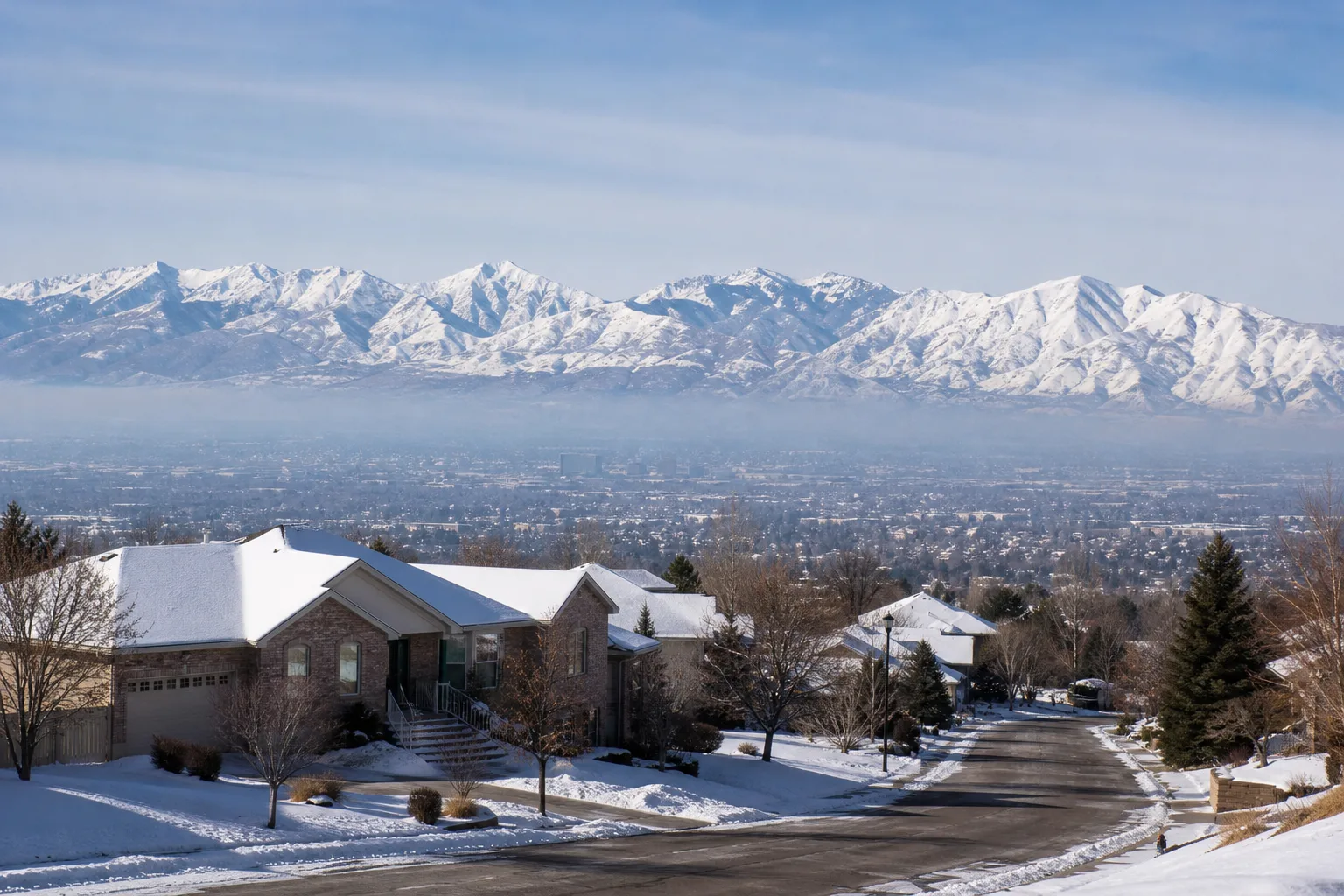
The Wasatch Front's valleys trap cold air under warmer air in winter. The Utah Department of Environmental Quality says a typical winter brings five to six multi-day inversion episodes, and an average of 18 days per winter with fine particle pollution (PM2.5) above the federal standard. Pollution builds the longer an inversion lasts, and it usually takes a storm to clear it.
How to test it: visit in January, not June. Stay a week in the area being considered and check the daily readings from the nearest state monitor at air.utah.gov. Then drive to a higher elevation on the same day and compare. More detail is in how winter inversions affect home buying.
3. Summer Ozone, Smoke and Dust
Air quality has a summer season too. All of Salt Lake and Davis counties and parts of Weber and Tooele counties do not meet the federal ozone standard of 70 parts per billion, according to the state Division of Air Quality. Salt Lake City recorded 42 days above that standard in 2021 and as few as seven in 2010 and 2014, so years vary widely. The division also calls wildfire smoke a major pollution source in Utah and notes that the smoke may come from a fire in another state. Dust storms typically occur from spring through fall, and the division says the Wasatch Front is directly exposed to dust from dry parts of the Great Salt Lake lakebed.
How to test it: look up several past summers of readings for the monitor closest to the home, not just the statewide picture. Households with asthma or other lung conditions should make the second visit in July or August.
4. Snow and Canyon Driving
NOAA's 1991-2020 climate normals show 51.9 inches of snow a year at Salt Lake City International Airport, 61.5 inches in Logan and 75 inches in Heber City. St. George averages 1.2 inches. Canyon roads add another layer. The Utah Department of Transportation enforces a traction law in Big and Little Cottonwood canyons during storms: all-wheel-drive and four-wheel-drive vehicles need mud-and-snow or three-peak mountain snowflake tires, and two-wheel-drive vehicles need the three-peak tires or chains. Traction rules can also apply on I-80 through Parleys Canyon and US-89 through Logan Canyon.
How to test it: drive the real commute on a weekday morning in winter. Price a set of winter tires. For homes on a hillside or bench, look at the slope of the driveway and the street, and ask who plows the road.
5. Dry Air and Elevation
Salt Lake City's airport sits at 4,225 feet and averages 15.5 inches of precipitation a year. Heber City is at 5,590 feet. St. George, at 2,857 feet, averages 9.3 inches. People arriving from humid, sea-level places are moving into a high desert, and that affects yards, water bills, wood floors and how a body feels during the first weeks.
How to test it: a weekend is too short. Spend at least a week, sleep at the elevation of the house being considered, and do normal exercise. Ask the seller for a year of water bills and find out what the city allows for lawn watering.
6. Summer Heat in St. George
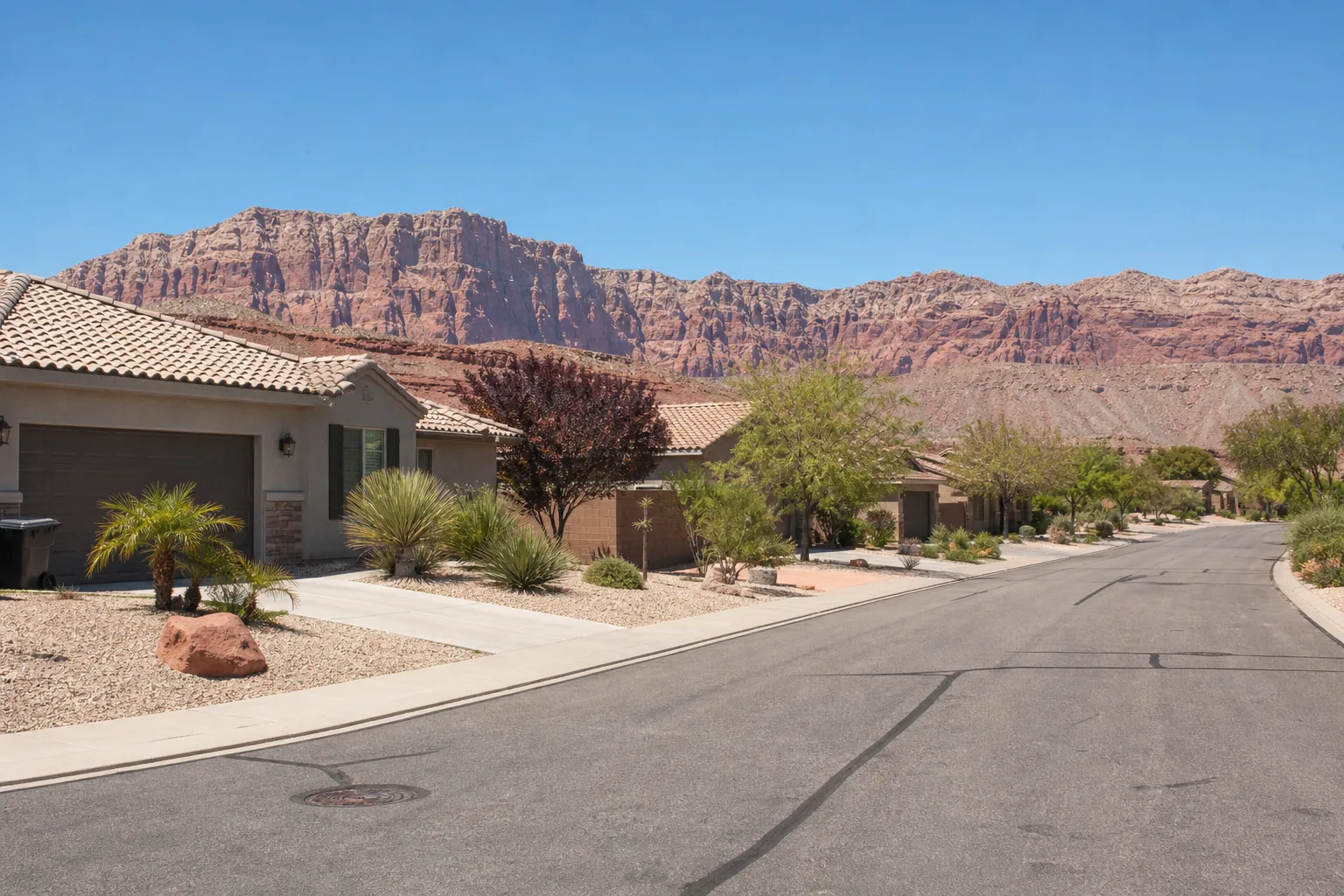
Southern Utah trades snow for heat. The NOAA normals for St. George show an average July high of 101.9 degrees and about 63 days a year at 100 degrees or hotter. Salt Lake City averages about eight such days. Winters are the reward: the average January high in St. George is 54 degrees.
How to test it: visit in July and try to live a normal day, with errands at 3 p.m. and a walk at 7 p.m. Ask for summer power bills and the age of the air conditioner. Retirees comparing climates can read where to retire in Utah, region by region.
7. Distance From Family and the Coast
Utah has no coastline, and many newcomers leave grandparents, siblings and old friends a flight away. This friction point tends to arrive late. The first year is full of new trails and ski days. The second year brings a sick child with no backup, an aging parent, or holidays that require plane tickets for the whole household.
Flights matter here. Salt Lake City International is the state's main airport. Smaller airports have fewer choices; the St. George Regional Airport website, for example, lists three airlines: American, Delta and United.
How to test it: price round trips to family for Thanksgiving and for a short-notice weekend from the nearest airport. Count how many trips a year the budget allows. Check whether the floor plan can host visitors for a week. Then give the move a fair trial of two winters before judging it.
8. Liquor Rules, Sunday Hours and Taxes
Some state rules surprise people, whatever their habits. According to the Utah Department of Alcoholic Beverage Services:
- Liquor, wine and beer stronger than 5% alcohol by volume are sold for takeout only at state stores and package agencies. The department runs 52 state stores, and there are more than 130 package agencies.
- Grocery and convenience stores sell beer up to 5% alcohol by volume.
- State law keeps state liquor stores closed on Sundays and on state and federal holidays.
- In a licensed restaurant, patrons must be dining to be served, and liquor and wine service ends at midnight. Bars may serve from 10 a.m. to 1 a.m.
On taxes, Utah has a flat state income tax. The 2026 Legislature cut the rate to 4.45%, the sixth straight annual reduction, KSL reported. Groceries are taxed too: the State Tax Commission lists a statewide sales tax rate of 3% on grocery food.
How to test it: run a paycheck through a Utah withholding calculator, and compare the full tax picture (income, property and sales) with the current state. People leaving the West Coast can also read what to know before leaving California for Utah.
9. Growth and the Commute
Utah's population reached 3,551,150 in 2025, and the Gardner Institute projects more than 4 million by 2035. Commutes are still short by national standards, with a statewide average of 23.2 minutes in 2024, but they have been getting longer since 2021. The longest averages, about 30 minutes each way, are in Eagle Mountain, Grantsville, Tooele, Stansbury Park, Alpine and Midway. Transit riders average 45 minutes.
How to test it: drive the route at 7:30 a.m. on a Tuesday and again at 5 p.m., not on a Saturday. Read the city's general plan to see what is approved for the empty land nearby.
Rent First or Buy First?
Selling a home costs money, so a purchase that lasts only two years is an expensive trial. Renting first costs less up front. The Gardner report found average asking rents in March 2026 of about $2,518 a month for a single-family house, $1,905 for a townhome and $1,329 for an apartment across Salt Lake, Davis, Utah, Weber and Washington counties, and it put the modeled payment on the median-priced home at $3,669.
Renting first tends to make sense when:
- the household has never spent a January or a July in Utah;
- one earner's job is new, remote or uncertain;
- the choice between regions, or between two cities, is still open;
- the stay may be shorter than five years.
Buying first tends to make sense when:
- the household has already visited in both seasons and tested the commute;
- income is settled and the budget was built on Utah take-home pay;
- family or work ties make a long stay likely;
- the right rental is hard to find, for example with large pets or a need for a specific school boundary.
The monthly math and break-even timeline are worked out in renting vs. owning in Utah.
Matching Utah Regions to What Newcomers Want
Much regret comes from choosing "Utah" instead of a specific place. The regions differ more than most newcomers expect.
| Region | Example city | Median sale price | Tends to suit newcomers who want | Test before buying |
|---|---|---|---|---|
| Salt Lake Valley | Salt Lake City | $590,000 | The largest job market, the main airport, ski canyons close by | January air, summer ozone, canyon traffic |
| Northern Utah County | Lehi | $607,000 | Tech employers and newer homes | Rush-hour drive on I-15, winter air |
| Weber and Davis counties | Ogden | $369,990 | Lower prices than Salt Lake County with mountains nearby | Drive time to work, summer ozone |
| Wasatch Back | Heber City | $890,000 | Cooler summers and a mountain valley setting | 75 inches of snow, cold nights, higher prices |
| Cache Valley | Logan | $374,619 | A university town with lower prices | Cold, snowy winters and winter inversions |
| Washington County | St. George | $505,000 | Mild winters with almost no snow | July heat, flight options, summer power bills |
Prices are the latest full month of MLS data and update automatically.
A Short Pre-Purchase Checklist
- Visit twice: once in January, once in July.
- Stay in the neighborhood, not a hotel across the valley.
- Drive the commute at rush hour in both directions.
- Check several years of air quality readings for the nearest monitor.
- Build the budget on Utah take-home pay.
- Price flights to family for a holiday week.
- Decide ahead of time how long the trial will run. Two winters is a fair test.
Each of these points is a reason to test before signing, not a reason to stay away. For a broader overview, start with moving to Utah: everything to know, and browse current listings in every region on Best Utah Real Estate.
Posted by Kristopher Larson
Frequently asked questions
Why do some people move to Utah and then leave?
Usually for several smaller reasons at once, not one large one. The most common are housing costs that outrun local pay, winter air quality in the valleys, snow or summer heat, distance from family, and a commute that was never tested. Most of these can be checked with a January visit, a July visit and an honest monthly budget before buying.
How many people move out of Utah each year?
The Census Bureau's 2024 American Community Survey estimates that about 86,000 people moved from Utah to another state in the prior year, while about 95,000 moved in from other states. Texas and California were the top two destinations for people leaving. These are survey estimates with wide margins of error.
Is it better to rent before buying a home in Utah?
Renting first tends to make sense for households that have never spent a winter in Utah, have a new or uncertain job, or have not settled on a region. Buying first fits households that have already visited in January and July, tested the commute and built the budget on Utah take-home pay. Selling soon after buying is costly, so a shorter expected stay favors renting.
How bad is winter air quality along the Wasatch Front?
The Utah Department of Environmental Quality says a typical winter has five to six multi-day inversion episodes and an average of 18 days with fine particle pollution above the federal standard. Conditions vary by year and by location. Daily readings for each state monitor are posted at air.utah.gov.
How hot does St. George get in summer?
NOAA's 1991-2020 climate normals show an average July high of 101.9 degrees in St. George and about 63 days a year at 100 degrees or hotter. Winters are mild, with an average January high of 54 degrees and about 1.2 inches of snow a year. The median sale price there is $505,000.
Where can people buy wine and liquor in Utah?
Liquor, wine and beer above 5% alcohol by volume are sold for takeout at state liquor stores and package agencies. State law keeps state stores closed on Sundays and on state and federal holidays. Grocery and convenience stores sell beer up to 5% alcohol by volume, and licensed restaurants and bars serve drinks on site.
Kristopher Larson
Realtor® since 2011 · Licensed in Utah & Nevada · Real Broker, LLC
Kris has sold Utah real estate since 2011 and been part of more than 350 transactions. He writes this site's guides from MLS data and public records, and says where every number comes from.
Keep reading
More from the blog

How Buyers Finance a Home at Auction Without Paying Cash
Should a Utah Seller Accept an FHA or VA Offer? What the Loan Addendum Commits Each Side To

PCS Orders to Utah: Home Search Checklist for Military Families