Where to Retire in Utah: Five Regions Compared on Taxes, Winters and Healthcare
Utah's tax rules are the same statewide, but winters, hospital access and housing are not. This comparison sorts St. George, Cedar City, the Wasatch Front, the Wasatch Back and Cache Valley for retirees.
Search for whether Utah is a good state to retire in and two answers come back. One says taxes are low. The other says Utah taxes Social Security. Both are partly right, and neither helps with the bigger decision, which is where in the state to live. A retiree in St. George and a retiree in Logan pay the same state income tax, but the January high temperature in the two cities differs by more than 20 degrees and the nearest major hospital is a very different drive.
This comparison starts with the rules that apply everywhere in Utah, then sorts five regions by winter, healthcare access and housing so the choice can be made on purpose.
What Is the Same Everywhere: State Taxes
Income tax and Social Security
Utah has a single flat income tax rate. The 2026 Legislature lowered it from 4.5% to 4.45%, the sixth cut in six years, according to KSL. There is no separate exclusion for pensions, IRA withdrawals or 401(k) distributions, so that income is taxed at the flat rate.
Utah is one of eight states that Kiplinger counts as still taxing Social Security benefits, but a credit wipes out the tax for many households. The Utah State Tax Commission's instructions work like this:
- The Social Security that is taxable on the federal return carries to the Utah return, and the credit equals the Utah tax on that amount.
- The full credit applies when modified income is at or below a threshold. On the 2025 return the thresholds were $90,000 for married couples filing jointly, $54,000 for single filers and $45,000 for married people filing separately.
- Above the threshold, the credit shrinks by 2.5 cents for each dollar of income over the line.
- The credit is nonrefundable, and it cannot be combined with the older retirement credit, which is worth up to $450 per person and is limited to people born on or before December 31, 1952.
- Military retirees have their own credit equal to the tax on taxable military retirement pay.
The practical reading: a household living mostly on Social Security often owes Utah little or nothing on it, while a household with a large pension or large required withdrawals pays the flat rate on that income. Thresholds can change from year to year, so a tax preparer should run the numbers before a move.
Property tax
A primary residence in Utah is taxed on 55% of its market value because state law exempts the other 45%. Second homes do not get the exemption and are taxed on full value, which matters for anyone planning to split the year between two Utah addresses. The owner must live in the home at least 183 consecutive days a year to qualify.
Relief programs for older owners are run through the counties. The Tax Commission's Publication 36, revised in September 2026, lists these terms:
- Homeowner's credit (the "circuit breaker"): for owner-occupants with 2025 household income under $44,221 who are at least 67, who qualified in 2025, or who are unmarried surviving spouses. Up to $1,412 can be abated, plus a credit equal to the tax on 20% of the home's value. Applications go to the county by September 1.
- Renter credit: same income limit, age 66 or older, up to $1,412, filed with the Tax Commission by December 31.
- Senior deferral: owners 75 and older with household income of no more than $88,442 can postpone property taxes if the home is assessed at or below the county median or has been owned for 20 continuous years, among other conditions. Deferred taxes accrue interest and the application must be renewed every year.
The circuit breaker was nearly phased out. A 2025 bill, SB197, would have closed it to new applicants and steered owners to deferral instead. The governor vetoed it on March 27, 2025, KSL reported. A fuller list of aid is in Utah programs that help seniors keep their homes.
Five Regions Side by Side
| Region (reference city) | Elevation | Average January high / low | Average July high | Median sale price | Median days on market |
|---|---|---|---|---|---|
| St. George area | about 2,900 ft | 54 / 28 | 102 | $502,500 | 40 days |
| Cedar City | about 5,600 ft | 43 / 18 | 91 | $387,200 | 68 days |
| Wasatch Front (Salt Lake City) | about 4,200 ft | 39 / 24 | 94 | $590,000 | 34 days |
| Wasatch Back (Heber City) | about 5,600 ft | 37 / 13 | 90 | $917,329 | 81 days |
| Cache Valley (Logan) | about 4,800 ft | 32 / 18 | 88 | $374,619 | 33 days |
Temperatures are degrees Fahrenheit from NOAA's 1991 to 2020 climate normals, and elevations are those of the NOAA weather stations (the Salt Lake City and Cedar City airports, and the Utah State University campus in Logan). Prices and days on market come from the latest full month of MLS data and update automatically.
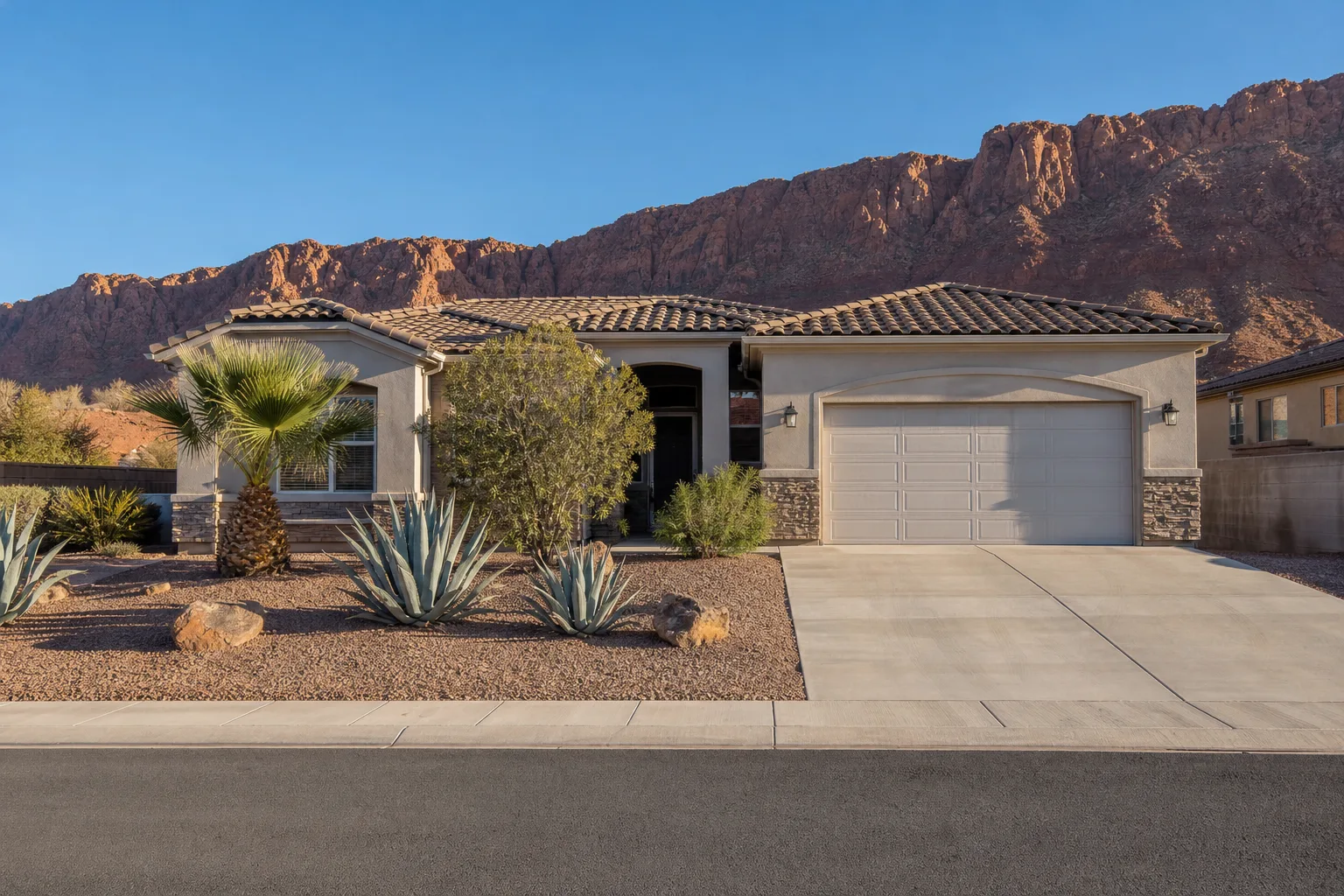
St. George Area: The Mild-Winter Choice
St. George is the only region on this list where snow is close to a non-issue: the NOAA normal is 1.2 inches a year. The price for that is summer. The average July high is about 102 degrees, so outdoor routines move to early morning for a few months.
Housing here is built with retirees in mind more than anywhere else in the state. Single-level floor plans are common, and the area has a long list of age-restricted neighborhoods. The guide to 55+ communities in St. George compares them, and retiring in St. George covers the trade-offs in detail. Neighboring Ivins is smaller and quieter, as described in retiring in Ivins.
For healthcare, Intermountain Health's St. George Regional Hospital is in town and open around the clock. The most specialized care in Utah is still in Salt Lake City, a long drive north on I-15.
Best fit: retirees who want to be done with snow shovels and can live with hot summers.
Cedar City: Four Seasons at a Lower Price
Cedar City sits about 2,700 feet higher than St. George, and the climate shows it. January lows average 18 degrees and July highs average 91, about 11 degrees cooler than St. George.
Intermountain's Cedar City Hospital offers 24-hour emergency care along with cancer care, cardiology and surgery. Complex cases may be referred to larger hospitals, so anyone with an ongoing specialty need should confirm that the specific service is offered locally. The costs and benefits are laid out in retirement in Cedar City.
Best fit: retirees who want southern Utah scenery and a university town without desert heat, and who are comfortable driving in snow some weeks of the year.
Wasatch Front: Closest to Specialists
The strongest argument for the Salt Lake Valley is medical. University of Utah Hospital is a Level 1 trauma center and a referral center for several surrounding states. Huntsman Cancer Institute, on the same campus, is the only National Cancer Institute-designated comprehensive cancer center in the Mountain West. Intermountain Medical Center in Murray sits in the middle of the valley. A retiree who sees a cardiologist or oncologist regularly can do it here without a canyon or a long highway drive.
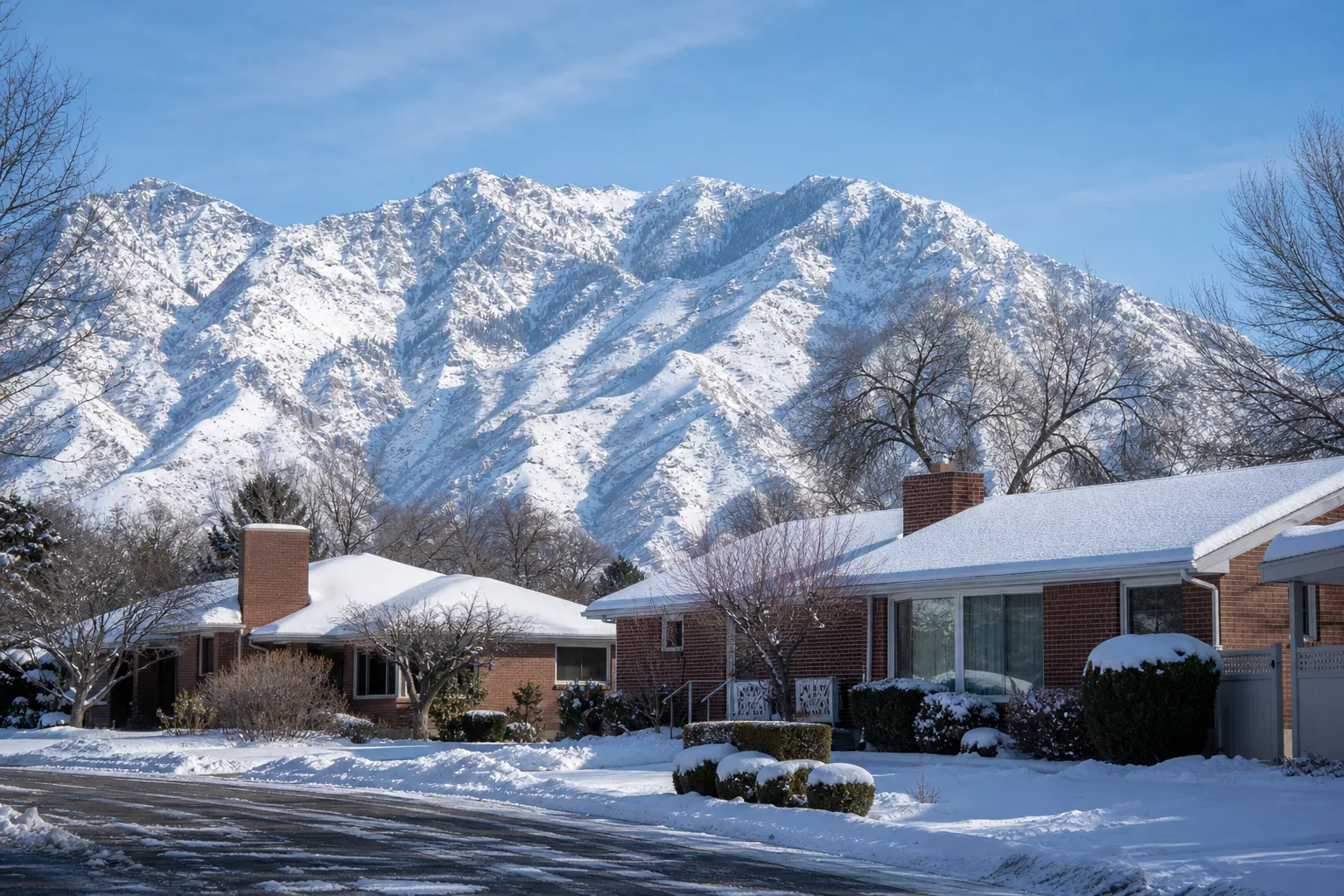
Winters are moderate in temperature but not in snow or air. Salt Lake City averages about 52 inches of snow a year at the airport, and benches closer to the mountains get more. Utah's Department of Environmental Quality notes that the Salt Lake, Utah and Cache valleys see high particulate levels during winter inversions, when cold air is trapped on the valley floor. For how that plays out by neighborhood, see how winter inversions affect home buying.
Housing is the most varied in the state: condos, townhomes, older ramblers and age-restricted neighborhoods, many of them listed in 55+ communities in the Salt Lake City area. Two-story homes with basements are common, so buyers planning to stay 20 years should look for a bedroom, full bath and laundry on the main floor.
Best fit: retirees with regular specialist visits, family along the I-15 corridor, or a need to be near a major airport.
Wasatch Back: Mountain Living With a Canyon Drive
Heber City has the coldest nights on this list, with an average January low near 13 degrees and about 75 inches of snow a year. Summers are the reward: July highs average 90 with nights near 50.
Intermountain operates hospitals with 24-hour emergency departments in both Heber City and Park City. Specialty care generally means driving down Provo Canyon or Parleys Canyon to the Wasatch Front, a simple trip in June and a harder one in a January storm. The elevation, about 5,600 feet in Heber and higher in Park City, is worth raising with a doctor for anyone with a heart or lung condition.
One local detail on taxes: in 2025 Wasatch County offered its own senior abatement for owners 66 and older with income up to $63,934, above the state limit, with credits of $500 to $1,000, KPCW reported. Programs like this change yearly, so check with the county clerk or auditor.
Best fit: healthy, active retirees who put scenery and cool summers first and accept snow and distance from specialists.
Cache Valley: University Town, Cold Winters
Logan is the coldest of the five by day, with an average January high of 32 degrees and roughly 60 inches of snow a year at the university. Like the Wasatch Front, the valley has winter inversions.
What Logan offers in exchange is a college town's calendar and summers that stay under 90 on average. Utah State University has run its Summer Citizens program for people 55 and older since 1976, and the university says it brings in more than 800 seniors each summer for classes and events. Intermountain's Logan Regional Hospital provides 24-hour emergency care locally, while the largest specialty centers are in the Salt Lake Valley to the south.
Best fit: retirees who like a campus setting and do not mind a long winter, or who plan to spend the coldest weeks somewhere warmer.
How to Narrow It Down
- Start with healthcare. List current doctors and likely needs over the next ten years, then check the drive to those specialists from each region in winter.
- Decide on winter. If snow and ice are deal-breakers, the choice is the St. George area. If four seasons are welcome, compare elevation and snowfall in the table above.
- Run the tax return both ways. Estimate Utah tax with the Social Security credit, then compare with the current state.
- Pick the house for the long run. Main-floor living, few entry steps, a flat driveway and an HOA that handles snow removal matter more each year.
- Visit in the worst month. July in St. George, January everywhere else.
Homes for sale in all five regions, including single-level and 55+ listings, can be searched on Best Utah Real Estate.
Posted by Kristopher Larson
Frequently asked questions
Does Utah tax Social Security benefits?
Yes, but a state credit cancels the tax for many retirees. On the 2025 return the full credit applied when modified income was at or below $90,000 for married couples filing jointly or $54,000 for single filers, and it phased out by 2.5 cents per dollar above those amounts. The Utah State Tax Commission publishes the current thresholds each year.
What is Utah's income tax rate for retirees?
Utah has one flat rate for everyone, and the 2026 Legislature lowered it to 4.45%. Pension income and withdrawals from IRAs and 401(k) plans are taxed at that rate. Credits are available for Social Security benefits and military retirement pay.
Does Utah have property tax relief for seniors?
Yes. The homeowner's credit, often called the circuit breaker, can abate up to $1,412 for qualifying owners age 67 and older with 2025 household income under $44,221, and a separate deferral is available to qualifying owners 75 and older. Applications are filed with the county by September 1. All primary residences are also taxed on 55% of market value.
What is the warmest place to retire in Utah?
The St. George area in the state's southwest corner. NOAA climate normals show an average January high of 54 degrees and about an inch of snow a year. Summers are hot, with an average July high near 102 degrees.
Which part of Utah has the best healthcare access for retirees?
The Salt Lake Valley. University of Utah Hospital is a Level 1 trauma center, Huntsman Cancer Institute is the only NCI-designated comprehensive cancer center in the Mountain West, and Intermountain Medical Center is in Murray. Other regions have community or regional hospitals but may refer complex cases to Salt Lake City.
How do home prices compare across Utah retirement areas?
The latest median sale prices are $502,500 in St. George, $387,200 in Cedar City, $590,000 in Salt Lake City, $917,329 in Heber City and $374,619 in Logan. These figures come from MLS data for the most recent full month and update automatically.
Keep reading
More from the blog
7 Costs to Check Before Developing a Small Utah Community
How to Negotiate a Home Purchase in Utah When Listings Are Sitting
Utah City in Vineyard: What Buyers Should Check Before Betting on the New Downtown