Utah Lawn Rules: Grass Limits, Park Strips and Rebates for Removing Turf
Utah cities now limit how much lawn a new home can have, and water districts pay owners of older homes up to $3 per square foot to replace grass. Here is how the state standards, city codes, HOA rules and rebate programs fit together.
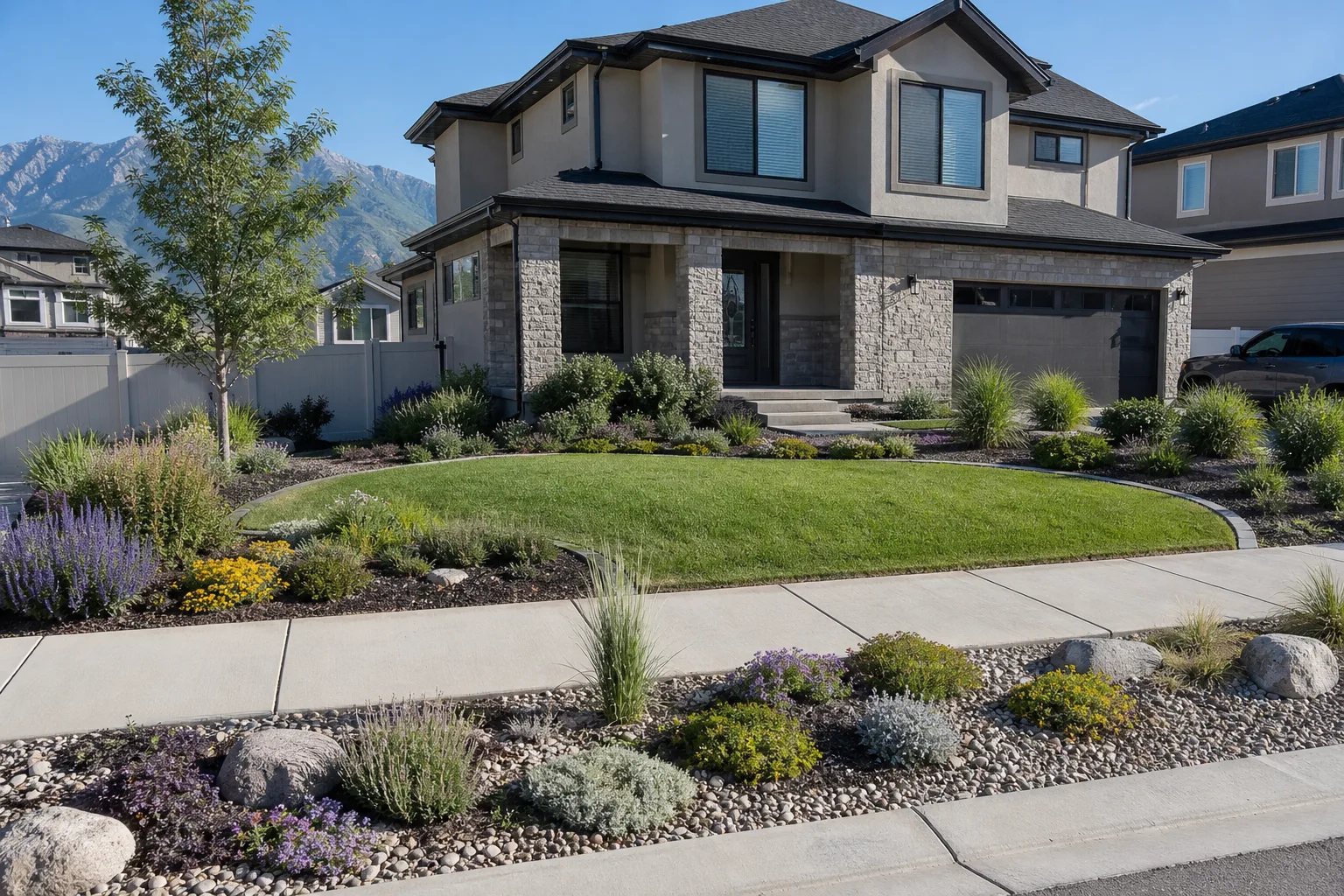
A buyer walks a new Utah subdivision and notices something: the front lawns are small, the strip between the sidewalk and the curb is rock and shrubs, and the back yard is bare dirt. None of that is a builder cutting corners. It is the result of water rules that most Utah cities have adopted over the last few years, and the same rules decide whether the owner of an older home can get paid to take lawn out.
The rules come in layers: a state standard, a city ordinance that may be stricter, a water district that pays the rebates, and sometimes an HOA. This article sorts out which layer controls what, with the figures from each agency's own pages as of November 2026.
How Much Lawn a New Home Can Have
The Utah Division of Water Resources sets water use efficiency standards in Utah Administrative Code R653-11-10. They are not a blanket order to every homeowner. They are the minimum a city or county has to write into its own ordinance for new development before its residents can receive state landscape incentive money. Because most cities wanted their residents to qualify, most adopted them, and a city may go further than the state minimum.
| Where | Lawn limit for new homes | Source |
|---|---|---|
| Anywhere the standards are adopted | No lawn in park strips or in any area narrower than 8 feet | R653-11-10 |
| Salt Lake, Utah, Weber and Davis counties | Lawn on no more than 35% of the front and side yard landscaped area | R653-11-10 |
| Washington County | Lawn on no more than 15% of the lot | R653-11-10 |
| All other counties | Lawn on no more than 50% of the front and side yard landscaped area | R653-11-10 |
| St. George (city code, stricter) | Lawn on no more than 8% of the lot, capped at 1,500 square feet on lots up to 20,000 square feet and 2,000 square feet on larger lots; lots under 7,500 square feet may have up to 600 square feet; no lawn on slopes over 15% | St. George landscape certification form, city code 10-23 |
Two details matter. The state lawn percentages do not apply to small lots with less than 250 square feet of landscaped area. And in the Wasatch Front counties the state percentage covers front and side yards, so the back yard depends on the city's own ordinance.
Washington County went first and furthest. In August 2022 the Washington County Water Conservancy District announced that the county's largest cities had limited grass at new homes, with most capping it at 8% of the lot and banning it in park strips, in areas under 8 feet wide and on slopes. Buyers looking in St. George can read more about impact fees and surcharges in this Washington County water guide for homebuyers, and the regional supply picture is covered in Southern Utah's water future.
Park Strips and the 8-Foot Rule
The park strip is the band between sidewalk and curb. Sprinklers on a strip that narrow spray the pavement as much as the grass, which is why the state standard bars lawn there and in any other area less than 8 feet wide in new development.
The same 8-foot figure shows up in state law for existing homes, from the other direction. Under Utah Code 10-20-619, a city may not require a property owner to install or keep lawn in an area less than 8 feet wide, and may not prohibit water-wise landscaping. A city can still require a plan review, healthy plants, and minimum or maximum plant coverage. That last point is why a strip of bare rock can still draw a notice in some cities.
Secondary Water Is Getting Meters
Many Utah neighborhoods water yards with secondary water: untreated irrigation water delivered through a separate pressurized system. The Division of Water Resources says hundreds of thousands of residential connections in Utah use it, and many have never had a meter.
Utah Code 73-10-34 requires every secondary water supplier to install and maintain a meter on each pressurized connection by January 1, 2030. The Division of Water Resources notes that the duty falls on suppliers, not on residents, and that the Legislature set aside $250 million in federal grant money to help pay for meters. The statute also limits how fast a supplier can raise rates to cover metering: no more than 10% in a calendar year, apart from emergencies.
For an owner, a meter means outdoor use becomes visible. Whether and how a supplier bills by volume is the supplier's decision, so it is worth asking before buying a home with a large lawn.
Rebates for Taking Out Lawn
Utah pays owners to replace living lawn with water-efficient landscaping. The state runs one program and four large water conservancy districts run their own, all reached through the same application at Slow the Flow's rebate page. The address decides which program applies. The state's Landscape Incentive Program page lists the qualifying cities and says more will be added as they update their ordinances.
| Program | Where | Payment per square foot of lawn replaced | Key conditions |
|---|---|---|---|
| Jordan Valley Water Conservancy District | Much of Salt Lake County, including West Jordan, South Jordan, Herriman, Draper and West Valley City | $3.00 | 200 square foot minimum; site visit before any work; 50% plant coverage; drip irrigation; no payment for artificial turf |
| Central Utah Water Conservancy District | Salt Lake City, Lehi, Sandy, American Fork, Spanish Fork and other qualifying cities | $3.00 | City must have adopted the efficiency standards; 200 square foot minimum; finish within 12 months of the first site visit |
| Central Utah, rural program | Provo, Orem, Eagle Mountain, Saratoga Springs and others | $1.50 | Same pre-approval rule; 200 square foot minimum |
| Weber Basin Water Conservancy District | Davis, Weber, Morgan and Summit counties | $2.50 in cities such as Layton, Kaysville, Roy and Park City; $1.25 in others, including Ogden and North Ogden | 250 square foot minimum; plants required; apply before work begins |
| Washington County Water Conservancy District | St. George, Washington City, Hurricane, Ivins, Santa Clara and nearby | $3.00 on the district's program page | Pre-conversion site visit; 50% plant coverage; a permanent conservation easement recorded on the converted area |
| Utah Division of Water Resources | Qualifying cities outside the four districts, such as Cedar City, Moab, Tooele and North Logan | $2.00 | 200 square foot minimum; $50,000 cap per application; finish within 365 days of approval |
One caution on the Washington County figure: the statewide portal's page for that county shows a tiered schedule of $2.00 per square foot up to 5,000 square feet and $1.00 beyond, with a 300 square foot minimum. Owners there should confirm the rate when they apply.
The rules shared by nearly every program:
- Approval comes first. The lawn has to be alive and maintained at the first site visit. Killing or removing it before approval ends eligibility.
- Plants are required. Utah Water Savers states that the converted area needs at least 50% perennial plant coverage at ground level, measured at mature size, plus drip irrigation. Rock alone does not qualify.
- Artificial turf is not paid for. Neither are concrete, pools or water features. Swapping to a drought-tolerant grass does not qualify either.
- The change is meant to last. Owners sign an agreement not to return the area to lawn. Jordan Valley says failing to maintain the landscape can mean repaying the incentive.
- Required work is not eligible. The state and Weber Basin programs exclude projects that a government code already requires.
The Washington County district estimates its incentive typically covers 30% to 50% of a project's cost.
Questions to Ask a Builder
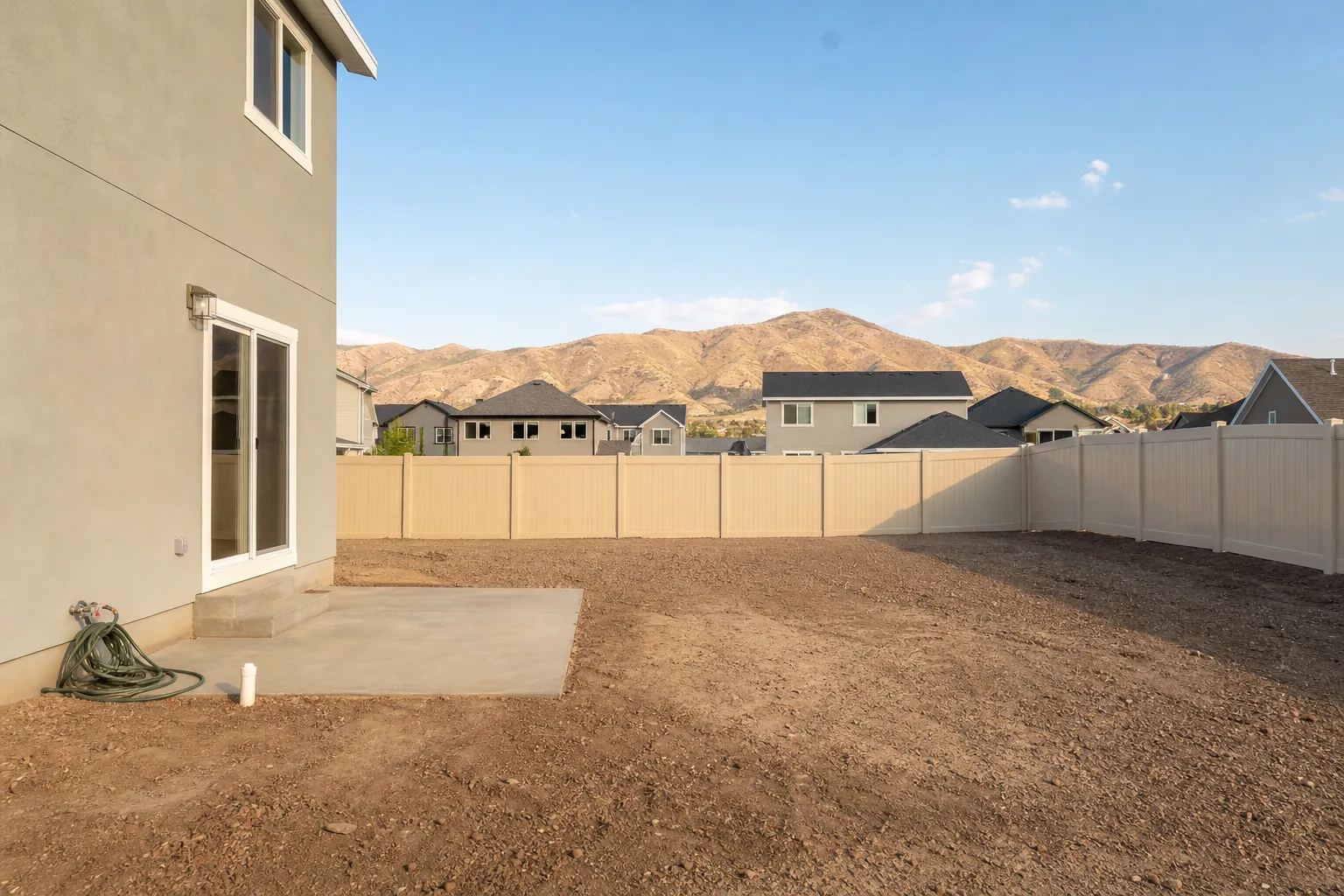
Landscaping is one of the largest costs a new-home contract can leave out. Before signing, a buyer in Lehi, Ogden or any other growing city should get answers to these in writing:
- What landscaping is included? Front yard only, front and sides, or none? Does it include sprinklers, a drip zone and a controller?
- Does the included design meet the city's lawn limit? Ask for the landscape plan, since some cities record it against the lot.
- What is the city's deadline to finish the yard? St. George, for example, requires at least 30% of the front yard to be landscaped within one year of occupancy, with half of that in live plants. Other cities set their own deadlines.
- Is outdoor water secondary or culinary? Who is the supplier, is the connection metered, and how is it billed?
- Is there an incentive for a new yard? Jordan Valley pays $1.00 per square foot for a previously bare back yard at a home built in the last five years, or $1.50 when the whole lot complies, with lawn held to 35% and the design approved before installation.
Whether to pay the builder for the yard or do it after closing is the same trade-off buyers face with interior options, covered in this piece on builder upgrades at the design center or after closing.
What an Owner of an Older Home Can Do
The lawn limits apply to new development. An existing yard in Salt Lake City can stay as it is. What changed for older homes is the money on offer and the right to use it.
The practical order is: look up the address on the rebate page, apply, wait for the site visit, and only then start work. Park strips and narrow side yards are the usual first project because they are the hardest areas to water well. On whether less grass hurts resale, see how a lawn affects property value; for the cost side of synthetic grass, which no Utah program pays for, see this artificial grass and natural turf cost comparison.
Where the HOA Fits
State law limits what an association can demand. Under Utah Code 57-8a-231, an HOA may not enforce a rule that prohibits the owner of a detached home from installing water-wise landscaping, and, except where needed for erosion control, may not require lawn in an area less than 8 feet wide. A related section, 57-8a-218, says an HOA rule may not prohibit or restrict converting a grass park strip to water-wise landscaping.
The association keeps real authority, though. It can require a design review before work starts, require healthy plants, restrict certain mulches and limit plant choices to a water-wise list. Rebate programs put the burden on the applicant to comply with HOA rules, and Utah Water Savers notes that the landscaping must belong to the applicant, not the association. More on these limits is in Utah HOA rules that surprise buyers.
What Counts as Water-Wise
State law defines water-wise landscaping broadly: plants suited to the site that stay healthy with minimal irrigation or without overhead sprinklers, efficient irrigation design, and layouts that reduce lawn. It does not mean a yard of gravel.
The design approach the districts teach is Localscapes, developed by a team of horticulturists, landscape designers, irrigation specialists and water agencies. It has five parts:
- Central open shape: one simple area of lawn, or of gravel, pavers or ground cover, that sprinklers can cover evenly.
- Gathering areas: patios, decks and seating placed outside the lawn.
- Activity zones: play sets, trampolines and sheds, also outside the lawn.
- Paths: walkways in place of narrow lawn strips.
- Planting beds: everything left over, filled with plants suited to Utah and watered by drip.
Plant choices vary by elevation and region, so the state's waterwise plant list and the district demonstration gardens are better guides than a single statewide list.
Common Mistakes
- Tearing out or killing lawn before the application is approved and the site is inspected.
- Installing artificial turf and expecting a check.
- Replacing lawn with rock only and falling short of the plant coverage requirement.
- Assuming the builder's price includes the back yard.
- Skipping HOA design review because state law is on the owner's side.
- In Washington County, forgetting that the conservation easement stays with the property after a sale.
Lawn rules now shape what a yard costs to install, water and maintain, so they belong on the checklist with the floor plan and the commute. Current listings in every Utah city, including new construction, are on Best Utah Real Estate.
Posted by Kristopher Larson
Frequently asked questions
How much lawn can a new home in Utah have?
It depends on the city, because each city adopts its own ordinance. The state minimum standards in Utah Administrative Code R653-11-10 cap lawn at 35% of the front and side yard landscaped area in Salt Lake, Utah, Weber and Davis counties, 15% of the lot in Washington County, and 50% of front and side yards elsewhere. Cities may be stricter: St. George limits lawn to 8% of the lot with a square footage cap.
Is grass allowed in a park strip in Utah?
In cities that have adopted the state water efficiency standards, new development may not have lawn in park strips or in any area narrower than 8 feet. Existing park strip lawn can stay, but state law bars cities and HOAs from requiring an owner to keep lawn in an area less than 8 feet wide. An HOA rule also may not prohibit converting a grass park strip to water-wise landscaping.
How much does Utah pay to remove lawn?
Payments range from $1.25 to $3.00 per square foot of lawn replaced, depending on the address. Jordan Valley and Central Utah's main program pay $3.00, the state Division of Water Resources program pays $2.00, Central Utah's rural program pays $1.50, and Weber Basin pays $2.50 or $1.25 depending on the city. Rates and eligible cities change, so the address should be checked on the Slow the Flow rebate page before planning a project.
Can a homeowner get a rebate for artificial turf in Utah?
No. Utah Water Savers and the water district programs do not pay for artificial turf, concrete, pools or water features. The converted area must have at least 50% perennial plant coverage at maturity and drip irrigation to qualify.
Can a Utah HOA require a homeowner to keep grass?
Only within limits. Under Utah Code 57-8a-231, an association may not prohibit the owner of a detached home from installing water-wise landscaping and may not require lawn in an area less than 8 feet wide, except where needed for erosion control. The HOA can still require design review, healthy plants and specific water-wise design standards.
What is the secondary water metering deadline in Utah?
Utah Code 73-10-34 requires secondary water suppliers to meter every pressurized secondary connection by January 1, 2030. The requirement applies to the supplier, not the homeowner. The law also bars a supplier from raising secondary water rates by more than 10% in a calendar year to cover metering costs, except after a catastrophic failure or similar event.
Keep reading
More from the blog

Buying a Home Near a FrontRunner Station: All 16 Stops, Real Commute Times and What Double-Tracking Changes

Responsibly Sourced Hardwoods for Custom Home Builds
Blue Agave Cleaning: Window Cleaning and Exterior Home Care