Buying a Home Near a FrontRunner Station: All 16 Stops, Real Commute Times and What Double-Tracking Changes
Every FrontRunner station from Ogden to Provo, what the commute looks like on UTA's published timetable, what the FrontRunner 2X double-tracking project would change, and what to check before buying a home near the tracks.
A home listing that says "minutes from FrontRunner" can mean a five-minute walk to a platform, a ten-minute drive to a park-and-ride lot, or a back fence that faces the tracks. Those are three very different ways to live. The train is also less frequent than many newcomers expect: on the schedule in effect since August 2026, it runs every 30 minutes at rush hour, once an hour for most of the rest of the day, and not at all on Sundays.
This article lists every station from Ogden to Provo, shows what the commute looks like using the Utah Transit Authority's published timetable, explains what the FrontRunner 2X double-tracking project would change and what could delay it, and ends with a checklist for buyers looking at homes near the line.
How the Train Runs Today
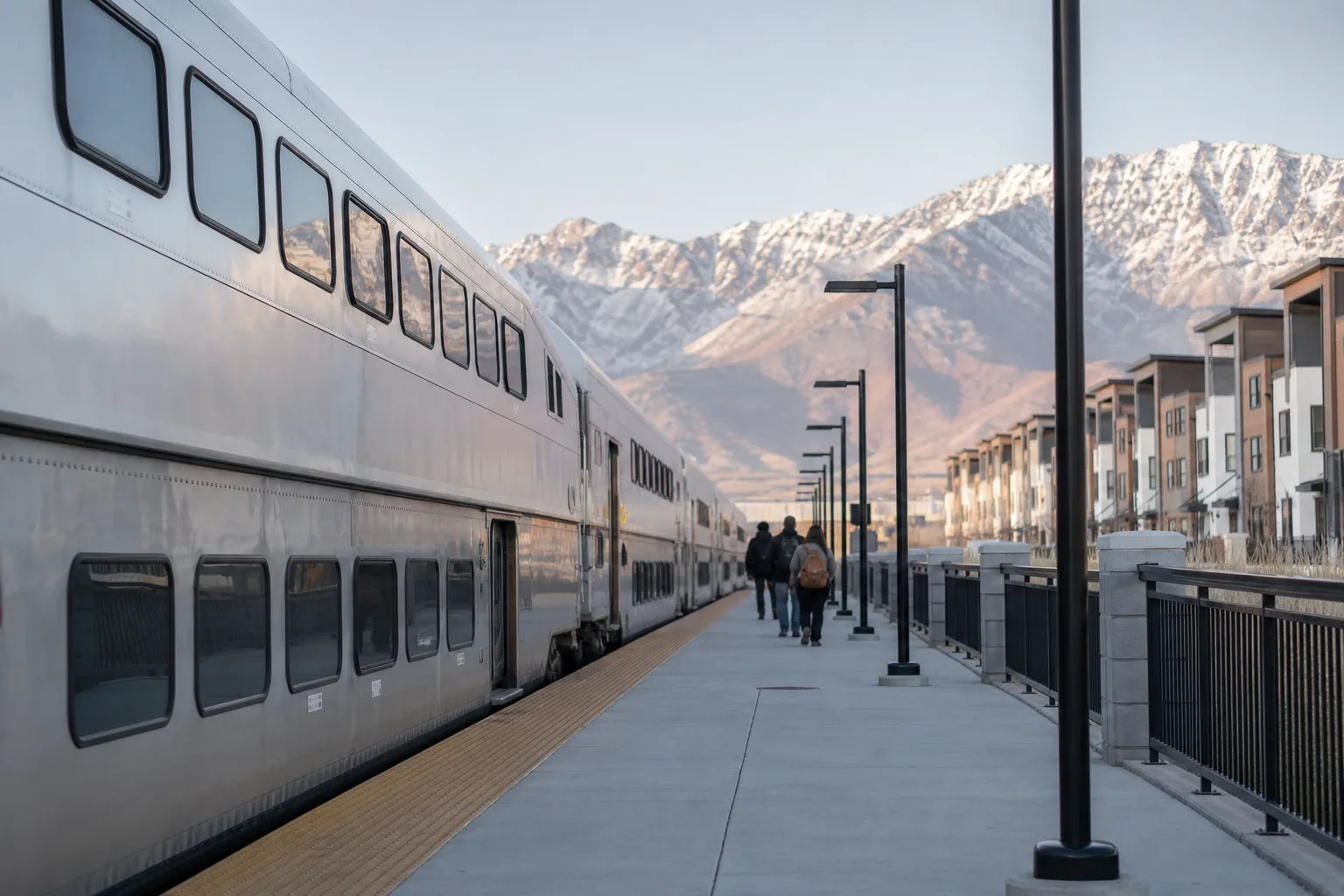
FrontRunner is UTA's commuter rail line, with 16 stations along a corridor of about 83 miles. UTA says trains reach up to 79 miles per hour and have restrooms, free Wi-Fi and, on most trains, one car set up for bikes. Parking at stations is free for people riding transit that day.
- Weekdays: the first northbound train leaves Provo at 4:46 a.m. and the first southbound train leaves Ogden at 5:07 a.m. Trains run every 30 minutes in the morning and afternoon peaks and hourly at midday and late evening, with the last departures around midnight.
- Saturdays: hourly service. The first full-line trains leave Provo at 7:53 a.m. and Ogden at 8:08 a.m.
- Sundays: no service. UTA has said it uses Sundays and a short overnight window for track maintenance, which is hard to do any other time on a mostly single-track line.
- Fares: $2.50 for a trip to the next station, plus 60 cents for each station after that, up to $9.70 between Provo and Ogden. By that formula Lehi to Salt Lake Central comes to $4.30 one way. Riders paying with a FAREPAY card are capped at $10 a day and $40 a week, and a ticket includes two hours of transfers to buses and TRAX.
Times change a few times a year, so check UTA's current FrontRunner schedule before counting on a particular train.
Every Station, North to South
Parking type comes from UTA's park-and-ride list. "Multi-day" lots allow a car to stay overnight or longer; "day" lots do not.
| Station | City | UTA parking | Rail and rapid-bus connections |
|---|---|---|---|
| Ogden | Ogden | Multi-day | Northern end of the line |
| Roy | Roy | Multi-day | |
| Clearfield | Clearfield | Multi-day | |
| Layton | Layton | Day | |
| Farmington | Farmington | Multi-day | |
| Woods Cross | Woods Cross | Multi-day | |
| North Temple | Salt Lake City | None listed | TRAX Green Line to the airport and downtown |
| Salt Lake Central | Salt Lake City | Day | TRAX Blue Line through downtown |
| Murray Central | Murray | Multi-day | TRAX Red Line to the University of Utah and Daybreak; Blue Line to Draper |
| South Jordan | South Jordan | Multi-day | |
| Draper | Draper | Multi-day | Hourly-rental bike lockers at the station |
| Lehi | Lehi | Multi-day | |
| American Fork | American Fork | Multi-day | |
| Vineyard | Vineyard | Day | |
| Orem Central | Orem | Multi-day | UVX rapid bus to Utah Valley University and BYU |
| Provo Central | Provo | Multi-day | UVX rapid bus; southern end of the line |
Local bus routes serve most stations, and they change more often than the train does, so look up the specific stop on UTA's trip planner. Vineyard is the newest station, opened in August 2022, and a large mixed-use district is going up around it; see what buyers should check at Utah City in Vineyard. From North Temple, the Green Line heads west past the Fairpark area covered in the Power District buyer's guide.
What the Commute Really Looks Like
These times are taken from UTA's weekday timetable for a morning train into Salt Lake Central, the downtown station. Prices and days on market are the latest full month of MLS data and update automatically.
| Station city | Train time to Salt Lake Central | Median sale price | Median days on market |
|---|---|---|---|
| Ogden | 59 minutes | $369,990 | 41 days |
| Layton | 35 minutes | $524,195 | 44 days |
| Farmington | 27 minutes | $614,000 | 54 days |
| Salt Lake City | At the station | $590,000 | 34 days |
| Draper | 26 minutes | $700,000 | 51 days |
| Lehi | 41 minutes | $607,000 | 45 days |
| Orem | 61 minutes | $489,900 | 44 days |
| Provo | 69 minutes | $548,750 | 33 days |
The time on the train is only the middle of the trip. Add the drive or walk to the platform, a few minutes of buffer, and the last leg at the other end, which for many downtown jobs means a TRAX ride from Salt Lake Central or North Temple. The door-to-door figure is always longer than the table, so time it before relying on it. The real cost of missing a train is the wait: 30 minutes at rush hour, an hour at midday.
The trade-off is that the time is predictable and usable, and it does not grow when I-15 backs up. For households comparing a longer drive against a train pass, the math in pricing a longer commute before buying applies here too.
Who gets the most out of it
- Downtown Salt Lake workers living in Davis County or the south valley. Farmington and Draper are both under half an hour by train from Salt Lake City. Buyers choosing between two of the northern station cities can read Ogden vs. Layton.
- Lehi tech corridor workers coming from either direction. The timetable shows 37 minutes from Salt Lake Central to Lehi, 9 minutes from American Fork, 20 from Orem and 28 from Provo. Few offices sit at the platform, so check how the last mile from the station to the office works.
- University commuters. UVX links Orem Central and Provo Central with Utah Valley University and BYU, and BYU lists the bus ride from either station at 18 minutes. The Red Line from Murray Central goes to the University of Utah.
- Frequent flyers. A transfer at North Temple puts the airport one Green Line ride away.
Utah County buyers weighing station towns against each other will find more detail in the best Utah Valley suburbs for families and commuters.
What FrontRunner 2X Would Change
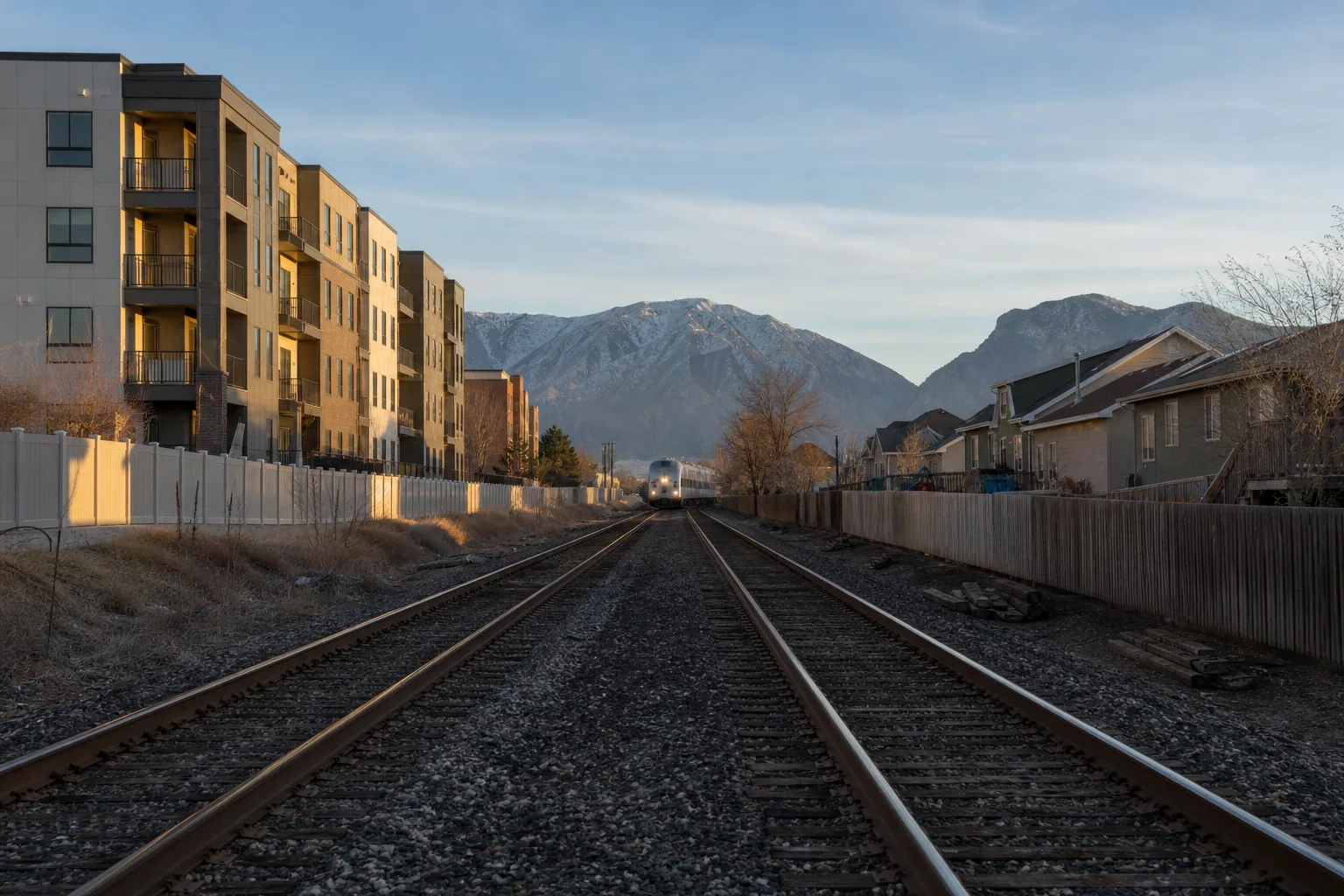
Most of the line is a single track, so trains can only pass each other in certain places. That is what limits how often they run. A UDOT official told the Standard-Examiner in 2025 that about 26% of the route is double-tracked. FrontRunner 2X, a joint UDOT and UTA project, would raise that to 58% by adding 26.1 miles of second track in 11 sections. It also includes 10 new trainsets, a new maintenance facility, and one new station in Bluffdale.
The goal is a train every 15 minutes at peak times and every 30 minutes the rest of the day, double what runs now. The agencies say service will keep operating during construction.
The money and the calendar
This is the part buyers should read carefully. In August 2026 the Federal Transit Administration moved the project into the engineering phase of its Capital Investment Grants program, which puts it in line for nearly $1.3 billion. That is not a signed grant. UDOT's project director told KUER that full-scale construction will not start until a full funding grant agreement is in hand, and that a year would be "really aggressive" and two years closer to average.
In an update to the Legislature's Transportation Interim Committee on October 21, 2026, UDOT put the project estimate at about $3.2 billion against roughly $2.65 billion in current and anticipated funding, a shortfall of $564 million. The same presentation shows construction from 2027 to 2030 and 15-minute peak service in 2031, with a footnote that the schedule depends on federal grant approval. The project website still lists completion in 2030.
Sunday trains are not part of any published schedule. UTA has said double-tracking would make them possible, without giving a date.
The new Bluffdale station
The added station is planned on the west side of The Point, the state-led redevelopment of the former prison site, near 14600 South. KSL reported in October 2025 that residents of an adjoining Bluffdale neighborhood objected to the location over noise, light and the height of the structure. For what the development means for nearby owners, see what buyers near The Point should know.
Extensions: one in review, one far off
A southern extension from Provo to Payson, with stations in Springville and Spanish Fork, has been in federal environmental review since 2024. UTA told KSL in 2024 that it was not funded for construction. A northern extension from Ogden to Brigham City is in long-range plans only; a UDOT official said in 2025 that the agency was not actively working on it, and UTA's executive director told KSL in 2026 that it is likely decades away. A home in Spanish Fork or Brigham City should be priced on today's commute, not on a station that has no construction money.
The Downsides of Living by the Tracks
- Horns. Two federal quiet zones cover the corridor: one from Salt Lake City to Ogden administered by Woods Cross, and one from Salt Lake City to Provo administered by Lehi. In a quiet zone trains do not routinely sound horns at street crossings. That protection can lapse. The Federal Railroad Administration suspended both zones at the end of September 2024 over crossings that no longer met its standards, and horns sounded at every crossing until the southern zone was restored in January 2025 and the northern one in March 2025. Horns are still used for emergencies and near work zones, which matters during double-track construction.
- Freight trains. For much of the route the FrontRunner track runs beside Union Pacific freight tracks. Freight trains keep their own schedule, and the 2X project's noise analysis and mitigation cover only the FrontRunner track, not the freight line.
- More trains. If 2X is built, a home by the tracks will see roughly twice as many passenger trains a day.
- Construction and land. Second track has to go somewhere. In Provo, Fox 13 reported that dozens of residents faced relocation as the state planned to acquire property for the project.
- Density. A 2022 state law, HB 462, requires cities with a rail station to adopt a station area plan covering a half-mile radius around the platform and to update zoning to carry it out. One required aim is more housing, including moderate-income housing. The deadline for existing stations was December 31, 2025. In practice, the parking lot or field next to a station is where apartments and townhomes are most likely to be approved.
A Checklist for Buyers
- Time the real trip. Ride the train on a weekday at the hour it would be used, door to door, both directions.
- Read the timetable for the return. Note the last practical train home and the midday gap, and plan for Sundays without it.
- Check the parking type. Day lots and multi-day lots have different rules, and a transit pass is not a parking pass.
- Stand in the yard when a train passes. Visit once at rush hour and once in the evening, and wait for a freight train if the freight line is nearby. Ask the seller about vibration.
- Look up the crossing. Find the nearest street-level crossing and ask the city whether it is inside a quiet zone and in compliance.
- Read the city's station area plan. It shows what heights and uses are planned for the blocks around the platform. Planning commission agendas show what has already been proposed.
- Check the 2X maps. The project site shows the 11 double-track sections. If the home backs onto one, ask the project team about property impacts and noise mitigation.
- Price the home on today's service. Treat 15-minute trains as a possible bonus in the early 2030s, not a promise.
Buyers who want to stay close to a platform often start with attached homes; the Lehi townhomes for sale page is one example. Homes for sale in every station city are on Best Utah Real Estate.
Posted by Kristopher Larson
Frequently asked questions
Does FrontRunner run on Sundays?
No. UTA's FrontRunner schedule effective August 2026 shows weekday and Saturday service and no Sunday service. UTA has said the FrontRunner 2X double-tracking project would make Sunday trains possible, but no start date has been announced.
How long is the FrontRunner ride from Lehi to Salt Lake City?
UTA's weekday timetable shows about 41 minutes from Lehi to Salt Lake Central on a morning northbound train and about 37 minutes on the southbound return. Door to door, add the trip to the station and any TRAX or bus connection downtown.
How often does FrontRunner run?
On weekdays trains run every 30 minutes during the morning and afternoon peaks and once an hour at midday and late evening. Saturday service is hourly. The FrontRunner 2X project aims for every 15 minutes at peak times and every 30 minutes the rest of the day.
What is FrontRunner 2X and when will it be finished?
FrontRunner 2X is a UDOT and UTA project to add 26.1 miles of second track in 11 sections, 10 new trainsets, a maintenance facility and a new station in Bluffdale. Construction is planned for 2027 to 2030, and an October 2026 UDOT update to legislators showed 15-minute peak service in 2031. The schedule depends on a federal grant that had not been finalized at that time.
Do trains blow their horns near homes along FrontRunner?
Most of the corridor is inside two federal quiet zones, where trains do not routinely sound horns at street crossings. Both zones were suspended from late September 2024 until early 2025 because some crossings fell out of compliance, and horns sounded at every crossing during that time. Horns are still used in emergencies and near construction work zones.
Will FrontRunner be extended to Payson or Brigham City?
A southern extension to Payson with stations in Springville and Spanish Fork is in federal environmental review, and UTA said in 2024 that construction was not funded. A northern extension to Brigham City is in long-range plans only, and UTA's executive director said in 2026 that it is likely decades away.
Keep reading
More from the blog

Responsibly Sourced Hardwoods for Custom Home Builds
Blue Agave Cleaning: Window Cleaning and Exterior Home Care

Settlement, Closing and Possession in Utah: When a Buyer Actually Gets the Keys