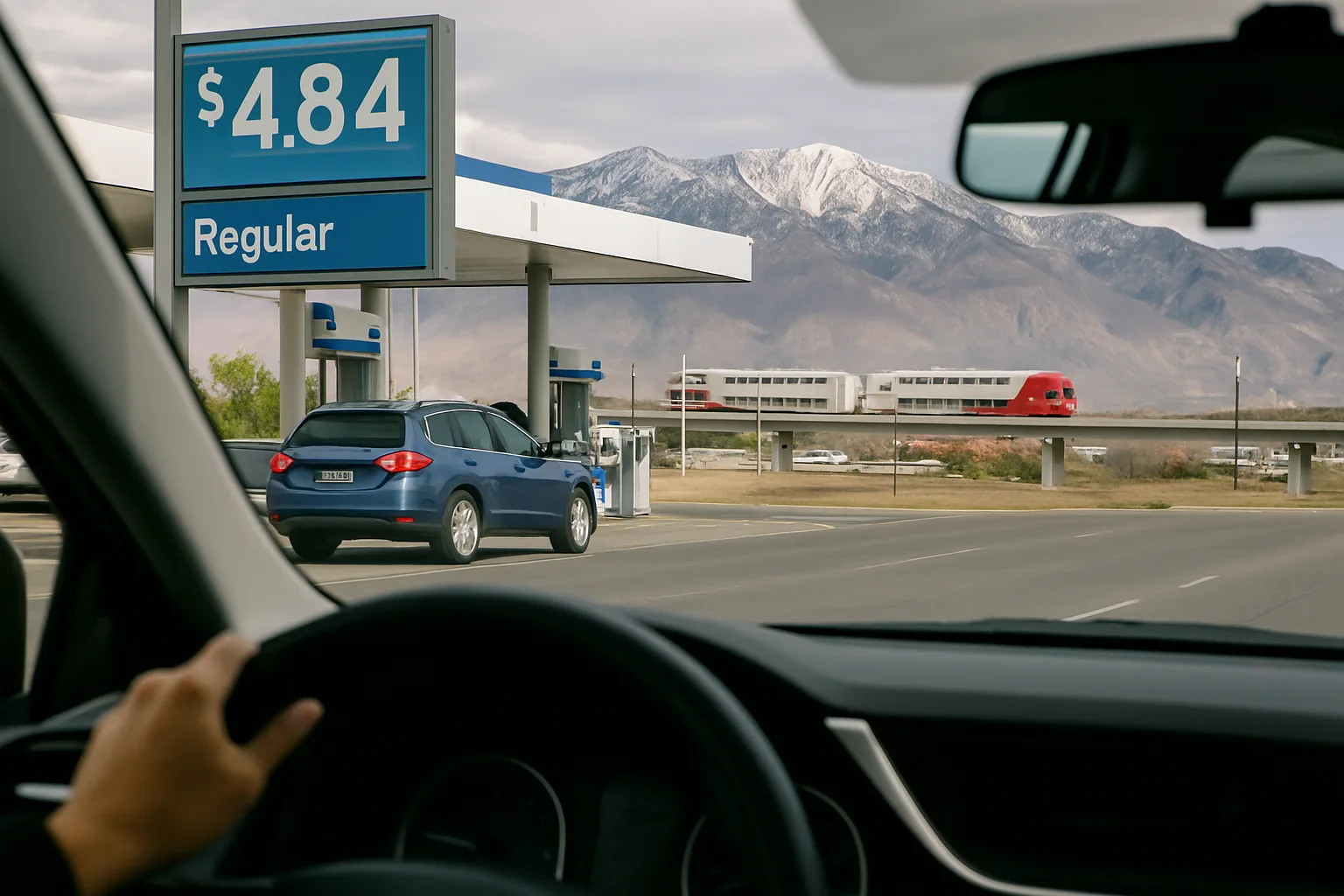
Gas Near $5 in Utah: How to Price a Longer Commute Before Buying a Home in 2026
With Utah gas averaging $4.84 a gallon in October 2026, a longer commute can cancel out a cheaper home. A worked example shows how to price the drive and compare it with FrontRunner and EV costs.
On October 10, 2026, AAA put Utah's average price for a gallon of regular at $4.84. A year earlier it was $3.37. A month earlier it was $4.69. The national average on the same day was $4.37, which leaves Utah drivers paying close to 50 cents a gallon more than the country as a whole. The Salt Lake Tribune reported in early October that Utah's average had climbed about $2.18 a gallon since the conflict with Iran began on February 28, the largest increase of any state, as disruption around the Strait of Hormuz pushed up global oil prices.
For most households that is a budget problem. For homebuyers it is also a location problem. The extra miles between a house and a job get paid for every workday for as long as the household lives there, yet they rarely make it into the affordability math that lenders and buyers run. The steps below show how to put a dollar figure on a commute, using numbers that can be swapped for any address on the Wasatch Front or anywhere else in Utah.
Where Utah Gas Prices Stand in 2026
AAA's daily survey for October 10, 2026 showed a fairly tight spread across the state's metro areas:
- Statewide average: $4.84 regular, $6.31 diesel
- Salt Lake City metro: $4.75
- Ogden: $4.80
- Provo-Orem: $4.83
- Logan: $4.85
- St. George: $4.92
Prices had eased slightly from the week before, when the statewide average was $4.94, but they remain well above the year-earlier level. Utah's record average, set in July 2022, is $5.26. Pump prices move week to week, so anyone running these numbers later should replace the October figure with the current one. The method matters more than the exact price.
The Commute Cost Formula
The fuel cost of a commute comes down to four inputs:
- One-way miles from the home to the workplace, taken from a mapping app using the actual route.
- Commuting days per month. A full-time, in-office schedule averages about 21 workdays. A hybrid schedule with three office days a week is closer to 13.
- Real-world fuel economy of the vehicle, in miles per gallon. The figure on the trip computer after a few weeks of normal driving is more useful than the window sticker, especially for winter driving and canyon grades.
- Price per gallon.
The calculation: one-way miles × 2 × commuting days ÷ mpg × price per gallon = monthly fuel cost.
A Worked Example With Labelled Assumptions
The scenario below is fictional and exists only to show the math. A household is choosing between two homes. Every number is an assumption except the gas prices, which come from AAA.
- Home A: 10 miles one way to work (assumption)
- Home B: 38 miles one way to work (assumption)
- Commuting days: 21 per month (assumption)
- Vehicle: 25 mpg in real-world driving (assumption)
- Gas price: $4.84 per gallon, the AAA Utah average on October 10, 2026
Monthly fuel cost
Home A: 10 × 2 × 21 = 420 miles a month. 420 ÷ 25 = 16.8 gallons. 16.8 × $4.84 = about $81 a month.
Home B: 38 × 2 × 21 = 1,596 miles a month. 1,596 ÷ 25 = 63.84 gallons. 63.84 × $4.84 = about $309 a month.
The gap is about $228 a month, or roughly $2,734 a year, for one driver. A two-commuter household with similar routes would roughly double it.
How much the price swing alone added
At the year-earlier average of $3.37, the same Home B commute would have cost about $215 a month. The higher price adds about $94 a month to that household's budget without a single extra mile driven. Every 50-cent change in the price of gas moves the Home B fuel bill by about $32 a month.
Fuel is only part of the cost
Gas is the most visible expense, but extra miles also mean more tires, oil changes, brakes, depreciation and, in some cases, higher insurance premiums. The IRS business standard mileage rate, which the agency raised to 76 cents a mile for driving on or after July 1, 2026 because of higher fuel prices, is one rough way to estimate the all-in cost of owning and running a car. Applied to the 1,176 extra monthly miles in this example, that rate suggests about $894 a month in total vehicle cost. Ordinary commuting is not tax-deductible; the rate is used here only as a yardstick for how much driving really costs beyond the pump.
Turning Commute Cost Into Home Price
A cleaner way for buyers to compare two homes is to translate the monthly commute difference into an equivalent mortgage amount. Assuming a 30-year fixed loan at 6.5% (an assumption for illustration, not a rate quote), each $1,000 borrowed costs about $6.32 a month in principal and interest. The $228 monthly fuel gap from the example would carry roughly $36,000 of mortgage principal.
Put another way, if Home B is not at least that much cheaper than Home A, the fuel bill alone erases the savings, before counting time behind the wheel or the extra wear on the car. If the full IRS-rate cost is used instead of fuel only, the break-even gap grows several times larger.
Recent closed prices show why buyers keep making this trade. The latest monthly median sale price in Eagle Mountain was $510,000, compared with $600,910 in Lehi and $543,500 in Salt Lake City. Medians mix very different homes, so they are a starting point rather than a verdict. The useful comparison is between the specific homes on a shortlist, with each one's commute priced in. For buyers weighing Utah County suburbs on both price and drive time, this overview of Utah Valley suburbs for commuters covers the trade-offs city by city.
Comparing the Drive With FrontRunner and TRAX
Transit changes the math for buyers who live near a station and work near one. UTA's posted fares as of October 2026:
- Local bus, TRAX, UVX and S-Line: $2.50 one way, valid for two hours, or $5 for a day pass.
- FrontRunner: $2.50 for the first station plus $0.60 for each additional station, up to $9.70 for the full Provo-to-Ogden trip.
- FAREPAY card caps: riders paying with the reloadable card stop being charged after $10 a day or $40 a week on premium services such as FrontRunner, and after $5 a day or $20 a week on local service.
- Reduced fares: youth, seniors 65 and older, riders with disabilities and qualifying low-income riders pay $1 a trip, with lower caps.
Using UTA's per-station formula, a ride from the Lehi FrontRunner station to Salt Lake Central passes through four more stations (Draper, South Jordan, Murray Central and Salt Lake Central), which works out to about $4.90 each way. Five round trips a week would total $49, so the $40 weekly cap applies, or about $173 a month on average.
Most suburban riders still drive to the station. If the fictional Home B household lived 8 miles from a FrontRunner stop (an assumption), the drive to and from the station would add about $65 a month in gas at the same 25 mpg and $4.84 price. That puts the combined transit commute at roughly $238 a month, compared with about $309 in fuel for driving all the way. The savings grow once parking downtown, wear on the car and the value of reading or working on the train are counted, and shrink if the trip needs a bus or TRAX connection at the far end. FrontRunner runs Monday through Saturday, every 30 minutes at peak times and hourly otherwise, so schedules matter for anyone with an early start or late finish.
Buyers who want to lean on transit should check walking or driving distance to the nearest station before writing an offer. Utah County stations are in Provo, Orem, Vineyard, American Fork and Lehi. Buyers looking at north Lehi neighborhoods such as Traverse Mountain can measure the drive from a specific address to the Lehi station at 3101 N. Ashton Blvd. before deciding how much the train will actually be used. Buyers who would rather skip the long commute entirely may find that condos for sale in Salt Lake City close to TRAX lines put both work and transit within reach.
What an EV or Hybrid Changes
Electricity prices in Utah have not followed gasoline upward. The U.S. Energy Information Administration reported Utah's average residential rate at 13.12 cents per kilowatt-hour in July 2026, slightly lower than a year earlier. A household's actual rate depends on its utility, rate plan and season.
Using the same 1,596-mile monthly Home B commute and assuming an electric vehicle that travels 3.5 miles per kilowatt-hour, plus about 10% lost during home charging (both assumptions):
- Electricity: about 502 kWh × $0.1312 = about $66 a month
- Utah's EV registration fee: under state law, battery-electric vehicles pay an annual fee equal to the road usage charge cap, which is $180 for 2026 and $280 for 2027. That adds about $15 a month this year and about $23 next year.
- Total: roughly $81 a month, compared with about $309 for gas at 25 mpg
A conventional hybrid at an assumed 45 mpg would burn about 35.5 gallons for the same commute, or about $172 a month at $4.84. Hybrids also pay a smaller registration surcharge than full EVs.
Two caveats matter for homebuyers. First, the cheapest charging happens at home, which depends on a garage or driveway with access to a 240-volt circuit. Condos, townhomes and homes with street parking may require HOA approval or rely on public chargers, which usually cost more per kWh. Second, solar panels can cut charging costs further; listings of Eagle Mountain homes with solar show what is currently on the market. Buyers should ask whether a system is owned or leased and request the past year of utility bills.
A Checklist for Pricing the Commute Before an Offer
- Drive the route at rush hour. Map distance is fixed; time is not. A test drive on a weekday morning shows what the commute actually feels like.
- Price it at today's gas price and at $1 higher. A budget that only works at today's price has no cushion.
- Count every commuter. Two working adults, or a teen driving to school, can multiply the cost.
- Ask about hybrid or remote schedules in writing. A workplace policy can change after closing; the house cannot move.
- Check station access and parking. Park-and-ride lots and transfer times can make or break a transit plan.
- Look at charging access if an EV is in the household's future, including HOA rules for condos and townhomes.
- Convert the monthly difference into a price difference using the mortgage math above, then compare it with the actual list prices.
Search tools on Best Utah Real Estate show active listings across the state, which makes it easier to compare homes closer to work against cheaper options farther out once the commute is priced in.
Frequently asked questions
What is the average gas price in Utah right now?
AAA reported Utah's average for regular gasoline at $4.84 a gallon on October 10, 2026, compared with $3.37 a year earlier and a national average of $4.37 that day. Prices change daily, so AAA's Utah page is the best place to check the current figure before running commute numbers.
How can a buyer calculate the monthly gas cost of a commute?
Multiply one-way miles by 2, then by commuting days per month, divide by the vehicle's real-world miles per gallon, and multiply by the price per gallon. A 38-mile one-way commute, 21 days a month, at 25 mpg and $4.84 a gallon comes to about $309 a month.
How much house price difference does a longer commute cancel out?
Divide the monthly commute difference by the monthly payment per $1,000 borrowed. At an assumed 6.5% 30-year fixed rate, each $1,000 costs about $6.32 a month, so a $228 monthly fuel gap is roughly equal to $36,000 of mortgage principal, before counting vehicle wear and time.
How much does FrontRunner cost for a daily commute?
FrontRunner costs $2.50 for the first station plus $0.60 for each additional station, up to $9.70 one way. Riders using a FAREPAY card are capped at $10 a day and $40 a week on premium services, which works out to about $173 a month for a five-day commuter who reaches the cap.
Is it cheaper to commute in an electric vehicle in Utah?
For long commutes, usually yes. At Utah's July 2026 average residential electricity rate of 13.12 cents per kWh, a 1,596-mile month in an EV that goes 3.5 miles per kWh costs about $66 in electricity with charging losses, plus about $15 a month for the state's $180 annual EV registration fee in 2026. The same miles cost about $309 in gas at 25 mpg.
What is Utah's electric vehicle registration fee?
Utah charges battery-electric vehicles an annual fee equal to the state's road usage charge cap, which is $180 for 2026 and rises to $280 in 2027 under Utah Code 72-1-213.1. Owners can instead enroll in the road usage charge program and pay per mile up to that cap. Hybrids and plug-in hybrids pay smaller surcharges.
Keep reading
More from the blog

Why Utah Homes Aren't Selling in Fall 2026: What 18,000 Active Listings Show

Fall Color Drives by Home Base: Which Wasatch Front Canyon Is Closest in 2026

Wasatch Front Halloween 2026: Haunts, Corn Mazes and Witch Displays by Scare Level