The Power District and Salt Lake City's West Side: A Buyer's Guide to What's Real in 2026
A 10-story Rocky Mountain Power tower is rising on North Temple, but the MLB ballpark is still waiting on a league decision. Here is what's approved, what's pending and what the data shows for nearby west-side neighborhoods in 2026.
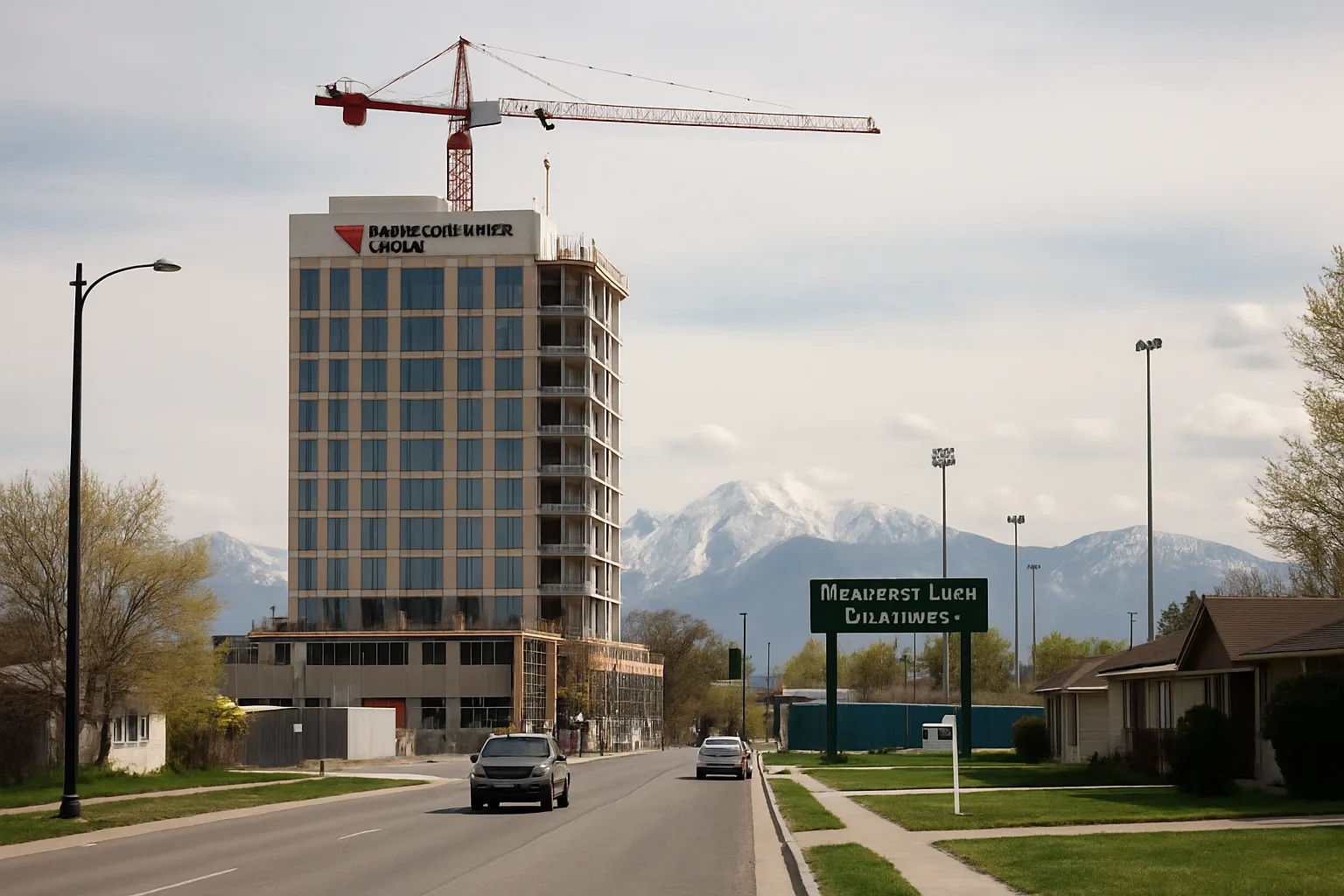
A 10-story office tower is going up at North Temple and 1460 West, and it is the first visible piece of a major redevelopment on Salt Lake City's west side. The Power District, a roughly 100-acre site along the Jordan River next to the Utah State Fairpark, is being built by the Larry H. Miller Company as a $3.5 billion mixed-use project. Part of the land is reserved for a Major League Baseball stadium that does not yet have a team.
For anyone buying or renting in Fairpark, Rose Park, Poplar Grove or Glendale, the useful question is not whether baseball will come. It is which parts of the plan are already approved or under construction, which parts are still contingent, and what the public record actually says about nearby housing. This breakdown separates the two and sticks to what has been documented.
What Is Already Approved or Under Construction
The state district (2024)
In February 2024 the Utah Legislature passed H.B. 562, which created the Utah Fairpark Area Investment and Restoration District. The law's stated goals are to protect the State Fairpark, rehabilitate the Jordan River, clean up an industrial site and revitalize the west side. It also set up a framework for a state-owned ballpark if Utah lands an MLB franchise by 2032, and it gave Salt Lake City and the developer until December 31, 2024 to reach a land-use agreement.
The city rezone (December 10, 2024)
The Salt Lake City Council voted unanimously on December 10, 2024 to rezone about 93 acres owned by the Larry H. Miller Company, running from the Jordan River to Redwood Road and from North Temple to I-80. The council approved a 40-year development agreement and a services agreement with the new district the same night. As reported by KSL, the key terms include:
- At least 10% of new housing built over the life of the agreement must be affordable to households earning 80% of area median income.
- At least 20% of new housing must be family-sized, with two or three bedrooms.
- Buildings may rise to 400 feet, subject to FAA clearance, with city design review above 200 feet.
- The company may keep temporary surface parking lots for up to 15 years.
- The city receives a quarter of the added property tax generated inside the district and will produce an annual audit of its costs and sales tax tied to the project.
The Tribune reported during the planning review that no existing housing sits inside the district boundaries; the site holds Rocky Mountain Power's offices along with a few commercial parcels. That matters for neighbors, because the project itself does not demolish homes.
The Rocky Mountain Power headquarters (2025 to 2027)
Rocky Mountain Power broke ground on October 27, 2025 on a new 10-story, roughly 300,000-square-foot corporate campus at North Temple and 1460 West. KSL reported that the offices are expected to be finished in September 2027, after which the old building will be demolished to free the land where a stadium could go. The developer said it wanted that site ready for construction by October 2026.
Jordan River work
The company has hired a landscape architecture firm to restore a half-mile stretch of the Jordan River, both banks, with goals that include water quality, native plants and a riverwalk. Its CEO described it to the Deseret News as an "eight-figure" investment. As of early 2026, most work on the site had been underground, mainly water and storm sewer lines, and the full project was expected to take about a decade.
What Is Still Proposed or Contingent
The ballpark
The stadium depends entirely on MLB expansion, and MLB has not opened a formal expansion process. Commissioner Rob Manfred has said he wants expansion settled before he retires in January 2029, and the Deseret News reported in August 2026 that new teams likely would not begin play until at least 2032 or 2033. National baseball writers have repeatedly described Salt Lake City as a leading candidate, with Nashville the main competitor, but no award has been made.
If a team is awarded, state law caps the public contribution at up to $900 million, drawn mainly from state sales tax generated within the district and a rental car tax that only takes effect once Utah has a franchise. The state would own the stadium and land and lease it to the team. Those stadium tax provisions are tied to a franchise award by 2032. The city rezone, by contrast, already allows residential and mixed-use development on the land whether or not baseball arrives.
Housing, hotel and retail inside the district
Plans and renderings show offices, housing, a hotel, dining, retail, trails and green space. None of these buildings has a published construction date. The affordable-housing percentages above apply over the 40-year agreement, not to a specific first phase, so the timing and number of new units are still open questions.
Transit and Airport Access
The district sits on the TRAX Green Line, which runs down the middle of North Temple between downtown and Salt Lake City International Airport. The Fairpark station is at about 1150 West North Temple, and the Power station, at roughly 1480 West, sits right next to the Rocky Mountain Power site. From there the line continues west to a 1940 West stop and then the airport terminal. For residents, that means a one-seat rail ride to both downtown and the airport already exists today, independent of whatever is built.
Game-day traffic is a different matter. With the ballpark still in early design, no public traffic or parking plan for events has been released. The city's planning commission asked for further review of airport-area traffic protections when it recommended the rezone, and the temporary parking allowance in the agreement suggests surface lots will be part of the picture for years. Buyers on streets that feed North Temple, Redwood Road or 1000 West should treat event traffic as an unknown, not a known quantity.
What the Numbers Say About Nearby Neighborhoods
Four neighborhoods surround the site. Fairpark sits next to it, Rose Park lies to the north, and Poplar Grove and Glendale stretch to the south. Rose Park homes carry the 84116 ZIP code, while most of Glendale and Poplar Grove fall in 84104.
MLS data pulled on October 10, 2026 shows:
- 84116: 82 active residential listings with a median asking price of $459,500. The median closed price over the past 12 months was $460,000, compared with $440,000 in the 12 months before that.
- 84104: 69 active residential listings with a median asking price of $410,000. The median closed price over the past 12 months was $413,500, compared with $401,250 the year before.
Those are modest gains of roughly 3% to 5%, and the data alone cannot attribute any change to the Power District. For comparison, the citywide median sale price for Salt Lake City is currently $543,500, and homes are selling in a median of 15 days. Buyers who want to stay under that figure can track the Salt Lake City homes under $500K list.
Rents and displacement concerns
No public dataset yet measures rent changes tied to the project. What the record does show is concern. In 2024 the Tribune reported that the All Seasons mobile home park near the district had about 240 residents, most of whom own their homes but rent the land, and that the park's manager said it was not for sale despite frequent calls from buyers. A University of Utah planning professor told the paper he expected Fairpark to gentrify, particularly if a ballpark is built, and warned that rising property values could push up taxes that landlords pass on. City leaders called displacement unacceptable, and the city's Redevelopment Agency had committed $17.7 million that year toward more than 1,500 new housing units.
A Practical Checklist for West-Side Buyers
- Separate the timeline. The RMP campus (2027) and river work are funded and underway. The stadium and most district buildings are not scheduled.
- Price the home as it stands. Pay for the house, lot and current neighborhood, not for a ballpark that may or may not arrive in the early 2030s.
- Map the corridors. Homes a block off North Temple, Redwood Road or 1000 West may see construction traffic for years and event traffic later.
- Use the rail line. Walking distance to the Fairpark or Power TRAX stations already delivers airport and downtown access today.
- Watch property taxes. Rising assessed values are the most concrete near-term cost risk noted by researchers; Salt Lake County's annual valuation notice is the place to check.
- Follow the public process. District board meetings and city council agendas are where housing phases, parking and event plans will be decided.
The Bottom Line
The Power District is real, funded and under construction, but the ballpark at its center is still a proposal waiting on a league decision. Nearby prices have moved like the rest of the city so far, and the clearest benefits for neighbors today are the TRAX line and the river cleanup. Buyers weighing a west-side home can compare neighborhoods such as Westpointe, Rose Park and Glendale and see current listings at Best Utah Real Estate.
Frequently asked questions
Where is the Power District in Salt Lake City?
The Power District is on Salt Lake City's west side, next to the Utah State Fairpark and the Jordan River. The rezoned area covers about 93 acres running from the Jordan River to Redwood Road and from North Temple to I-80, including the current Rocky Mountain Power offices.
Has Salt Lake City been awarded an MLB team?
No. As of October 2026, Major League Baseball had not opened a formal expansion process or awarded any new team. Salt Lake City is widely reported as a leading candidate, and Commissioner Rob Manfred has said he wants expansion settled before he retires in January 2029.
When will the new Rocky Mountain Power headquarters be finished?
Rocky Mountain Power broke ground on October 27, 2025 on a 10-story, roughly 300,000-square-foot campus at North Temple and 1460 West. KSL reported the offices are expected to be complete in September 2027, after which the old building is slated for demolition.
Does the Power District include affordable housing?
The development agreement approved by the Salt Lake City Council on December 10, 2024 requires that at least 10% of new housing built over its 40-year term be affordable to households at 80% of area median income, and that at least 20% be family-sized with two or three bedrooms. No housing construction dates have been published yet.
How do you get from the Power District to the airport?
The TRAX Green Line runs along North Temple past the Fairpark and Power stations and continues west to Salt Lake City International Airport. The same line runs east into downtown, so residents near those stations already have a one-seat rail ride in both directions.
Are home prices rising near the Power District?
Not dramatically so far. MLS data from October 2026 shows the median closed price in the 84116 ZIP code (Rose Park) rose from $440,000 to $460,000 year over year, and in 84104 (most of Glendale and Poplar Grove) from $401,250 to $413,500. The data does not show how much of that change, if any, is linked to the project.
Salt Lake City, Utah housing market
A quick read on what homes are doing in Salt Lake City right now — pulled live from the MLS.
Keep reading
More from the blog
55+ Communities in the Salt Lake City Area
Moving to South Salt Lake, Utah: The 2026 Guide
Moving to Salt Lake City: How to Choose the Right Utah Area