Artificial grass vs natural turf: a 10-year cost comparison
Over a 10-year period, artificial grass typically costs less than natural turf when you factor in installation, water, maintenance, and labor. The upfront price of synthetic turf is significantly higher, but those ongoing savings add up fast enough that most homeowners break even somewhere between year five and year eight. If you're trying to decide which option actually makes financial sense for your property, the answer depends heavily on your yard size, local water rates, and how much you currently spend on lawn care.
How much does each option cost to install?
Natural grass is the clear winner on day one. Sod installation typically runs $0.50 to $3 per square foot, which means a standard 1,000 sq. ft. lawn might cost you $500 to $3,000 all in. Seeding is even cheaper, though it takes longer to establish and requires more babysitting through the early weeks.
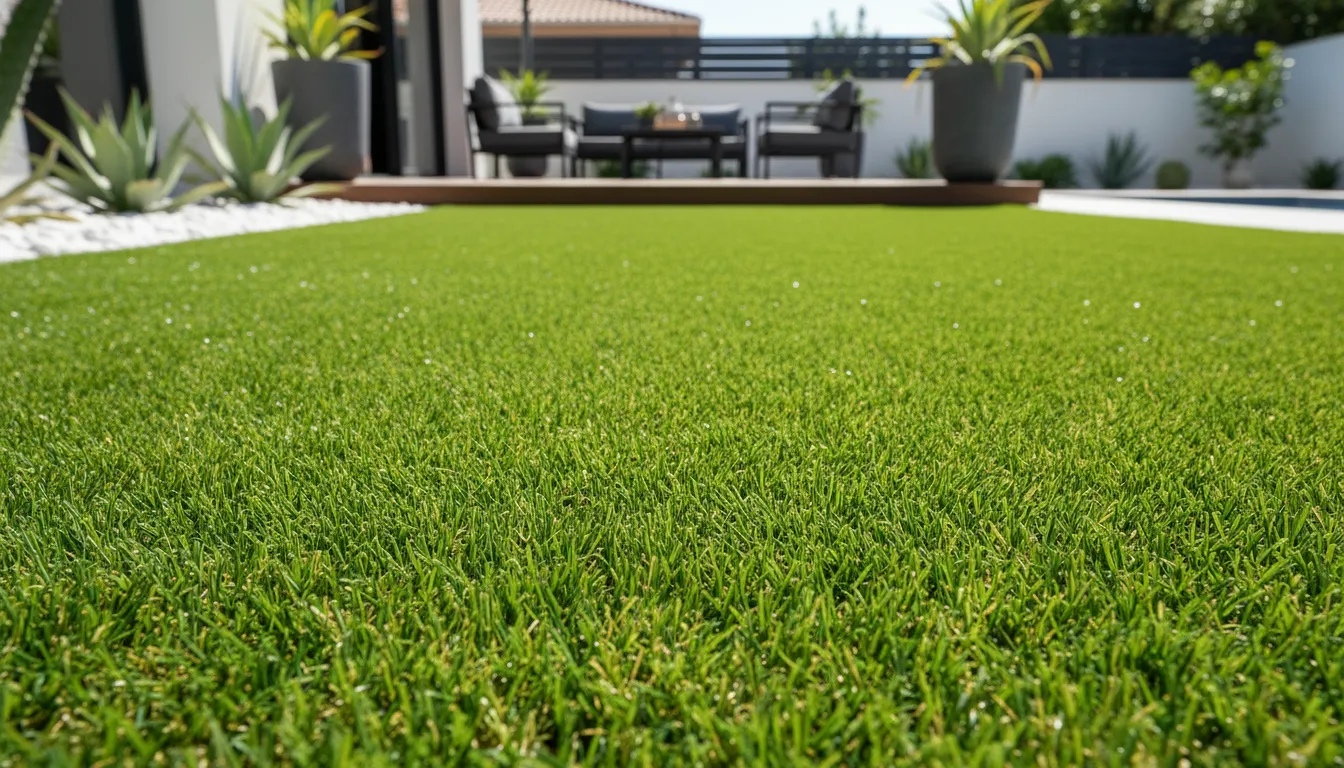
Artificial turf is a different story. Installation ranges from $8 to $20 per square foot depending on turf quality, base preparation, infill type, drainage, and labor. That same 1,000 sq. ft. lawn could run anywhere from $8,000 to $20,000. For a typical residential backyard, most homeowners land somewhere between $10,000 and $15,000 after everything is done right.
That gap looks scary at first. But installation cost is just the starting point.
What does maintenance actually cost year over year?
Natural grass maintenance costs consistently outpace what synthetic turf requires. Here's what a typical homeowner spends annually on a natural lawn:
-
Mowing (weekly during growing season, professional service): $1,200 to $2,400 per year
-
Fertilizing and weed control: $200 to $500 per year
-
Irrigation and water bills: $600 to $1,200 per year depending on your region
-
Irrigation system maintenance: $100 to $200 per year
-
Aeration, overseeding, and seasonal repairs: $300 to $700 per year
Add it up and you're looking at $2,400 to $5,000 annually for a properly maintained natural lawn. Over 10 years, that's $24,000 to $50,000 on top of your install costs.
Artificial turf, on the other hand, needs very little. Occasional brushing to keep the blades standing, rinsing to clear dust or pet odors, and periodic infill top-up in high-traffic areas. Most homeowners spend $150 to $350 per year maintaining synthetic turf. Over 10 years, that's $1,500 to $3,500 total.
The 10-year cost comparison, side by side
|
Cost category |
Natural grass (1,000 sq. ft.) |
Artificial turf (1,000 sq. ft.) |
|
Initial installation |
$500 to $3,000 |
$8,000 to $20,000 |
|
Annual maintenance |
$2,400 to $5,000 |
$150 to $350 |
|
Total over 10 years |
$24,500 to $53,000 |
$9,500 to $23,500 |
These numbers reflect a realistic mid-range scenario for a homeowner using a professional lawn care service and living in a region with average water costs. If you mow yourself and have cheap water, the break-even point shifts further out. If you pay for full-service lawn care and live somewhere like Southern California or Arizona where water is expensive, artificial turf starts paying for itself much sooner.
When does artificial turf break even?
For most homeowners using professional lawn care services, the break-even point lands around year five to seven. The formula is straightforward: take the difference in installation costs and divide it by your annual savings in maintenance and water. If you installed turf for $12,000 and were previously spending $3,000 per year on the lawn while turf costs you $300 per year, you're saving $2,700 per year. That $12,000 upfront difference gets recovered in about 4.5 years.
This is also where the artificial turf cost conversation gets interesting. The math changes based on your personal situation, but the direction almost always points the same way over a long enough time horizon. Savings compound.
What drives natural grass costs higher than people expect?
Most homeowners underestimate what they spend on their lawn because the costs are spread out and easy to overlook. The mower you replace every eight years. The irrigation head that blows out in summer. The re-sodding after a bad drought year or a dog tears up a corner. The fertilizer runs every spring and fall. None of these feel like big money in isolation, but together they represent a substantial ongoing drain.
Water is often the biggest hidden cost. A 1,000 sq. ft. lawn needs roughly 600 to 1,000 gallons per week during peak season. In states like Texas, Florida, or Nevada, that adds up to tens of thousands of gallons per year. Depending on your local utility rates, you could easily spend $800 to $1,500 on lawn irrigation alone every summer.
Does site preparation affect the total cost?
Yes, significantly. Both grass types need a properly graded, well-draining base to perform well and last. Slopes, drainage problems, existing tree roots, or old concrete that needs breaking up can add thousands to any project. This is where a lot of cost estimates fall apart: people get a materials quote without accounting for site work.
For artificial turf, the base installation is especially critical. A poor base leads to poor drainage, uneven surfaces, and premature wear. Companies like local site preparation expert Site Prep handle this phase properly, making sure the grading, compaction, and sub-base work are done correctly before any turf goes down. Cutting corners at this stage leads to expensive fixes later.
Natural grass also benefits from proper site prep. Topsoil depth, soil composition, and grading all affect how well a lawn establishes and how much water it needs long-term. Skipping this step is one of the main reasons natural lawns underperform and end up requiring more maintenance than expected.
How long does artificial turf actually last?
High-quality artificial turf installed correctly lasts 15 to 20 years. Some products carry warranties of 8 to 10 years but will perform well beyond that with reasonable care. The main factors that shorten lifespan are heavy foot traffic without periodic infill replenishment, extreme heat without cooling measures, and UV degradation on lower-grade products.
Natural grass does not have a defined lifespan, but it does require periodic investment to stay healthy. Re-sodding damaged areas, overseeding thin spots, and occasional full renovation can cost several thousand dollars each time they become necessary.
Are there any costs that catch people off guard with artificial turf?
A few things tend to surprise first-time turf owners:
-
Infill replacement in high-use areas every few years: $100 to $300 per zone;
-
Professional deep cleaning for pet areas: $150 to $300 per visit if needed;
-
Heat: synthetic turf can reach 140 to 160°F on hot summer days, which some homeowners find limits use during afternoon hours;
-
End-of-life disposal: when the turf eventually needs replacing, disposal is an added cost, and recycling options are still limited in many areas.
None of these are deal-breakers, but they're worth knowing going in so your budget is realistic.
What does academic research say about long-term costs?
The cost argument in favor of synthetic turf has been studied repeatedly, particularly in the context of athletic fields. One academic study on turf maintenance expenses, published through a university sports management program, found that while synthetic fields require higher capital investment, the cost per hour of actual use was substantially lower than natural grass fields that need regular rest periods for recovery. For residential use, the underlying logic holds even if the scale is different.
Which option is right for your situation?
Artificial turf makes the most financial sense for homeowners who use professional lawn services, live in dry or hot climates, have kids or pets who use the yard heavily, or simply want to eliminate lawn maintenance from their weekends. The higher upfront cost is real, but over a decade it typically results in meaningful savings.
Natural grass is still the better choice if you're on a tight short-term budget, love working in the yard, or have a large property where full synthetic turf installation would run into six figures. Grass also has environmental benefits like carbon sequestration and habitat value that synthetic turf does not replicate.
The decision is not purely financial, but for most homeowners who run the full 10-year numbers honestly, the math usually favors turf by a clear margin.
Keep reading
More from the blog
Gas Line Installation: What Homeowners Need to Know First
Roof Timeline Guide for Buying an Older Utah Home
How to Choose Windows for a Utah Home With a Mountain View