Before You Dig in Utah: Blue Stakes 811 Rules for Fences, Trees and Sprinklers
Fence posts, new trees and sprinkler trenches all count as digging under Utah law. Here is how Blue Stakes 811 works, what the paint colors mean, which private lines go unmarked and what to do if a gas line is hit.
Natural gas service lines, fiber cables and electric lines can sit just a few inches under a Utah lawn. A post-hole digger, a stump grinder or a trencher for new sprinkler lines can reach them in seconds. Utah's answer is a free notification system, Blue Stakes of Utah 811, and a state law that spells out who has to call, how far ahead, and who pays when something gets hit.
This guide walks Utah homeowners through the rules project by project, explains what the colored paint and flags mean, covers the private lines utility locators will not mark, and lists the safety steps to take if a shovel finds a gas line anyway. The rules below reflect Utah Code Title 54, Chapter 8a, as in effect in 2026.
What Utah Law Requires
Utah defines excavation broadly: any operation in which earth, rock or other material on or below the ground is moved or displaced by tools, equipment, explosives or demolition. Under Utah Code Section 54-8a-4, anyone who excavates must notify the operators of underground facilities in the area first. A request to Blue Stakes counts as notice to every member operator with lines at the site.
The statute carves out three narrow exceptions to the notice requirement: emergencies, gardening, and tilling private ground. Setting fence posts, planting trees, digging footings for a deck or pergola, trenching for sprinklers, installing a pool and regrading a yard are not on that list. Blue Stakes' own guidance is to call no matter how shallow the digging, because many cables and pipes lie at very shallow depths.
Timing: the 48-hour rule and the 14-day window
- Not too early, not too late. Notice must be given at least 48 hours before digging starts and no more than 14 days before.
- Utah counts 48 hours in business days. The clock starts at 8:00 a.m. on the first business day after the request and skips Saturdays, Sundays and holidays. Blue Stakes advises planning to submit a request at least three business days before work begins.
- Holidays include more than the obvious ones. State law adds the Friday after Thanksgiving and December 24 to the list of holidays, which matters for fall projects.
- Requests expire. A locate request is valid for 21 days. Longer projects need an update before it runs out.
How to submit a request
Homeowners digging at a single address can submit a request online at any hour, or call 811 (or 1-800-662-4111). New requests are processed during business hours, 8 a.m. to 4 p.m. on weekdays, excluding holidays. The service is free to the person digging; member utilities fund it. Expect to describe the location, the area to be dug, its rough dimensions and the type of work. If the dig area is hard to describe, the law allows outlining it in white paint or flags.
Project-by-Project Notes for Homeowners
Fences
Fence lines often follow property boundaries, and utility easements commonly run along lot lines too. Every post hole is a separate chance to hit a line. Anyone weighing materials and layout can find planning tips in this look at what to consider before a new fence installation; the locate request should come before the first post hole. Owners of larger lots, such as horse properties in Herriman, often run long pasture fences that cross service lines several times.
Trees and shrubs
A hole for a tree's root ball is wide and deep, and service lines reach the house from the street, so a front-yard tree can easily land on top of one.
Sprinklers and landscaping
New construction neighborhoods are where much of Utah's first-time landscaping happens. Buyers moving into new construction in Saratoga Springs or newer subdivisions in Eagle Mountain often finish back yards themselves, adding sprinklers, drip lines and planters. Trenching for irrigation counts as excavation.
Pools, decks, sheds and patios
A pool dig moves a large volume of soil, and the lines that feed a pool heater or outdoor kitchen are usually private. Homes with existing pools, like many homes with pools in Washington, Utah, may already have buried electrical and gas lines running across the yard that no utility will mark.
What the Colors Mean
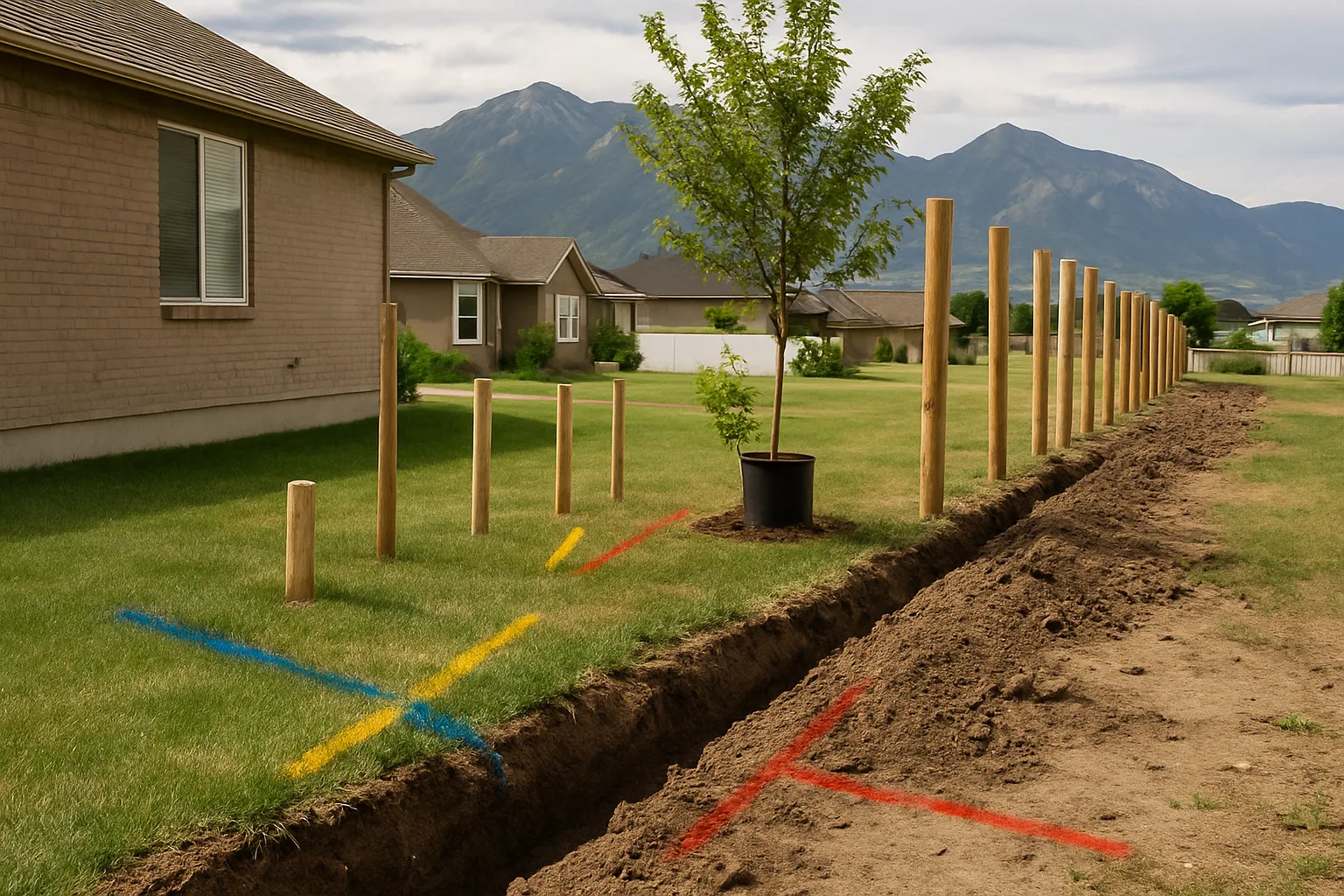
Locators mark with paint or flags using the American Public Works Association color code:
- Red: electric power lines, cables, conduit and lighting cables
- Yellow: gas, oil, steam, petroleum or other gaseous materials
- Orange: communication, alarm or signal lines and cables
- Blue: potable water
- Purple: reclaimed water, irrigation and slurry lines
- Green: sewers and drain lines
- White: proposed excavation
- Pink: temporary survey markings
Marks show the approximate location and direction of a line, not its depth. Utah law sets a tolerance zone of 24 inches on either side of the outside edge of a mark (or half the marked diameter plus 24 inches from the center when a diameter is marked). Inside that zone, power equipment is off-limits until the line's exact location is confirmed by digging carefully with hand tools. If marks fade or get scraped away, the excavator has to request a re-mark before continuing; a re-mark does not extend the 21-day life of the request.
Private Lines: What Blue Stakes Will Not Mark
This is the part that surprises most homeowners. Utah law only requires utilities to mark facilities they own, which usually means up to the meter. The statute specifically says an operator need not mark a water or sewer lateral or a facility running from a house to a garage or outbuilding. According to Blue Stakes' FAQ, lines that are typically unmarked include:
- Water and sewer laterals
- Power to a detached garage, shop or lamppost
- Sprinkler and irrigation systems
- Lines connected to a propane tank or septic system
- Gas lines from the meter to a pool heater or barbecue (a point Enbridge Gas also makes in its homeowner guidance)
Blue Stakes notes that private lines are especially common in townhome complexes, mobile home parks, gated subdivisions and cabin communities. For these, homeowners can hire a private locating company, which charges a fee. Old plans, permit records and the sellers' disclosures from the purchase can also help show where a previous owner ran lines.
Who Pays When a Line Is Hit
Utah's statute puts real weight on the notice requirement:
- No call, presumed negligent. If someone damages an underground facility without giving the required notice, that is prima facie evidence the excavator is liable for the damage caused by their negligence.
- Digging inside the tolerance zone. An excavator is liable for damage inside the tolerance zone when the operator marked correctly.
- Civil penalties. A violation can carry a penalty of up to $5,000, capped at $100,000 per excavation, plus up to $500 for failing to give notice. Penalties apply only when someone fails to comply and damages a facility. Excavating with hand tools on property the excavator owns or occupies is exempt from the civil penalty, but that exemption does not erase liability for repair costs.
- Utility errors. No civil penalty can be imposed on an excavator when damage results from the operator's failure to mark or inaccurate marking.
Homeowners hiring out the work should not assume the contractor has called. A simple request for the locate ticket number before work starts confirms it. Each excavator working the same site is required to give its own notice.
If a Gas Line Is Hit or Gas Is Smelled
Utility gas is treated with an odorant that smells like rotten eggs or sulfur. Other signs include a hissing or whistling sound and dead or dying vegetation over a buried line. Enbridge Gas, the natural gas utility in Utah, recommends these steps:
- Stop work and shut off any powered equipment.
- Leave the area immediately, leaving doors and windows open on the way out if that can be done without delay.
- Do not use phones, light switches or electronics near the leak, do not smoke, and do not start a vehicle nearby.
- From a safe distance, call 911 and Enbridge Gas's 24-hour emergency line at 1-800-767-1689.
- Do not try to repair the line or put out a gas fire.
Utah law also requires anyone who contacts or damages a facility to notify the operator immediately, and to call 911 when gas, electricity or another hazardous material escapes. The duty covers contact as well as obvious damage, so even a scrape or dent gets reported, and backfilling around the line has to wait until the utility authorizes it.
A Simple Pre-Dig Checklist
- Outline the dig area and decide the start date.
- Submit a Blue Stakes request at least three business days ahead, and no more than 14 days ahead.
- Check the request's response status and look for marks from every listed utility.
- Hire a private locator for sprinkler, outbuilding, pool, propane and other private lines.
- Hand-dig within 24 inches of any mark.
- Keep the marks visible and renew the request if work runs past 21 days.
Bottom Line
Calling 811 costs nothing and takes a few minutes, while hitting a line can mean a gas evacuation, a neighborhood outage and a repair bill with the homeowner's name on it. The rules are straightforward: request locates two to three business days ahead, respect the 24-inch tolerance zone, and remember that private lines need a private locator. Buyers planning yard projects after a move can browse current listings at Best Utah Real Estate.
Frequently asked questions
Do Utah homeowners have to call 811 before digging?
Generally, yes. Utah Code 54-8a-4 requires anyone who excavates to notify underground facility operators first, and a request through Blue Stakes of Utah 811 provides that notice. The statute exempts emergencies, gardening and tilling private ground, but projects such as fence posts, tree planting, sprinkler trenches and pools are not exempt.
How far in advance should a Blue Stakes request be made in Utah?
At least 48 hours before digging, counted in business days starting at 8 a.m. on the first business day after the request, and no more than 14 days before. Blue Stakes recommends submitting at least three business days ahead. A request stays valid for 21 days.
Does Blue Stakes mark sprinkler lines and other private lines?
No. Utilities only have to mark the lines they own, usually up to the meter. Sprinkler systems, water and sewer laterals, power to detached garages or lampposts, and lines to propane tanks, septic systems, pool heaters or barbecues are typically private and need a private locating company, which charges a fee.
What do the paint colors from utility locators mean?
Red is electric, yellow is gas or other petroleum products, orange is communications, blue is drinking water, purple is reclaimed water and irrigation, green is sewer and drain lines, white marks the proposed dig area and pink is temporary survey marking. Marks show approximate location and direction, not depth.
Who pays if a homeowner hits a utility line in Utah?
Under Utah law, damaging a facility without giving the required notice is prima facie evidence the excavator is liable for the damage. Digging inside the 24-inch tolerance zone of a correct mark also makes the excavator liable. Hand digging on one's own property is exempt from civil penalties, but not from responsibility for repair costs.
What should someone do after hitting a gas line?
Stop work, shut off equipment and leave the area right away, without using phones, switches or anything that could spark. From a safe distance, call 911 and Enbridge Gas's 24-hour emergency line at 1-800-767-1689. Do not try to fix the line or put out a gas fire.
Keep reading
More from the blog

Cost Segregation for Rental Owners: Choosing a Study Provider

Utah HOA Rules That Surprise Buyers in 2026 and What State Law Won't Let HOAs Ban
Buying a Bear Lake Cabin: Lake Levels, Rental Rules and Winter Access