Percale vs. Sateen vs. Linen vs. Bamboo Sheets: Thread Count Myths and Picks for Every Sleeper
Percale, sateen, linen, bamboo viscose or microfiber: which sheets sleep coolest, why thread count misleads, and which sets suit each type of sleeper.
Two sheet sets can carry the same thread count, the same "100% cotton" label and a similar price, and still sleep completely differently. One feels like a cool, crisp hotel bed; the other feels smooth and heavy and traps a little more warmth. The difference is mostly the weave and the fiber, not the number printed in large type on the package.
This guide explains how percale, sateen, linen, bamboo-derived viscose and microfiber actually differ, why thread count is one of the least useful numbers on the label, how to read certification and fit claims, and which widely sold sets fit each type of sleeper.
As an Amazon Associate, Best Utah Real Estate earns from qualifying purchases.
Quick verdict: which sheets for which sleeper
- Hot sleepers who like a crisp, cool feel: cotton percale, such as the Brooklinen Percale Sheet Set.
- Anyone who wants smooth, silky cotton on a budget: a 400-thread-count cotton sateen set such as the California Design Den 100% Cotton Sateen Sheet Set.
- Very hot sleepers and humid bedrooms: linen, such as the Simple&Opulence 100% French Linen Sheet Set, if a textured, wrinkled look is welcome.
- Sleepers who want the softest, most fluid drape: viscose from bamboo, such as the Cozy Earth Bamboo Sheet Set, with careful washing.
- Guest rooms, kids' rooms and tight budgets: brushed microfiber such as the Mellanni Iconic Sheet Set, which resists wrinkles but breathes less than natural fibers.
Sheet fabrics compared
| Fabric | Feel | Sleeps | Wrinkles | Typical thread count | Main trade-off | Price tier |
|---|---|---|---|---|---|---|
| Cotton percale | Crisp, matte, light | Cool | Moderate to high | 200–400 | Can feel stiff for the first few washes | Budget to premium |
| Cotton sateen | Smooth, silky, slight sheen | Neutral to slightly warm | Low to moderate | 300–600 | Floating yarns can snag and pill sooner | Budget to premium |
| Linen (flax) | Textured, heavier, softens over time | Very cool, dries fast | High | Rarely listed; low by design | Rough at first; always looks rumpled | Mid-range to premium |
| Viscose from bamboo | Very smooth, drapey, cool to the touch | Cool | Low to moderate | Not meaningful | Weaker when wet; shrinks with hot drying | Mid-range to premium |
| Polyester microfiber | Soft, brushed, peach-skin | Warm | Very low | Not meaningful (sold by GSM) | Less breathable; can pill | Budget |
Weave first: percale vs. sateen
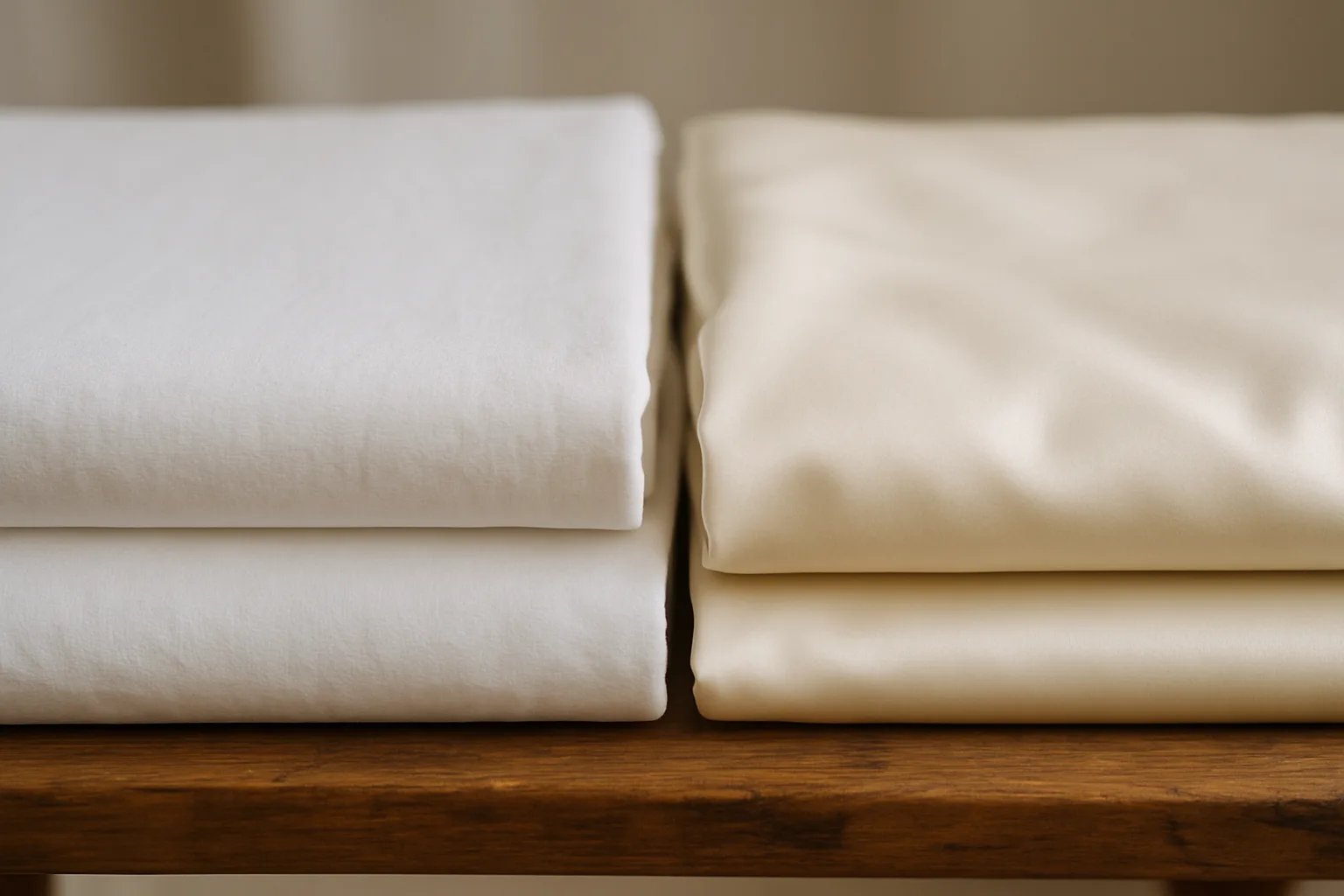
Most cotton sheets are woven one of two ways, and that choice shapes the feel more than the cotton itself.
Percale
Percale is a plain weave: each crosswise yarn passes over one lengthwise yarn and under the next, in a tight one-over, one-under grid. The result is a matte surface with a dry, crisp hand, the "cool side of the pillow" feeling that people associate with hotel beds. Because the weave is balanced and open, air moves through it easily, which is why percale is the usual recommendation for people who wake up warm. The downsides are wrinkles and an initial stiffness that relaxes after several washes.
Sateen
Sateen floats yarns over several others before tucking under one (commonly a three- or four-over, one-under pattern). Those longer floats put more yarn on the surface, so the fabric looks lustrous, feels smoother and drapes closer to the body. Sateen tends to wrinkle less and feel a little warmer and heavier than percale. Those same floats are more exposed to abrasion, so sateen can pill or snag sooner, especially when it is dried hot or washed with zippers and hook-and-loop fasteners.
A quick way to choose: people who like a freshly ironed shirt usually prefer percale; people who like the feel of a smooth dress shirt or pajamas usually prefer sateen.
The thread count myth
Thread count is the number of lengthwise and crosswise yarns in one square inch of fabric. Past a point, it says little about quality. Fabric can only hold so many yarns per inch, so very high numbers are usually reached by twisting several thin strands into one plied yarn and counting each strand separately.
The Federal Trade Commission's staff addressed this in an opinion letter to the textile industry, concluding that a sheet woven with two-ply yarns should be described by its actual count with the ply disclosed (for example, "300 thread count, 2-ply yarn") rather than advertised as "600 thread count." Consumer Reports has reported the same pattern in its sheet testing: performance did not track thread-count claims, with sets around 300 thread count rating near the top and some 1,000-thread-count sets near the bottom.
Practical rules of thumb:
- For percale, about 200 to 400 is the useful range. Higher counts in a plain weave tend to feel denser and hotter, not better.
- For sateen, about 300 to 600 is typical. A claim far above that is a reason to look for "single-ply" on the label.
- For linen, bamboo viscose and microfiber, thread count is barely relevant. Linen yarns are thick, so the count is naturally low; microfiber is often described by fabric weight in grams per square meter (GSM) instead.
- Fiber quality matters more. Long-staple cotton (Egyptian, Pima, or Supima, a trademark for American-grown Pima) spins into smoother, stronger yarn that pills less than short-staple cotton.
Natural and semi-synthetic alternatives
Linen
Linen is woven from flax fibers, which are longer, thicker and stiffer than cotton. The fabric feels textured, even slightly rough, when new, and softens noticeably with each wash. It handles moisture well and dries quickly, which makes it the coolest-sleeping of the common sheet fabrics for many people. It also wrinkles constantly; most linen sets are sold pre-washed (often described as stone washed) so the rumpled look is part of the style rather than a flaw.
The Simple&Opulence set is made from French flax and is listed as OEKO-TEX Standard 100 certified. Linen fitted sheets often have shallower pockets than cotton sets, so check the listed depth against the mattress height.
 Simple&Opulence Linen Sheet SetCheck today’s price on AmazonBuy on Amazon →
"Bamboo" sheets are viscose or rayon
Almost every sheet marketed as bamboo is a regenerated cellulose fabric: bamboo pulp is chemically dissolved and extruded into fibers, producing rayon (often called viscose) or, with a closed-loop solvent process, lyocell. Federal labeling rules require the fiber to be named, which is why honest listings say "viscose from bamboo" or "rayon made from bamboo." The FTC has enforced this for years; in one case, two national retailers agreed to pay a combined $5.5 million over textiles sold as bamboo that were actually rayon, along with environmental claims the agency called deceptive (FTC announcement).
None of that makes the fabric bad. Viscose sheets are very smooth, cool to the touch and drape beautifully, which is why they are popular with hot sleepers. The trade-offs are durability and care: rayon fibers lose strength when wet, and Consumer Reports has flagged rayon sheets for shrinking far more than cotton. Cold washing, low-heat or line drying and skipping fabric softener help them last. The Cozy Earth set is sold as 100% viscose from bamboo, and its listing calls for a cold wash without bleach or softener.
 Cozy Earth Bamboo Sheet SetCheck today’s price on AmazonBuy on Amazon →
Microfiber
Microfiber sheets are very fine polyester, usually brushed for a peach-skin softness. They are inexpensive, resist wrinkles and come in dozens of colors, which makes them practical for guest beds, kids' rooms and rentals. Polyester does not absorb moisture the way cotton or linen does, so many people find microfiber warmer. Mellanni's own listing is candid on this point: it cites lab breathability testing but says the fabric is not marketed as active cooling or moisture-wicking.
The best-known budget and premium cotton picks
Brooklinen Percale
Brooklinen's percale is woven from 100% long-staple cotton and is aimed squarely at hot sleepers who want a classic, crisp hotel feel. It sits in the mid-range to premium tier and is sold in a wide run of sizes and colors. Expect the first few nights to feel firmer and crisper than a sateen set, then soften with washing.
 Brooklinen Percale Sheet SetCheck today’s price on AmazonBuy on Amazon →
California Design Den Cotton Sateen
This set is one of the most widely sold budget cotton sheets: 100% cotton in a 400-thread-count sateen weave, with a 16-inch pocket and elastic all the way around the fitted sheet. It carries the Good Housekeeping Seal, according to the listing. For shoppers who want real cotton with a smooth finish without paying boutique prices, it is the obvious starting point.
 California Design Den Cotton Sateen SheetsCheck today’s price on AmazonBuy on Amazon →
Labels worth reading
- OEKO-TEX Standard 100: the finished textile was tested for a long list of harmful substances. It says nothing about organic farming, but it is a useful baseline, especially for dyed fabrics (OEKO-TEX standard details).
- GOTS (Global Organic Textile Standard): certifies organic fiber content and covers processing, so it is the label to look for on "organic cotton" claims.
- Fiber content: "cotton rich" or "cotton feel" usually means a polyester blend. Look for "100% cotton" if that matters.
- Ply: "single-ply" is a good sign on high-thread-count sateen; "multi-ply" with a very large count is the inflated kind.
Getting the fit right
A fitted sheet that pops off a corner overnight is usually a pocket-depth problem, not a quality problem. Measure the mattress from the bottom seam to the top surface, add any topper or protector, and buy a fitted sheet whose pocket is an inch or two deeper. Standard pockets run about 14 to 16 inches; deep-pocket sets reach 18 to 22 inches. Elastic that runs all the way around the fitted sheet holds better than elastic only at the corners. Mattress shoppers weighing a thicker hybrid can find more on height and construction in this guide to choosing a mattress.
Care that makes sheets last
- Wash before the first use to remove finishing residue; cotton and linen soften with the first few cycles.
- Use warm or cold water, not hot, for most sets. Heat speeds shrinkage and fiber wear.
- Dry on low and remove promptly. Over-drying is the main cause of brittle cotton and shrunken viscose.
- Go light on detergent and skip softener on linen, viscose and performance fabrics; residue reduces absorbency.
- Rotate two or three sets so no single set takes every weekly wash.
Bedding is only part of the equation for warm sleepers. A breathable top layer matters too; this rundown on choosing a cooling comforter covers fill and shell fabrics, and the ideas in making a room feel cozy help a bedroom feel finished once the bed is made.
Bottom line
Choose the weave and fiber before anything else. Percale and linen for heat, sateen for smoothness, viscose for softness with careful laundering, and microfiber where price and wrinkle resistance matter most. Treat thread counts above roughly 600 with suspicion, read the fiber and ply lines, and measure the mattress before ordering. A well-chosen 300-thread-count set will usually outlast and outsleep a 1,000-count bargain.
Posted by Kristopher Larson
Frequently asked questions
Is percale or sateen better for hot sleepers?
Percale is usually the better choice for hot sleepers. Its one-over, one-under plain weave is light, matte and breathable, so it feels crisp and cool. Sateen's floating yarns make a smoother, slightly heavier fabric that many people find a little warmer.
What thread count is best for sheets?
For percale, roughly 200 to 400 is the useful range; for sateen, about 300 to 600. Higher numbers are often reached by counting each strand of a plied yarn separately, and Consumer Reports has found that sheet performance does not track thread-count claims. Fiber quality and weave matter more.
Are bamboo sheets really made of bamboo?
Most sheets sold as bamboo are rayon (viscose) or lyocell made from bamboo pulp that has been chemically processed into new fibers. U.S. labeling rules require the fiber to be named, so accurate listings say "viscose from bamboo" or "rayon made from bamboo." The fabric is smooth and cool, but it needs gentler washing than cotton.
Why do linen sheets feel rough at first?
Linen is made from flax, a longer, thicker and stiffer fiber than cotton. New linen can feel coarse, but it softens with each wash. Pre-washed or stone-washed linen starts out softer and is designed to look relaxed and wrinkled.
How deep should a fitted sheet pocket be?
Measure the mattress height, add any topper or protector, and choose a pocket an inch or two deeper than that total. Standard pockets are about 14 to 16 inches, and deep-pocket sheets run roughly 18 to 22 inches. Elastic all the way around the fitted sheet also helps it stay put.
How often should bed sheets be washed?
Weekly washing is the common recommendation, or more often during illness or hot weather. Rotating two or three sets spreads out wear, and washing in warm or cold water with low-heat drying helps cotton, linen and viscose sheets last longer.
Keep reading
More from the blog
Whole-House Surge Protectors: Type 1 vs. Type 2, What They Can't Stop, and Square D vs. Siemens vs. Eaton

Propane vs. Electric Patio Heaters: Mushroom vs. Infrared vs. Tabletop, and How Much Heat a Patio Needs
How to Measure Home Electricity Use: Kill A Watt vs. Smart Plugs vs. Emporia Vue vs. Sense