Best Rechargeable AA Batteries: Eneloop vs. POWEROWL vs. Amazon Basics vs. Tenergy
Eneloop, Amazon Basics, POWEROWL, Tenergy and EBL lithium AAs compared: real capacity, shelf life and which to keep for remotes, toys and an outage kit.
Most homes go through AA batteries in the same places: TV remotes, game controllers, toys and wireless mice. The same cells also power the flashlights, radios and lanterns that come out when the power goes off. A good set of rechargeables covers both jobs, but only if they hold their charge in a drawer and deliver close to the capacity printed on the label.
The gap between brands is real. Some nickel-metal hydride (NiMH) cells lose a noticeable share of their charge within weeks, some lithium AAs fall well short of their stated capacity, and a few cells fail outright. This guide covers which AA rechargeables measure up, which type suits which device, and how to keep a set ready for an outage kit.
Quick verdict
- Best overall: the Panasonic eneloop AA. Consistent cells, little charge lost on the shelf and the longest cycle rating here. The pick for an outage kit.
- Starter kit with a charger: the POWEROWL AA 2800mAh with Charger. Eight high-capacity cells plus an 8-bay USB charger.
- Capacity that matches the label: the Amazon Basics High-Capacity AA, which delivered right at its 2,400 mAh rating.
- Top high-capacity NiMH: the Tenergy Premium Pro AA, a 2,800 mAh low self-discharge cell that outperformed the other high-capacity NiMH cells.
- Full 1.5 volts: a rechargeable lithium AA kit such as EBL's 3,000 mWh set (details below), for devices that complain about 1.2-volt NiMH cells.
The batteries side by side
| Battery | Shop | Type | Rated capacity | Rated cycles | Charger included | Best for |
|---|---|---|---|---|---|---|
| Panasonic eneloop AA |  View on Amazon | Low self-discharge NiMH, 1.2 V | 2,000 mAh typical (1,900 min) | Up to 2,100 | No | Outage kits, remotes, anything that sits |
| POWEROWL AA 2800mAh with Charger | 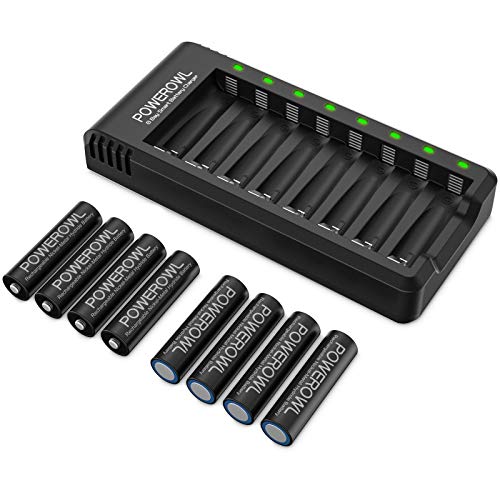 View on Amazon | NiMH, 1.2 V | 2,800 mAh | Up to 1,200 | Yes, 8-bay USB | A first set with a charger |
| Amazon Basics High-Capacity AA |  View on Amazon | NiMH, 1.2 V | 2,400 mAh | Not stated | No | Toys, controllers, daily-use devices |
| Tenergy Premium Pro AA | 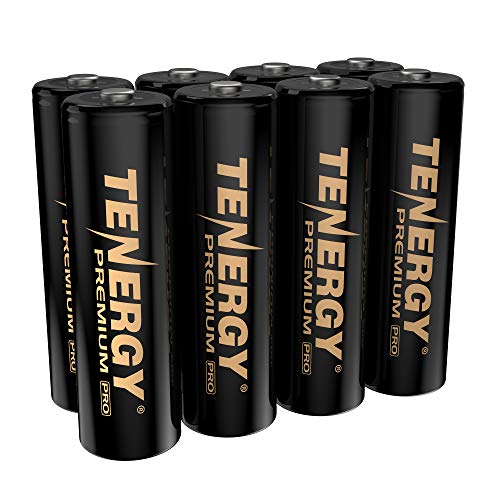 View on Amazon | Low self-discharge NiMH, 1.2 V | 2,800 mAh | Up to 1,200 | No | Flashlights, cameras, high drain |
Best overall
Panasonic eneloop AA
Very consistent cells with low self-discharge, almost no wear after about 300 cycles and the highest cycle rating in the group.
- 2,000 mAh typical
- Up to 2,100 cycles
- Pre-charged
Good for
- Outage kits and devices that sit unused
- Flashlights and toys that take several cells
Skip it if
- Maximum runtime in a high-drain controller
What separates good rechargeables from bad ones
Holding a charge in the drawer
For an outage kit, the most important number isn't capacity. It's how much charge is left when the batteries come out of the drawer months later. Low self-discharge NiMH cells such as the eneloop are built for this. Over about six weeks on a shelf, the eneloop and other low self-discharge cells lost roughly 7% of their charge, while a high-capacity NiMH cell lost charge at about twice that daily rate. After close to a year on the shelf, the eneloop still delivered around three-quarters of its rated capacity. Panasonic rates the eneloop to keep 70% of its charge for up to ten years when stored unused and properly (Panasonic's eneloop FAQ).
High-capacity cells pack more energy but usually leak it away faster: good for a weekly game controller, weaker for a box in the closet.
Capacity claims vs. measured capacity
Printed ratings are not all equally honest. Charged and drained on the same analyzer, the Amazon Basics High-Capacity cell delivered 2,402 mAh against its 2,400 rating. The POWEROWL delivered about 2,295 mAh against 2,800, and an EBL 2,800 mAh NiMH about 2,176. One off-brand cell claiming 3,300 mAh delivered just over half of that. Running the same small fan, the Amazon Basics lasted 5 hours 18 minutes and the POWEROWL 5 hours, both near the top of the group.
Lithium AAs are rated in milliwatt-hours, and their claims run even further from reality. Across a group of lithium-ion AAs, the average cell delivered well under its stated energy. EBL's 3,000 mWh cell was the most honest of the better ones, delivering about 2,756 mWh.
1.2-volt NiMH vs. 1.5-volt lithium
NiMH cells run at about 1.2 volts, lower than a fresh alkaline, but hold that level steadily, and nearly every remote, toy and flashlight works fine on them. Rechargeable lithium AAs contain a lithium-ion cell and a small converter circuit that holds the output near 1.5 volts. That suits devices that show a low-battery warning too early on NiMH.
- Sudden cutoff. Most lithium AAs stay flat at 1.5 volts and then stop almost at once, so a device can show a full battery right before it dies. EBL's 3,000 mWh cell holds close to 1.5 volts for most of the run and then drops off near the end.
- Converter failures. The extra circuit is a weak point. One cell from a four-pack of a lesser-known brand put out 1.8 volts and then 3.8 volts, far above what an AA device expects, and another brand's cell had a converter fault that stopped it working at all.
- Charging waste. Lithium AA kits turned only about half of the energy drawn from the wall into stored charge; the rest became heat.
- Dedicated chargers. They need a charger made for 1.5 V lithium cells. An AA with its own USB-C charging port began smoking within seconds when placed in an ordinary NiMH charger. Never mix the two unless the charger says it supports both.
Types to skip
- "Heavy duty" carbon zinc cells. They died faster than every other chemistry; one ran a flashlight for about 10 seconds.
- Low-capacity NiMH. Some rechargeables are rated around 1,300 mAh, about half of what fits in the same size. The PKCELL 1200, Tenergy Solar (a different line from the Premium Pro) and Rayovac Recharge cells were the weakest NiMH performers.
- "Pro" versions that perform the same. The POWEROWL Pro performed the same as the standard POWEROWL 2800.
The picks in detail
Panasonic eneloop AA: best overall
The white Panasonic eneloop AA remains the benchmark. The cells are made to a tight standard, so every cell in a pack performs about the same, which matters in a flashlight that takes several at once, and a charged set stays useful in a drawer for months.
The cells also age well. After nearly a year of daily charge and discharge in solar garden lights, about 300 cycles, an eneloop still delivered 99% of its rated capacity, and its internal resistance barely moved (77 milliohms before, 78 after). Rising resistance is the usual sign of a worn cell. Panasonic rates it for up to 2,100 recharges and ships it pre-charged.
The trade-off is capacity: about 2,000 mAh typical, less than the 2,400 to 2,800 mAh cells here, so a fast-draining controller runs longer on a higher-capacity cell.
Best overall
Panasonic eneloop AA
Very consistent cells with low self-discharge, almost no wear after about 300 cycles and the highest cycle rating in the group.
- 2,000 mAh typical
- Up to 2,100 cycles
- Pre-charged
Good for
- Outage kits and devices that sit unused
- Flashlights and toys that take several cells
Skip it if
- Maximum runtime in a high-drain controller
POWEROWL AA 2800mAh with Charger: starter kit with a charger
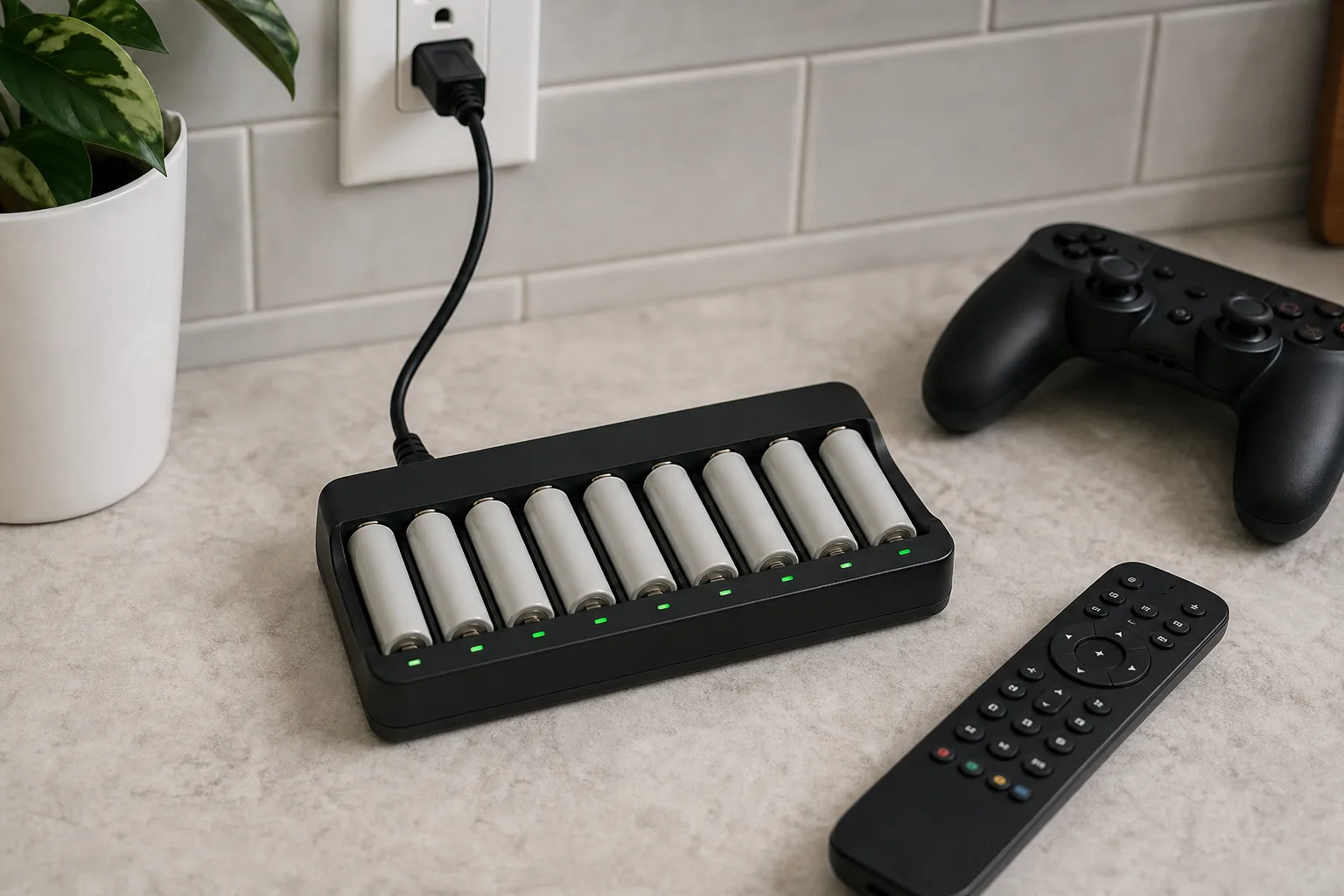
The POWEROWL AA 2800mAh with Charger is the easiest way to start from nothing. It pairs eight 2,800 mAh NiMH cells with an 8-bay charger that takes any mix of AA and AAA cells, charges each slot independently and stops when a cell is full. The charger runs on USB (5 V, 2 A input), and POWEROWL states it passed UL 1310 safety certification. A USB input also means it can charge from a power bank or a portable power station during an outage.
The cells finished near the top of the NiMH field and kept a small fan running for 5 hours. Real capacity landed below the 2,800 rating, at about 2,295 mAh, which is still more than the eneloop's rating. POWEROWL ships the cells partly charged, so charge them fully before first use, and expect them to reach full capacity after a few cycles.
Starter kit with a charger
POWEROWL AA 2800mAh with Charger
Eight 2,800 mAh NiMH cells with an 8-bay USB charger that charges each slot on its own and shuts off when full.
- 8 cells
- 8-bay USB charger
- Up to 1,200 cycles
Good for
- First set of rechargeables
- Charging from a power bank in an outage
Skip it if
- Long storage in a kit (eneloop holds charge better)
Amazon Basics High-Capacity AA: capacity that matches the label
The Amazon Basics High-Capacity AA did exactly what its label says. It measured 2,402 mAh against a 2,400 rating, ran a small fan the longest of the group (5 hours 18 minutes, one minute ahead of a Duracell), and kept the largest share of its capacity when filled on a fast-charge setting: 2,366 mAh, a drop of only 36.
Capacity is its strength. Use it for toys, controllers and remotes in regular rotation, and keep eneloop cells, with their ten-year storage rating, for the emergency box.
Most accurate capacity
Amazon Basics High-Capacity AA
Measured right at its 2,400 mAh rating, ran a small fan the longest and kept nearly all of its capacity on a fast charge.
- 2,400 mAh
- 4-pack
- NiMH 1.2 V
Good for
- Toys, controllers and remotes in daily use
- Charging on a fast charger
Skip it if
- A kit that sits for months (the eneloop is the storage pick)
Tenergy Premium Pro AA: top high-capacity NiMH
The Tenergy Premium Pro AA was the strongest performer among the high-capacity NiMH cells. Unlike many high-capacity cells, it is a low self-discharge design: Tenergy rates it to keep 85% of its charge after a year in storage, ships it about 80% charged, and lists an operating range of -4°F to 122°F. It is rated for up to 1,200 recharges; treat that as an upper bound rather than a promise.
It comes without a charger, so pair it with a NiMH charger that has independent slots.
High-capacity NiMH
Tenergy Premium Pro AA
A 2,800 mAh low self-discharge cell that led the high-capacity NiMH group and is rated to keep 85% of its charge after a year.
- 2,800 mAh
- 85% after one year (rated)
- Up to 1,200 cycles
Good for
- Flashlights and other fast-draining devices
- Long runtime per charge
Skip it if
- No charger in the box
For a full 1.5 volts: EBL's 3,000 mWh lithium AA kit
Among rechargeable lithium AAs, EBL's 8-pack of 3,000 mWh cells with its charger was the cleanest buy. It delivered about 2,756 mWh, close to its rating and more usable energy than the group average, with the longest everyday runtime of the better lithium AAs, about average high-drain runtime and no failed cells. Heat stayed low under both light and heavy loads. The kit includes eight cells and an 8-slot USB-C charger that also handles 1.2 V NiMH and NiCd cells, with independent slots and auto shut-off (EBL product page).
EBL sells several lithium AA lines with different ratings. Its 3,500 mWh cell is supposed to hold more but did worse, especially at high drain, so check that the set says 3,000 mWh. Charging efficiency is below average. For remotes and clocks, NiMH is simpler; EBL's kit earns its place in devices that need the full 1.5 volts.
Other batteries worth knowing
- IKEA LADDA. Sold only at IKEA, not on Amazon. The LADDA performs slightly below the eneloop and is rated for fewer cycles, but it is a solid NiMH cell.
- XTAR and Olight lithium AAs. Both performed well, the XTAR especially. Each comes with a charger that also takes NiMH cells.
- Alkalines. About half of common alkaline AAs deliver less on a single use than most NiMH cells deliver per charge, and alkalines are prone to leaking. Among single-use cells, disposable lithium AAs performed best.
Starter kit with a charger
POWEROWL AA 2800mAh with Charger
Eight 2,800 mAh NiMH cells with an 8-bay USB charger that charges each slot on its own and shuts off when full.
- 8 cells
- 8-bay USB charger
- Up to 1,200 cycles
Good for
- First set of rechargeables
- Charging from a power bank in an outage
Skip it if
- Long storage in a kit (eneloop holds charge better)
Keeping AA batteries ready for an outage
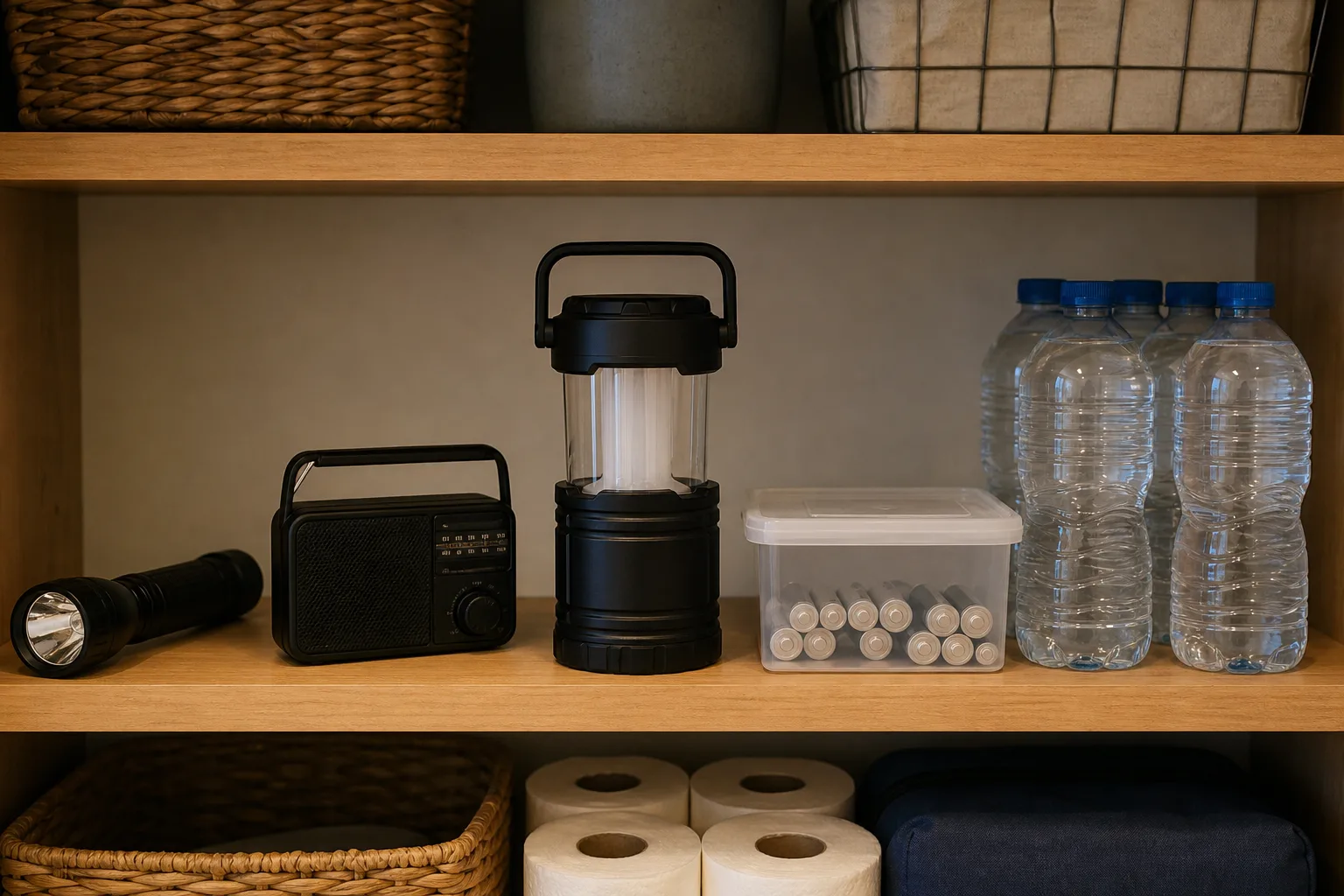
- Know the count. Check how many AAs the kit's flashlights, radio and lantern take, and keep at least one full spare set for each. The flashlight guide covers lights that run on AAs.
- Use low self-discharge cells for the kit. Eneloop cells are the first choice; Tenergy rates its Premium Pro cells to keep 85% of their charge after a year.
- Top them up. Charge the stored set every few months, for example when the clocks change.
- Store batteries outside the devices. A cell left inside a flashlight for years can drain or leak into the contacts.
- Plan to recharge. A USB charger can run from a power bank or a portable power station during a long outage.
- Build out the rest of the kit with water; see the emergency water filter guide.
- Recycle worn cells. NiMH and lithium-ion batteries shouldn't go in the trash; Call2Recycle lists drop-off sites.
Who should buy which
- Stocking an emergency kit or powering remotes and clocks: the Panasonic eneloop AA.
- Starting from scratch with no charger: the POWEROWL AA 2800mAh with Charger.
- Feeding a house full of toys and controllers: the Amazon Basics High-Capacity AA.
- Running flashlights and lanterns as long as possible: the Tenergy Premium Pro AA.
- A device that won't work right on 1.2 volts: a 1.5-volt lithium kit such as EBL's 3,000 mWh AA set.
This guide is part of our home emergency checklist, which covers water, food, power, light, communication and first aid in one place.
Posted by Kristopher Larson
Frequently asked questions
Are rechargeable AA batteries good for an emergency kit?
Yes, if they are low self-discharge NiMH cells such as Panasonic eneloop, which Panasonic rates to keep 70% of their charge for up to ten years in storage. Store them outside the devices, top them up every few months, and keep a USB charger that can run from a power bank during a long outage.
Do rechargeable AA batteries work in devices made for 1.5-volt alkalines?
Almost always. NiMH rechargeables run at about 1.2 volts but hold that level steadily, so remotes, toys, flashlights and controllers work normally. A few devices show a low-battery warning early; for those, a 1.5-volt rechargeable lithium AA is the better fit.
What is the difference between eneloop and eneloop pro?
The standard white eneloop AA is rated at about 2,000 mAh and up to 2,100 recharges, and keeps 70% of its charge for up to ten years in storage. The black eneloop pro holds more, about 2,550 mAh minimum, but Panasonic rates it for up to 500 recharges and to keep 85% of its charge for one year. The standard cell suits most homes and outage kits.
Can 1.5V lithium AA batteries go in a regular NiMH charger?
Only if the charger says it supports 1.5-volt lithium-ion AAs. A standard NiMH-only charger can overheat them. Lithium AA kits such as EBL's 3,000 mWh set include a charger that handles both lithium and NiMH cells.
Why do lithium rechargeable AAs die without warning?
A converter circuit inside each cell holds the output near 1.5 volts until the lithium-ion cell inside is nearly empty, then the output stops. Devices that judge battery level by voltage see a full battery right up to the end. NiMH cells fade more gradually.
How long do rechargeable AA batteries last?
It depends on the cell and how hard it is used. Makers rate their cells for about 1,200 recharges (POWEROWL, Tenergy Premium Pro) up to 2,100 for the eneloop, and treat those numbers as upper limits. A well-made low self-discharge cell can still deliver close to its full rated capacity after a year of daily charging. Replace cells that run noticeably shorter or get warm, and recycle them rather than throwing them away.
Keep reading
More from the blog
Hardtop Gazebo Buying Guide: Purple Leaf 10x12 vs. 12x16 vs. 12x20, Plus YOLENY
Best Borescope for Home Inspection: Teslong TD450S vs. DXZtoz AGC430N vs. Milwaukee M12 M-Spector 360
Best Portable Photo Printer: Canon Selphy, Liene M100, HP Sprocket Studio Plus, Instax Mini Link 3