Best Borescope for Home Inspection: Teslong TD450S vs. DXZtoz AGC430N vs. Milwaukee M12 M-Spector 360
Teslong TD450S, DXZtoz AGC430N and Milwaukee M12 M-Spector 360 compared on focus distance, glare, steering tips and recording for walls, ducts and drains.
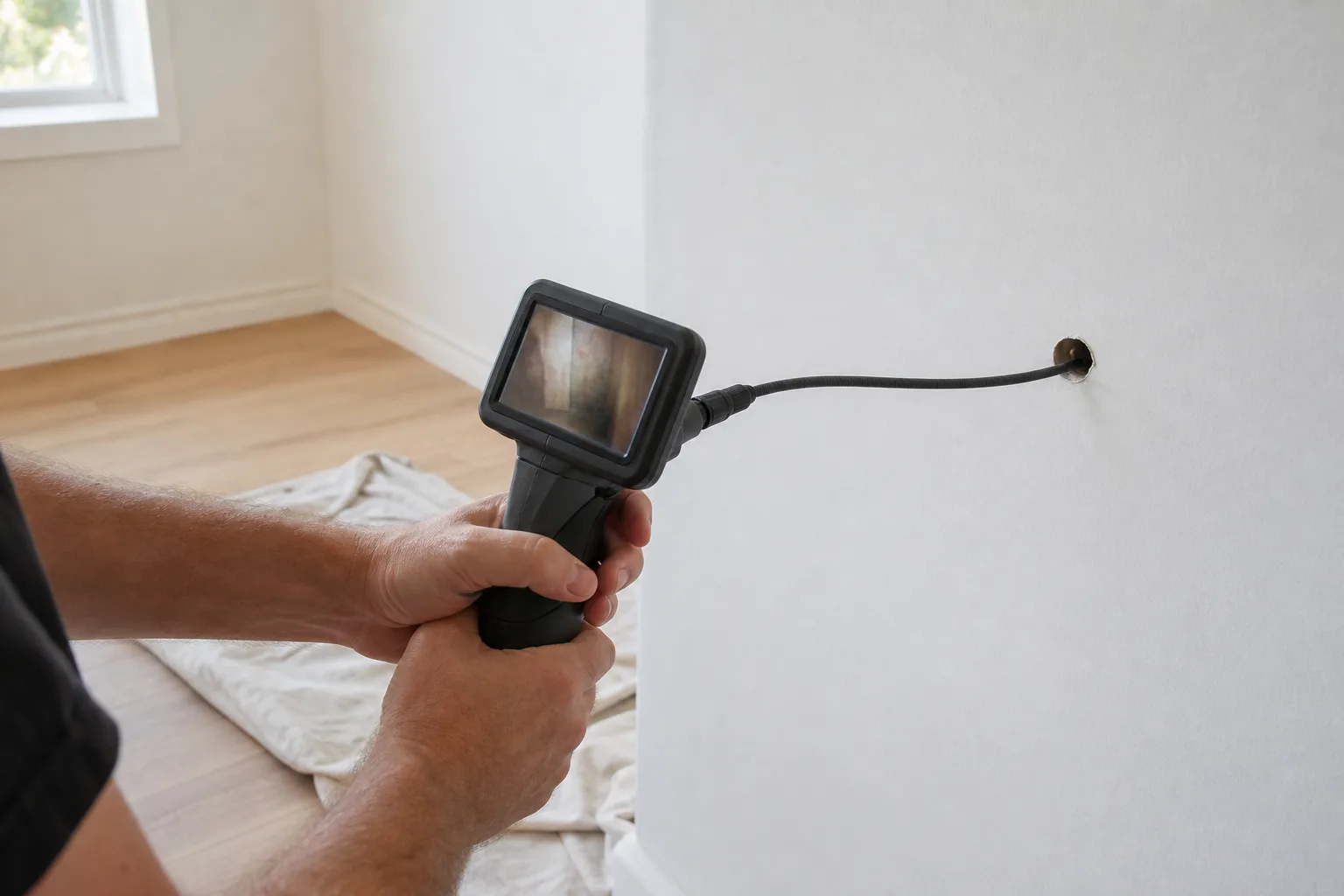
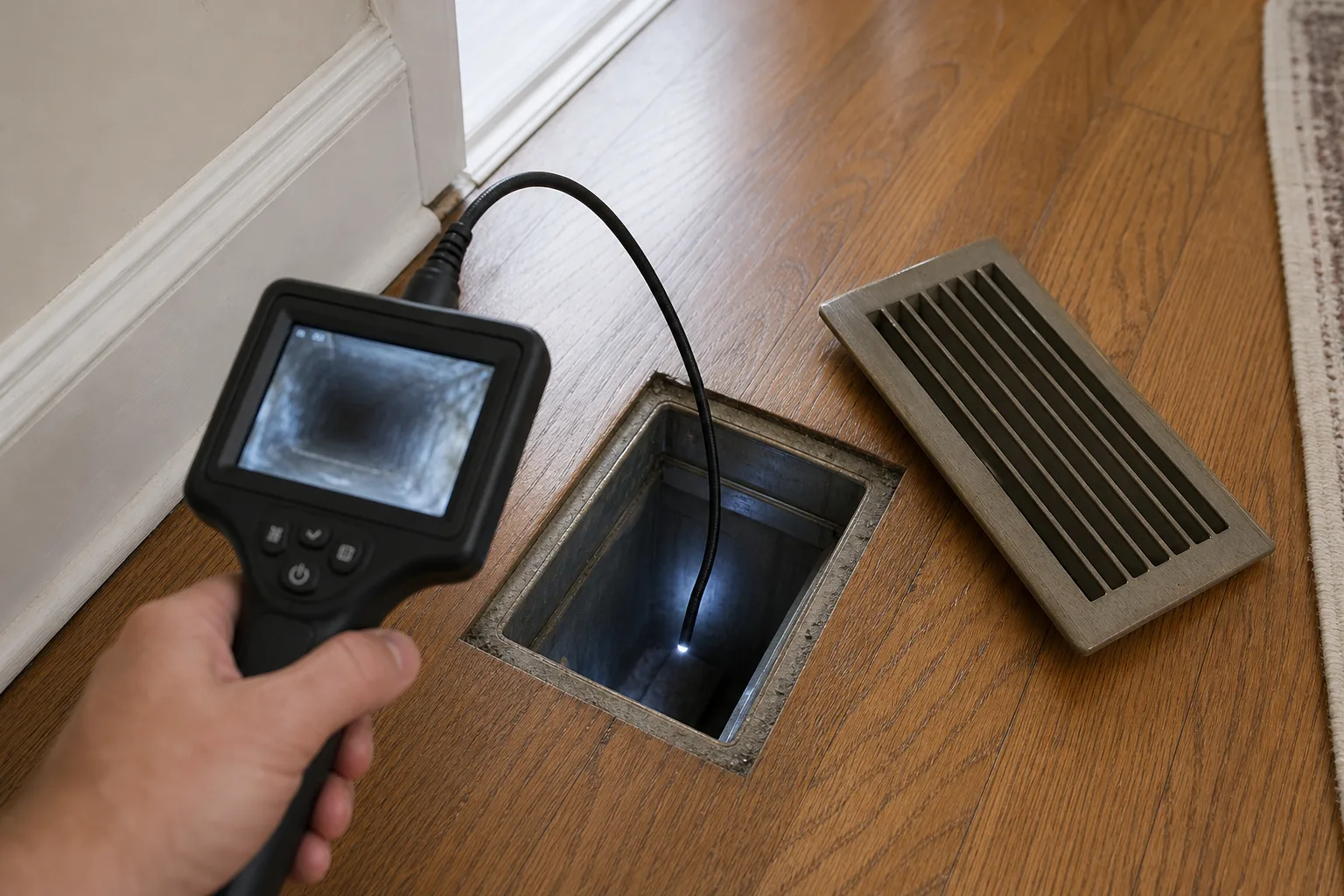
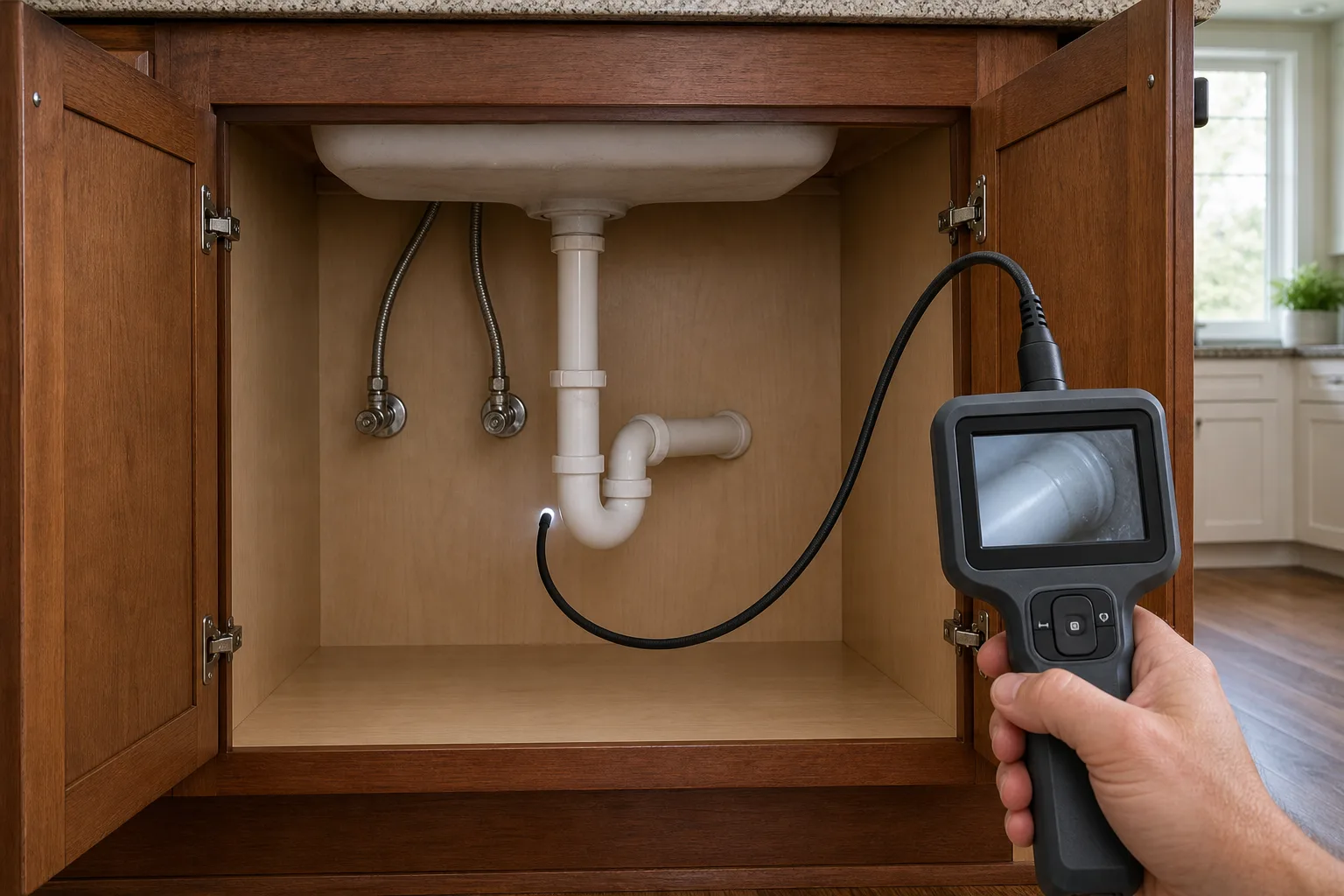
A borescope is a small camera and light on the end of a stiff cable, wired to a handheld screen. It goes where a head and a flashlight can't: into a wall cavity through an existing opening, behind a tub, into a dryer vent or furnace duct, down a sink drain, or into a crawlspace or attic corner nobody can reach.
For a home inspector, landlord, flipper or buyer doing due diligence, a few differences matter: how far from the lens the picture stays sharp, how the light behaves on shiny pipe and duct, whether the tip can look sideways, and whether the photos and video are good enough for a report.
Quick verdict
For looking into walls, ducts and cabinets, start with the single-lens Teslong: it is the one that holds focus across the depth of a stud bay. Pick one of the others for a specific reason.
- Sharp picture across a wall cavity: the Teslong TD450S Single Lens. Its picture stayed crisp from half an inch out to 3 inches, and its tip steers.
- Shiny pipe, duct and fittings up close: the DXZtoz AGC430N. It kept its own light from washing out the picture on polished metal.
- Looking sideways without steering: the Teslong TD450S Dual Lens, the same handset and steering probe with a second camera on the side of the head.
- Crews already on M12 batteries: the Milwaukee M12 M-Spector 360, a fixed-tip camera on a swappable tool battery with a picture that rotates upright.
Four borescopes side by side
| Borescope | Shop | Probe | Tip | Screen | Where the picture is sharp | Light on shiny metal |
|---|---|---|---|---|---|---|
| Teslong TD450S Single Lens |  View on Amazon | 8.5 mm, 5.08 ft | Steers up to 210°, one front lens | 4.5 in | 1/2 in to 3 in | Some reflection; clearer in recordings |
| DXZtoz AGC430N |  View on Amazon | Size and length on the listing | Steers two ways | Built in; size on the listing | 1/2 in to 2 in; soft at 3 in | Very little reflection |
| Teslong TD450S Dual Lens |  View on Amazon | 8.5 mm, 5.08 ft | Steers up to 210°, front and side lenses | 4.5 in | Maker range: 0.79 to 3.94 in (front), 0.4 to 2.76 in (side) | Three light levels plus off |
| Milwaukee M12 M-Spector 360 4 ft Inspection Camera Kit |  See options | 10 mm head, 4 ft cable | Fixed; mirror attachment included | 4.3 in | 1/2 in to 2 in; soft at 3 in | Heavy on the live screen; clearer in recordings |
Sharp out to 3 inches
Teslong TD450S Single Lens
A steering-tip borescope whose picture stayed crisp from half an inch out to 3 inches, the depth of a stud bay.
- 8.5 mm probe, 5.08 ft
- Steers up to 210°
- 4.5 in screen
Good for
- Wall cavities and duct interiors
- Photos and video for a report
- Looking back at the wall the probe came through
Skip it if
- Most targets are polished metal up close
- A side view without steering is the priority
What the picture looks like at working distances
Borescope lenses are fixed-focus, and the sharp zone is short. A 2x4 stud bay is 3.5 inches deep, so a probe slipped in at the face of the wall sees the back of the opposite drywall from about 3 inches away. A dryer duct is 4 inches across.
At 3 inches, the Teslong TD450S Single Lens still showed fine print clearly, and it stayed crisp at 2 inches, 1 inch and half an inch. Teslong lists the focus range as 0.79 to 3.94 inches. The DXZtoz AGC430N and the Milwaukee M12 M-Spector 360 were both soft at 3 inches and came into focus at 2 inches. Zooming did not fix the Milwaukee at 3 inches. All three stayed clear with the lens half an inch from the target.
- Zoom doesn't extend focus. It helps read a label or a stamped number inside the sharp zone and does nothing for a target beyond it.
- Recordings often beat the live view. On several scopes, the Milwaukee among them, saved video showed more detail than the screen did live. Record each pass and review it before deciding nothing is there.
Glare: the problem with shiny pipe and duct
The LEDs sit in a ring around the lens, so anything reflective throws light straight back. On polished metal at close range, most scopes could not be turned down far enough: even on the lowest setting, stamped numbers and fine print washed out.
The DXZtoz AGC430N handled this well. Stamped characters on bare metal were easy to read on its screen and in its recordings, fine scratches on a machined surface showed clearly, and its own magnet tip barely reflected. The single-lens Teslong showed more reflection on its screen, though most characters were readable in its recording and small raised lettering stayed legible. The Milwaukee has five brightness modes, but on bright metal up close its live picture still washed out; the saved video was better.
When glare hides the target, drop the light to its lowest step and come at the surface from an angle, which a steering tip makes much easier.
Low glare on shiny metal
DXZtoz AGC430N
A steering-tip borescope that kept stamped markings and fine scratches readable on polished metal where other scopes washed out.
- Two-way steering tip
- Built-in screen
- Sharp from 1/2 in to 2 in
Good for
- Copper, chrome and galvanized surfaces up close
- Reading stamped or printed markings
- Recorded video of close work
Skip it if
- The target sits 3 inches or more from the lens
- A familiar tool brand matters
How to choose a borescope for house work
Steering tip, side lens or fixed tip
A fixed tip looks straight ahead, so inside a wall it shows whatever is directly behind the opening and little else. A steering (articulating) tip bends when a lever on the handle is moved. The Teslong TD450S bends up to 210 degrees, far enough to look back at the inside face of the wall the probe came through. It bends in one plane only, so aiming left or right means twisting the cable.
A side lens is simpler: the dual-lens TD450S switches between front and side cameras when the trigger is held for two seconds, and the arrow keys flip the picture. The Milwaukee has neither, but a mirror attachment is in the kit.
Probe diameter and length
The Teslong probe is 8.5 mm thick and the Milwaukee head is 10 mm. Either fits a sink drain or a dryer duct with room to spare. Slimmer probes exist: Klein's ET18 has a 5.5 mm camera, but its picture was soft at 3 inches, low in contrast and prone to glare.
Four to five feet of cable covers wall cavities, cabinets, tub access panels and the first stretch of a duct. For longer runs, Milwaukee sells the M-Spector 360 with a 4 ft cable (2323-21) or a 10 ft cable (2324-21), and Teslong sells the single-lens TD450S with a 6.5 mm, 9.8 ft probe.
Screen, recording and battery
A built-in screen means no app and no pairing. All four picks save photos and video to a memory card; the Teslong and Milwaukee kits include a 32 GB card. The dual-lens TD450S takes stills at 1920 x 1080, records 1280 x 720 video with sound, and can stamp the date on each file, which helps when photos go into a report. Teslong rates the TD450S battery at 3 to 4 hours. The Milwaukee runs on a swappable M12 battery, and the kit comes with a battery and charger.
Handling the cable
- Don't bend a steering probe tighter than the coil it shipped in.
- Center the steering lever so the tip is straight before pulling the probe back out or putting it away.
- Wipe the lens after a drain; the TD450S probe is rated IP67.
What a borescope can and can't tell you
A borescope shows what is in front of the lens: a stain on the back of drywall, corrosion on a fitting, lint packed in a dryer duct, a pipe in the path of a planned hole. It does not measure moisture, identify mold, find pests or check wiring. A stain says water was there once; leak sensors report it when it happens.
Opening up walls, electrical boxes and gas appliances is work for a licensed professional, and no probe belongs inside an electrical panel or a live box. Home inspectors work to a standard of practice: the InterNACHI standard describes a home inspection as a non-invasive, visual examination and does not require inspectors to dismantle or open components. A borescope extends what can be seen through openings that already exist.
For documenting the rooms themselves, see the laser measure guide.
Front and side views in one probe
Teslong TD450S Dual Lens
The TD450S handset and steering probe with a second camera on the side of the head for pipe walls, duct seams and the inside face of a wall.
- Front and side lenses
- 8.5 mm probe, 5.08 ft
- IP67 probe
Good for
- Drain and duct walls
- Switching views without re-aiming the probe
- Date-stamped photos and video with sound
Skip it if
- Fine print and small markings must be read
- A probe longer than 5 ft is needed
The picks in detail
Teslong TD450S Single Lens: sharp from half an inch to 3 inches
The Teslong TD450S Single Lens pairs a 4.5 inch screen with a 5.08 ft semi-rigid probe and a steering tip. Its live picture is as clear as any here, color is good, and recorded video held up at 2 and 3 inches. Zoom goes to 1.5x. On bright metal at close range it showed more glare than the DXZtoz. Teslong lists the single lens at 2.0 megapixels and includes a hook and a magnet.
Sharp out to 3 inches
Teslong TD450S Single Lens
A steering-tip borescope whose picture stayed crisp from half an inch out to 3 inches, the depth of a stud bay.
- 8.5 mm probe, 5.08 ft
- Steers up to 210°
- 4.5 in screen
Good for
- Wall cavities and duct interiors
- Photos and video for a report
- Looking back at the wall the probe came through
Skip it if
- Most targets are polished metal up close
- A side view without steering is the priority
DXZtoz AGC430N: low glare on shiny metal
The DXZtoz AGC430N produced the crispest, most legible close-up picture of the group once the lens was within 2 inches, and it controlled reflection better than the rest. Its tip steers two ways, and its zoom helped on very close work. At 3 inches the picture was soft, so it suits pipe, fittings and duct seams more than a look across an open cavity. It is sold through the brand's own Amazon storefront, and the listing is the only spec sheet, so read the probe size, cable length and return terms there.
Low glare on shiny metal
DXZtoz AGC430N
A steering-tip borescope that kept stamped markings and fine scratches readable on polished metal where other scopes washed out.
- Two-way steering tip
- Built-in screen
- Sharp from 1/2 in to 2 in
Good for
- Copper, chrome and galvanized surfaces up close
- Reading stamped or printed markings
- Recorded video of close work
Skip it if
- The target sits 3 inches or more from the lens
- A familiar tool brand matters
Teslong TD450S Dual Lens: front and side views in one probe
The Teslong TD450S Dual Lens adds a side camera with its own LED to the same handset and steering probe. In a house it went through a furnace access opening and well into the ductwork, down a second-floor register, and down a sink drain, where the buildup on the pipe wall was plain to see. The focus and glare results above belong to the single-lens camera. Teslong lists each lens here at 1.0 megapixel, half the single-lens figure, so choose it for the second viewing angle and not for fine detail.
Front and side views in one probe
Teslong TD450S Dual Lens
The TD450S handset and steering probe with a second camera on the side of the head for pipe walls, duct seams and the inside face of a wall.
- Front and side lenses
- 8.5 mm probe, 5.08 ft
- IP67 probe
Good for
- Drain and duct walls
- Switching views without re-aiming the probe
- Date-stamped photos and video with sound
Skip it if
- Fine print and small markings must be read
- A probe longer than 5 ft is needed
Milwaukee M12 M-Spector 360: a fixed tip on a tool battery
The Milwaukee M12 M-Spector 360 has a 10 mm camera head, a 4.3 inch screen, a 720p camera, three zoom levels and five brightness modes. Its live picture matched the Teslong's at 2 inches, and its close-up recordings were excellent. The 360 degree image rotation matters overhead and under sinks: the picture can be set upright, by turning the screen or pressing a button, without twisting the tool. Its weak points are focus at 3 inches and glare on bright metal, and the tip does not steer. Hook, mirror, magnet and a plumbing ball are in the kit.
Milwaukee's number for the 4 ft kit is 2323-21, and older M-Spector kits carry other numbers, so confirm the model number on the listing before ordering.
For crews already on M12 batteries
Milwaukee M12 M-Spector 360 4 ft Inspection Camera Kit
A fixed-tip inspection camera with a rotating picture, a swappable M12 battery and a 10 mm head on a 4 ft cable.
- 10 mm camera head
- 4 ft cable (2323-21)
- 360° image rotation
Good for
- Contractors and landlords with M12 tools
- Overhead and under-sink work
- Close-up photos and video
Skip it if
- A steering tip is needed
- Most targets are 3 inches or more away
Longer cables and phone scopes
VEVOR's triple-lens scope with a 4.5 inch screen and a 16.5 ft cable produced a sharp, well-lit picture at 1 to 3 inches, and that length suits a long dryer vent or duct run. Most of the small cameras that plug into a phone were blurry at 2 to 3 inches, washed out on metal, and in one case lagged badly on the live view.
Sharp out to 3 inches
Teslong TD450S Single Lens
A steering-tip borescope whose picture stayed crisp from half an inch out to 3 inches, the depth of a stud bay.
- 8.5 mm probe, 5.08 ft
- Steers up to 210°
- 4.5 in screen
Good for
- Wall cavities and duct interiors
- Photos and video for a report
- Looking back at the wall the probe came through
Skip it if
- Most targets are polished metal up close
- A side view without steering is the priority
Who should buy which
- Home inspectors and buyers looking into cavities, ducts and under cabinets: the Teslong TD450S Single Lens, for its focus at 3 inches and steering tip.
- Plumbing and HVAC close-ups on bright metal: the DXZtoz AGC430N.
- Landlords chasing drain and duct problems: the Teslong TD450S Dual Lens, for the side view of a pipe wall.
- Flippers and maintenance crews with M12 tools: the Milwaukee M12 M-Spector 360.
An owner checking a house before listing it can also request a home valuation before deciding which repairs to make first.
Posted by Kristopher Larson
Frequently asked questions
What is the difference between a borescope, an endoscope and an inspection camera?
For house work the three names describe the same tool: a small camera and light on a flexible or semi-rigid cable, with a screen or a phone showing the picture. Sellers use the terms interchangeably. What separates products is the probe diameter and length, whether the tip steers or has a side lens, and whether the screen is built in.
Can a borescope see inside a wall without cutting drywall?
Only through an opening. That can be one that already exists, such as a plumbing access panel or a gap around a pipe, or a small hole about 1/2 inch across, which is enough for an 8.5 mm or 10 mm probe. In a house that belongs to someone else, drilling one needs the owner's permission. Insulation blocks the view in exterior walls, and the picture is sharp only within a few inches of the lens, so expect to see the area near the opening and not the whole bay. Electrical boxes are not viewing ports; leave those to a licensed electrician.
Is an articulating borescope worth it over a dual-lens model?
A steering tip can aim anywhere along one arc, including back toward the opening the probe came through, and it lets the lens approach a shiny surface at an angle to cut glare. A dual-lens probe gives one fixed side view with no steering to learn. The Teslong TD450S is sold both ways: steering with one lens, or steering with front and side lenses at a lower resolution per lens.
What size borescope fits a sink drain or a dryer vent?
Probes of 8.5 mm to 10 mm fit both with room to spare. A dryer duct is 4 inches across, so the lens needs to sit near the duct wall to keep it in focus. For a long vent run, cable length matters more than diameter: 4 to 5 ft reaches the first stretch, and 10 ft or 16.5 ft cables reach farther. Sewer and main drain lines call for a reel-type drain camera, not a borescope.
Can a borescope find mold or a leak inside a wall?
It can show what is in view: staining, corrosion, standing water, damaged material or discoloration on the back of drywall. It cannot measure moisture or identify mold. Treat what it shows as a reason to follow up with a moisture meter, a plumber or a qualified mold assessor.
Do home inspectors use borescopes?
Some do, as an extra. Standards of practice describe a home inspection as a visual, non-invasive examination of accessible areas, and they do not require inspectors to open walls or dismantle components. An inspector who carries a borescope uses it through openings that are already there, and the inspection agreement defines what is covered.
Keep reading
More from the blog
Best Rechargeable AA Batteries: Eneloop vs. POWEROWL vs. Amazon Basics vs. Tenergy
Hardtop Gazebo Buying Guide: Purple Leaf 10x12 vs. 12x16 vs. 12x20, Plus YOLENY
Best Portable Photo Printer: Canon Selphy, Liene M100, HP Sprocket Studio Plus, Instax Mini Link 3