Best Power Bank: Anker 737 vs. Sharge HyperTower vs. UGREEN Nexode vs. INIU P62
Anker 737, Sharge HyperTower, UGREEN Nexode and INIU P62-E1 power banks compared on real capacity, laptop output, refill speed and outage use.
A good power bank keeps a phone alive on a long travel day, tops up a laptop at a café table, and keeps the household's phones charged when the power goes out. The numbers on the box don't tell you much, though. Every bank delivers less than its label says, some far less, and a big wattage figure can hide a bank that shuts down when a second device is plugged in.
This guide compares five laptop-capable banks from Anker, Sharge, UGREEN and INIU on what they actually deliver: usable capacity, sustained output, how fast they refill and how warm they run. It also covers how to size a bank for a power outage.
Quick verdict
For one bank that covers phones, tablets and most laptops, pick the Sharge HyperTower 170. For two laptops at once or quick turnarounds between trips, pick the Anker 737, and for one big laptop under heavy load, the UGREEN 25,000mAh. In more detail:
- Fastest to refill, two laptops at once: the Anker 737 Power Bank 24,000mAh 140W. Empty to full in about 48 minutes on a 140 W charger, and about 130 W across two laptops and a phone. It's heavy, at 630 g.
- The all-rounder with cables built in: the Sharge HyperTower 170. Two attached USB-C cables, cool running and very consistent capacity.
- Steady 100 W on every USB-C: the UGREEN Nexode Power Bank 25,000mAh 165W. It held its rated output on every USB-C and has two built-in cables.
- Compact 100 W laptop bank: the UGREEN Nexode Power Bank 20,000mAh 100W, which delivered its full 100 W at 20 V in a smaller, lighter body.
- Smallest and most efficient: the INIU P62-E1 Power Bank 20,000mAh 65W, a 20,000 mAh bank that beat its own printed capacity and wasted the least energy refilling.
The power banks side by side
| Power bank | Shop | Capacity | Max output | Ports | Weight | Best for |
|---|---|---|---|---|---|---|
| Anker 737 Power Bank 24,000mAh 140W |  View on Amazon | 24,000 mAh | 140 W | 2 USB-C, 1 USB-A | 630 g | Fast refills, two laptops |
| Sharge HyperTower 170 |  View on Amazon | 25,000 mAh (under 100 Wh) | 170 W total, 100 W per USB-C | 2 built-in USB-C cables, 1 USB-C, 1 USB-A | 665 g | Everyday carry with cables attached |
| UGREEN Nexode Power Bank 25,000mAh 165W | 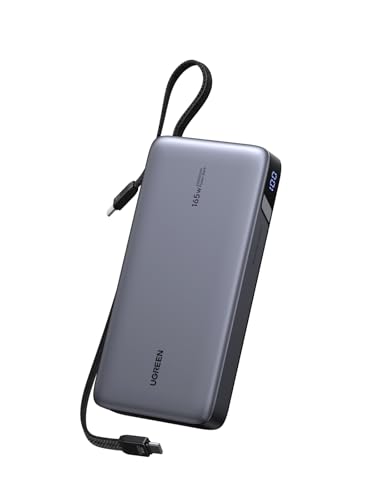 View on Amazon | 25,000 mAh (90 Wh) | 165 W total | 2 built-in USB-C cables, 1 USB-C, 1 USB-A | Not listed | Big laptops, heavy loads |
| UGREEN Nexode Power Bank 20,000mAh 100W |  View on Amazon | 20,000 mAh (72 Wh) | 100 W (USB-C1) | 2 USB-C, 1 USB-A | 420 g | One laptop, lighter bag |
| INIU P62-E1 Power Bank 20,000mAh 65W |  View on Amazon | 20,000 mAh | 65 W (USB-C1) | 2 USB-C, 1 USB-A | 324 g | Phones and tablets, small bag |
Fastest to refill
Anker 737 Power Bank 24,000mAh 140W
Refills in about 48 minutes on a 140 W charger and powers two laptops at roughly 130 W combined, with an accurate, detailed display.
- 24,000 mAh
- 140 W PD 3.1
- 2 USB-C + 1 USB-A
Good for
- Two laptops at once
- Fast turnaround between trips
- Watching battery health
Skip it if
- Pocket carry (630 g)
- No 140 W USB-C charger at home
What separates a good power bank from a bad one
Real capacity is 80 to 90 percent of the label
The mAh figure describes the cells, not what reaches your phone. Converting cell voltage to USB voltage costs energy as heat, so a well-made bank delivers about 80 to 90 percent of its rated watt-hours. The four larger banks here landed in that range, and the INIU did slightly better.
Unknown brands are a different story. Several no-name banks sold with huge numbers, 26,800 to 42,800 mAh, delivered only 38 to 55 percent of their ratings and took 8 to 13 hours to recharge. The watt-hour rating printed on the case is more honest than the headline mAh. INIU goes a step further and prints the expected usable capacity on the P62-E1.
USB-C with Power Delivery is the port that matters
Across a large group of banks, phones charged at only 7 to 8 W from USB-A ports, no matter what fast-charge logos the listing showed. Over USB-C with Power Delivery, the same phones pulled 18 to 20 W, roughly twice as fast. For laptops, look at the single-port USB-C rating: 65 W covers a small laptop, 100 W covers most larger ones, and 140 W helps only the biggest laptops.
Sustained output beats headline wattage
Big numbers don't always hold. Anker's Prime 300 W bank throttled from heat after about four minutes at full output, while the 25,000 mAh UGREEN was the only bank in its group that ran at its claimed limit. How a bank fails also matters: most banks cut every port when overloaded. The Sharge keeps its main cable running and resets the others, and the INIU recovers on its own after a rest.
Heat and refill speed
Heat wears out lithium cells, so a bank that runs cool while charging and discharging should last more cycles. The Sharge and the 25,000 mAh UGREEN both stayed cool both ways; the INIU got noticeably warmer while recharging. Larger banks also refill faster than small ones because they accept higher input; a popular 10,000 mAh slim bank needed almost 5.5 hours. Fast input needs a matching wall charger; the Anker reaches its top speed only on a 140 W USB-C PD 3.1 charger.
Wireless charging costs you a lot of the battery
Magnetic wireless banks are convenient, but they lose 23 to 42 percent of their stored energy compared with a cable. If the goal is to stretch a charge, plug in.
Using a power bank in a power outage
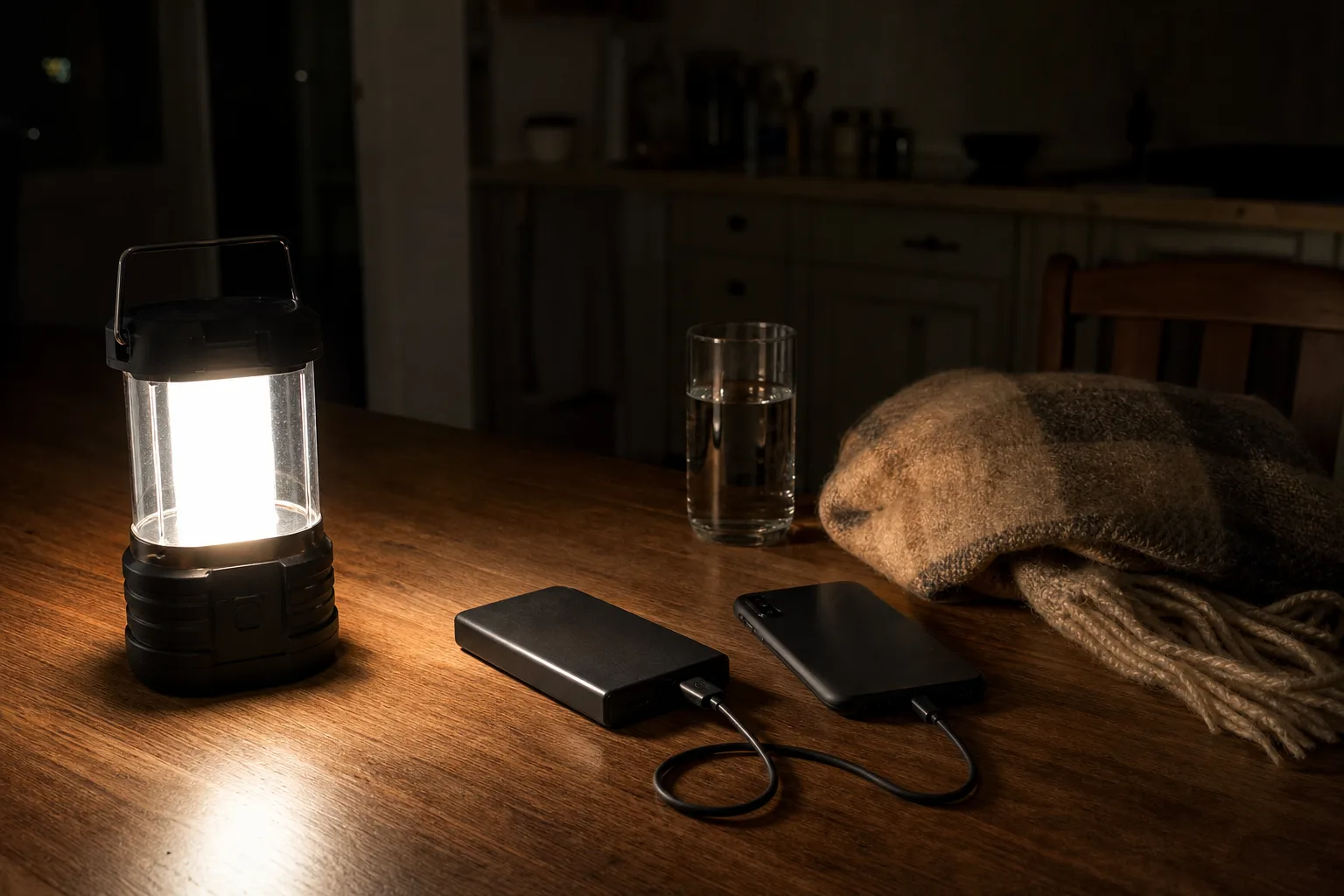
A charged phone is how you get outage updates and reach family, and Ready.gov's outage checklist lists a portable charger or power bank among the basics. Sizing is simple. A 20,000 to 25,000 mAh bank gives about three to three and a half charges of a large phone, or one and a half to two charges of a large tablet. A household with several phones is better served by two or three banks than by one large one, so everyone can charge at once.
- Keep it topped up. A bank in a drawer slowly loses charge, and a display left on drains it faster: Anker says the 737 uses about 15 percent of its battery a day if its settings screen is left on. Turn the screen off and recharge banks every few months.
- Store the cables with it. Built-in cables, like those on the Sharge and the 25,000 mAh UGREEN, mean nobody hunts for a cord in the dark.
- Use a cable, not a wireless pad. It saves a quarter or more of the stored energy.
- Charge phones, not appliances. A power bank is for phones, tablets, earbuds, headlamps and laptops. For a router, fridge or medical device, a UPS battery backup or a portable power station is the right tool, and a whole-home battery backup covers longer outages.
A rechargeable flashlight that charges over USB-C can run off the same bank, and a portable water filter rounds out a basic outage kit.
Cables built in, runs cool
Sharge HyperTower 170
30% offBlack Friday Dealoff list price · as of 9:20 pm MT · details
Two attached USB-C cables, very consistent capacity, cool running and a main cable that stays powered when another port overloads.
- 25,000 mAh
- 170 W total
- 100 W per USB-C
Good for
- One bank for phone, tablet and laptop
- Grab-and-go outage kits
- Charging up to four devices
Skip it if
- Lightweight carry (665 g)
Flying with a power bank
Under the FAA's PackSafe rules, power banks travel in carry-on bags only, and lithium-ion batteries up to 100 Wh need no approval; every bank here is under that line. Banks of 101 to 160 Wh, such as most 40,000 mAh models, need airline approval. Airlines can set stricter rules, so check with your carrier.
The picks in detail
Anker 737 Power Bank 24,000mAh 140W: fastest to refill
The Anker 737 is the bank to beat on charging speed in both directions. Its USB-C ports support Power Delivery 3.1 at up to 140 W, and on a 140 W charger it drew close to 140 W and filled its 24,000 mAh in about 48 minutes, under one minute per watt-hour stored. On the output side it sent 93.6 W to a laptop from one USB-C port, and about 130 W total while charging two laptops and a phone. On a fixed 20 V load, though, it held only about 70 W, where the 20,000 mAh UGREEN held its full 100 W. It delivered about 69 to 73 Wh of usable energy, and that figure barely changed from run to run.
The display is the most informative here: battery percentage, per-port wattage, temperature, battery health and cycle count, and its readings matched an external meter. At 630 g and thick, it's a bag item, not a pocket one, and it has no built-in cables.
Fastest to refill
Anker 737 Power Bank 24,000mAh 140W
Refills in about 48 minutes on a 140 W charger and powers two laptops at roughly 130 W combined, with an accurate, detailed display.
- 24,000 mAh
- 140 W PD 3.1
- 2 USB-C + 1 USB-A
Good for
- Two laptops at once
- Fast turnaround between trips
- Watching battery health
Skip it if
- Pocket carry (630 g)
- No 140 W USB-C charger at home
Sharge HyperTower 170: the all-rounder with cables built in
The Sharge HyperTower 170 has two attached USB-C cables, one retractable and one fixed that doubles as a strap, plus a USB-C port and a USB-A port. It delivered about 85 percent of its rated capacity, which works out to about three and a half charges of a large phone, close to two of a large tablet and about 70 percent of a 16-inch laptop. Its results were the most consistent of its group, within a fraction of a percent across repeated drains, and it ran cool both charging and discharging. It refilled quickly, returning 82 percent of the energy put in.
When another port is overloaded, it keeps its main cable powered and resets the other ports instead of shutting down. Combined output topped out at 165 W, not the 170 W on the label. The screen shows battery level, time remaining and output per port.
Cables built in, runs cool
Sharge HyperTower 170
30% offBlack Friday Dealoff list price · as of 9:20 pm MT · details
Two attached USB-C cables, very consistent capacity, cool running and a main cable that stays powered when another port overloads.
- 25,000 mAh
- 170 W total
- 100 W per USB-C
Good for
- One bank for phone, tablet and laptop
- Grab-and-go outage kits
- Charging up to four devices
Skip it if
- Lightweight carry (665 g)
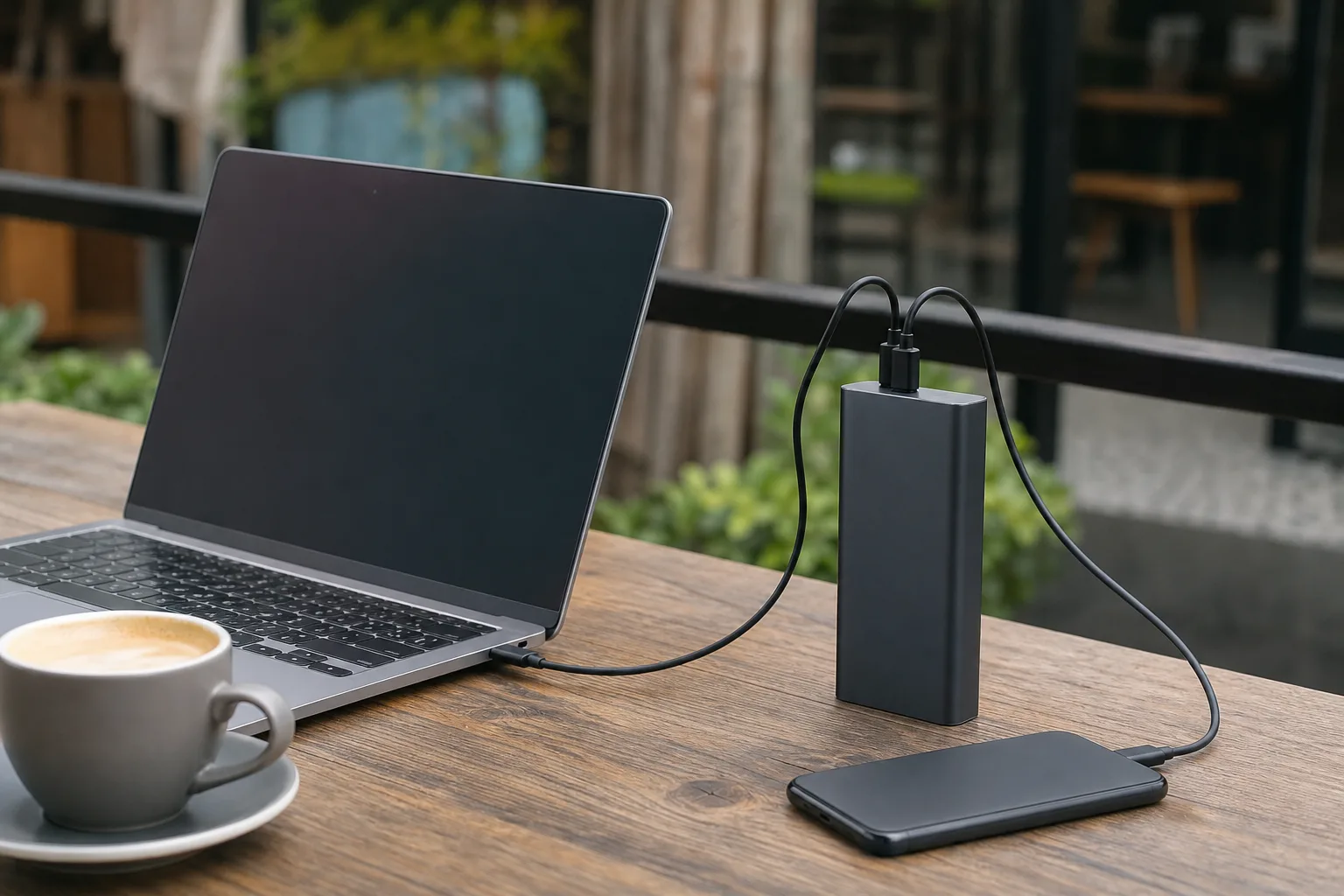
UGREEN Nexode Power Bank 25,000mAh 165W: steady 100 W on every USB-C
The UGREEN 25,000 mAh is the specialist for heavy loads. It held 100 W from each USB-C connection, including both built-in braided cables, and it was the only bank in its group that ran at its claimed limit without throttling. It gave about 85 percent of its 90 Wh rating, enough for roughly three and a half large-phone charges or about 70 percent of a 16-inch laptop, ran cool in both directions and recharges at up to 90 W, so it refills quickly.
It did shut down once when a second 100 W load was plugged in while one cable was already delivering 100 W, an extreme case most owners won't hit. The screen responds a little slowly and shows battery health alongside capacity.
Steady 100 W on every USB-C
UGREEN Nexode Power Bank 25,000mAh 165W
36% offBlack Friday Dealoff list price · as of 9:20 pm MT · details
Held its rated 100 W on every USB-C, ran cool and has two built-in braided cables.
- 25,000 mAh / 90 Wh
- 165 W total
- 90 W recharge
Good for
- Large laptops
- Several power-hungry devices
Skip it if
- Phone-only use
- Plugging in a second 100 W load mid-charge
UGREEN Nexode Power Bank 20,000mAh 100W: compact laptop bank
The UGREEN 20,000 mAh 100W is a more traditional slab, 139 x 80 x 26.5 mm and 420 g, that still delivers its full 100 W at 20 V from its main USB-C port. Its second USB-C port tops out at 30 W and the USB-A at 22.5 W. It delivered 59 Wh, 82 percent of its printed 72 Wh, and refilled from empty in 1 hour 48 minutes.
Compact laptop bank
UGREEN Nexode Power Bank 20,000mAh 100W
38% offBlack Friday Dealoff list price · as of 9:20 pm MT · details
Delivers its full 100 W from the main USB-C port in a 420 g body and refills in under two hours.
- 20,000 mAh / 72 Wh
- 100 W USB-C
- 65 W input
Good for
- One laptop plus a phone
- Lighter bags
Skip it if
- Two laptops at full speed (second USB-C is 30 W)
INIU P62-E1 Power Bank 20,000mAh 65W: smallest and most efficient
The INIU P62-E1 is the smallest bank here, 324 g and about 11 x 7.1 x 2.9 cm, and the most honest about capacity. INIU prints the expected usable energy, about 65 Wh, on the case, and the bank delivered about 4 percent more than that. It was also the most efficient of its group, returning 84 percent of the energy used to recharge it, and it refills from empty in under two hours. That's about three large-phone charges, about one and a half large-tablet charges, or 60 percent of a 16-inch laptop.
The trade-offs: its main USB-C port is rated at 65 W, so it's a phone-and-tablet bank that can carry a small laptop, not a big one. It ran warmer than the others while recharging, and its screen shows only battery level. When both USB-C ports were maxed out and a USB-A device was added, it shut off, then recovered after resting. A detachable USB-C lanyard cable comes in the box.
Smallest and most efficient
INIU P62-E1 Power Bank 20,000mAh 65W
15% offBlack Friday Dealoff list price · as of 9:20 pm MT · details
A small 20,000 mAh bank that beat its printed usable capacity and wasted the least energy refilling.
- 20,000 mAh
- 65 W USB-C
- 324 g
Good for
- Phones and tablets
- Small bags and pockets
- Outage kits that need several banks
Skip it if
- Large laptops (65 W max per port)
Who should buy which
- Two laptops, or a laptop that needs a fast turnaround: the Anker 737.
- One bank for everything, with no loose cables: the Sharge HyperTower 170.
- A big laptop under heavy, sustained load: the UGREEN 25,000 mAh 165W.
- One laptop and a lighter bag: the UGREEN 20,000 mAh 100W.
- Phones and tablets, a small bag, or a few banks for an outage kit: the INIU P62-E1.
This guide is part of our home emergency checklist, which covers water, food, power, light, communication and first aid in one place.
Posted by Kristopher Larson
Deal badges come from Amazon. Product prices and availability are accurate as of the date/time indicated and are subject to change.
Frequently asked questions
What size power bank is good for a power outage?
A 20,000 to 25,000 mAh bank gives about three to three and a half full charges of a large phone, or one and a half to two charges of a large tablet. A household with several phones does better with two or three banks than one, so everyone can charge at once. Keep a cable stored with each bank.
How long does a power bank hold its charge in storage?
A charged bank slowly loses energy sitting in a drawer, and a screen left on drains it much faster: Anker says the 737 uses about 15 percent of its battery a day if its settings screen stays on. Turn screens off, store banks somewhere cool, and top them up every few months so they're ready when the power goes out.
Why does a power bank deliver less than its mAh rating?
The mAh figure describes the cells at their internal voltage. Raising that to USB voltage loses energy as heat, so a well-made bank delivers about 80 to 90 percent of its rated watt-hours. Some no-name banks with very large mAh claims deliver only 38 to 55 percent, so the watt-hour rating printed on the case is the better guide.
Can a power bank charge a laptop?
Yes, if it has a USB-C Power Delivery port with enough wattage. About 65 W covers most small laptops, and 100 W covers most larger ones. A 20,000 to 25,000 mAh bank holds roughly 60 to 70 percent of a full charge for a 16-inch laptop, so it extends a work session rather than doubling it.
Can a power bank go on a plane?
Yes, in carry-on bags only. FAA rules allow lithium-ion batteries up to 100 Wh without approval, and 101 to 160 Wh with airline approval. Most 20,000 to 25,000 mAh banks are under 100 Wh. Airlines can set stricter rules of their own, so check with the carrier.
Does a power bank need a special wall charger to refill quickly?
Yes, for the fastest refills. A bank can only take in as much power as the wall charger and cable supply, up to its own input limit. The Anker 737 accepts up to 140 W, but only from a USB-C PD 3.1 charger of that size; the Sharge HyperTower 170 accepts up to 100 W, the UGREEN 25,000mAh up to 90 W and the UGREEN 20,000mAh up to 65 W. A smaller charger works, just more slowly.
Keep reading
More from the blog
Mr. Heater Portable Buddy vs. Big Buddy for a Winter Power Outage: What Each Heats and What the Manuals Require
Best Under-Sink Reverse Osmosis System: Waterdrop vs. APEC vs. iSpring vs. Frizzlife

How to Make Beer at Home: Beer Making Kits, Fermenters and Machines