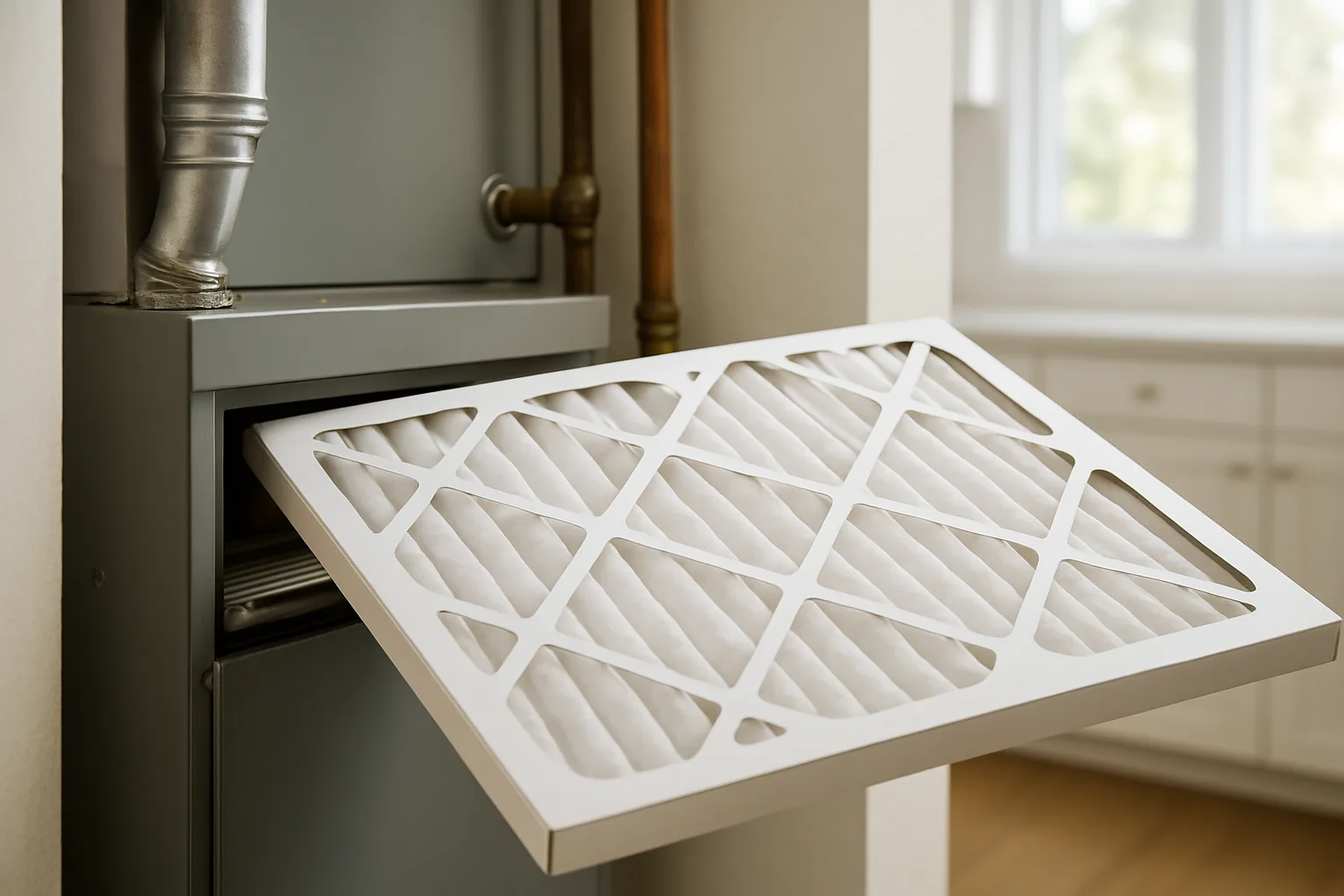
Best Furnace Filter: MERV 8 vs MERV 13, Filtrete vs Honeywell
Is MERV 13 too high for your furnace? MERV, MPR and FPR explained, why pleats and 4-inch filters breathe easier, change intervals, plus 4 picks.
The highest MERV number on the shelf is not automatically the best furnace filter. A filter's first job is to protect the blower and coil, and every step up in filtration makes the media finer and harder for air to pass through.
What matters more than the number on the box is how much media is folded into the frame and how thick the filter is. Below: the rating scales, the airflow trade-off, change intervals and four filters worth buying.
As an Amazon Associate, Best Utah Real Estate earns from qualifying purchases.
Quick verdict
- Best for a 1-inch slot when allergies are a concern: the Filtrete MPR 1900 MERV 13 Filter (16x25x1). Extra pleats let it catch fine particles without choking airflow as fast as other high-MERV filters.
- Best overall, if the system has a 4-inch cabinet: the Honeywell Home MERV 8 Media Filter (16x25x4). The lowest resistance of any filter here, clean or loaded with dust.
- Best value for homes without allergies: the Filtrete MPR 300 MERV 5 Filter (16x25x1). It stops the bulk of household dust and lint and barely slows the air.
- A middle step for dust and pollen: the Filtrete MPR 600 Filter (16x25x1). Strong capture for a mid-range rating, but it clogs fast, so change it on time.
The links go to 16x25 listings. Buy the size printed on your current filter's edge; other sizes are on the same listing pages or a search away.
The picks side by side
| Filter | Shop | Thickness | Rating | Labeled life | Best for |
|---|---|---|---|---|---|
| Filtrete MPR 1900 MERV 13 Filter (16x25x1) |  Buy on Amazon | 1 in | MERV 13 | Up to 3 months | Allergies, smoke, a 1-inch slot |
| Honeywell Home MERV 8 Media Filter (16x25x4) |  Buy on Amazon | 4 in | MERV 8 | Up to 1 year | Systems with a 4-inch media cabinet |
| Filtrete MPR 300 MERV 5 Filter (16x25x1) |  Buy on Amazon | 1 in | MERV 5 | Up to 3 months | Dust and lint on a budget, no allergies |
| Filtrete MPR 600 Filter (16x25x1) |  Buy on Amazon | 1 in | MERV 7 (per listing) | Up to 3 months | A step up for dust, pollen and dust mite debris |
MERV, MPR and FPR, explained
Three scales describe the same thing. MERV is the industry standard from ASHRAE. It rates how well a filter catches particles from about 0.3 to 10 microns, and higher means finer capture; the EPA's MERV chart lists what each level traps. MPR is 3M's scale for Filtrete, running from 100 to 2800 and weighted toward the smallest particles. FPR is The Home Depot's scale for the Honeywell and HDX filters it sells.
Most packages print a MERV equivalent. Filtrete MPR 300 is MERV 5, MPR 700 is MERV 8, MPR 1085 is a MERV 11 equivalent, MPR 1900 is MERV 13, and MPR 2500 and 2800 sit at MERV 14. On the FPR side, FPR 5 lines up with MERV 8 and FPR 7 with MERV 11.
Static pressure: why MERV 13 can be too much for a 1-inch slot
Static pressure is the resistance the blower works against, in inches of water column. Most new residential equipment is rated for about 0.5 inches of external static pressure, and that includes the filter. Systems that run well above it for long stretches can wear out ECM blower motors, which are costly to replace.
On a 5-ton furnace that measured 0.55 inches with no filter at all (about 1,965 CFM on the manufacturer's chart), a plain 1-inch MERV 8 raised it to 0.74, cutting airflow to about 1,820 CFM. Three different 1-inch MERV 11 filters landed at 0.82 to 0.83, and a 1-inch MERV 13 reached 0.93, about 1,649 CFM. A 4-inch MERV 8 measured just 0.67 (about 1,877 CFM), and a 3.5-inch MERV 15 from Carrier came in at 0.71.
So the answer to "is MERV 13 too high?" depends on the slot. In a standard 1-inch return, staying at MERV 8 or below is the safer default unless the return is enlarged or a second filter is added. For MERV 11 and up, a 4-inch filter is the better path. A clean MERV 13 starts around 0.2 inches of pressure drop versus about 0.03 for a MERV 5, leaving little room as it loads. If one is used anyway, change it monthly rather than waiting for the label's three months. A fan pushing against more resistance also uses more energy.
Ducts change the math: a system reading about 0.3 inches without a filter has far more headroom.
Pleats and media area matter more than brand
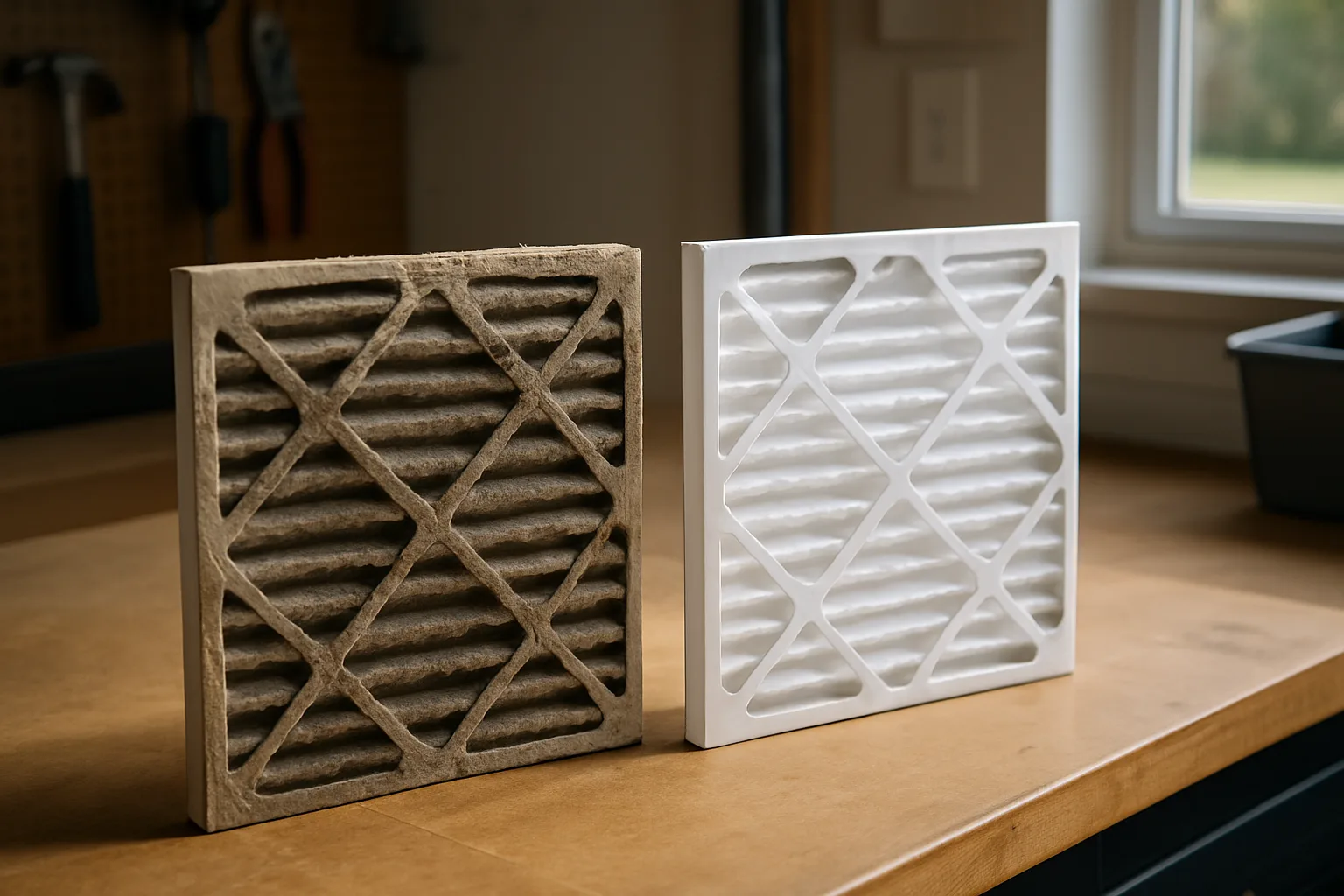
Among 1-inch filters with the same rating, brand barely mattered: three MERV 11s from different makers measured within 0.01 inches of each other. Media area made the difference. A 1-inch Filtrete MPR 2500 (MERV 14) with far more pleats measured 0.85 on the same furnace, lower than the 0.93 MERV 13 despite the higher rating.
The flour-load results below show the same pattern. Filters with tightly woven media and limited area (760 and 640 square inches in two MERV 11 models) clogged quickly. The Filtrete MPR 1900 in the 16x20 size measured had 54 pleats and 1,560 square inches of media, more than twice as much as any other 1-inch filter in the group, and it stayed far lower on resistance once loaded.
How the filters handled a heavy dust load
Fourteen filters were measured on a sealed stand with a particle counter below them. Each was measured clean, then loaded with one cup of flour, an extreme load that shows which choke first. The bare stand read 0.16 inches; these are not furnace numbers.
| Filter | Shop | Clean (in. w.c.) | Loaded (in. w.c.) | What got through |
|---|---|---|---|---|
| Filtrete MPR 1900 MERV 13 Filter (16x25x1) | Buy on Amazon
| 0.37 | 0.52 | Barely any increase (about 70 small, 50 large particles) |
| Honeywell Home MERV 8 Media Filter (16x25x4) | Buy on Amazon
| 0.23 | 0.22 | About 300 small, 200 large |
| Honeywell 2-inch MERV 8 | 0.28 | 0.34 | Just under 300 small, about 200 large | |
| Filtrete MPR 600 Filter (16x25x1) | Buy on Amazon
| 0.35 | 1.31 | About 400 small, 500 large |
| Filtrete MPR 1085 (MERV 11) | 0.38 | 0.80 | No increase | |
| Honeywell FPR 7 (MERV 11) | 0.37 | 1.01 | No increase | |
| Filtrete Basic | 0.43 | 0.87 | About 1,400 small, 1,100 large | |
| Washable electrostatic | 0.38 | 0.53 | About 4,100 small, 3,200 large; a visible puff of flour | |
| Fiberglass (AAF Flanders EZ Flow) | 0.24 | 0.26 | Over 22,000 small, over 20,000 large |
The Honeywell 2-inch and 4-inch filters caught nearly as much as the MERV 11 and 13 models while staying close to the bare-stand reading; the 4-inch actually read lower loaded than clean. The MPR 600 caught more than any of the 1-inch MERV 8 filters, but its resistance climbed the most once loaded. The Filtrete Basic's 0.87 is a level likely to harm a blower motor over time.
1-inch vs 2-inch vs 4-inch filters
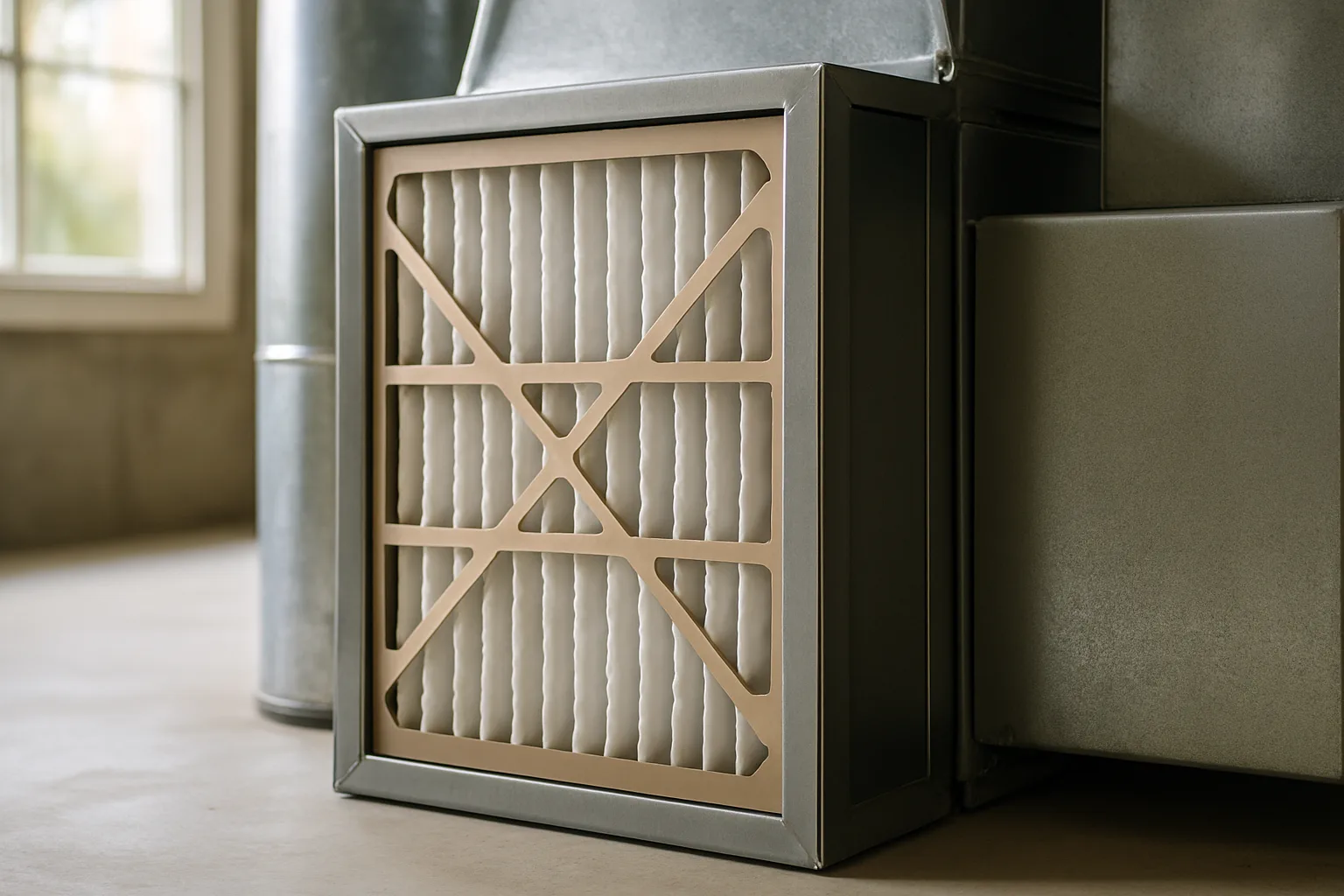
Thickness is the single biggest upgrade available. A 4-inch filter holds far more media than a 1-inch one of the same face size, so air passes easily and it lasts much longer. If the system has a 2-, 3- or 4-inch slot, use it. Many systems only take 1-inch filters, and a thicker one needs a matching media cabinet.
Allergies or not: picking the rating
- No allergies, no pets, no smokers: a MERV 5 to 8 pleated filter protects the equipment and catches household dust and lint. Some HVAC pros run a MERV 5 in their own homes.
- Pets, seasonal allergies or a lot of dust: MERV 8 to 11, ideally in a 4-inch format.
- Severe allergies, breathing problems, heavy candle use or wildfire smoke: MERV 13 can help capture finer particles. Use a high-media filter like the MPR 1900, change it often, or move to a 4-inch cabinet. For medical concerns, ask a doctor.
The EPA suggests MERV 13 or as high as the fan and filter slot can handle; an HVAC technician can confirm that limit. In dry, dusty climates like much of Utah, and during wildfire smoke seasons, filters may load faster than the label suggests, so check them monthly.
A furnace filter cleans air only while the fan runs. For a single room, the air purifier CADR and room-size guide covers portable units.
Change intervals and fit
- Fiberglass: labeled for about 30 days.
- 1-inch pleated: usually labeled for up to 90 days. Go sooner with a high MERV or pets.
- 4-inch media: labeled for up to a year.
Fit matters as much as rating. A filter that sits short of the opening leaves an air gap, and air takes the easy path around the media. Flimsy frames can also bow inward under suction. Point the frame's arrow toward the furnace.
Skip fiberglass and washable filters
Cheap fiberglass filters breathe easily because they stop very little. Over 20,000 particles got through one, and with a 30-day life they are not even cheap. Washable electrostatic filters promise to never need replacing, but one let a visible puff of flour into the airstream and passed thousands of particles, far more than the pleated MERV 11 and 13 filters.
The picks in detail
Filtrete MPR 1900 MERV 13 Filter (16x25x1)
This filter makes MERV 13 workable in a 1-inch slot, with more than twice the media of other 1-inch filters. It barely let any flour through and finished well below the MERV 11 filters on resistance. It still starts higher than a MERV 8. On a system with tight ducts, change it monthly and watch for weak airflow at the vents.
Filtrete MPR 1900 MERV 13 Filter (16x25x1)Check today’s price on Amazon

 Buy on Amazon →
Honeywell Home MERV 8 Media Filter (16x25x4)
With a 4-inch media cabinet, this is the easy choice. It posted the lowest resistance of every filter, clean or loaded, while catching nearly as much as the MERV 11 and 13 models. It is labeled to last up to a year. Confirm the cabinet model first.
Honeywell Home MERV 8 Media Filter (16x25x4)Check today’s price on Amazon Buy on Amazon →
Filtrete MPR 300 MERV 5 Filter (16x25x1)
The MPR 300 is the value pick. It stops the bulk of thrown dust, though some still gets through, a big step up from fiberglass. Airflow barely dropped. The MERV 8 MPR 700 let almost nothing through, but without allergies the step up rarely pays off.
Filtrete MPR 300 MERV 5 Filter (16x25x1)Check today’s price on Amazon

 Buy on Amazon →
Filtrete MPR 600 Filter (16x25x1)
The MPR 600 catches more dust than its MERV 7 rating suggests, and it starts in the middle of the pack on resistance. But loaded, it hit the highest resistance of any filter, so treat the three-month label as a maximum.
Filtrete MPR 600 Filter (16x25x1)Check today’s price on Amazon

 Buy on Amazon →
Who should buy which
- A 4-inch cabinet: the Honeywell Home MERV 8 Media Filter.
- A 1-inch slot and allergies: the Filtrete MPR 1900, changed often.
- A 1-inch slot, no allergies: the Filtrete MPR 300.
- Extra dust or pollen: the Filtrete MPR 600, swapped on time.
- Dry winter air: a filter won't fix it; see the humidifier types guide. For water quality, see the whole-house water filter guide.
Posted by Kristopher Larson
Frequently asked questions
Is MERV 13 too high for a home furnace?
It can be in a standard 1-inch slot. A 1-inch MERV 13 pushed one 5-ton furnace to 0.93 inches of external static pressure, well past the roughly 0.5 inches most new residential equipment is rated for. A high-media filter like the Filtrete MPR 1900, changed monthly, eases that, and a 4-inch media cabinet is the better route to MERV 11 and up. An HVAC technician can measure your system's static pressure to confirm.
MERV 8 vs MERV 13: which should I buy?
Without allergies, pets or smoke concerns, a MERV 8 (or even a MERV 5) protects the equipment, catches household dust and lint, and keeps airflow up. MERV 13 catches much finer particles, such as smoke, and is worth it for severe allergies or wildfire smoke, as long as the system can handle the extra resistance or uses a thicker filter.
Is the Filtrete 1900 worth it?
For a 1-inch slot in a home with allergies, it is one of the better choices. Its pleated design carries more than twice the media of typical 1-inch filters, so it barely let any flour through under a heavy load while staying far below MERV 11 filters on resistance. It still restricts airflow more than a MERV 8, so change it often.
What is the difference between MERV, MPR and FPR?
MERV is the industry standard set by ASHRAE, rating capture of particles from about 0.3 to 10 microns. MPR is 3M's scale for Filtrete filters, from 100 to 2800. FPR is The Home Depot's scale for the filters it sells. Most packages list a MERV equivalent: Filtrete MPR 300 is MERV 5 and MPR 1900 is MERV 13, while FPR 5 lines up with MERV 8.
How often should I change my furnace filter?
Follow the label as a maximum. Fiberglass filters are typically labeled for about 30 days, 1-inch pleated filters for up to 90 days, and 4-inch media filters for up to a year. Check monthly and change sooner with pets, heavy dust, smoke or a high-MERV filter in a 1-inch slot, since resistance climbs as a filter loads.
Are washable furnace filters any good?
Generally not a good trade. A washable electrostatic filter let a visible puff of flour into the airstream and passed thousands of particles, far more than pleated MERV 11 and 13 filters. A disposable pleated filter changed on schedule is the more reliable choice.
Keep reading
More from the blog

Man Cave Ideas: Layouts, Must-Haves and How to Build One in a Basement, Garage, Spare Room or Shed
Best Inverter Generator: Honda EU2200i vs GENMAX 2200W
Best Massage Gun: Theragun vs Ekrin vs Bob and Brad Mini Guns