Hurricane Flooded Twice in Ten Weeks. Here Is What Is Confirmed and What It Means for Owners and Buyers.
Gould Wash flooded Hurricane neighborhoods on August 14 and October 22, 2026, and a roughly $63 million flood-control plan is still unbuilt. Here is what is confirmed, what is only planned, and what owners and buyers should check.
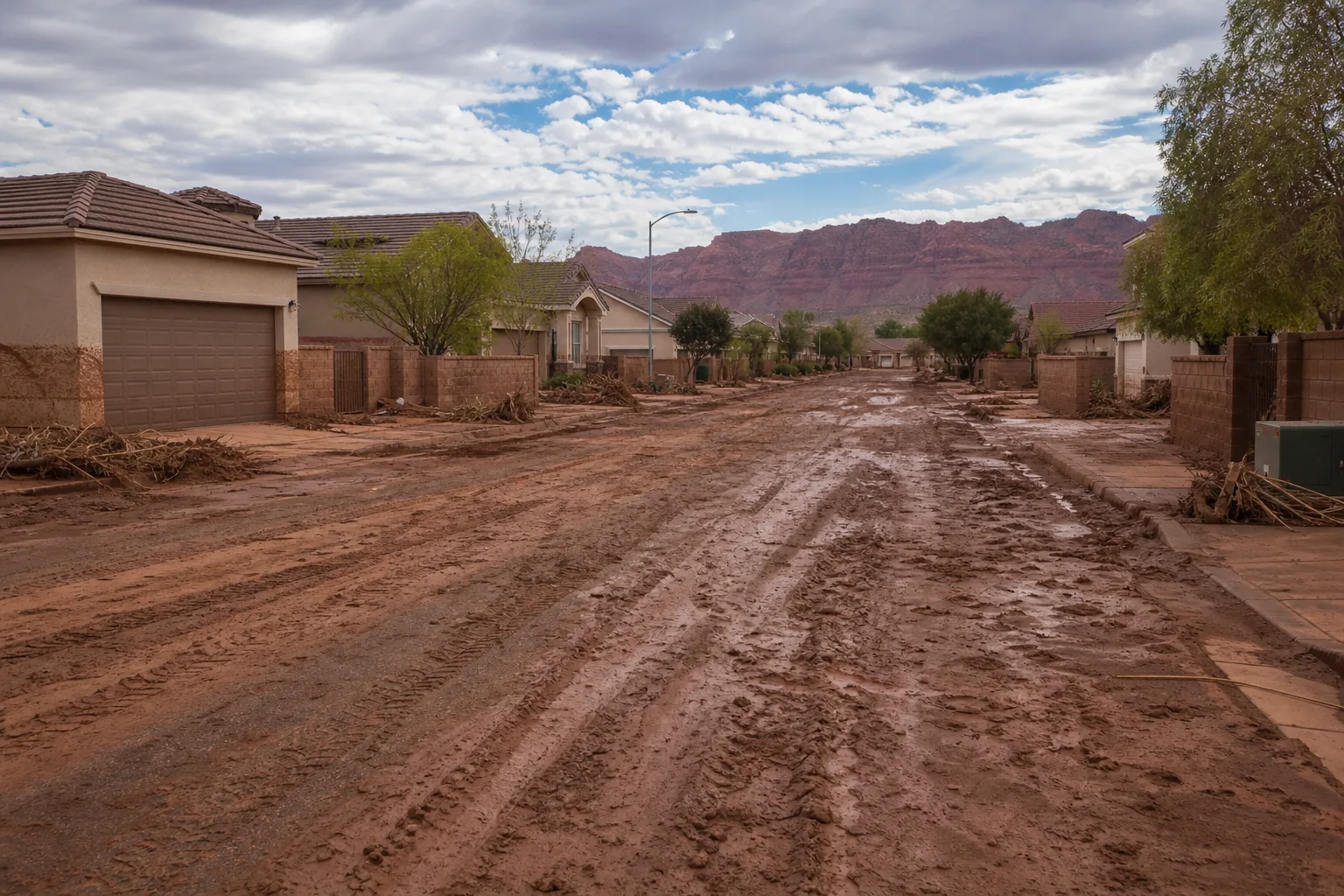
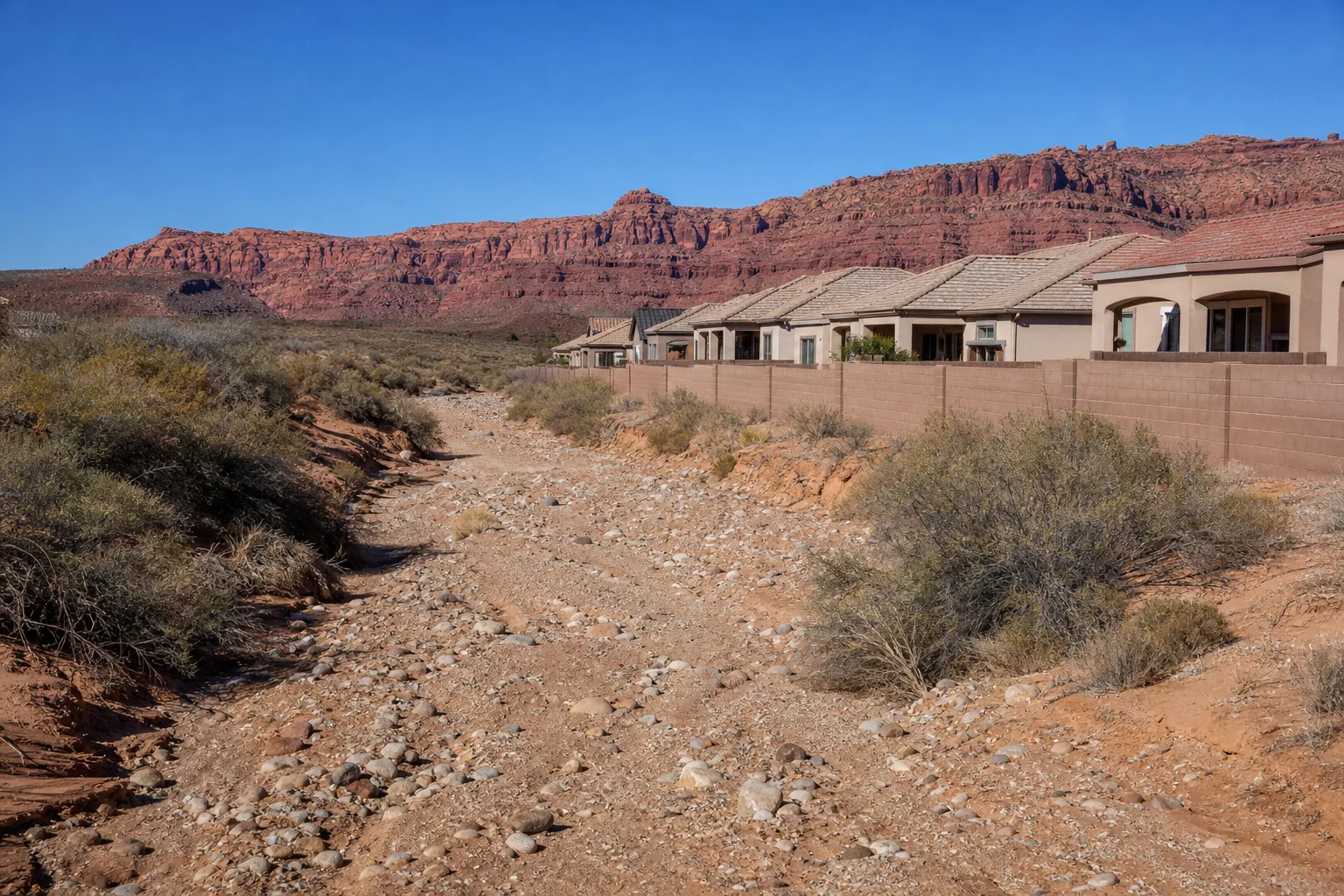
Gould Wash is dry most of the year. On October 22, 2026, it left its banks in the middle of Hurricane for the second time in ten weeks, and the city's early count put the damage at about 80 homes and 50 RVs. Some of those homes had only just been repaired after the first flood on August 14.
This update covers what is confirmed so far, what is still only a plan, and what the two floods change for people who own or want to buy in Hurricane and the towns around it. General background on monsoon flooding and lot checks is in the earlier guide to flash flood risk in Hurricane and Southern Utah.
What Happened: A Timeline
| Date (2026) | Event |
|---|---|
| March 20 | The final plan and environmental study for the Gould Wash Flood Protection Project is released by the Natural Resources Conservation Service (NRCS), Washington County and Hurricane City. |
| August 14 | First flood. Gould Wash overflows into the Pecan Townhomes area and nearby streets. The mayor writes that it is the biggest flow he has personally seen, though below the projected 100-year flood. |
| September 17 | NRCS publishes its Record of Decision selecting a detention dam plus channel work. |
| October 22 | Second flood. Evacuations are ordered along the wash and at Willow Wind RV Park. Mayor Clark Fawcett declares a local emergency that afternoon. |
| October 29 | Lt. Gov. Deidre Henderson visits. The mayor says the city had not cleared the wash near homes between the two floods. |
| Early November | City crews clear vegetation from the wash between 700 West and 1150 West. Another storm passes without new flooding. |
| November 6 | Gov. Spencer Cox declares a state of emergency for Washington and San Juan counties. |
The October 22 Flood, by the Numbers
A storm near Apple Valley, east of town, dropped up to two inches of rain in about two hours, according to the National Weather Service figures reported by the Salt Lake Tribune. The water ran down Gould Wash and into the neighborhoods west of the city center, around 850 West between roughly 150 South and 200 South, and into the RV park at 1150 West.
- Homes and RVs: the city's preliminary assessment was about 80 residential homes and 50 RVs, roughly 130 structures in all. News outlets have used both figures, which is why some reports say "at least 80 homes" and others say 130.
- Public damage: bridges, roads, culverts and electrical boxes were damaged.
- Cost: city officials have estimated the damage at several million dollars. No final figure has been released.
- Depth: residents described waist-deep water in the street, and basements that filled to the ceiling.
Several families told reporters they had finished repairs from August days or weeks before the water came back. One household told the Tribune it had spent about $80,000 on the first round of repairs.
Why It Flooded Twice
After the August flood, the city said the water and debris came from outside city limits and that nothing inside Hurricane had failed. After October, the answer was less tidy. Fawcett told KUTV the city normally clears the wash once a year, in December, after irrigation season ends, and that it had not cleared the stretch near homes before the second flood. He told the Tribune the odds of two major floods so close together looked close to zero, and that the saturated channel made it risky to bring in heavy equipment over buried utilities.
The mayor has since said the city is rethinking that schedule and may clear the wash more often. He also said the wash needs more capacity even if a detention basin is built upstream.
Confirmed vs. Still Planned
Confirmed
- A local emergency declared by the mayor on October 22, which lets the city ask for outside help.
- A state of emergency from the governor on November 6. Under Utah law it lasts 30 days unless the Legislature extends it, and it allows the state to send resources and seek federal help.
- State equipment, firefighters and volunteers sent to help with sandbagging and cleanup.
- Vegetation cleared from the wash between 700 West and 1150 West. The city says buried utilities limit how much deeper it can dig.
- Free sandbags: empty bags at the Hurricane Police Department, with sand piles at several city sites.
- A federal decision on the design. The NRCS selected an alternative called "New Detention Dam and 3,000 cfs Channel Modifications": a dry detention dam upstream of the city, changes to the channel through town, and easements for the work.
Planned, not built and not fully funded
- The detention dam and channel project. FOX 13 reported the total at about $63 million, with $58 million expected from the federal government. Earlier coverage put the figure at $67 million. The dam would sit on Bureau of Land Management land east of the flood zone and release stormwater slowly. According to the Tribune, the city's next step is to apply for NRCS money to hire a design consultant, and that request had not been approved as of November 5. Fawcett said a basin could be "four or five years away."
- Work inside town. City engineers are looking at replacing the 700 West bridge and at raising the banks and adding capacity from 850 West to 1040 West. Those ideas need an Army Corps of Engineers permit and run into property lines, utility lines and the risk of pushing water toward other neighborhoods.
What Help Exists for Owners
So far, very little public money is headed to individual homeowners. Fawcett said the Federal Emergency Management Agency told the city the event was too small to qualify for individual assistance, and that any federal help would likely go to infrastructure. Henderson said funding for homeowners would be harder to secure than equipment and labor. Rep. Celeste Maloy's office has said it is working with the NRCS and the Small Business Administration, which makes low-interest disaster loans to homeowners and businesses when an area qualifies.
Most of the direct help has been local: a flood relief account the city opened at State Bank of Southern Utah after the August flood, a nonprofit named by the city for donations after the second one, church and volunteer crews, and a citizen committee that has gone house to house to assess damage. The city said in August that some affected residents had no flood insurance or could not get it.
What This Means for Owners
- Flood is a separate policy. Most homeowners policies do not cover flood damage. Coverage comes from the National Flood Insurance Program or a private insurer. Owners already dealing with Utah's tight insurance market can read about what to do after a nonrenewal, which is a different problem but often hits the same households.
- There is a waiting period. National Flood Insurance Program policies generally start 30 days after purchase, according to FloodSmart, the program's consumer site. A policy bought when a storm is in the forecast will not help with that storm.
- Keep every record. Photos, repair invoices, permits and insurance claim paperwork will matter for any aid application and for a future sale.
- Watch the city's wash schedule. The December-only clearing is under review. Council meetings are where the maintenance plan, the bridge and the bank work will be decided.
What This Means for Buyers
Hurricane is still an active market, with 462 homes for sale and a recent median sale price of $536,900. The flooding this fall followed one wash through specific streets, so the lesson is about the individual lot, not the city name.
- Check two sets of maps. Look up the address at the FEMA Flood Map Service Center, then ask Hurricane City for its own floodplain maps. The city manager told KUTV in August that the city had recently updated its maps to model a 100-year storm on Gould Wash, and that some residents near the wash said they had not known they were in a floodplain.
- Do not stop at the mapped zone. Flood maps model a storm of a set size, typically the 100-year event. Desert washes can deliver water from storms miles away, and a low-risk label means lower risk, not none.
- Walk the wash. Find the nearest channel, see how high the banks are next to the lot, and look for bridges or culverts just downstream where debris can pile up.
- Ask the seller direct questions in writing. Has water ever entered the home, garage or yard? Were there insurance claims? What was repaired, by whom, and was it permitted? Utah courts have held that sellers must disclose known material defects, and a past flood that a seller knows about is hard to describe as anything else.
- Get a flood quote before the deadline. Utah's purchase contract lists the cost and availability of homeowners and flood insurance as part of due diligence, as explained in the summary of Utah's updated Real Estate Purchase Contract. Add the flood premium to the figures in what Utah buyers should budget for homeowners insurance.
- Look at a repaired home with an inspector. Ask for moisture readings, and for proof that wet drywall and insulation were removed and not just dried.
- Do not price in the dam. The upstream basin is selected on paper. It is not designed, funded or scheduled.
Nearby Towns
The October flooding reported in this article was along Gould Wash in Hurricane. The same checks apply anywhere in eastern Washington County where homes sit near a wash or the Virgin River, including La Verkin and Toquerville. For a wider look at how the three towns compare, see the buyer's guide to Hurricane, La Verkin and Toquerville.
What to Watch Next
- Whether the NRCS approves design money for the detention dam, and any construction funding after that.
- Whether the Legislature extends the governor's emergency past early December.
- A final damage total from the city, which determines what state and federal grants it can apply for.
- The city's decision on a new clearing schedule for the wash before next summer's monsoon.
Current listings across Southern Utah are on Best Utah Real Estate. This article will be worth rereading against the city's next announcements, since several of the items above could change within weeks.
Sources: Hurricane City news releases and mayor's updates (Aug. 17 to Nov. 2, 2026); USDA Natural Resources Conservation Service Record of Decision (Federal Register, Sept. 17, 2026) and Washington County's project notice; Salt Lake Tribune (Oct. 24 and Nov. 5, 2026); KSL (Oct. 23, 2026); KUTV (Aug. 17 and 18, Oct. 29, 2026); FOX 13; ABC4; St. George News (Oct. 22, 2026); Deseret News (Nov. 6, 2026); FloodSmart.gov.
Posted by Kristopher Larson
Frequently asked questions
When did Hurricane, Utah flood in 2026?
Gould Wash flooded Hurricane neighborhoods twice in 2026: on August 14 and again on October 22, about ten weeks apart. The second flood was the larger of the two for many residents and led the mayor to declare a local emergency the same day.
How many homes were damaged in the October 2026 Hurricane flood?
Hurricane City's preliminary assessment was about 80 residential homes and 50 RVs at Willow Wind RV Park, roughly 130 structures. City officials have estimated total damage at several million dollars, and no final figure has been released.
Has the Gould Wash flood-control project been built?
No. In September 2026 the Natural Resources Conservation Service selected a plan for a dry detention dam upstream of Hurricane plus channel work through town, reported at about $63 million. As of early November 2026 it was not designed, fully funded or scheduled, and the mayor said a basin could be four or five years away.
Is FEMA helping Hurricane homeowners repair flood damage?
Not as of early November 2026. Mayor Clark Fawcett said FEMA told the city the event was too small to qualify for individual assistance, and that federal help would more likely go to infrastructure. Most direct help for homeowners has come from local donations, volunteers and a city-opened relief account.
Does homeowners insurance cover flash flood damage in Utah?
Usually not. Most homeowners policies exclude flood, so coverage has to come from a separate policy through the National Flood Insurance Program or a private insurer. National Flood Insurance Program policies generally take effect 30 days after purchase, so they have to be bought well before a storm.
What should a buyer check before buying near a wash in Hurricane?
Look up the address on FEMA's Flood Map Service Center and ask Hurricane City for its own updated floodplain maps. Walk the nearest wash, ask the seller in writing about any past water in the home and any repairs, and get a flood insurance quote before the due diligence deadline.
Hurricane, Utah housing market
A quick read on what homes are doing in Hurricane right now — pulled live from the MLS.
Keep reading
More from the blog
Flash Flood Risk in Hurricane and Southern Utah: What Buyers Should Check
Pros and Cons of Living in Hurricane, Utah
Salt Lake City's Big Projects in 2026: What's Finished, Under Construction and Still Only Planned