How a 1% Mortgage Rate Increase Changes the Home You Can Afford
Even with the same down payment and monthly budget, a 1% rate increase can shrink your borrowing power by about $33,000 on a $2,000 payment. Learn how to adjust your home search.
Often, after a rate change, your dream home can move beyond what you are able to afford. Unfortunately, this can happen even when your down payments and monthly budget stay the same. Let’s find out why.
For many, buying a home can be one of the most memorable times of their lives. First, there is the search for the dream house that suits their needs and then comes the task of working out a monthly mortgage payment that will realistically fit the monthly budget.
And, just when you think that you can afford to buy a property, your lender gives you an updated interest rate, and suddenly, the numbers change.
Now the home that you were set on purchasing no longer fits realistically into your monthly budget, despite the fact that the down payment is still the same. This can be extremely disheartening, and the question many people ask is why?
Here is the short answer. When it comes to mortgage interest rates, even a 1% increase can affect how much you can borrow and affect your monthly mortgage payment affordability.
What the Same Monthly Payment Supports at 6% and 7%
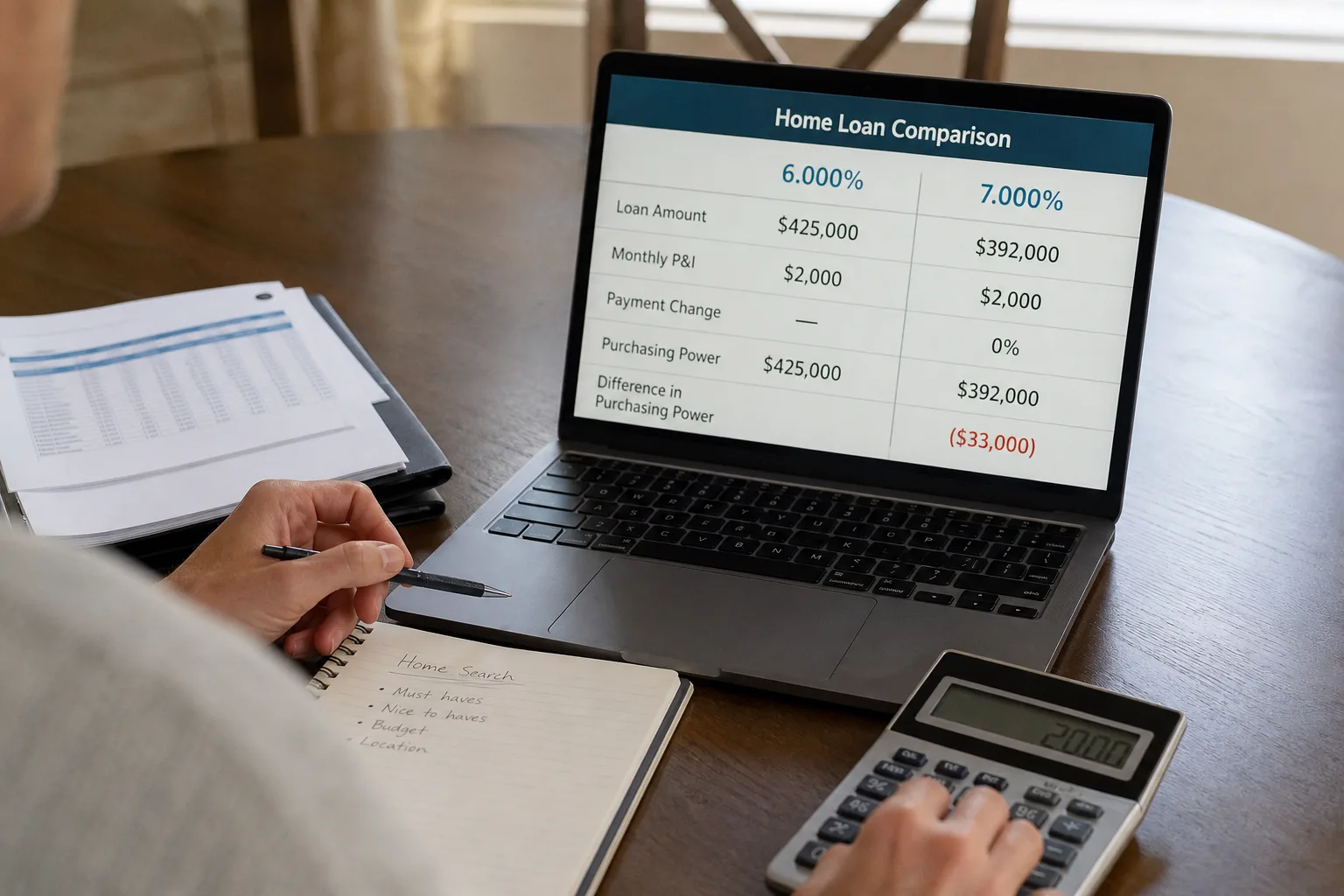
Let’s dig a little bit deeper so that you have more of an understanding of this important concept. In this example, we are going to look at a mortgage rate increase from 6% to 7%. This is a 1% rate increase.
Both percentages are based on a 30-year fixed-rate mortgage. This means that the rate will stay the same throughout the duration of the loan term.
The initial amount borrowed from the lender is referred to as your principal. The interest on that amount is the money that is paid in order to borrow the principal amount.
The principal amount and the interest amount are added together and are the amounts that make up your monthly mortgage payments.
If you have a look at the table, you will see a comparison between taking a loan at 6% interest and 7% interest respectively. Its aim is to help you decipher how much you can borrow at each rate.
Monthly principal-and-interest budget | Loan at 6% | Loan at 7% |
$1,000 | $166,792 | $150,308 |
$1,500 | $250,187 | $225,461 |
$2,000 | $333,583 | $300,615 |
$2,500 | $416,979 | $375,769 |
$3,000 | $500,375 | $450,923 |
Each row relates to a monthly principal-and-interest budget.
An example of this is a $2,000 monthly payment that works to support about $333,583 in borrowing at 6% interest compared with $300,615 at 7% interest.
Even though your monthly payment will stay the same, you will note that there is a difference of almost $33,000 in borrowing power.
Add the down payment that you have available to the loan amount, and then you will be able to work out the purchase price you can afford.
For argument’s sake, let’s say that you have a $60,000 down payment available. Your purchase price will be estimated at $393,583 at 6%, as compared with $360,615 at 7%.
There is a substantial difference in the workings, and it is clear to see that keeping your down payments and monthly budget fixed is extremely important when comparing interest rates.
However, let’s not forget that these numbers only cover the principal and interest of your home loan. There are still going to be other housing costs such as property taxes, homeowners’ insurance, mortgage insurance and homeowners’ association fees.
It is crucial to allow some breathing space for these expenses when doing your monthly budget. Always make sure that you fully understand the total costs for each property before you commit to any kind of purchase.
What Does the New Rate Mean for Your Home Shortlist?
When you have a good understanding of how interest rates can affect your buying power, you are better able to apply this comparison when doing your own home search.
Essentially, you need to take your income, your existing monthly debt payments, and the down payment that you have available to work out what you can afford. But this does not need to be a tricky task. You can use an affordability calculator to help you see how these all work together.
A helpful platform to look at is Arcanomy's home affordability calculator.
Within this platform, you can type in your income, debt payments, interest rate and down payment that you have available. Now, run the calculation at 6% and then again at 7%, but don’t change any of the information that you have already loaded.
Based on the results, you will be able to get estimates based on your financial information, income and ownership costs.
Once you have done this, you will be able to compare the figures by updating the maximum asking price in your property searches. However, always remember that your revised budget must include taxes, insurance, and HOA dues as well.
Which Home Features Matter Most?
Having a smaller borrowing limit does not mean that you must stop searching for homes. It just means that you may have to reconsider which property features mean the most to you.
Luckily, there are ways around this. Say for example you are looking for a 3-bedroom home in a certain neighborhood. It might make more sense to look for similar properties that are more affordable in a community nearby, such as Toquerville or Washington. Or, maybe, a smaller home with a bigger backyard would be a better fit.
You can also look around for a property that needs some improvements. These properties are often listed at lower prices, but it is important to remember to estimate the extra funds that you are going to need to do the renovations before you make a final decision.
In addition to this, there are HOA fees that also need to be considered as a property that has a lower purchase price may have high monthly associated fees and potentially end up costing more than another home with a higher asking price.
It boils down to finding a home that fits your needs, while not breaking the bank trying to live up to your mortgage responsibilities.
Get an Updated Payment Estimate Before Making an Offer
Always ask your lender for an up-to-date principal-and-interest payment estimate. Do not use an old estimate, especially if market rates or your loan terms have changed.
Another important question to ask your lender is whether your interest rate is locked. A rate lock is an agreement between the lender and the purchaser where the lender agrees to hold a certain rate for a specific period. Of course, this is subject to terms and conditions, depending on the lender.
Don’t forget to ask when the lock expires and what happens if the purchase takes longer than expected. For more on timing, see what recent election results mean for Utah mortgage rates.
A one-percentage-point rate increase can change the amount of home you can comfortably afford. However, when you understand the numbers, you will be in a better position to make more informed decisions.
Today, understanding what you can comfortably afford will allow you to choose properties that fit your budget, instead of committing to a home that stretches your finances to their limit.
Frequently asked questions
How much does a 1% mortgage rate increase reduce what I can borrow?
Does a higher interest rate change my down payment requirement?
What costs besides principal and interest should I budget for when buying a home?
What is a mortgage rate lock and why does it matter?
How can I keep shopping for homes when my budget shrinks after a rate hike?
Keep reading
More from the blog
Offer Accepted on a House: What Happens Next for Buyers

Environmental Due Diligence Before Buying Land

7 Best Trade Area Analysis Tools for Commercial Properties