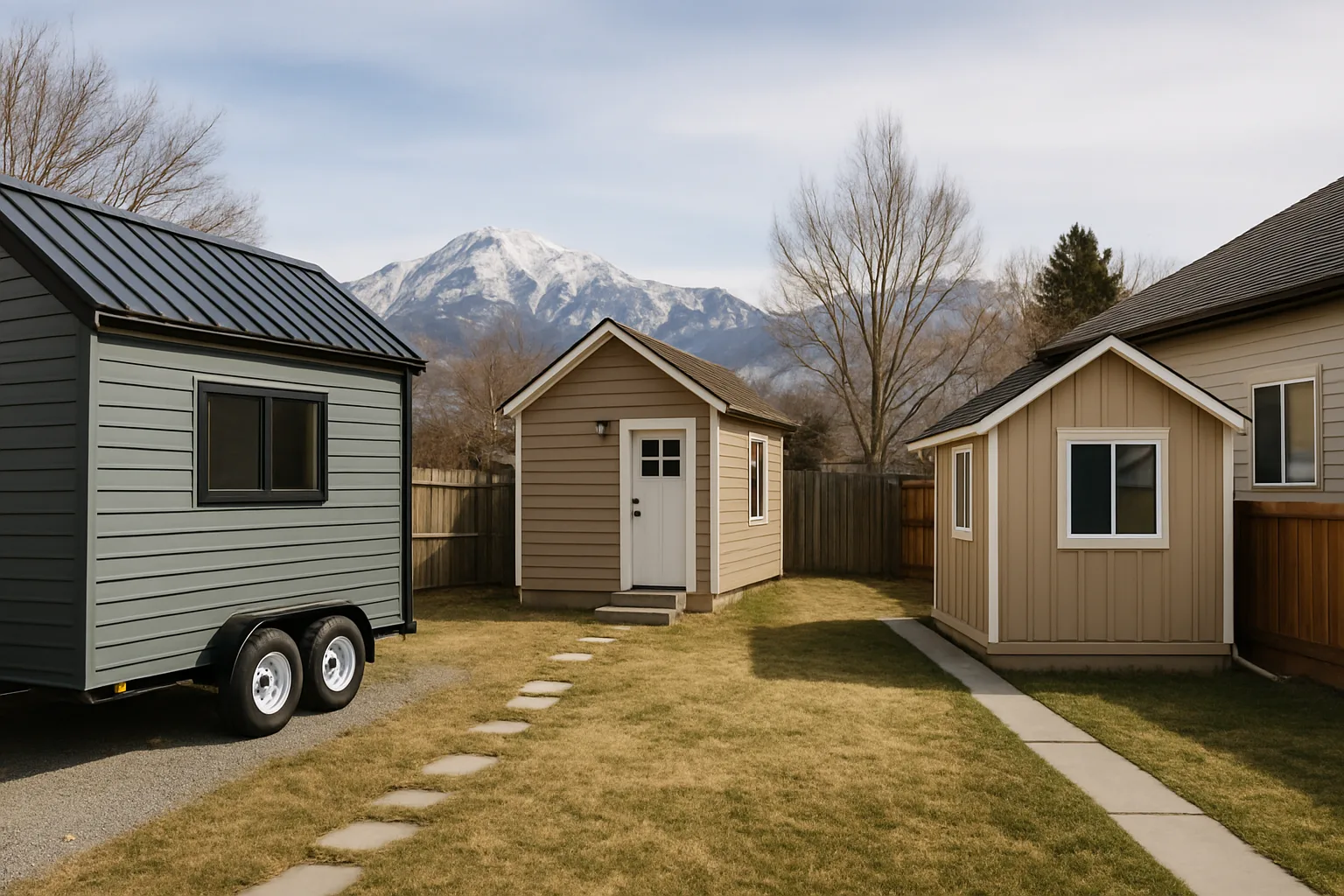
Tiny Homes in Utah: Zoning, Building Code and the New Backyard ADU Law
Utah treats a tiny home on wheels, a tiny house on a foundation and a backyard ADU as three different things. Here is what zoning, the building code and the new detached ADU law allow in 2026.
A tiny home can be a vehicle, a house, or a backyard rental unit, and Utah law treats each of those very differently. The same 300-square-foot structure might be welcome on one lot and prohibited on the lot next door, depending on whether it sits on wheels or a foundation, whether it is the only dwelling on the property, and which city or county controls the zoning. Anyone planning to buy, build or live in a tiny home in Utah needs to sort out which category it falls into before spending money on land or a build.
This rundown covers the three legal paths for a tiny home in Utah in 2026, the building code that applies, the state laws that now push cities to allow backyard units, and the financing and insurance questions that tend to surprise first-time tiny home buyers.
Three Categories, Three Sets of Rules
Utah's Office of the Property Rights Ombudsman, in its guide to accessory dwellings and other dwelling types, describes a tiny house as generally a single dwelling of 400 square feet or less. It notes that a tiny house can be built on site like a conventional home, but may also be classified as a modular unit or a manufactured home depending on how it is built and delivered. Where it can go depends on local land use rules and on whether it is a primary home or an accessory unit. In practice, most tiny home plans fall into one of three groups:
- Tiny house on wheels. Built on a trailer chassis and moved over the road.
- Tiny house on a foundation as the main home. A small permanent house on its own lot.
- Tiny house as an accessory dwelling unit (ADU). A small detached unit in the backyard of an existing single-family home.
Path 1: Tiny Houses on Wheels
A tiny house on wheels is the hardest category to live in full time. Utah's motor vehicle code defines a park model recreational vehicle as a unit designed and marketed as temporary living quarters for recreational, camping, travel or seasonal use, not permanently affixed to real property for use as a permanent dwelling, built on a single chassis on wheels, and no larger than 400 square feet when set up. A wheeled tiny home built and titled along those lines is, legally, a vehicle rather than a house.
That classification has consequences:
- Zoning. Residential zones are written for permanent dwellings. Living year-round in a vehicle on a residential lot is something each city or county decides, and many local codes limit it. Before buying land for a wheeled tiny home, check the zoning ordinance for how it treats recreational vehicles used as dwellings.
- Parking options. Campgrounds and RV parks are built for recreational vehicles, but each sets its own length-of-stay rules, so full-time occupancy has to be confirmed with the park.
- Building code. A home built to RV standards is not built to the residential building code, so it generally cannot simply be set on a lot and permitted as a house later without meeting that code.
Path 2: A Tiny House on a Foundation
A permanent tiny house is treated as a dwelling, and it must meet the building code. Utah's State Construction Code adopts the 2021 International Residential Code along with its tiny house appendix, Appendix AQ. The appendix applies to dwellings of 400 square feet or less, not counting lofts, and relaxes several rules that make very small homes difficult to build under the standard code. The appendix allows lower ceiling heights than a standard house, lets lofts be reached by ladders, ship's ladders or alternating-tread devices instead of full stairways, and allows a qualifying skylight or roof window in a sleeping loft to serve as the emergency escape opening.
Building code compliance is only half of the question. The other half is zoning. According to the Property Rights Ombudsman, state law limits some local design rules, but cities can still set a minimum square footage for homes, and that minimum can allow or block a tiny house outright. A lot zoned for single-family homes with a 1,000-square-foot minimum will not accept a 350-square-foot house, no matter how well it is built.
When a tiny house is a manufactured home
Some small factory-built homes are manufactured homes. Utah law says a manufactured home attached to a permanent foundation cannot be excluded from any zone where a single-family home is allowed, as long as it meets local land use ordinances, building codes and any restrictive covenants that apply to single-family homes there. That protection helps, but it does not override a minimum home size or a subdivision's CC&Rs.
Path 3: The Tiny Home as a Backyard ADU
The fastest-changing part of Utah law covers accessory dwelling units, and it is where tiny homes have the clearest legal opening.
Internal ADUs
Since 2021, an internal ADU, meaning a unit inside the footprint of a single-family home such as a basement apartment, has been a permitted use in areas zoned primarily for residential use. Cities can still attach conditions. They may require an extra parking space, require a rental license, ban rentals shorter than 30 days, prohibit internal ADUs on lots of 6,000 square feet or less, require the owner to live on the property if the unit is rented, and restrict internal ADUs in zones covering up to 25 percent of the city's residential area. That limit rises to 67 percent in cities with a main university campus of 10,000 or more students, which includes places like Provo. Internal ADUs are not tiny houses, but the rules are a useful model for how cities handle detached units.
Detached ADUs: the 2026 law
A new statute, enacted in the 2026 General Session and effective October 1, 2026, goes further. Under Utah Code 10-21-304, larger cities must adopt rules that permit a detached accessory dwelling unit on any lot of 11,000 square feet or more that contains a single-family home, where single-family use is allowed. The requirement covers cities with 10,000 or more residents, plus cities of 5,000 or more in the state's more populous counties. Key terms include:
- No conditional use permit can be required for a detached ADU in a primarily residential zone.
- Parking requirements are capped at two spaces for a unit of 650 square feet or more and one space for a smaller unit.
- Cities may still regulate size, height, setbacks and lot coverage, require the design to match the main house, and keep the ADU out of front yards and recorded easements.
- Cities may require the owner to live in either the main home or the ADU, limit a lot to one ADU, and prohibit rentals shorter than 90 days.
- A city may deny a unit that lacks adequate access to sewer, water, power or storm drainage, or where the utility system lacks capacity.
- Restrictions in development agreements signed on or before May 6, 2026, are not overridden.
Cities can allow detached ADUs on smaller lots if they choose, and some have had their own ADU rules for years. Salt Lake City, for example, overhauled its accessory dwelling unit rules in 2023. For a buyer, the practical effect of the new law is that a large lot in a qualifying city now carries a clearer path to adding a small backyard home.
What the law does not cover
The detached ADU statute governs cities. It does not address private covenants. A subdivision's CC&Rs can still restrict outbuildings, and buyers should read them before assuming a backyard unit is possible. Unincorporated county land and smaller towns follow their own ordinances.
Financing and Insurance Realities
How a tiny home is classified also drives how it can be financed and insured.
- Homes on foundations. Fannie Mae's selling guide does not set a minimum square footage for most homes, so small size alone is not disqualifying. The guide does expect appraisers to use comparable sales of similar size, and finding recent sales of 300-square-foot houses can be difficult in most Utah markets. A thin set of comparables can make appraisal the sticking point.
- Homes on wheels. Because a wheeled unit is a vehicle rather than real property, a standard mortgage is generally not the right product. Financing usually means an RV loan, a personal loan or cash, and buyers should compare terms carefully because these loans are structured differently from a 30-year home loan.
- Backyard ADUs. A detached ADU becomes part of the property, so common funding options include the owner's existing equity, a renovation loan or a construction loan rather than a separate purchase loan.
- Insurance. A wheeled tiny home and a permanent house are different risks. Owners should confirm in writing whether a policy treats the structure as a dwelling, an RV or an outbuilding, and whether it covers full-time occupancy.
A Checklist Before Buying Land or a Lot
- Identify the category. Decide whether the home will be on wheels, a primary house on a foundation, or a backyard ADU.
- Read the zoning. Check minimum dwelling size, accessory structure rules, and how recreational vehicles may be used.
- Measure the lot. For a detached ADU in a larger city, 11,000 square feet is the threshold where state law requires the city to allow one.
- Read the CC&Rs. Private covenants can block a unit the city would otherwise allow.
- Confirm utilities. Sewer or septic capacity, culinary water and power connections are frequent deal breakers.
- Line up financing early. Ask lenders how they will appraise a very small home before committing to a lot.
Buyers who would rather start with an existing secondary unit can browse St. George homes with casitas or Provo homes with casitas, and those looking for room outside city limits can compare Cedar City homes with acreage. For design and planning basics, see this guide to planning an ADU home.
Bottom Line
Tiny homes are legal in Utah, but only within the category they fit. Wheeled homes are vehicles and depend on local rules for full-time living. Permanent tiny houses have a building code in Appendix AQ but still have to clear local minimum sizes. Backyard units have the most momentum, with a state law that took effect October 1, 2026, opening large lots in bigger cities to detached ADUs. Anyone shopping for land or a home with room for a small second dwelling can start a search at Best Utah Real Estate and confirm the details with the city's planning office before making an offer.
Frequently asked questions
Are tiny homes legal in Utah?
Yes, but the rules depend on the type. A permanent tiny house on a foundation can be built under the residential code's tiny house appendix if local zoning allows a home that small. Tiny houses on wheels are generally treated as vehicles, and backyard tiny homes fall under accessory dwelling unit rules.
What building code applies to tiny houses in Utah?
Utah's State Construction Code adopts the 2021 International Residential Code and its tiny house appendix, Appendix AQ. The appendix covers dwellings of 400 square feet or less, excluding lofts, and allows features such as lower ceilings and ladder access to lofts.
Can a tiny house on wheels be a full-time home in Utah?
It depends on local rules. Utah law defines a park model RV as temporary living quarters that is not permanently affixed for use as a permanent dwelling. Full-time occupancy on a residential lot is up to each city or county, so check the zoning ordinance before buying land.
Do Utah cities have to allow backyard tiny homes?
Under a state law effective October 1, 2026, cities of 10,000 or more residents, and cities of 5,000 or more in larger counties, must permit a detached accessory dwelling unit on single-family lots of 11,000 square feet or more. Cities can still regulate size, setbacks, design and short-term rentals.
Can an HOA prohibit a tiny home ADU in Utah?
The 2026 detached ADU law applies to city land use rules and does not address private covenants, so a subdivision's CC&Rs can still restrict outbuildings. Internal ADUs are different: the Property Rights Ombudsman notes that a private association cannot prohibit renting an internal ADU that complies with local codes.
Can a tiny house get a mortgage?
A tiny house on a permanent foundation may qualify, since Fannie Mae does not set a minimum square footage for most homes, but appraisers need comparable sales of similar size, which can be scarce. A tiny house on wheels is a vehicle, so financing usually comes from an RV loan, a personal loan or cash.
Keep reading
More from the blog
Planning a Backyard Shed for a Utah Home: What to Check
Does a New Water Heater Increase Home Value?
Property Boundary Upgrades That Boost Curb Appeal