Utah School Choice in 2026: How Utah Fits All, Charters and Open Enrollment Affect a Home Search
Utah families can choose among boundary schools, open enrollment, charters and the Utah Fits All Scholarship. Here is what each option guarantees in 2026 and how much a school boundary should weigh in a home purchase.
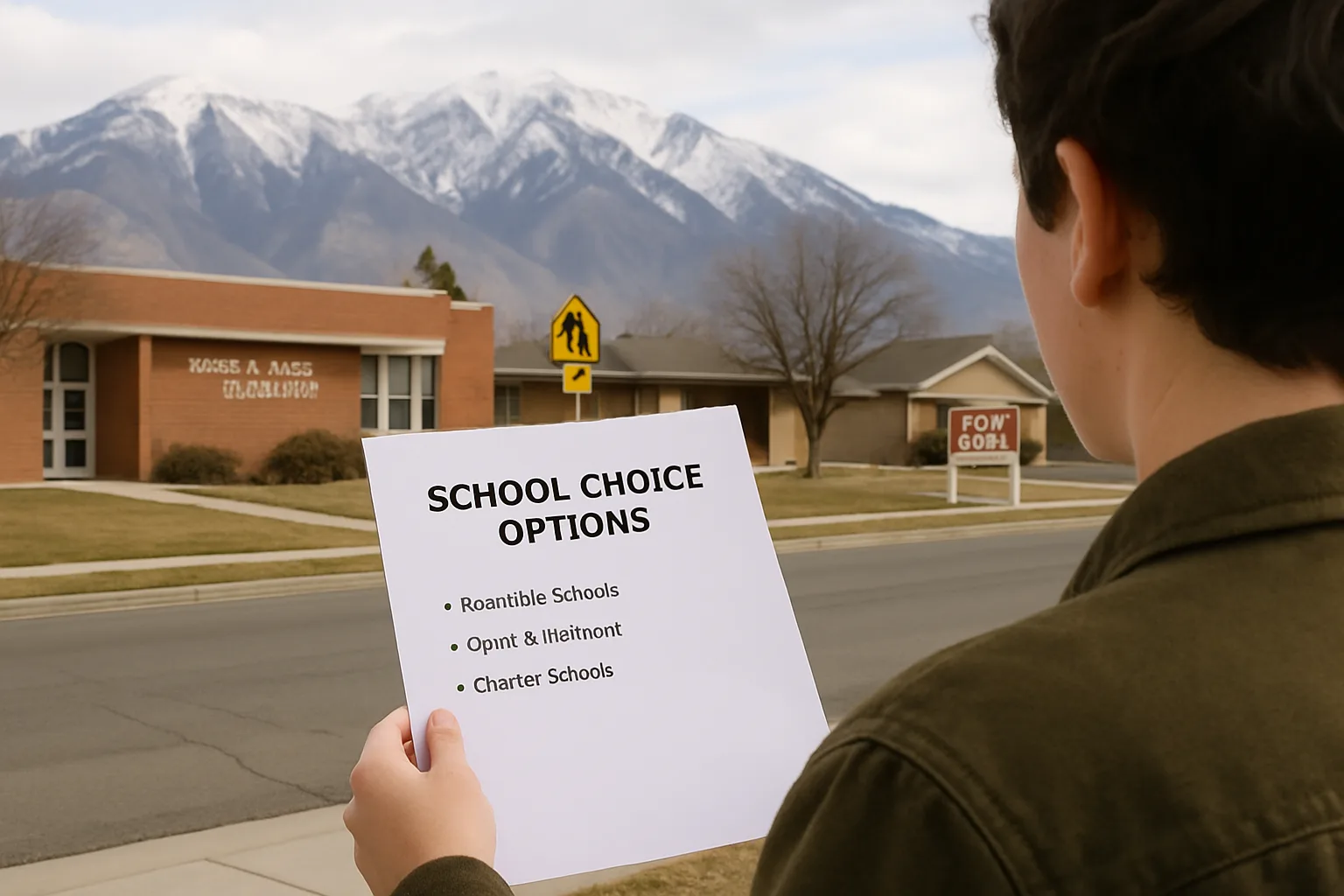
For decades, the advice to Utah families shopping for a house was simple: find the school first, then find a home inside its boundary. That advice still holds for many households, but it is no longer the whole picture. Utah families can now choose among their assigned neighborhood school, a school in another district through open enrollment, a tuition-free public charter school, or, for some students, a private school or home education paid for partly by the state's Utah Fits All Scholarship. Each option comes with its own rules, deadlines and uncertainty, and those details decide how much a school boundary should weigh in a purchase.
This breakdown looks at where each option stands in 2026, what is guaranteed and what is not, and how families can factor school choice into a home search without overpaying for a boundary or assuming access they may not get.
The Four Paths a Utah Student Can Take
Utah's public school system enrolled 656,311 students in the 2025-26 school year, according to Utah State Board of Education figures reported by KSL in October 2025. That total fell 1.7 percent from the year before, the third straight annual decline. Charter schools moved the other way: charter enrollment rose 3.6 percent, and charter students now make up about 13 percent of the state's public school population. Several large districts, including Salt Lake City, Granite and Washington County, each saw enrollment drop about 4.5 percent.
Those numbers show families are using the options available to them. The four main paths are:
- The school of residence. The school assigned by the home's address. This is the only option tied directly to where a family lives.
- Open enrollment. A transfer to another school in the same district or a different district, subject to space.
- Charter schools. Public schools open to any Utah resident, with admission by lottery when applications exceed seats.
- Utah Fits All Scholarship. State-funded education savings accounts that private school and homeschool students can use for tuition, curriculum, tutoring and other approved costs.
Utah Fits All: Where the Scholarship Stands
The Utah Fits All Scholarship Program was created by HB 215 in the 2023 legislative session and began funding students in the 2024-25 school year. The program is run by an outside administrator, Odyssey, which took over from the previous administrator in May 2025. The Utah State Board of Education's program page points families to the administrator for eligibility details, application windows and funding questions.
Demand and the waitlist
KUTV reported in July 2026 that a record 27,560 students applied for the 2026-27 cycle. About 19,800 scholarships were awarded in June, and roughly 7,500 students were placed on a waitlist. Awards go first to returning students, then to siblings of returning students, then to applicants from households at or below 300 percent of the federal poverty level, and then to everyone else. The same report put the average scholarship at about $6,400 per student.
Scholarship amounts depend on the type of student. According to KSL's September 2026 coverage of the program's annual report, private school students can receive up to $8,000, homeschool students ages 12 to 18 receive $6,000, and younger homeschool students receive $4,000. In the 2025-26 school year, 14,522 students used the scholarship, split between 6,953 homeschool students and 7,569 private school students.
The court case
In April 2025, Third District Judge Laura Scott ruled that the program violates the Utah Constitution, in a lawsuit brought by the Utah Education Association. The state appealed, and the parties agreed the program would keep operating while the Utah Supreme Court considers the case. As of late September 2026, KSL reported the appeal was still pending. There is no fixed deadline for the court to rule, and the outcome could keep the program in place or end it.
For a homebuyer, the practical takeaway is that the scholarship is not something to build a purchase around. It is capped by legislative funding, it has a waitlist, it is awarded year by year, and its legal future is unsettled. A family counting on it should still be comfortable with the public school options at the address it buys.
Open Enrollment: A Real Option With Limits
Utah's open enrollment law lets students apply to attend a school outside their assigned boundary, in their own district or another one. Under Utah Code 53G-6-402, the early application window for the following school year runs from November 15 through the first Friday in February. Districts must use standard state forms, may charge a one-time $5 processing fee, and generally must answer early applications within six weeks or by March 31, whichever is later. Late applications are accepted after the early window, but they compete for whatever space remains.
Several rules matter to anyone hoping to buy outside a preferred boundary and transfer in:
- Space decides everything. A school is open to nonresident students while its enrollment is at or below the state's open enrollment threshold. Above that level, accepting transfers is up to the local school board.
- In-district transfers can come first. State law allows districts to give priority to transfers within the district over transfers from other districts.
- A seat can be lost later. An accepted student usually stays without reapplying each year, but if a school's enrollment grows past its threshold, the district can end nonresident enrollment, starting with the most recently enrolled students. Families must be told by March 15.
- Transportation is usually on the family. Districts such as Canyons note that bus service is not provided to students attending a school outside their boundary.
- Boundary changes reopen the window. When a district redraws boundaries, affected families must be given at least 30 days to apply for a transfer.
Open enrollment works best as a backup or a bonus, not as the plan. A family that buys in one boundary while counting on a transfer into a crowded school two miles away is taking on real risk.
Charter Schools and the Two-Mile Preference
All Utah residents are eligible to apply to any charter school. When a charter receives more timely applications than it has seats, it must select students at random, with some exceptions. State law lets charters give enrollment preference to several groups, including siblings of current or former students, children of employees and founders, and children of military families.
One preference ties directly to housing. Under Utah Code 53G-6-502, a charter school may give priority to students who live within up to two miles of the school when their school of residence is over capacity. Charters approved after May 2014 in designated high-growth areas generally must give a preference to students living within two miles. For families with a specific charter in mind, the distance from the home to the school can change their odds in the lottery, so it is worth asking the school directly how it applies these preferences before choosing a street.
Each charter sets its own application timeline, and many hold their lotteries in the winter for the following school year. Weber State University Charter Academy, for example, told families applying for 2026-27 that it would announce by February 20, 2026, whether a lottery was needed. A purchase that closes in summer may arrive after the main lottery has already been held.
How to Weigh a School Boundary When Buying
With all of these options, the assigned school still carries one advantage none of the others offer: a guaranteed seat. That makes it the foundation of a sound decision. A practical approach looks like this:
- Confirm the actual boundary. Listing descriptions sometimes name schools that are nearby rather than assigned. Check the district's boundary lookup for the exact address, and ask the district whether any boundary studies are underway.
- Judge the resident school on its own merits. If the family would be satisfied there, every other option becomes upside rather than a requirement.
- Map the backups. Note which charters sit within two miles, which nearby schools have historically accepted transfers, and when each application window opens.
- Price the commute. Without district busing, a transfer or charter can mean two school drop-offs a day. Factor that time into the choice of neighborhood.
- Treat the scholarship as uncertain. Between the waitlist and the pending court decision, a Utah Fits All award should not be the reason a budget works.
A fictional example
Consider a hypothetical family relocating from Phoenix with two elementary-age children. They find a house they like in a four-bedroom neighborhood in Lehi, but the assigned elementary school is near capacity, and a charter they toured is three miles away. Rather than stretch for a house inside a different boundary, they check the charter's preference policy, apply in its winter lottery, and confirm they are comfortable with the assigned school if the lottery does not work out. The house fits their budget either way, and school choice becomes an option instead of a gamble.
What This Means for Home Values
Expanded choice does not erase the role of boundaries in pricing. Buyers still pay attention to assigned schools, and families who want certainty will continue to shop by boundary. What choice does change is the size of the trade-off. A family willing to use open enrollment or a charter may be able to buy in a neighborhood that fits its budget or commute better, rather than paying extra for a specific attendance zone. Sellers, meanwhile, should describe school assignments carefully and point buyers to the district for confirmation, since boundaries can change after a listing goes live.
District size and growth also play a role. In districts where enrollment is falling, such as Salt Lake City and Washington County, which serves St. George, more schools may have room for transfers. In fast-growing suburbs where new schools fill quickly, open enrollment seats can be harder to secure. Either way, the district is the authority on current capacity, and a quick call before writing an offer is cheap insurance.
Bottom Line
School choice gives Utah families more flexibility than at any point in the state's history, but most of that flexibility depends on space, lotteries, funding and a pending court ruling. The assigned school remains the only guaranteed option, so it deserves careful attention in any purchase. Families can compare school assignments and nearby options through the Utah schools hub, review what Utah parents need to know about local schools, and browse homes statewide at Best Utah Real Estate.
Frequently asked questions
Is the Utah Fits All Scholarship still available in 2026?
Yes. A district judge ruled the program unconstitutional in April 2025, but the parties agreed it would keep operating while the Utah Supreme Court hears the appeal. As of late September 2026 the appeal was still pending, and scholarships for the 2026-27 school year were awarded in June 2026.
How many students are on the Utah Fits All waitlist?
KUTV reported in July 2026 that 27,560 students applied for the 2026-27 cycle, about 19,800 received awards, and roughly 7,500 were placed on a waitlist. Returning students and their siblings get first priority, followed by lower-income households.
How much is a Utah Fits All Scholarship worth?
Private school students can receive up to $8,000. Homeschool students ages 12 to 18 receive $6,000, and younger homeschool students receive $4,000. KUTV put the average award at about $6,400 per student in 2026.
When is open enrollment in Utah?
State law sets the early application window for the following school year from November 15 through the first Friday in February. Districts publish their own exact dates, and late applications are accepted afterward if space remains. A district may charge a one-time $5 processing fee.
Does living near a Utah charter school improve admission odds?
It can. Utah law lets a charter school give preference to students living within up to two miles when their assigned school is over capacity, and charters approved after May 2014 in high-growth areas generally must offer a two-mile preference. Families should ask each charter how it applies these rules.
Should Utah homebuyers still shop by school boundary?
The assigned school is the only option with a guaranteed seat, so it still deserves close attention. Open enrollment, charters and scholarships depend on space, lotteries and funding, which makes them useful backups rather than guarantees. Confirm the exact boundary with the district before making an offer.
Keep reading
More from the blog

Property Boundary Upgrades That Boost Curb Appeal
Utah ADU Rules in 2026: State Law and City-by-City Limits

Inherited a House? The Order to Tackle Each Step